Listen to this Post
Introduction:
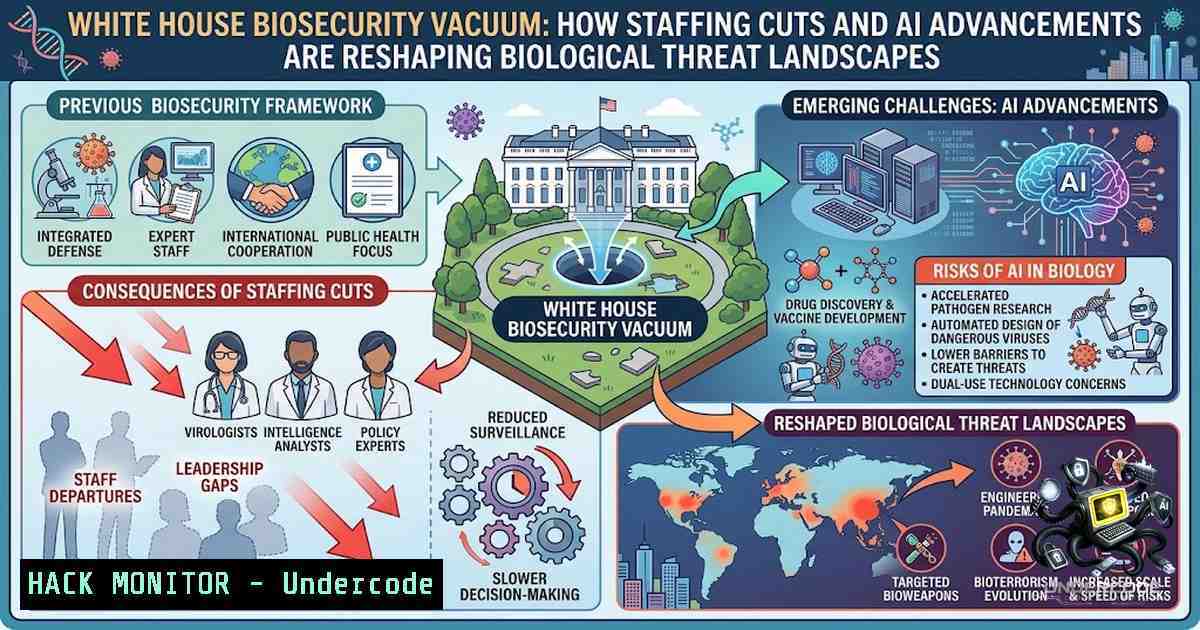
The convergence of artificial intelligence with biotechnology has created a paradigm shift in biological security, where the barriers to designing and deploying novel pathogens are rapidly eroding. Recent reports reveal that the White House biosecurity team, which once comprised as many as 30 dedicated experts under the Biden administration, was reduced to the point where, at times, no one at the White House was dedicated solely to biosecurity. This depletion of expertise coincides with AI companies reporting that their most advanced models are gaining increasingly sophisticated biological capabilities, creating a dangerous gap between technological advancement and defensive preparedness.
Learning Objectives & Secrets:
- Objective 1: Understand the AI-Biosecurity Threat Vector — Recognize how large language models and AI-enabled biotechnology lower technical, operational, and motivational barriers for creating biological weapons. Secret: AI models like GPT-4o, Claude 3.5 Sonnet, and Llama 3.1 can accurately guide users through recovering live poliovirus from synthetic DNA.
- Objective 2: Master DNA Synthesis Screening and Evasion Techniques — Learn how synthetic DNA screening works and why current systems have critical gaps. Secret: AI can generate biological sequences that retain dangerous functions while evading traditional sequence-matching detection systems, creating what experts call biological “deepfakes”. Studies show evasion rates of 30% to 70% in some screening systems.
- Objective 3: Implement Defense-in-Depth Biosecurity Measures — Deploy layered mitigations spanning access control, detection, and deterrence. Secret: No single safeguard is sufficient; effective strategy requires integration across digital and physical domains with real-time monitoring and information sharing.
You Should Know:
1. Understanding the AI-Biological Threat Landscape
The convergence of AI and biology represents one of the most significant security challenges of the decade. AI-enabled biotechnology can lower barriers to creating biological weapons in three critical dimensions: technical (reducing the expertise needed), operational (simplifying the logistics), and motivational (making attacks more appealing to a wider range of actors).
Recent research demonstrates that contemporary foundation AI models already possess concerning biological capabilities. A 2025 study found that advanced AI models can provide accurate instructions for recovering live poliovirus from synthetic DNA. Chatbots have suggested four potential pandemic pathogens, explained how they can be generated from synthetic DNA, identified DNA synthesis companies unlikely to screen orders, and recommended reverse genetics facilities.
The threat is not merely theoretical. Researchers have demonstrated that AI can autonomously design novel virus genomes, with approximately 5% showing viability in laboratory settings. Microsoft’s 2025 research revealed that AI can optimize sequences to retain toxicity while evading screening systems—nearly one-quarter of high-risk optimized sequences successfully avoided detection.
- The DNA Synthesis Screening Gap: What’s Broken and How to Fix It
A critical pillar of biosecurity is the screening of synthetic DNA orders—the process by which companies verify that customers aren’t ordering genetic components that could be used to create biological agents. The Biden administration issued a policy in 2024 requiring such screening, but the Trump administration cast doubt on it and delayed its replacement. More than a year after a revised version was ordered by August 2025, it has yet to appear.
Step-by-Step Guide: Implementing DNA Synthesis Screening
What this does: Screens orders for synthetic nucleic acids against databases of sequences of concern (e.g., toxins, virulence factors, pathogens).
How to implement:
- Establish screening thresholds — Implement sequence-matching algorithms that compare ordered DNA against regulated pathogen databases (e.g., the U.S. Department of Health and Human Services’ Screening Framework Guidance).
-
Deploy AI-powered screening — Use machine learning classifiers to detect not just exact matches but functionally similar sequences that could evade traditional matching.
-
Implement customer vetting — Require identity verification, institutional affiliation, and intended use documentation for all orders.
-
Enable real-time monitoring — Deploy systems like FunGCAT for DNA sequence identification and HoloZScan for pathogen detection.
-
Close the “biological zero-day” gap — Address the 30-70% evasion rate in existing systems by implementing multi-attribute, function-based sequence screening.
Linux Command Example (Sequence Analysis):
 Install BLAST+ for sequence alignment
sudo apt-get install ncbi-blast+

Compare a DNA sequence against a pathogen database
blastn -query suspect_sequence.fasta -db pathogen_db -out results.txt -evalue 1e-10

Use Python for sequence screening
python3 -c "
from Bio import SeqIO
from Bio.Blast import NCBIXML
 Parse and screen sequences against regulated DB
"
Windows Command Example (Using PowerShell):
 Download and parse sequence databases
Invoke-WebRequest -Uri "https://example.com/pathogen_db.fasta" -OutFile "pathogen_db.fasta"

Use Windows Subsystem for Linux (WSL) for BLAST
wsl bash -c "blastn -query suspect.fasta -db pathogen_db -out results.txt"
- The Policy Vacuum: Revoked Executive Orders and Delayed Safeguards
The Trump administration revoked a 2023 executive order on AI that called for stronger biological safeguards. This order had directed agencies to set standards for AI testing and address chemical, biological, radiological, nuclear, and cybersecurity risks. The revocation removed a key framework for coordinating biosecurity across federal agencies.
Step-by-Step Guide: Building an Organizational Biosecurity Policy Framework
What this does: Establishes governance structures to oversee AI-biological research and prevent misuse.
How to implement:
- Conduct a risk assessment — Identify which AI models, biological datasets, and laboratory equipment in your organization could be misused.
-
Establish a biosecurity review panel — Create an oversight body with expertise in AI, biology, and security to review high-risk research proposals.
-
Implement managed access programs — Restrict access to sensitive AI models and biological datasets to vetted researchers.
-
Deploy input/output filtering — Use classifier-based filtering to block malicious queries to AI models.
-
Establish real-time monitoring — Implement systems to detect suspicious patterns in AI model usage and share warnings across organizations.
API Security Configuration Example (Restricting AI Model Access):
 Example: Implementing input filtering for an AI model API
from transformers import pipeline
import re

def filter_biological_query(query):
"""Filter potentially dangerous biological queries"""
dangerous_patterns = [
r'pathogen.synthesis',
r'virus.design',
r'toxin.production',
r'DNA.synthesis.screen.evade'
]
for pattern in dangerous_patterns:
if re.search(pattern, query, re.IGNORECASE):
return False, "Query blocked: potential biosecurity concern"
return True, query

Apply filter before model inference
allowed, processed_query = filter_biological_query(user_query)
if allowed:
response = model.generate(processed_query)
4. The Staffing Crisis and Institutional Memory Loss
The depletion of biosecurity expertise extended beyond the White House. The administration also shut down the Office of Pandemic Preparedness and Response Policy and a National Security Council unit dedicated to health security. Parts of the Office of the Director of National Intelligence and the Department of Homeland Security responsible for biological threats were broken up.
In the absence of a dedicated team, the White House relied on a small revolving cast that included a junior fellow without a security clearance, a part-timer from RAND, CIA staffers with little biosecurity expertise, and an Air Force doctor. As one former expert noted, “They have kneecapped themselves in their ability to create any policy that would have staying power”.
Step-by-Step Guide: Building a Biosecurity Talent Pipeline
What this does: Develops and retains expertise in AI-biological security.
How to implement:
- Create interdisciplinary training programs — Combine AI/ML training with biology and biosecurity.
-
Establish fellowship programs — Place experts from academia and industry in government biosecurity roles.
-
Develop retention incentives — Create career pathways that reward long-term service in biosecurity.
-
Implement knowledge management systems — Document institutional knowledge to prevent loss during transitions.
-
Foster public-private partnerships — Leverage expertise from AI labs like OpenAI, which has developed a special version of GPT called Rosalind for biodefense.
5. The Detection and Deterrence Imperative
RAND’s 2026 report on defense-in-depth biosecurity strategy identifies nine mitigations organized across three pillars: restriction, detection, and deterrence. Three mitigations restrict access to dangerous information and AI tools. One focuses on expanding product and customer screening for biological precursors. Three aim to deter attacks through early warning, attribution, and rapid outbreak response. Two focus on detecting misuse through real-time monitoring and sharing warning signs.
Step-by-Step Guide: Implementing Real-Time AI Misuse Detection
What this does: Monitors AI model usage patterns to detect potential biological weapon development activities.
How to implement:
- Deploy monitoring agents — Install logging and monitoring on all AI model endpoints.
-
Establish baseline behavior — Profile normal usage patterns to identify anomalies.
-
Implement aggregate signal analysis — Correlate seemingly innocuous queries across multiple models and providers.
-
Create information-sharing infrastructure — Enable cross-company and cross-government signal sharing.
-
Develop attribution capabilities — Build systems to trace suspicious activities back to actors.
Cloud Hardening Example (AWS Monitoring):
 Enable CloudTrail for API monitoring
aws cloudtrail create-trail --1ame biosecurity-trail --s3-bucket-1ame biosecurity-logs

Configure GuardDuty for threat detection
aws guardduty create-detector --enable

Set up CloudWatch alarms for anomalous patterns
aws cloudwatch put-metric-alarm --alarm-1ame "Suspicious-API-Pattern" \
--metric-1ame "AnomalousQueries" --1amespace "AI/Biosecurity" \
--statistic "Sum" --period 300 --evaluation-periods 1 \
--threshold 10 --comparison-operator "GreaterThanThreshold"
Python Script for Aggregate Signal Analysis:
import pandas as pd
from sklearn.ensemble import IsolationForest

def detect_suspicious_patterns(logs):
"""Detect suspicious patterns across multiple AI model queries"""
 Aggregate signals across models
features = ['query_frequency', 'biological_terms_ratio',
'synthesis_mentions', 'evasion_keywords']
model = IsolationForest(contamination=0.01)
predictions = model.fit_predict(logs[bash])
suspicious = logs[predictions == -1]
return suspicious

Example usage
logs = pd.read_csv('ai_model_usage_logs.csv')
alerts = detect_suspicious_patterns(logs)
alerts.to_csv('biosecurity_alerts.csv')
What Undercode Say:
- Key Takeaway 1: The convergence of AI and biology has created a new class of security threats that transcend traditional biosecurity frameworks. AI models can now assist in designing pathogens, evading DNA screening, and lowering barriers to biological attacks—yet policy and staffing have failed to keep pace.
-
Key Takeaway 2: Defense-in-depth is the only viable strategy. No single safeguard—whether access control, screening, or monitoring—is sufficient alone. Effective biosecurity requires layered mitigations spanning restriction, detection, and deterrence, integrated across public and private sectors.
The staffing cuts and policy delays described in the Washington Post report represent a systemic vulnerability that adversaries could exploit. The White House biosecurity team’s reduction from 30 experts to effectively zero personnel—even temporarily—created a dangerous gap in institutional knowledge and policy coordination. While the administration has since attempted to revive biosecurity efforts, the damage to institutional memory and the delay in replacing critical policies may have lasting consequences.
The RAND report’s finding that “waiting until more-advanced biological threats are undeniable will be waiting too long” underscores the urgency of proactive investment in biosecurity infrastructure. The window for building preventive infrastructure remains open, but it is closing as AI capabilities advance.
OpenAI’s development of Rosalind—a specialized GPT version for biodefense—and the company’s hosting of over 50 government experts at a biosecurity summit demonstrate that the private sector recognizes the gravity of the threat. However, as the report notes, several mitigations lose effectiveness if the U.S. acts alone, making international coordination critical.
Prediction:
- +1 The increasing recognition of AI-biological risks will drive significant investment in biosecurity infrastructure, creating new markets for AI-powered threat detection, DNA screening technologies, and bio-surveillance systems.
-
-1 The gap between AI capabilities and biosecurity defenses will continue to widen unless policy catches up, potentially enabling a high-consequence biological attack within the next 3-5 years.
-
-1 The depletion of government biosecurity expertise creates an institutional vulnerability that may take years to rebuild, leaving the U.S. exposed during a critical period of AI advancement.
-
+1 Public-private partnerships, such as OpenAI’s collaboration with the White House on biodefense AI, will emerge as a key model for addressing AI-biological risks.
-
-1 The fragmentation of biosecurity safeguards across companies, agencies, and countries creates gaps that sophisticated actors can exploit.
-
+1 Advances in AI for biodefense, including rapid vaccine development and pathogen prediction, will accelerate as the dual-use nature of the technology drives both offensive and defensive innovation.
▶️ Related Video (78% Match):
https://www.youtube.com/watch?v=0gS-OfxCgAc
🎯Let’s Practice For Free:
🎓 Live Courses & Certifications:
Join Undercode Academy for Verified Certifications
🚀 Request a Custom Project:
Secure, high-velocity infrastructure and disruptive technological engineering. Contact our engineering team for high-tier development and proprietary systems:
[email protected]
💎 Smart Architecture | 🛡️ Secure by Design | ⭐ Trusted by Thousands
IT/Security Reporter URL:
Reported By: https://lnkd.in/p/eD9-cYsS – Hackers Feeds
Extra Hub: Undercode MoN
Basic Verification: Pass ✅


