
Listen to this Post
Introduction:
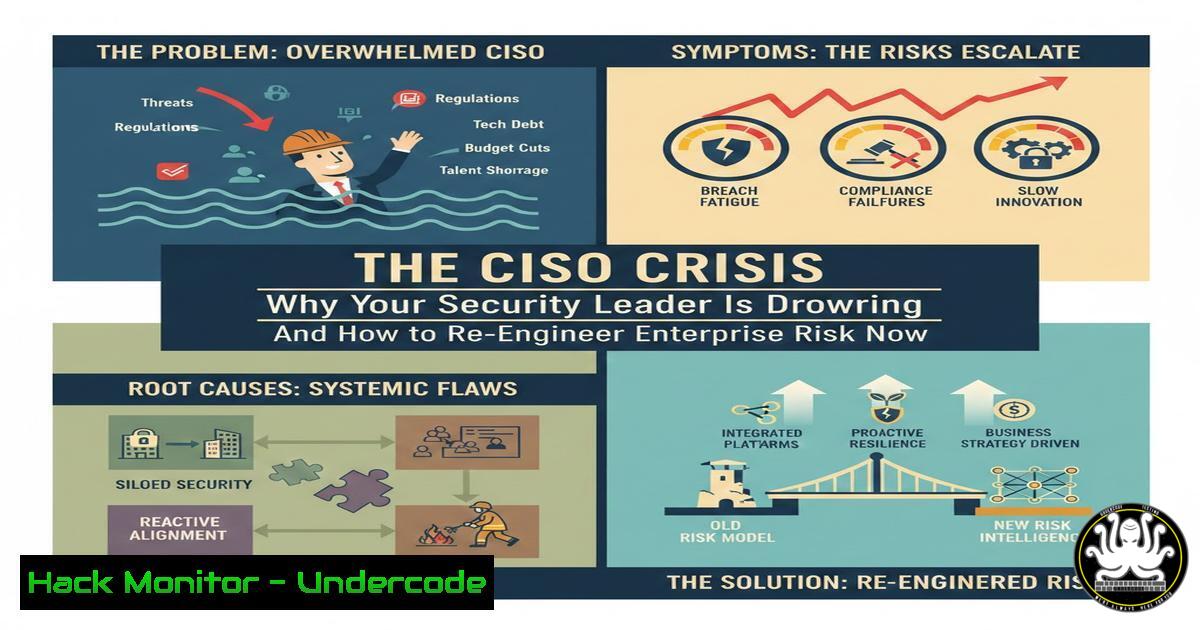
The modern Chief Information Security Officer (CISO) is no longer just a technical gatekeeper; they are a manager of geopolitical, regulatory, and enterprise-wide risk. However, a recent report highlights a breaking point: a majority of security leaders view their roles as “no longer fully manageable.” As corporate jurisdictions expand without corresponding resources or authority, the industry must pivot from concentrating risk in a single role to distributing accountability across the entire organization. This article explores the technical and structural shifts required to transform cybersecurity from a siloed function into a collective enterprise responsibility.
Learning Objectives:
- Understand the organizational design flaws that lead to CISO burnout and security gaps.
- Learn how to implement shared accountability models using governance frameworks.
- Identify technical controls and commands for enforcing risk ownership across IT, development, and business units.
You Should Know:
- The Anatomy of Scope Creep: Why CISOs Are “Boxed In”
The core issue, as articulated by experts like Brian Levine and Tony S., is not merely bandwidth but flawed organizational design. When a CISO is responsible for everything from cloud security to regulatory compliance to physical security, they become a “risk magnet.” This concentration creates a single point of failure. To fix this, enterprises must shift from a centralized security model to a federated risk model where business unit leaders own the risk of their data and processes, with the CISO acting as the governance overseer rather than the sole operator.
Step‑by‑step guide: Mapping Accountability with a RACI Matrix
To redistribute workload, you must first document who is responsible for specific assets.
1. Identify Assets: List critical data repositories and applications (e.g., CRM Database, HR Cloud Storage).
2. Define Roles: Identify key players (CISO, CIO, Data Owner, IT Manager, Developer).
3. Assign RACI:
- Responsible: The person who does the work (e.g., IT Manager patches the server).
- Accountable: The person who signs off (e.g., Data Owner accepts the risk of not patching).
- Consulted: Those whose opinions are sought (e.g., CISO advises on criticality).
- Informed: Those kept updated (e.g., Board is informed of risk acceptance).
- Tool Command (Linux/macOS for Audit): Use `grep` and `awk` to audit ownership from configuration files.
Example: Find all Nginx configs and list the system owner
grep -i "server_name" /etc/nginx/sites-enabled/ | awk -F':' '{print $1}' | xargs ls -l | awk '{print $3, $9}'
This command helps identify which system user (and by extension, which team) “owns” the web server config, reinforcing that ownership must be transparent.
-
Implementing Shared Risk Ownership with NIST SP 800-171
As highlighted in the comments regarding defense contractors, compliance frameworks like NIST SP 800-171 can feel overwhelming if the burden rests solely on IT. The solution is to embed control ownership within business functions. For example, the “Access Control” family (AC) shouldn’t just be the CISO’s problem; HR should own the identity lifecycle, and facility managers should own physical access.
Step‑by‑step guide: Enforcing Data Ownership via Windows Active Directory
To ensure business units manage their own users (taking pressure off the CISO), delegate control in Active Directory.
1. Open Active Directory Users and Computers (ADUC).
- Right-click the Organizational Unit (OU) for a specific department (e.g., “Sales”).
3. Select Delegate Control.
- Add the Sales Manager’s group and delegate permissions like “Reset user passwords and force password change at next logon.”
- PowerShell Command (Run as Admin): To audit who has delegated control, use:
Get-Acl -Path "AD:\OU=Sales,DC=domain,DC=local" | Format-List
This reveals the security principals (users/groups) that have modify permissions, proving that accountability has been successfully pushed to the business line.
3. The Technical Fix: Automating Compliance Checks (DevSecOps)
If the CISO is the only one checking for vulnerabilities, the system fails. The goal is to automate compliance so that developers and system admins are forced to meet security standards before deployment, a concept echoed in the need for “structural alignment.”
Step‑by‑step guide: Using InSpec for Automated Compliance
InSpec is an open-source framework for defining automated compliance tests.
1. Install InSpec: `curl https://omnitruck.chef.io/install.sh | sudo bash -s — -P inspec`
2. Create a Control: Write a test to ensure the Sales department’s file share isn’t world-readable.
 sales_share_control.rb
control "sales-share-01" do
impact 0.7
title "Sales Share Permissions"
desc "Ensure the Sales share is not accessible by unauthorized users."
describe file('//fileserver/sales_data') do
it { should be_directory }
its('owner') { should eq 'sales_admin' }
it { should_not be_readable.by('others') }
end
end
3. Execute the Test:
inspec exec sales_share_control.rb
If this test fails, the build pipeline should halt, forcing the Sales Admin (the owner) to fix it, not the CISO.
4. API Security and Governance: Decentralizing the Perimeter
When risk is distributed, APIs become the communication channels between business units and the security team. If a business unit wants to expose data, they must own the security of that endpoint. The CISO provides the gateway policy.
Step‑by‑step guide: Rate Limiting with Nginx (Business Unit Enforcement)
To prevent a business unit’s API from being abused (thus creating enterprise risk), enforce rate limits at the proxy level.
1. Edit your Nginx configuration (`/etc/nginx/nginx.conf`).
- Define a limit zone in the `http` block:
http { limit_req_zone $binary_remote_addr zone=sales_api_limit:10m rate=10r/s; ... } - Apply it to the specific location block for the Sales API:
server {
location /api/sales/ {
limit_req zone=sales_api_limit burst=20 nodelay;
proxy_pass http://sales_backend;
}
}
4. Test Configuration & Reload:
nginx -t
systemctl reload nginx
This technical control places the burden of availability and abuse prevention on the API’s performance profile, managed by the owning unit, while adhering to the enterprise standard.
- Cloud Hardening: Enforcing Tagging for Cost and Risk Allocation
In the cloud, if resources aren’t tagged with an owner (e.g., “CostCenter=Sales”), the CISO’s team wastes time figuring out who is responsible for a vulnerable asset. Automate the enforcement of ownership tags.
Step‑by‑step guide: Azure CLI to Enforce Resource Tags
Use Azure Policy or manual CLI checks to ensure accountability.
1. List all untagged VMs:
az vm list --query "[?tags.owner==null].[name, resourceGroup]" -o table
2. Apply a tag retroactively (if you know the owner):
az vm update --resource-group SalesRG --name SalesVM --set tags.owner='SalesDept'
3. Deny creation via policy: In a production environment, use a policy definition that denies deployment if the mandatory “owner” tag is missing. This shifts the cognitive load from the CISO to the deploying engineer.
What Undercode Say:
- Key Takeaway 1: The CISO role is structurally broken; adding more resources to a CISO without redistributing accountability simply creates a more expensive point of failure. The solution is a federated risk model where business leaders own the P&L of their security posture.
- Key Takeaway 2: Automation is the only way to scale decentralized security. By embedding compliance checks (InSpec), infrastructure ownership (cloud tags), and delegated access (AD delegation) into the daily workflow, security becomes a byproduct of business operations rather than a bottleneck.
The conversation must move from “What keeps the CISO up at night?” to “How do we structure the business so that risk keeps everyone appropriately alert?” It is not about fixing the CISO; it is about transforming the enterprise into a resilient organism where security is a shared language, not a foreign department.
Prediction:
Within the next three years, we will see the emergence of the “Distributed Risk Officer” (DRO) model, replacing the singular CISO in large enterprises. Boards will mandate that every C-suite executive have a portion of their compensation tied to specific cybersecurity KPIs of their departments. Furthermore, GRC (Governance, Risk, and Compliance) will become a real-time, automated feedback loop rather than an annual audit, driven by the failure of the centralized model to keep pace with the velocity of modern business and threat actors.
▶️ Related Video (76% Match):
🎯Let’s Practice For Free:
IT/Security Reporter URL:
Reported By: Schumanevan With – Hackers Feeds
Extra Hub: Undercode MoN
Basic Verification: Pass ✅


