
Listen to this Post
Introduction:
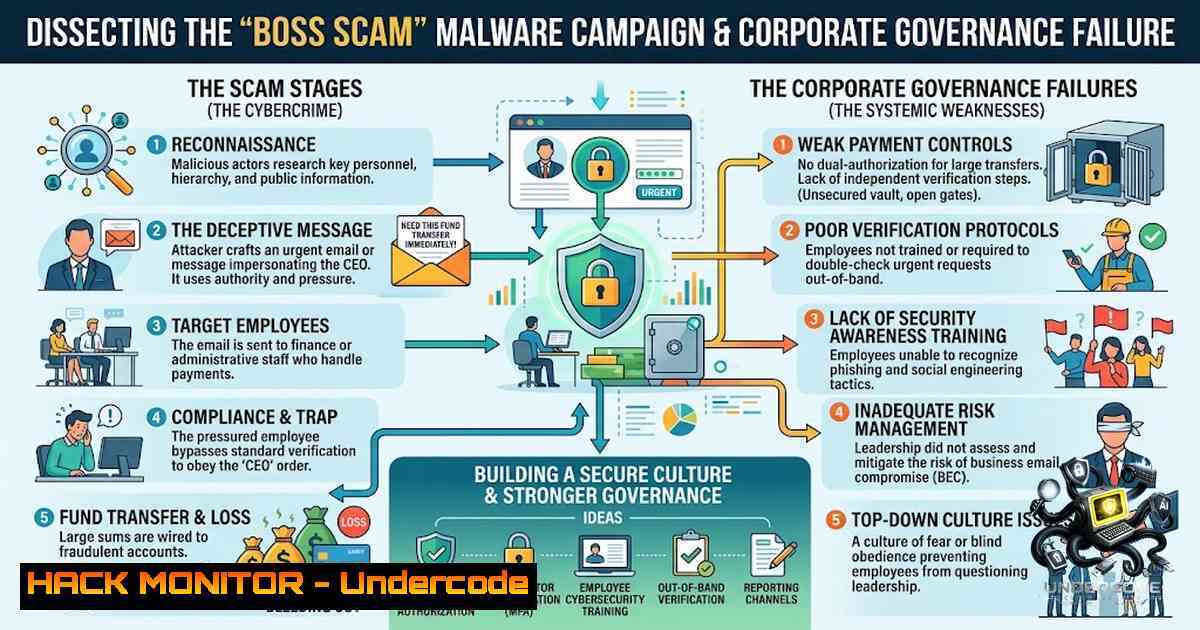
The modern corporate treasury is under siege not by sophisticated zero-day exploits, but by a simple, devastatingly effective deception: the compromised WhatsApp message. A recent case in Pune, where a sugar trader lost ₹3 crore in under an hour after his accountant followed WhatsApp instructions from a spoofed “CEO” number, highlights a critical governance failure. This incident, part of a wider “Boss Scam” campaign flagged by the Indian Cyber Crime Coordination Centre (I4C), demonstrates that authority is not authentication—and that without independent verification, a single compromised device can bypass an organisation’s entire financial controls.
Learning Objectives & Secrets:
- Objective 1: Map the Attack Kill Chain. Understand how malicious ZIP files disguised as “Statement of Account.zip” or “RBI.zip” lead to WhatsApp Web session hijacking and automated malware propagation.
- Objective 2 Secret Tips: Detect DLL Sideloading. Learn to identify the evasion technique used by this campaign; the malware uses a malicious .exe and a Dynamic Link Library (.dll) to evade standard antivirus detection.
- Objective 3 Secret Tips: Implement “Out-of-Band” Verification. The single most effective control is not technical, but procedural: mandating a direct voice call to a known, verified number for any high-value or urgent payment instruction.
You Should Know:
- Anatomy of the Attack: From ZIP File to ₹3 Crore Heist
This campaign is a textbook example of a multi-stage social engineering and malware attack. It begins with the victim receiving a compressed (.zip) file via WhatsApp, SMS, or email. The file names are carefully chosen to appear as routine financial documents, such as “Statement of Account.zip”, “RBI.zip”, or “MCA.zip”. The accompanying message is crafted to look like an urgent compliance notice from regulators like the Reserve Bank of India or the Ministry of Corporate Affairs.
The archive contains a malicious Windows executable (.exe) and a Dynamic Link Library (.dll) file. When the victim extracts and opens the file on a Windows computer, a Trojan is installed that compromises the device and hijacks the active WhatsApp Web session. Once the account is compromised, the malware automatically forwards the same malicious file to all the victim’s contacts and groups, often with a request to forward it to the company’s finance manager.
This is where the “Boss Scam” begins. Using the compromised WhatsApp account of a senior executive, or by covertly saving an attacker-controlled number under the “CEO’s” name, fraudsters send urgent instructions to finance personnel to transfer money to mule accounts. The Pune case is a perfect example: the accountant received a message from an unknown number saved under the trader’s name, asked for the account balance, and then instructed the transfer of ₹3 crore.
- The Technical Deep Dive: DLL Sideloading and Evasion
This is not a simple script-kiddie operation. Technical analysis by the I4C’s National Cybercrime Threat Analytics Unit (NCTAU) reveals that the campaign is operated by organised cross-border cybercriminal networks using advanced malware. The key evasion technique is DLL sideloading, where the malware uses a legitimate Windows executable to load a malicious DLL file, allowing it to bypass security software that only scans for known malicious executables.
The malware is designed to specifically target Windows systems. The use of WhatsApp Web sessions is particularly insidious because it doesn’t require the attacker to phish for credentials or bypass multi-factor authentication (MFA) on the mobile app itself; they simply steal the active browser session token.
Step‑by‑step guide for detection and response:
- For Windows Administrators: Block the execution of unknown .exe and .dll files from user profile directories (e.g.,
%USERPROFILE%\Downloads,%TEMP%) using Windows Defender Application Control or AppLocker. - For SOC Analysts: Monitor for suspicious execution of `rundll32.exe` loading DLLs from unusual paths, a common indicator of sideloading.
- For Individuals: Regularly review WhatsApp’s “Linked Devices” section (
Settings > Linked Devices) and log out of any sessions you do not recognise.
- The Corporate Governance Failure: It’s Not an IT Problem
The critical question a Board must ask is not “Do we have cybersecurity software?” but “Can our internal controls stop an apparently genuine executive instruction from moving money without independent verification?”. The ₹3 crore heist succeeded because the company lacked a fundamental control: independent verification for high-value payments.
As the I4C itself advises, organisations must independently verify urgent fund-transfer instructions through a direct call to a known and previously verified number. This is known as “out-of-band” verification, and it is the single most effective control against CEO fraud and BEC. No message, regardless of how authentic it looks, should ever by itself constitute payment authority.
Step‑by‑step guide for implementing financial controls:
- Mandate Dual Approval: No single employee should be able to initiate and process a large-value transaction. Implement a policy of multi-party approval for all wire transfers and vendor payment updates.
- Implement Out-of-Band Verification: For any payment instruction or bank detail change received via email or WhatsApp, require a verbal confirmation via a phone call to a number that is independently known and verified, not the one in the message.
- Segregation of Duties: Separate responsibilities for payment initiation, approval, and reconciliation.
- Review Beneficiary Accounts: Ensure that changes to beneficiary accounts are independently verified and that a “Positive Pay” system is in use to match issued checks and ACH transactions against a list of approved payees.
4. The I4C Response and Mitigation Measures
The I4C has been proactive in its response. They have issued detailed advisories, including one on June 22, 2026, titled “Regulatory and Executive Impersonation for WhatsApp Account Takeover using Malicious Windows Executables and High Value Financial Fraud”. They have intimated over 58,000 potential victims through SMS and shared technical indicators with CERT-In, Microsoft, and leading Indian cybersecurity firms. Through the Sahyog Portal, they have geo-blocked command-and-control (C2) servers, protecting more than 10,000 citizens.
Step‑by‑step guide for organisations:
- Employee Training: Sensitise employees, especially finance teams, about the “Boss Scam” and the dangers of opening unsolicited ZIP files.
- Email Security: Ensure proper configuration of SPF, DKIM, and DMARC to prevent email spoofing, and set DMARC to `p=reject` or
p=quarantine. - Incident Response: Establish a clear procedure for reporting suspected fraud. Speed is critical; reporting a fraudulent transaction within 72 hours offers the best chance of recovery.
5. Linux and Windows Security Commands
While the malware primarily targets Windows, system administrators on both platforms can use these commands for monitoring and forensics.
Windows Commands:
- Check for Suspicious Scheduled Tasks: `schtasks /query /fo LIST /v` (Look for tasks created by unknown users).
- Monitor Network Connections: `netstat -anob` (Shows active connections and the owning process).
- Check for Recently Created Files in Temp: `dir %TEMP% /od` (Lists files in the temp directory, sorted by date).
- Check Startup Programs: `wmic startup get caption,command` (Lists programs that run at startup).
Linux Commands (for servers and network monitoring):
- Monitor Suspicious Processes: `ps auxf` (Shows a tree of running processes).
- Check for Open Ports: `ss -tulpn` (Lists listening ports and associated services).
- Monitor File System Changes: `auditctl -w /tmp -p wa -k tmp_watch` (Sets up auditing on the /tmp directory).
- Check for Crontab Entries: `crontab -l` (Lists scheduled tasks for the current user).
What Undercode Say:
- Key Takeaway 1: Technology is not a substitute for process. The most sophisticated security software is useless if a single employee can authorise a multi-crore transfer based on a WhatsApp message.
- Key Takeaway 2: The “Boss Scam” is a crisis of corporate governance, not just cybersecurity. Boards and Audit Committees must ask the hard questions about their financial controls, not just their antivirus software.
Analysis: The Pune incident is a stark warning that the human element remains the weakest link in the security chain. The fraudsters didn’t hack the bank; they hacked the accountant’s perception of authority. This campaign’s success lies in its ability to exploit trust and urgency, bypassing technical controls by manipulating people. The response must be a holistic one, integrating cybersecurity, fraud prevention, and internal controls into a single governance framework. The question every Audit Committee should be asking is not if it can happen to them, but what independent control would stop the money from leaving if it did.
Prediction:
- +1 The I4C’s proactive measures, including sharing threat intelligence with CERT-In and Microsoft, will lead to faster signature updates and improved detection rates for this specific malware, reducing its initial infection success rate.
- -1 This campaign will likely evolve. We can expect to see variants that target macOS and mobile operating systems, not just Windows, broadening the attack surface.
- -1 The success of this social engineering tactic will inspire copycat campaigns using other messaging platforms like Telegram and Signal, and may lead to an increase in vishing (voice phishing) attacks that bypass the out-of-band verification process.
- +1 The high-profile nature of the ₹3 crore heist will force regulators like SEBI to mandate stricter internal financial controls for listed companies, similar to the Sarbanes-Oxley Act in the US, potentially standardising “out-of-band” verification as a regulatory requirement.
▶️ Related Video (70% Match):
🎯Let’s Practice For Free:
🎓 Live Courses & Certifications:
Join Undercode Academy for Verified Certifications
🚀 Request a Custom Project:
Secure, high-velocity infrastructure and disruptive technological engineering. Contact our engineering team for high-tier development and proprietary systems:
[email protected]
💎 Smart Architecture | 🛡️ Secure by Design | ⭐ Trusted by Thousands
IT/Security Reporter URL:
Reported By: https://lnkd.in/p/euj6DebG – Hackers Feeds
Extra Hub: Undercode MoN
Basic Verification: Pass ✅


