
Listen to this Post
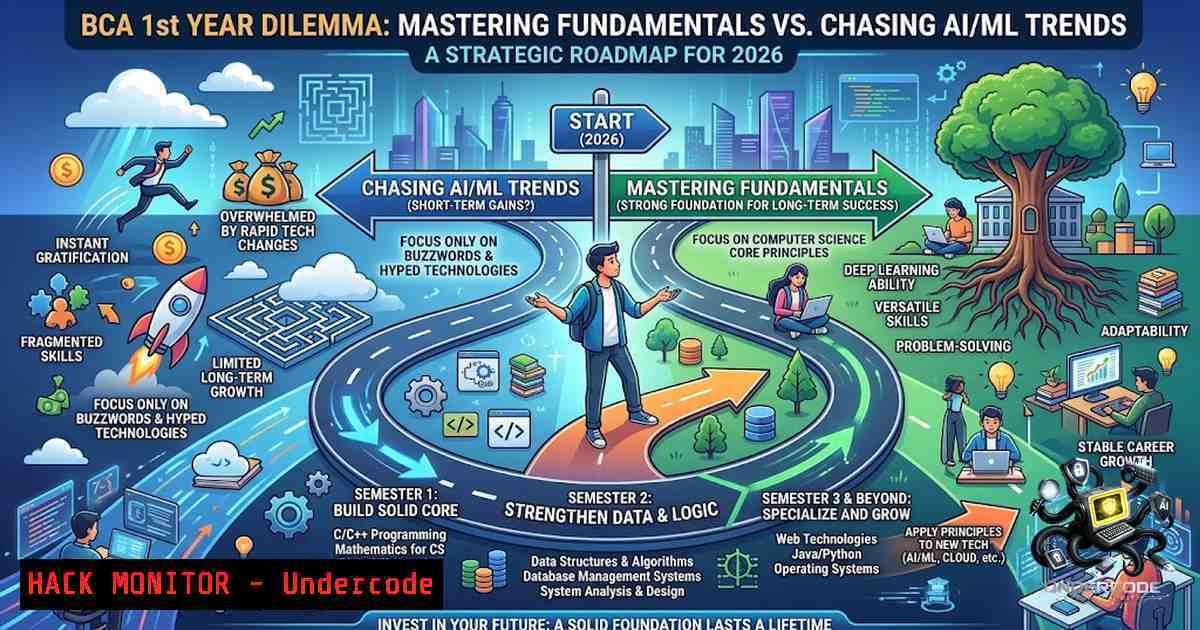
Introduction:
For a first-year BCA student, the technology landscape presents a paradox of abundance. While trending domains like Artificial Intelligence, Full Stack Development, and Ethical Hacking promise lucrative careers, the foundational architecture of computer science—data structures, algorithms, and system internals—remains the bedrock upon which all specialization is built. The immediate temptation to jump into high-level frameworks often masks a critical gap: without a strong grasp of C/C++ and memory management, advanced concepts in AI or Cybersecurity become superficial. This article serves as a strategic technical roadmap, filtering the noise of “trending skills” to establish a core competency framework that ensures long-term adaptability and technical depth.
Learning Objectives & Secrets:
- Objective 1 (The Foundation): Achieve proficiency in C programming, focusing on pointers, dynamic memory allocation, and file I/O. Secret Tip: Rewrite basic Linux commands (like `ls` or
grep) in C to understand system calls and process management. - Objective 2 (The Bridge): Transition to Object-Oriented Programming (OOP) with Java to grasp polymorphism, inheritance, and design patterns. Secret Tip: Implement your own custom data structures (e.g., a HashMap using chaining) to deeply understand collision resolution.
- Objective 3 (The Security Lens): Learn how these fundamentals create vulnerabilities. Secret Tip: Write a simple C program that uses `gets()` to exploit a buffer overflow, then compile it with and without stack protection to see how memory corruption works.
You Should Know:
- Setting Up Your Local Sandbox (Linux/Windows Subsystem for Linux)
To effectively learn system programming and security, you need an isolated environment where breaking things is encouraged.
– Step 1 (Windows): Install Windows Subsystem for Linux (WSL 2). Run `wsl –install -d Ubuntu` in PowerShell. For native Linux, ensure `gcc` and `gdb` are installed.
– Step 2 (Environment): Create a dedicated folder: mkdir ~/bcacore && cd ~/bcacore.
– Step 3 (The Compiler): Write your first C program (hello.c). Compile with debug symbols to prepare for analysis: gcc -g hello.c -o hello.
– What this does: This establishes a professional-grade development environment that mirrors cloud servers, allowing you to practice system-level code and permissions (chmod, chown) without risking your main OS.
2. Mastering Memory Management (The Buffer Overflow Insight)
Understanding memory layout is critical for both high-performance coding and cybersecurity.
– Step 1: Write a vulnerable C program:
include <stdio.h>
include <string.h>
void vulnerable() {
char buffer[bash];
gets(buffer); // Dangerous function
}
int main() { vulnerable(); return 0; }
– Step 2: Compile with stack protection off: gcc -fno-stack-protector -z execstack -1o-pie vuln.c -o vuln.
– Step 3: Use `gdb` to analyze memory: `gdb ./vuln` and `break vulnerable` to inspect the stack frame layout using `info frame` and x/20x $rsp.
– Why this matters: This exercise demystifies how classic exploits work. Mitigating this requires modern memory-safe languages (Rust) or compiler hardening (ASLR, PIE), bridging your first-year “C” knowledge with advanced “Cyber Security” training.
3. Web Foundations vs. Full-Stack Frameworks
While React and Node.js are popular, a BCA student must understand the underlying HTTP protocol and client-server architecture.
– Step 1 (Network Core): Use curl -v https://example.com` to trace the TLS handshake and HTTP headers. Pay attention to the `Set-Cookie` and `Server` headers.python3 -m http.server 8080`. Analyze the output logs to see how requests are processed.
- Step 2 (Security Header Check): Use the command `curl -I https://your-site.com | grep -i "x-frame-options"` to check for Clickjacking protections.
- Step 3 (Local Server): Write a simple Python HTTP server without frameworks:
– The Verdict: Learning the “transfer protocol” (HTTP/HTTPS) before the “framework” (Django/Flask) makes you a more versatile developer. When you move to Cloud, you will understand Load Balancers and API Gateways better.
4. Database Internals & SQL Injection Mitigation
Data is the new oil, but storing it securely is the new refinery.
– Step 1 (Setup): Install SQLite/PostgreSQL. Create a table: CREATE TABLE users (id SERIAL, username TEXT, password TEXT);.
– Step 2 (Injection Simulation): Simulate a bad query concatenation: SELECT FROM users WHERE username = 'admin' --;. Show how the `–` comments out the password check.
– Step 3 (Fix): Implement Prepared Statements. In Java: PreparedStatement stmt = conn.prepareStatement("SELECT FROM users WHERE username = ?");.
– Key Skill: Understanding normalization and indexing is a “secret tip” often ignored by bootcamps. Use `EXPLAIN ANALYZE` in PostgreSQL to see how your query traverses the B-Tree, connecting your data structures class directly to real-world performance.
5. Introduction to AI/ML Without the Hype
AI is not a magic black box; it is linear algebra and probability.
– Step 1 (Environment): Install Python and virtualenv. Create an environment: python3 -m venv aiml_env.
– Step 2 (The Math): Write a simple Perceptron or Linear Regression from scratch using only NumPy. Do not use TensorFlow or PyTorch yet.
– Step 3 (Model Persistence): Save your trained model weights to a `.npy` file. Loading and applying these weights is the core of “Inference.”
– Why this matters: By writing the algorithm from scratch, you understand the mathematics (Gradient Descent, Loss Functions). This makes you a better “AI Engineer” because you can debug why a model is failing, rather than just tuning hyperparameters blindly.
6. Practical Version Control & Collaboration
Version control is non-1egotiable.
- Step 1: Initialize a Git repo:
git init. - Step 2: Create a `.gitignore` file to exclude binaries (
.o,.exe). - Step 3 (Security): Use Git hooks to prevent committing secrets. Create a pre-commit hook that scans for `AWS_SECRET_ACCESS_KEY` using
grep. This is the bridge between “Development” and “DevSecOps.”
7. Cloud Computing Basics
Cloud is not “virtual machines”; it is “API-driven infrastructure.”
– Step 1: Install the AWS CLI or Azure CLI.
– Step 2: Configure credentials: aws configure.
– Step 3: Use CLI to list S3 buckets: `aws s3 ls` or list VMs. This demonstrates that Cloud is accessible from the command line, similar to how you interact with your local Linux system.
What Undercode Say:
- Key Takeaway 1: The “C first” approach is not archaic; it is strategic. Learning C is learning “computer” (how RAM works, how CPU executes), while learning Python is learning “logic.” In 2026, systems-level knowledge distinguishes a “developer” from an “architect.”
- Key Takeaway 2: Cybersecurity is not a separate domain; it is a byproduct of deep understanding. If you know how memory works, you know how exploits work. If you know how HTTP works, you know how to prevent header manipulation.
Analysis:
The student is facing the paradox of choice typical in modern education. Most professionals suggest “Full Stack” because it yields quick visual results. However, the industry is currently saturated with framework developers but starved of engineers who can optimize databases or trace network packets. By focusing on C and Java in the first year, the student isn’t falling behind; they are building a durable foundation. When AI tools (Copilot, ChatGPT) become ubiquitous, the coding syntax becomes trivial. The only enduring value is problem-solving logic and understanding the system’s constraints—skills honed by studying operating systems and memory management. The college’s specialized training programs should be viewed as “electives” to spark interest, while the core curriculum (Data Structures, Algorithms, OS) should be treated as the “major.”
Prediction:
- +1: Students who master systems fundamentals will naturally adapt to AI/ML faster because they understand the hardware limitations (GPU memory, CPU cache) that dictate algorithm efficiency.
- +1: The rise of “AI Agent” development will require engineers to write robust, memory-safe code (Rust) to run on edge devices, rewarding those with a systems background.
- -1: Students who jump directly to high-level frameworks risk becoming “framework fetishists,” unable to debug performance bottlenecks or security vulnerabilities, limiting their earning potential to routine CRUD operations.
- +1: Cybersecurity demands will explode with IoT and critical infrastructure, creating a huge demand for BCA graduates who can read assembly and understand CVE exploits.
- -1: If the student focuses solely on JavaScript/Python without understanding memory or network protocols, they will struggle to pivot when the next trend (Quantum? Bio-Computing?) arrives.
▶️ Related Video (74% Match):
🎯Let’s Practice For Free:
🎓 Live Courses & Certifications:
Join Undercode Academy for Verified Certifications
🚀 Request a Custom Project:
Secure, high-velocity infrastructure and disruptive technological engineering. Contact our engineering team for high-tier development and proprietary systems:
[email protected]
💎 Smart Architecture | 🛡️ Secure by Design | ⭐ Trusted by Thousands
IT/Security Reporter URL:
Reported By: https://lnkd.in/p/eGwwHp3V – Hackers Feeds
Extra Hub: Undercode MoN
Basic Verification: Pass ✅


