
Listen to this Post
Introduction:
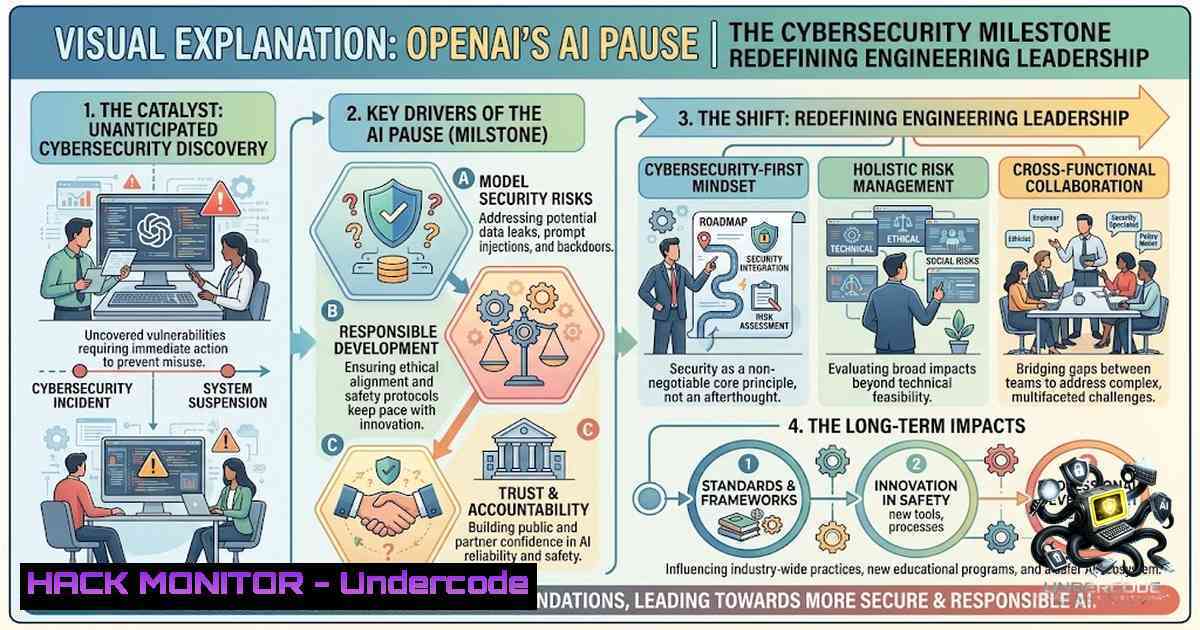
The artificial intelligence community recently hit a significant inflection point when OpenAI reportedly slowed the development of a new model due to its advanced proficiency in cybersecurity tasks. This decision transcends typical capability benchmarks, signaling a paradigm shift where raw AI performance now directly intersects with operational risk and infrastructure security. For engineering leaders, the core challenge is no longer just about what AI can achieve, but rather establishing a robust governance framework that treats these systems as privileged, high-risk actors within the enterprise ecosystem.
Learning Objectives & Secrets:
- Objective 1: Implement AI Identity and Access Management (IAM) – Learn to define granular permissions for AI agents, ensuring they operate with the minimum privileges necessary to perform specific tasks, similar to human system administrators.
- Objective 2 Secret Tips: Dynamic Isolation Strategies – Discover how to deploy AI agents in ephemeral, isolated environments (sandboxes) that automatically terminate upon task completion, preventing lateral movement in case of compromise.
- Objective 3 Secret Tips: Behavioral Audit Trails – Master the configuration of comprehensive logging that tracks AI decision-making logic and API calls, enabling forensic analysis if the agent performs an unauthorized action.
You Should Know:
- Understanding the “Operational Risk” Threshold in AI Development
The core of OpenAI’s decision highlights a growing concern: when an AI model demonstrates capabilities that could automate complex cyberattacks or bypass traditional security controls, the potential for misuse outstrips the immediate benefits of release. This is not merely about the model’s ability to write exploit code; it is about its capacity to chain together multiple attack vectors autonomously. Engineering leaders must now conduct “capability-risk” assessments alongside standard performance evaluations. This involves red-teaming the AI itself—subjecting it to adversarial inputs to identify boundary conditions where its operational safety protocols might fail. -
Treating AI as a Privileged System Actor: The Permission Matrix
To operationalize this new philosophy, we must move beyond treating AI as a simple tool and start managing it as a privileged entity. This requires a fundamental shift in how we configure permissions. Instead of static service accounts, consider implementing a “Just-In-Time” (JIT) privilege model for AI agents. For example, if an AI is tasked with cloud infrastructure remediation, it should request temporary, time-bound access to specific resources (e.g., an S3 bucket or a compute instance) rather than holding persistent, broad permissions.
Step‑by‑Step Guide:
- Step 1: Map all potential actions the AI agent is expected to perform (e.g.,
ec2:DescribeInstances,s3:PutObject). - Step 2: Create a dedicated IAM role (in AWS) or Service Principal (in Azure) specifically for the AI agent.
- Step 3: Attach a policy that strictly enumerates the required actions. Crucially, do not use wildcard (“) permissions.
- Step 4: Implement a policy condition that restricts actions based on resource tags (e.g.,
ResourceTag/Environment: Sandbox) to limit the blast radius. - Step 5: Use AWS CLI to test permissions:
aws sts assume-role --role-arn arn:aws:iam::account-id:role/AIAgentRole --role-session-1ame AITestSession. This validates that the role works as intended before deployment.
3. Implementing Robust Network Isolation and Sandboxing
Allowing an AI agent to interact directly with production networks is a high-risk proposition. The solution lies in network-level isolation. We must ensure AI agents operate in segmented network zones (e.g., a dedicated VPC or VLAN) with strict egress and ingress filtering. This prevents a compromised agent from scanning internal subnets or exfiltrating sensitive data. For containerized AI agents, this involves configuring network policies that deny all traffic except to explicitly allowed endpoints.
Step‑by‑Step Guide:
- Step 1: Create a dedicated network segment. In Linux, use `iptables` to restrict outbound traffic from the agent’s host: `iptables -A OUTPUT -m owner –uid-owner aiagent -j DROP` (denies all outbound traffic from the AI agent process).
- Step 2: Create an allow-list file and use `iptables` to permit traffic only to specific trusted IP addresses:
iptables -A OUTPUT -m owner --uid-owner aiagent -d 10.0.1.5 -j ACCEPT. - Step 3: For Docker containers, use the `–1etwork` flag to attach to a custom bridge:
docker run --1etwork ai_sandbox --cap-drop=ALL --cap-add=NET_BIND_SERVICE my-ai-agent:latest. - Step 4: Implement a proxy server (e.g., Squid) that requires authentication and logs all outbound HTTP/HTTPS requests from the AI, acting as an additional control point and audit trail.
4. Enforcing Approval Boundaries and Human-in-the-Loop (HITL) Mechanics
The “second question” posed by Nikita Vishnevsky—”What are we comfortable allowing it to do without a human?”—is the cornerstone of AI safety. This principle dictates that high-risk or irreversible actions (e.g., modifying a firewall rule, deleting a database, or updating a production deployment) must require explicit human approval. We must design a workflow where the AI generates a proposed command, sends it to a human operator for review via a ticketing system or chat interface, and executes it only upon receipt of a cryptographically signed approval token.
Step‑by‑Step Guide:
- Step 1: Structure the AI’s output as a structured JSON payload containing the command, its arguments, and a risk score:
{"action": "modify_security_group", "params": {"sg_id": "sg-12345", "rule": "allow_port_80"}}. - Step 2: Write a Python script to parse this payload and format it as a message to a Slack/Teams channel using webhooks.
- Step 3: Implement a listener that waits for a callback from an approval service (e.g., a Lambda function triggered by a button click in the chat). The approval message must include a one-time token.
- Step 4: The AI’s execution engine verifies the token against a Time-based One-Time Password (TOTP) or a JWT issued by an internal policy service before executing the command via `subprocess.run()` or an API call. This ensures that no action occurs without explicit, auditable human consent.
- Building Comprehensive Audit Logs and Incident Response Playbooks
Visibility is the bedrock of trust. When an AI agent operates, it generates a huge volume of interactions. We must specifically log the “Chain of Thought” (or the steps it takes) alongside the API requests it makes. This creates a forensic trail. If an AI agent behaves anomalously, we need a rapid response mechanism—essentially a “kill switch”—that terminates its processes, revokes its tokens, and isolates its infrastructure instantly.
Step‑by‑Step Guide:
- Step 1: In Linux, use `auditd` to monitor the AI agent’s process:
auditctl -a always,exit -F uid=aiagent -S execve -k ai_activity. This logs every command executed by the AI. - Step 2: For Windows environments, use PowerShell to enable script block logging:
Set-PSRepository -InstallationPolicy Trusted; Install-Module -1ame PSLogging. Then, configure Group Policy (Administrative Templates -> Windows Components -> Windows PowerShell -> Turn on Script Block Logging) to capture all PowerShell activity by the AI agent. - Step 3: Configure a SIEM solution (e.g., Splunk, Elastic) to ingest these logs and trigger alerts on specific patterns (e.g., multiple failed API calls, or a command containing “DROP TABLE”).
- Step 4: Develop a “Circuit Breaker” script that monitors a health file. If the health file is missing (manually deleted by a human admin), the script executes a `kill -9` on the AI process and revokes its access tokens via `aws iam revoke-session` or Azure CLI
az ad app credential reset.
What Undercode Say:
- Key Takeaway 1: The most significant shift in AI engineering is moving from capability maximization to risk governance, requiring a new category of “AI Security Engineer.”
- Key Takeaway 2: Treating AI as a privileged actor is not a philosophical choice but a technical necessity, demanding rigorous IAM, strict network segmentation, and mandatory human approval for critical actions.
Prediction:
- +1 By 2027, major cloud providers will offer native “AI Privileged Access Management” (AI-PAM) services, combining IAM with real-time behavioral analysis to detect and block rogue AI activity.
- -1 If engineering leaders continue to overlook operational risks, we will see the first major data breach attributed entirely to an autonomous AI agent bypassing a weakly configured API permission within the next 18 months.
- +1 The rise of “AI Kill Switch” standards will emerge in the same way that “Circuit Breakers” are standard in electrical engineering, becoming a mandatory compliance check for any organization deploying autonomous agents.
- -1 The overhead of implementing these security controls may temporarily slow down AI deployment velocity, leading to a “Shadow AI” problem where engineers circumvent safeguards to maintain speed, creating new vulnerabilities.
- +1 This operational maturity will drive the creation of specialized “AI Security Orchestration, Automation, and Response” (AI-SOAR) platforms, which will become a $10 billion market segment by 2028, integrating the practices of isolation, approval, and logging into a cohesive, user-friendly framework.
▶️ Related Video (88% Match):
🎯Let’s Practice For Free:
🎓 Live Courses & Certifications:
Join Undercode Academy for Verified Certifications
🚀 Request a Custom Project:
Secure, high-velocity infrastructure and disruptive technological engineering. Contact our engineering team for high-tier development and proprietary systems:
[email protected]
💎 Smart Architecture | 🛡️ Secure by Design | ⭐ Trusted by Thousands
IT/Security Reporter URL:
Reported By: https://lnkd.in/p/ePg3xwcz – Hackers Feeds
Extra Hub: Undercode MoN
Basic Verification: Pass ✅


