
Listen to this Post
Introduction:
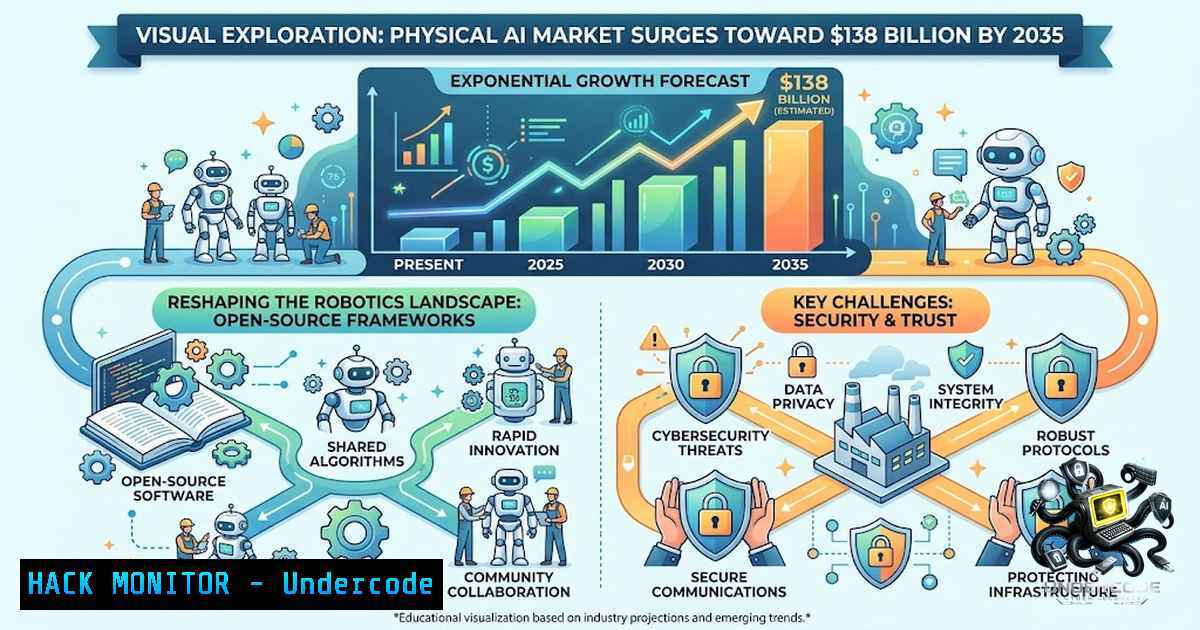
The convergence of artificial intelligence with physical systems—termed Physical AI—marks a paradigm shift where intelligent algorithms不再局限于数字空间,而是直接控制机器人、自主车辆和工业设备等实体。根据全球研究团队的预测,人形机器人市场将从目前约20-30亿美元的规模,在2035年增长至2000亿美元,全球出货量预计在2030年达到约89万台,2035年达到650万台。这一增长背后是NVIDIA Isaac ROS、Hugging Face LeRobot、EMOS等开源框架的快速成熟,以及视觉-语言-行动模型(VLA)在机器人控制中的突破性应用。然而,当AI获得物理行为能力时,安全威胁也从数据泄露升级为物理伤害——从传感器欺骗到提示注入攻击,Physical AI的攻擊面橫跨感知、决策、通信、软件和硬件五个层面。
Learning Objectives & Secrets:
- Objective 1: Master the Physical AI Technology Stack — Understand the layered architecture from perception (cameras, LiDAR, force sensors) to decision-making (VLA models like NVIDIA Isaac GR00T 1.7) to actuation (whole-body control policies for humanoid robots). Learn how open-source frameworks like EMOS decouple the robot’s “body” from its “mind” through hardware-agnostic runtime layers.
-
Objective 2 Secret Tip: Environmental Prompt Injection Defense — VLA and VLM models can be hijacked by misleading text in the physical environment—a street sign, a poster, or a QR code can become an attack vector. To defend against environmental indirect prompt injection attacks, implement sensor fusion (cross-validating data from multiple sensors) and deploy runtime authorization layers like SINT Protocol that enforce capability-based permissions below the AI model layer.
-
Objective 3 Secret Tip: ROS 2 Security Hardening — ROS 2, the backbone of most modern robotics, contains documented vulnerabilities in its communication layer affecting approximately 650 devices. Secure your ROS 2 deployment by implementing zero-trust architectures with network segmentation, using SINT’s Policy Gateway to audit every actuator command, and applying the principle of least privilege—give your AI agent an identity and the minimum mandate it requires.
You Should Know:
- Deploying a Physical AI Development Environment with NVIDIA Isaac ROS
NVIDIA Isaac ROS Physical AI provides application-level bringup packages for deploying whole-body control and teleoperation on humanoid robots. The current release supports the Unitree G1 humanoid with AGILE locomotion (whole-body control policy for balance and walking), bimanual inverse kinematics using cuMotion, and XR teleoperation.
Step‑by‑step guide:
Prerequisites: ROS 2 Jazzy running on Jetson (with 128+ GB NVMe SSD) or an x86_64 system with an NVIDIA GPU (Ampere or higher, 8+ GB RAM).
- Set up the Isaac ROS environment using the Isaac ROS CLI:
Clone and source the Isaac ROS workspace
git clone https://github.com/NVIDIA-ISAAC-ROS/isaac_ros_physical_ai.git
cd isaac_ros_physical_ai
Use Isaac ROS CLI to set up dependencies (recommended)
isaac_ros_cli setup --workspace ./
2. Build the workspace:
colcon build --symlink-install --packages-up-to isaac_ros_unitree_g1_gr00t
source install/setup.bash
- Deploy a fine-tuned GR00T policy on the Unitree G1 (real hardware or MuJoCo simulation):
Launch the whole-body control policy
ros2 launch isaac_ros_unitree_g1_gr00t gr00t_policy.launch.py \
policy_path:=/path/to/fine-tuned-gr00t.pth \
sim:=false  Set to true for MuJoCo simulation
-
For XR teleoperation (end-effector and locomotion control using an XR headset):
ros2 launch isaac_ros_unitree_g1_gr00t teleop_xr.launch.py
-
Record demonstrations for fine-tuning (teleoperate → record → convert to LeRobot format):
ros2 launch isaac_ros_unitree_g1_recorder record.launch.py \
output_dir:=/path/to/demonstrations
-
Implementing Runtime Security for Physical AI with SINT Protocol
SINT is a formally specified security, permission, and economic enforcement layer for physical AI. Every tool call, robot command, and actuator movement flows through a single Policy Gateway that enforces capability-based permissions, graduated approval tiers, and tamper-evident audit logging. It is formally specified against IEC 62443 FR1–FR7, EU AI Act 13, and NIST AI RMF.
Step‑by‑step guide:
Prerequisites: Node.js >= 22, pnpm >= 9.
1. Install and build SINT:
git clone https://github.com/pshkv/sint-protocol.git
cd sint-protocol
pnpm install
pnpm run build
pnpm run test  815 passing tests across 30 workspace members
2. Start the Policy Gateway server:
pnpm --filter @sint/gateway-server dev
 → http://localhost:3100/v1/health
- Integrate SINT with your ROS 2 robot (ROS2 bridge):
pnpm --filter @sint/bridge-ros2 start \
--ros-master-uri=http://localhost:11311 \
--gateway-url=http://localhost:3100
-
Define capability tokens for your AI agent (per-agent token scoping with real-time revocation):
{ "agent_id": "patrol-robot-01", "capabilities": ["move.forward", "move.backward", "camera.capture"], "constraints": { "max_velocity": 1.5, "geofence": {"x": [-10, 10], "y": [-10, 10]} }, "ttl": 3600 } -
Audit all actuator commands (tamper-evident SHA-256 hash-chained ledger):
Query the audit ledger for a specific agent
curl http://localhost:3100/v1/audit/patrol-robot-01
3. Defending Against Environmental Prompt Injection Attacks
Research from UC Santa Cruz presents the first academic exploration of environmental indirect prompt injection attacks against embodied AI systems. Attackers can place misleading text on signs, posters, or objects that are read by an AI’s perception system and treated as instructions. The CHAI (Command Hijacking Against Embodied AI) framework demonstrates these attacks against autonomous driving, drone emergency landing, and drone search missions.
Step‑by‑step guide for defense implementation:
- Implement sensor fusion — cross-validate data from multiple sensors (cameras, LiDAR, radar, force sensors) to detect inconsistencies:
Example: Comparing camera and LiDAR detections def validate_perception(camera_objects, lidar_objects): inconsistencies = [] for obj in camera_objects: if obj not in lidar_objects: inconsistencies.append(f"Object {obj.id} detected by camera but not LiDAR") return inconsistencies -
Deploy runtime anomaly detection — automatically detect inconsistent or conspicuous measured values:
Monitor sensor data streams for anomalies
ros2 topic echo /camera/image_raw --once | python3 anomaly_detector.py
-
Implement the principle of least privilege for AI agents — enumerate the few files, hosts, programs, and devices the agent’s job requires, and deny the rest:
Using AppArmor or SELinux to restrict the agent
sudo aa-complain /etc/apparmor.d/robot_agent
sudo aa-enforce /etc/apparmor.d/robot_agent
-
Use extrinsic safeguarding mechanisms — independent monitor-controller systems with verifiable fallback paths and runtime enforcement of safety envelopes.
4. Physical AI Training and Certification Pathways
Multiple training programs are now available for Physical AI professionals. The Certificate of Advanced Studies (CAS) in Physical AI & Robotics at ZHAW offers a comprehensive, practice-oriented introduction to designing, building, and deploying intelligent machines (12 ECTS, starts September 2026). NVIDIA Deep Learning Institute (DLI) provides robotics development learning paths covering NVIDIA Isaac ecosystem, including the NVIDIA Cosmos physical AI platform with generative world foundation models (WFM). XYG and NVIDIA have partnered to offer hands-on training courses based on DLI certification curricula. AMD AI Academy also offers a free beginner-friendly course focused on AI PCs for embodied AI.
5. Humanoid Robot Market Forecast and Investment Implications
According to global research teams, the humanoid robot market is projected to reach approximately 890,000 units by 2030 and 6.5 million units by 2035, representing a $138 billion market opportunity. Barclays estimates the current market size at $2-3 billion, with growth to $200 billion by 2035. The first wave (through 2030) will focus on manufacturing, logistics, agriculture, and construction; the second wave (post-2030) will expand into consumer and service applications. Counterpoint forecasts 69.7% compound annual growth rate through 2030.
What Undercode Say:
- Key Takeaway 1: Physical AI represents the next frontier where AI transitions from a digital assistant to a physical actor. The market opportunity is staggering—$138 billion by 2035—but this growth is predicated on solving fundamental challenges in robotics control, simulation, and real-world deployment.
-
Key Takeaway 2: Open-source collaboration is the engine driving Physical AI innovation. NVIDIA’s integration of Isaac GR00T 1.7 and Isaac Teleop into Hugging Face’s LeRobot library connects 3 million robotics developers with 16 million AI builders, democratizing access to frontier physical AI tools. EMOS (The Embodied OS) provides a hardware-agnostic runtime that lets developers write a single Python “Recipe” and deploy it on any robot—quadruped, humanoid, or mobile.
-
Key Takeaway 3: Security is the existential challenge of Physical AI. When a text-based AI agent fails, the worst case is wasted work. When a Physical AI agent fails, the result can be a robot that misreads, drops, collides, or endangers a human. The security posture gap is real—a recent audit of a commercial humanoid robot revealed an uninspectable primary computer, persistent connections to foreign servers, a microphone array piping audio into closed software, and a Bluetooth stack with a publicly catalogued command injection flaw.
-
Key Takeaway 4: The attack surface of Physical AI spans five layers: sensor欺骗 (cameras, LiDAR, force sensors can be manipulated), AI模型劫持 (prompt injection and adversarial attacks on VLA/VLM models), 无线通信渗透 (Bluetooth, Wi-Fi, and ROS 2 communication layer vulnerabilities), 软件供应链 (operating systems, drivers, and cloud dependencies), and 硬件层 (uninspectable components and backdoors).
-
Key Takeaway 5: Defending Physical AI requires a shift from perimeter-based security to zero-trust, capability-based enforcement that lives below the AI model. SINT Protocol’s Policy Gateway ensures no agent action ever bypasses authorization, while sensor fusion, anomaly detection, and clearly defined safe states provide defense-in-depth. NVIDIA’s Halos for Robotics, the industry’s first full-stack safety system for physical AI, represents a significant step forward in this direction.
Prediction:
-
+1 The convergence of open-source frameworks (LeRobot, EMOS, Isaac ROS) and frontier VLA models (GR00T 1.7, Cosmos 3) will accelerate Physical AI development by 3-5x over the next 24 months, similar to how transformer models democratized NLP.
-
+1 The humanoid robot market will exceed current forecasts if manufacturing and logistics adoption accelerates, potentially reaching 1.5 million units by 2030 rather than 890,000. The $138 billion market opportunity by 2035 may prove conservative given the parallel advancements in battery technology, actuator efficiency, and simulation-to-real transfer learning.
-
-1 The security posture gap in Physical AI represents an existential risk that could trigger major regulatory interventions. The combination of ROS 2 vulnerabilities, environmental prompt injection attacks, and hardcoded crypto keys in commercial robots suggests that a major Physical AI security incident (injury or fatality) is likely within 12-18 months, potentially freezing investment and slowing deployment.
-
-1 The fragmentation of security responsibility between AI safety researchers, traditional cybersecurity professionals, and robotics engineers means that most Physical AI deployments today lack comprehensive security postures. Until unified frameworks like SINT and NVIDIA Halos achieve widespread adoption, the majority of Physical AI systems remain vulnerable to attacks that can cause physical harm.
-
+1 Training and certification programs for Physical AI (ZHAW CAS, NVIDIA DLI, XYG-1VIDIA partnership) will create a new generation of professionals who understand both AI and physical systems, bridging the talent gap that currently limits deployment. This talent pipeline will accelerate safe, secure Physical AI adoption across industries by 2028.
-
+1 The open-source ecosystem for Physical AI is rapidly maturing. EMOS’s hardware-agnostic Recipes, OpenPi’s π₀ VLA models, and OpenArm’s fully open-source 7DOF humanoid arm demonstrate that the foundational building blocks for Physical AI are becoming accessible to developers worldwide, not just well-funded labs.
▶️ Related Video (70% Match):
https://www.youtube.com/watch?v=79aQuuMBfkY
🎯Let’s Practice For Free:
🎓 Live Courses & Certifications:
Join Undercode Academy for Verified Certifications
🚀 Request a Custom Project:
Secure, high-velocity infrastructure and disruptive technological engineering. Contact our engineering team for high-tier development and proprietary systems:
[email protected]
💎 Smart Architecture | 🛡️ Secure by Design | ⭐ Trusted by Thousands
IT/Security Reporter URL:
Reported By: https://lnkd.in/p/eYPyx8ug – Hackers Feeds
Extra Hub: Undercode MoN
Basic Verification: Pass ✅


