Listen to this Post
Introduction:
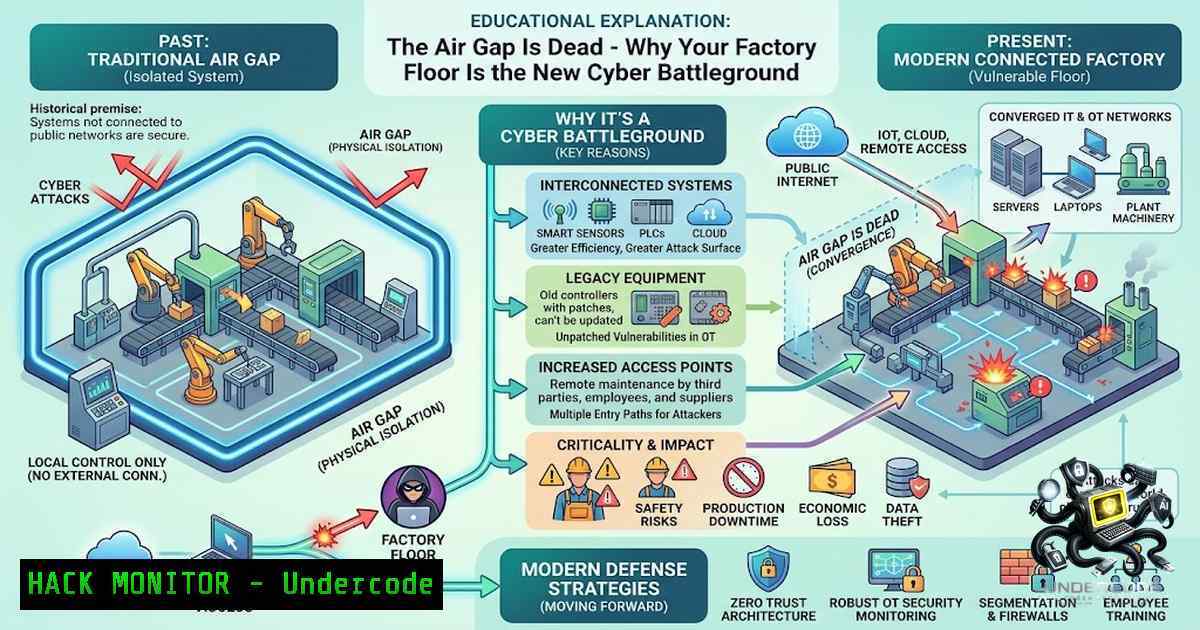
The assumption that operational technology (OT) networks are isolated from the internet is the single most dangerous misconception in modern manufacturing. As Industrial IoT (IIoT), smart sensors, and edge computing dissolve the traditional air gap, every connected programmable logic controller (PLC), gateway, and human-machine interface (HMI) becomes a potential entry point for cyber threats that can disrupt production, damage equipment, and create physical safety hazards. Cybersecurity is no longer an IT responsibility alone—it must be engineered into every industrial automation project from day one, treating the factory floor as a contested digital environment where trust is never implicit.
Learning Objectives:
- Understand why the traditional air gap is obsolete and how IT-OT convergence expands the attack surface
- Master the implementation of network segmentation using the Purdue Model and IEC 62443 zones-and-conduits
- Learn to deploy Zero Trust access control and continuous monitoring for industrial environments
- Apply AI-powered anomaly detection and edge computing strategies to identify threats before they cause failures
You Should Know:
- Network Segmentation: Building Defensible Architectures with the Purdue Model
The Purdue Enterprise Reference Architecture (PERA) remains the foundational framework for industrial network design, dividing a plant into hierarchical layers from physical processes (Level 0) to enterprise IT (Level 5). However, convergence has forced this model to adapt rather than disappear—sensors now send data directly to the cloud, and remote access reaches deep into control layers. The contemporary approach treats Purdue not as a rigid blueprint but as a conceptual guide combined with IEC 62443 zones and conduits.
Step-by-Step Implementation:
Step 1: Asset Inventory and Traffic Baseline
Before segmenting, you must know what exists on your network. Use passive monitoring to discover OT devices and map communication flows.
 Linux: Discover OT devices using nmap with industrial protocol scripts
nmap -sS -p 502,44818,2222,2404,4840 --open -oG ot_devices.txt 192.168.1.0/24

Windows: Use PowerShell to enumerate network adapters and ARP table
Get-1etAdapter | Where-Object {$_.Status -eq "Up"}
arp -a > arp_table.txt

OT-specific discovery using cyprobe (Linux/Windows with Npcap)
cyprobe discover --interface eth0 --timeout 30
The `nmap` command scans for common OT ports: 502 (Modbus TCP), 44818 (EtherNet/IP), 2222 (EtherNet/IP CIP), 2404 (IEC 60870-5-104), and 4840 (OPC UA).
Step 2: Zone Partitioning Based on Risk
Partition the industrial automation and control system (IACS) into security zones based on functional requirements, criticality, and consequence of compromise. Each zone contains assets with common security requirements.
Example IEC 62443 Zone Definition:
- Zone Z1-SIS (Safety Instrumented Systems): Physically air-gapped, no remote access, dual-authorization change management
- Zone Z2-BPCS (Basic Process Control): Security Level Target SL 2, high criticality, controlled conduits to higher levels
- Zone Z3-MES (Manufacturing Execution Systems): Security Level Target SL 1, medium criticality
Step 3: Deploy Industrial Firewalls with Deep Packet Inspection
Unlike IT firewalls, OT firewalls must support industrial protocols such as Modbus TCP, DNP3, OPC UA, and EtherNet/IP. They should inspect payloads for protocol anomalies, not just IP headers.
 Linux iptables example: Restrict Modbus TCP (port 502) to specific OT subnet
iptables -A INPUT -p tcp --dport 502 -s 192.168.10.0/24 -j ACCEPT
iptables -A INPUT -p tcp --dport 502 -j DROP

Windows Netsh example: Block all traffic except to specific OT VLAN
netsh advfirewall firewall add rule name="Block_Non_OT" dir=in action=block remoteip=192.168.10.0/24
Step 4: Implement a Demilitarized Zone (DMZ)
Place a DMZ between IT and OT networks to broker all communication. Firewall rules should specify that OT and ICS protocols are blocked anywhere outside of specific OT and ICS networks.
Step 5: Continuous Monitoring and Rule Auditing
Regularly audit firewall rules and remove outdated or unnecessary entries. Implement intrusion detection that logs port scanning, repeated failed connections, and protocol anomalies.
- Zero Trust Architecture: Eliminating Implicit Trust in OT Environments
Zero Trust assumes that no user, device, or connection is inherently trusted, even inside the perimeter. For OT environments, this means continuously validating access based on identity, context, and device posture. Traditional perimeter security is insufficient because internal traffic is no longer safe—attackers who gain a foothold in IT can pivot into OT if the boundary is weak.
Step-by-Step Implementation:
Step 1: Identity Verification for All Users and Devices
Extend identity management beyond human users to include service accounts, controllers, and sensors. Implement multi-factor authentication (MFA) for all remote access.
 Linux: Configure SSH with key-based authentication and disable password login
 Edit /etc/ssh/sshd_config
PasswordAuthentication no
PubkeyAuthentication yes
PermitRootLogin no

Restart SSH service
systemctl restart sshd

Windows: Enable PowerShell Remoting with authentication
Enable-PSRemoting -Force
Set-Item WSMan:\localhost\Client\TrustedHosts -Value "192.168.10.0/24"
Step 2: Micro-Segmentation with Zero Trust Network Access (ZTNA)
Deploy micro-segmentation to restrict communication to only what is explicitly required. Zero trust complements segmentation by assuming no implicit trust based on location. Remote access should be brokered through gateways that authenticate users, verify device posture, and limit sessions to specific assets and ports.
Step 3: Deploy OT-Aware Zero Trust Gateways
Solutions like AegisOT provide cross-protocol security for DNP3 and OPC UA traffic without requiring modifications to deployed field equipment. These gateways combine time validation, per-point Access Control Lists (ACLs), and tamper-evident audit logging.
Step 4: Continuous Attestation and Monitoring
Use Trusted Platform Modules (TPMs) and Trusted Execution Environments (TEEs) to anchor device identity and integrity. Continuously attest that endpoints remain in a known-good state.
 Linux: Check TPM status
tpm2_getcap handles-persistent

Verify system integrity with AIDE (Advanced Intrusion Detection Environment)
aide --check
Step 5: Implement Secure Remote Access
Remote access has historically been one of the hardest security problems to solve without disrupting operations. Use direct-routed ZTNA architecture that enables encrypted connections to authorized OT systems without exposing the entire network.
- AI-Powered Anomaly Detection: Identifying Threats Before Failures Occur
Machine learning provides tremendous capabilities to detect complex and evolving threats through anomaly detection, predictive analytics, and real-time threat hunting. AI-powered anomaly detection can monitor streaming data and sensor readings from multiple IoT devices simultaneously, detecting suspicious activity such as atypical traffic spikes and unauthorized access attempts. Intelligent algorithms like Random Forest classifiers and Long Short-Term Memory (LSTM) networks can identify abnormal scenarios in real time.
Step-by-Step Implementation:
Step 1: Establish a Behavioral Baseline
Collect and analyze normal network and machine behavior over a defined period. This baseline becomes the reference for detecting deviations.
Step 2: Deploy Passive Monitoring First
Implement OT-specific intrusion detection systems (IDS) with passive monitoring initially to avoid disrupting production. Use Deep Packet Inspection (DPI) for OT protocols.
 Linux: Capture OT traffic with tcpdump for analysis
tcpdump -i eth0 -w ot_traffic.pcap port 502 or port 44818 or port 4840

Analyze with Wireshark (CLI version: tshark)
tshark -r ot_traffic.pcap -Y "modbus" -T fields -e modbus.func_code -e modbus.data
Step 3: Implement Digital Twin-Enhanced Detection
Digital twins—real-time, physics-consistent virtual replicas of controlled industrial processes—can confirm or reject anomaly scores produced by deep-learning ensembles. This approach reduces false positives and provides physical context to alerts.
Step 4: Deploy Edge-Based AI Inference
Run AI models on edge servers close to operational devices to enable low-latency detection. Edge-forged zero trust architectures enforce security at the network edge using AI-driven continuous authentication and strict micro-segmentation.
Step 5: Integrate with Incident Response
Anomaly alerts should trigger automated responses: network isolation, rule rollbacks, and logging of incidents.
 Python example: Simple anomaly detection using statistical thresholds
import numpy as np
from scipy import stats

Assuming 'traffic_data' is an array of network metrics
z_scores = np.abs(stats.zscore(traffic_data))
anomalies = np.where(z_scores > 3)  Threshold of 3 standard deviations
print(f"Anomalies detected at indices: {anomalies}")
4. Edge Computing: Keeping Critical Operations Running Locally
Edge computing shifts processing from the cloud to the network edge, near operational devices. This approach reduces latency, maintains operational continuity even when cloud connectivity is lost, and limits data exposure. However, edge devices themselves must be secured through lightweight cryptography, AI-based intrusion detection, and blockchain-based flow integrity verification.
Step-by-Step Implementation:
Step 1: Harden Edge Devices
Disable unnecessary services, use encrypted protocols, and enforce strong passwords.
 Linux: Disable unnecessary services
systemctl list-units --type=service --state=running
systemctl stop [bash]
systemctl disable [bash]

Windows: Disable unnecessary services via PowerShell
Get-Service | Where-Object {$_.Status -eq "Running"}
Stop-Service -1ame "UnnecessaryService"
Set-Service -1ame "UnnecessaryService" -StartupType Disabled
Step 2: Implement Secure Boot and Firmware Verification
Ensure that edge devices boot only with cryptographically signed firmware.
Step 3: Deploy Containerized Security Microservices
Zero-trust security gateways can be deployed as containerized microservices. This approach provides vendor-agnostic security layers that are practical and scalable.
Step 4: Enable Local Decision-Making
Configure edge devices to maintain critical operations locally when cloud connectivity is interrupted.
Step 5: Regularly Patch Edge Devices
Patches should be tested before deployment. Establish maintenance windows approved by operations management.
5. Securing Industrial Communication Protocols
Many industrial protocols—Modbus, DNP3, IEC 60870-5-104, and IEC 61850—were not designed with security in mind. They lack built-in encryption, authentication, or integrity checks, making them highly susceptible to spoofing, replay, man-in-the-middle (MITM), and unauthorized command injection attacks. Securing these protocols requires both application-level and network-level approaches.
Step-by-Step Implementation:
Step 1: Use Secure Protocol Variants
Where possible, deploy secure versions: Modbus over TLS, DNP3 Secure Authentication, OPC UA with encryption.
Step 2: Implement Network-Level Encryption
Use VPNs, IPsec, or MACsec to encrypt all OT traffic traversing untrusted networks.
 Linux: Set up WireGuard VPN for OT remote access
wg genkey | tee privatekey | wg pubkey > publickey
 Configure /etc/wireguard/wg0.conf with appropriate settings
wg-quick up wg0
Step 3: Deploy Protocol-Aware Firewalls
Configure firewalls to perform deep packet inspection for industrial protocols, blocking unauthorized function codes and malformed packets.
Step 4: Monitor for Protocol Anomalies
Implement continuous monitoring for unusual protocol behavior, such as unexpected function codes or abnormal data values.
Step 5: Implement Zero-Trust Gateways
Deploy gateways that provide cross-protocol security without requiring modifications to legacy field equipment.
What Undercode Say:
- The air gap is a dangerous illusion. IT-OT convergence has dissolved the isolation that once protected industrial networks. Pretending the air gap still exists is the most dangerous posture an operator can take.
- Security must be engineered, not bolted on. Cybersecurity must be part of every industrial automation project from day one—not treated as an afterthought or an IT-only concern.
- Zero Trust is not optional. With flat networks and implicit trust, a single compromised device can become a plant-wide crisis. Zero Trust eliminates implicit trust and requires continuous validation.
- AI is a force multiplier. AI-powered anomaly detection can identify threats that signature-based systems miss, but it requires clean baselines and continuous tuning.
Analysis: The manufacturing sector has become a prime target for ransomware operators and state-aligned actors because it combines valuable intellectual property with operational urgency. When a plant stops, losses mount quickly, and the pressure to pay increases. The convergence of IT and OT has handed attackers a path: a foothold in IT can become a route into OT if the boundary between them is weak. Organizations that invest in both operational intelligence and cybersecurity will achieve higher reliability, resilience, and customer confidence. Those that don’t will find themselves fighting fires—literally and figuratively—as connected machines become liabilities rather than assets. The future of smart manufacturing is not just about collecting more data; it’s about ensuring the data and the systems generating it can be trusted.
Prediction:
- -1 Ransomware attacks on manufacturing will increase by over 40% by 2028 as attackers pivot from IT to OT environments, exploiting insecure legacy protocols and flat network architectures.
- -1 Regulatory fines and litigation related to OT security failures will surge, with IEC 62443 compliance becoming a mandatory requirement for government contracts and insurance coverage.
- +1 AI-powered anomaly detection will become standard in all new IIoT deployments, reducing mean time to detection (MTTD) from days to minutes.
- +1 Zero Trust architecture will replace perimeter-based security in OT environments, driven by CISA guidance and vendor adoption of ZTNA solutions.
- +1 Edge computing will emerge as the preferred architecture for critical industrial applications, enabling local decision-making and reducing attack surfaces exposed to the cloud.
- -1 Legacy equipment will remain the weakest link, with many plants unable to patch or replace decades-old controllers, forcing reliance on compensating controls that are often inadequate.
- +1 Cybersecurity will become a competitive differentiator, with manufacturers that demonstrate robust OT security gaining preferred supplier status and lower insurance premiums.
▶️ Related Video (80% Match):
🎯Let’s Practice For Free:
🎓 Live Courses & Certifications:
Join Undercode Academy for Verified Certifications
🚀 Request a Custom Project:
Secure, high-velocity infrastructure and disruptive technological engineering. Contact our engineering team for high-tier development and proprietary systems:
[email protected]
💎 Smart Architecture | 🛡️ Secure by Design | ⭐ Trusted by Thousands
IT/Security Reporter URL:
Reported By: Zamri Ares – Hackers Feeds
Extra Hub: Undercode MoN
Basic Verification: Pass ✅


