
Listen to this Post
Introduction:
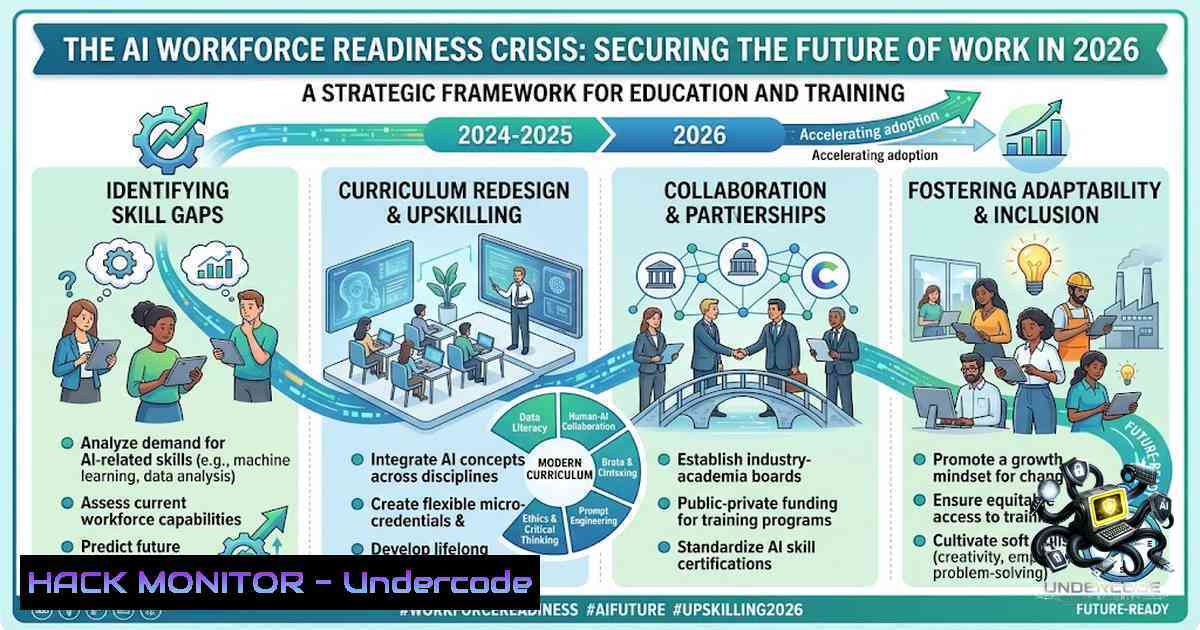
As organizations race to integrate artificial intelligence into every facet of their operations—from HR and talent management to cybersecurity operations—a critical gap is emerging between AI adoption and workforce preparedness. Gallagher’s newly released Talent Benchmarks Report, drawing on insights from more than 3,700 organizations, reveals that while 63% of businesses have now operationalized AI (up from 45% in 2025), over half report skills gaps and recruitment challenges as major barriers to implementation. The cybersecurity implications are profound: AI is reshaping the threat landscape faster than governance can keep up, and organizations are discovering that AI security is fundamentally a workforce problem, not merely a technology problem.
Learning Objectives & Secrets:
- Objective 1: Assess Your Organization’s AI Workforce Readiness — Evaluate current AI skills maturity across security, HR, and IT teams using frameworks like the AI security skills maturity model (Ad hoc → Foundational → Operational → Advanced → Adaptive). Map existing capabilities against emerging requirements including interpreting AI-driven threat signals, understanding model vulnerabilities, and evaluating third-party AI solutions.
-
Objective 2 Secret Tip: Implement Role-Based AI Access Control — Follow Bayer’s model: tie AI competence to controlled access through small, role-based training modules that serve as prerequisites for accessing internal AI platforms. This creates a tiered access model that gates who can develop and run agentic workflows while enabling security teams to track data usage.
-
Objective 3 Secret Tip: Move from Human-in-the-Loop to Human-on-the-Loop — As agent-assisted processes scale, SOC analysts must evolve from manual triage to supervised automation. Organizations should begin developing operational playbooks and training programs that prepare teams to use and manage AI agents, not just AI copilots.
You Should Know:
- The Shadow AI Threat: What Your HR Team Isn’t Telling You
The most immediate cybersecurity risk in most organizations isn’t external—it’s the AI tools your employees are already using without approval. Over 80% of HR professionals are using personal AI tools daily, primarily through free platforms their organization has never approved or reviewed. OpenAI ChatGPT leads at 43% adoption among HR professionals, while approved, secured HR systems AI tools are used by just 3%.
The deeper risk extends beyond data exposure. Patterns of questions alone can reveal hiring plans, compensation thinking, and workforce strategy without a single confidential file being shared. Organizations that restrict personal AI use without offering genuine alternatives simply push the behavior out of sight while losing productivity gains.
Step‑by‑Step Guide to Shadow AI Discovery and Control:
Step 1: Gain Visibility. Start by auditing which AI tools are being used across your organization. Run network traffic analysis to identify AI platform domains:
 Linux: Monitor DNS queries for common AI platforms
sudo tcpdump -i any -1 port 53 | grep -E "chatgpt|openai|gemini|copilot|claude|perplexity"

Windows: Check recent application usage via PowerShell
Get-WinEvent -LogName "Microsoft-Windows-Shell-Core/Operational" |
Where-Object { $_.Message -match "chatgpt|openai|gemini" } |
Select-Object TimeCreated, Message -First 50
Step 2: Establish an Approved AI Tool Registry. Create a formal inventory of sanctioned AI tools with clear use cases and data handling requirements. Define what constitutes sensitive data and prohibit its entry into unapproved tools.
Step 3: Deploy DLP Controls. Implement data loss prevention policies that block sensitive data from reaching unapproved AI endpoints. Configure content inspection rules:
 Example Python script for detecting PII before API calls
import re
PII_PATTERNS = {
'email': r'\b[A-Za-z0-9._%+-]+@[A-Za-z0-9.-]+.[A-Z|a-z]{2,}\b',
'phone': r'\b\d{3}[-.]?\d{3}[-.]?\d{4}\b',
'ssn': r'\b\d{3}-\d{2}-\d{4}\b'
}
def scan_for_pii(text):
findings = {}
for name, pattern in PII_PATTERNS.items():
matches = re.findall(pattern, text)
if matches:
findings[bash] = matches
return findings
Step 4: Treat BYOAI as a Shared Leadership Challenge. The organizations handling BYOAI best treat it as a shared leadership challenge between HR and IT, starting with visibility before reaching for policy.
- Building an AI-Ready Cybersecurity Team: The 2026 Blueprint
AI skills have moved to the top of the training priority checklist, with 47% of security leaders identifying AI skills as the most important training need—ahead of cloud computing security, security analysis, and risk assessment. Yet 52% of organizations report that training for human-AI collaboration is limited or insufficient.
INE’s 2026 Training Roadmap for Building AI-Augmented Security Teams provides structured guidance across three career stages:
- Junior Analysts (0–2 years): Building foundational skills in SOC environments, learning to operate effectively alongside AI-driven tools
- Mid-Level Analysts (3–5 years): Developing specialization, improving investigation quality, and optimizing AI-assisted workflows
- Senior Analysts and Team Leads (5+ years): Driving strategy, evaluating tools, and aligning security initiatives with business objectives
Step‑by‑Step Guide to AI Security Skills Development:
Step 1: Assess Current Capabilities. Map your team’s skills against the AI security skills maturity model. Identify gaps in: interpreting AI-driven threat signals, understanding model vulnerabilities, applying enterprise risk management to AI systems, and evaluating third-party AI solutions.
Step 2: Define Certification Pathways. Establish clear certification pathways tied to job roles and career progression. Key certifications to consider include AI security, cloud security, and security operations credentials.
Step 3: Implement Cross-Level Training Programs. Create training programs that align junior, mid-level, and senior development with shared learning objectives and measurable outcomes.
Step 4: Measure Training Effectiveness. Track metrics including detection speed, response time, and false positive reduction. Link training investments to business outcomes including incident reduction and cost avoidance.
- The Governance Gap: Regulatory Compliance and AI Risk Management
Less than half of businesses have adopted formal risk management frameworks for AI. Meanwhile, regulatory pressure is mounting. The EU AI Act classifies AI systems used for recruitment, selection, and employment decisions as “high-risk,” triggering strict obligations including mandatory human oversight and transparency requirements.
Organizations must align with multiple frameworks:
- NIST AI RMF 1.0: Four functions (Govern, Map, Measure, Manage) for responsible AI governance
- OWASP LLM Top 10 2026: Critical risks include Prompt Injection (LLM01), Sensitive Information Disclosure (LLM02), Excessive Agency (LLM03), and Supply Chain (LLM04)
- MITRE ATLAS: 170 techniques, 16 tactics, and 57 case studies covering threats to AI systems including prompt injection, jailbreaks, RAG poisoning, and agent/MCP abuse
Step‑by‑Step Guide to AI Governance Implementation:
Step 1: Establish an AI Governance Council. Define every strategic move for using and deploying AI, including standards that third-party suppliers must meet. Update procurement contracts with AI-specific security annexes requiring suppliers to disclose how they use your data, which AI tools they employ, and to report incidents.
Step 2: Implement the NIST AI RMF Four Functions:
 NIST AI RMF Implementation Checklist
GOVERN:
- Establish AI governance policies and accountability structures
- Define roles and responsibilities for AI oversight

MAP:
- Identify AI system contexts, risks, and impacts
- Document data sources, model architectures, and system boundaries

MEASURE:
- Conduct quantitative and qualitative risk assessments
- Monitor AI system performance and behavior over time

MANAGE:
- Implement risk treatment strategies
- Develop incident response procedures for AI-specific events
Step 3: Address the OWASP LLM Top 10 Risks. Prioritize prompt injection defense through input filtering, output validation, and execution policy layers. No single probabilistic defense is considered sufficient.
Step 4: Apply Zero Trust Principles to AI Systems. Implement strict Role-Based Access Control (RBAC) for every digital identity, enforcing the principle of least privilege so no agent has more power than strictly necessary. Security must follow the agent lifecycle—addressed through continuous monitoring, not a single control or checkpoint.
- Practical Commands and Tools for AI Security Operations
Security teams must develop hands-on capabilities across Linux and Windows environments:
Linux Commands for AI Security Monitoring:
 Monitor AI model API traffic
sudo tcpdump -i any -1 -v port 443 | grep -E "api.openai|api.anthropic|api.google"

Scan for exposed AI model endpoints
nmap -p 8000-9000 --open <target-ip-range>

Check for AI-related processes
ps aux | grep -E "python.transformers|tensorflow|pytorch|llama|ollama"

Audit containerized AI workloads
docker ps -a | grep -E "ai|model|llm|inference"
docker inspect <container-id> | grep -E "Env|Mounts|NetworkSettings"
Windows Commands for AI Security Monitoring:
 Check for AI tool installations
Get-WmiObject -Class Win32_Product | Where-Object { $_.Name -match "AI|Python|Anaconda|TensorFlow" }

Review AI-related event logs
Get-WinEvent -LogName "Security","Application","System" |
Where-Object { $_.Message -match "AI|machine learning|model|inference" } |
Select-Object TimeCreated, Id, LevelDisplayName, Message -First 100

Monitor network connections to AI platforms
netstat -an | findstr "443" | findstr "openai anthropic googleapis"
Tool Configurations for AI Security:
 Example AI Gateway Configuration (NGINX-based)
location /api/ai/ {
 Input validation layer
if ($request_body ~ "(ignore|override|system prompt|jailbreak)") {
return 403;
}

Rate limiting
limit_req zone=ai_api burst=10 nodelay;

Log all requests for audit
access_log /var/log/nginx/ai_api.log ai_log_format;

Proxy to validated AI endpoint
proxy_pass http://ai-gateway-internal:8080;
}
- The Human Element: Security Awareness in the Age of AI
Traditional security awareness training is obsolete. Bayer’s CISO Kevin Jones explains that conventional advice—looking for spelling mistakes, suspicious URLs, or odd attachments—no longer works when attackers “have learnt to spell, in five different languages, all in real time, and it’s all generated with AI at scale”.
Step‑by‑Step Guide to AI-Era Security Awareness:
Step 1: Reframe Security Training Around Psychology. Teach employees to recognize psychological manipulation rather than technical indicators. Ask: Is someone applying undue pressure? Are they posing as an authority? Train staff to “stop and pause and think” before breaking process.
Step 2: Implement In-Context Nudges and Reminders. Use subtle prompts inside everyday applications to reinforce what good AI behavior looks like: what can and can’t be shared, when to escalate.
Step 3: Deploy Approved AI Assistants. Rather than fighting shadow AI, embed approved AI assistants into workplace tools. Make the secure path the easiest one by prompting employees exactly when it matters most.
Step 4: Use AI to Protect Against AI. Implement AI-powered human and AI risk orchestration embedded across the organization.
What Undercode Say:
- Key Takeaway 1: The AI skills gap is the single greatest cybersecurity vulnerability facing organizations in 2026. Organizations are deploying AI tools faster than their teams can safely manage them, creating a new category of vulnerability that cannot be solved with technology alone.
-
Key Takeaway 2: Shadow AI is already pervasive and represents an immediate, measurable risk. With over 80% of HR professionals using unapproved AI tools and only 15% of UK teams having formal AI policies, organizations must treat BYOAI as an urgent governance priority.
Analysis: The convergence of workforce readiness and AI security represents a fundamental shift in how organizations must approach cybersecurity. AI does not arrive as a clean layer on top of existing systems—it exposes gaps across systems, processes, and people. Organizations cannot scale AI securely without addressing workforce readiness. The data is clear: 73% say AI oversight and governance is the most important future capability, outranking technical expertise at 68%. Yet 57% of organizations report a capacity gap in AI security and risk management. The organizations that bridge this gap first will gain a significant competitive advantage, while those that delay will face escalating regulatory, operational, and security risks.
Prediction:
- +1 Organizations that implement role-based AI access controls and mandatory AI security training as prerequisites for AI tool access will achieve 40-60% faster AI adoption with significantly lower security incidents, following Bayer’s proven model of tying competence to controlled access.
-
-1 The gap between AI adoption and workforce readiness will widen through 2027, with 80% of IT security professionals believing AI will significantly reduce the number of people required to perform their current roles—46% expect this shift within two years. Organizations unprepared for this transition will face severe talent retention challenges.
-
+1 Regulatory frameworks including the EU AI Act and NIST AI RMF will drive standardization in AI governance, creating clear compliance pathways for organizations that invest early in formal AI governance programs and baseline AI security training.
-
-1 Prompt injection and agentic AI hijacking will emerge as dominant attack vectors. With 24% of cybersecurity practitioners prioritizing Machine Learning Model Exploitation and 12% focused on Agentic AI Hijacking, organizations without layered mitigations at input filtering, output validation, and execution policy layers will face significant breaches.
-
+1 The shift from “human in the loop” to “human on the loop” in SOC environments will enable security teams to scale threat detection and response while maintaining meaningful human oversight. Organizations that invest in this transition now will achieve operational resilience advantages by 2028.
▶️ Related Video (84% Match):
https://www.youtube.com/watch?v=1UufaK3pQMg
🎯Let’s Practice For Free:
🎓 Live Courses & Certifications:
Join Undercode Academy for Verified Certifications
🚀 Request a Custom Project:
Secure, high-velocity infrastructure and disruptive technological engineering. Contact our engineering team for high-tier development and proprietary systems:
[email protected]
💎 Smart Architecture | 🛡️ Secure by Design | ⭐ Trusted by Thousands
IT/Security Reporter URL:
Reported By: https://lnkd.in/p/eueyybTs – Hackers Feeds
Extra Hub: Undercode MoN
Basic Verification: Pass ✅


