
Listen to this Post
Introduction:
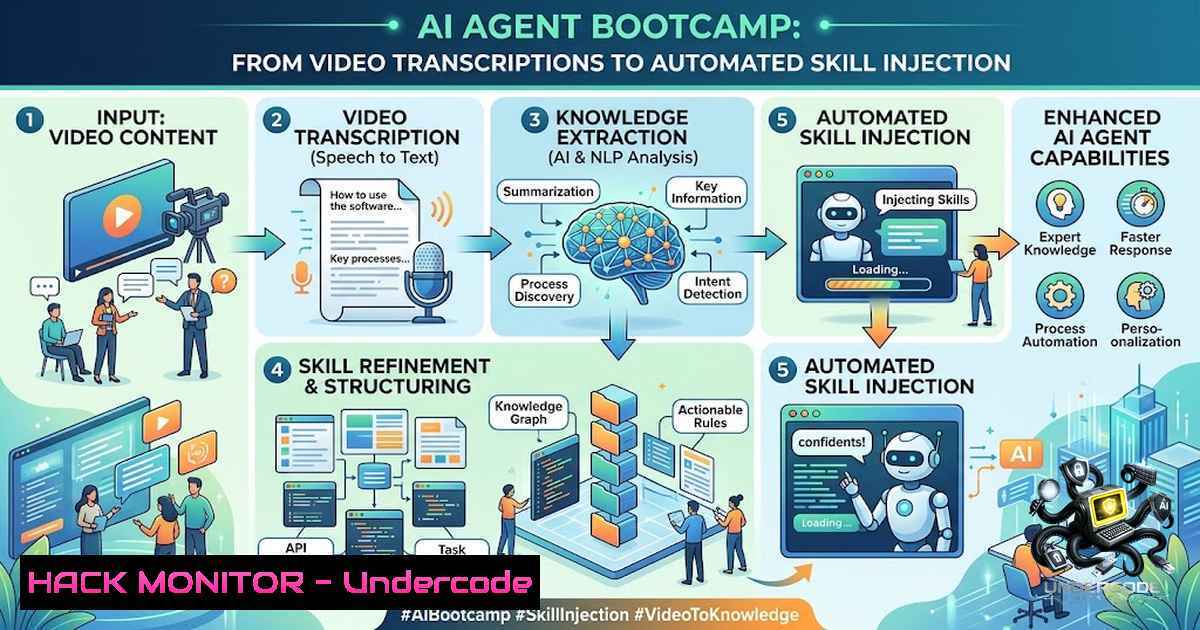
The advent of Large Language Models (LLMs) and autonomous AI agents has shifted the paradigm of knowledge work. While foundational models contain vast general knowledge, they lack specific, proprietary, or newly developed skills. This gap is bridged by techniques like Retrieval-Augmented Generation (RAG) and fine-tuning, but a novel, efficient, and somewhat controversial method has emerged: “Skill Injection via Mass Transcription.” This involves feeding an AI agent transcripts of structured training courses to instantly upload domain-specific knowledge into its long-term memory. This article explores the technical pipeline behind this “life hack,” detailing the automation, data processing, and security implications of turning video lectures into actionable agent skills.
Learning Objectives & Secrets:
- Objective 1: Automated Media Extraction. Learn how to automate the extraction of audio from video files and generate high-fidelity transcripts using open-source AI models like Whisper or commercial APIs.
- Objective 2: Contextual Chunking for RAG. Secret tip: Do not dump raw text into the agent. Implement semantic chunking to break transcripts into logical sections, preserving context, and embed these chunks for efficient vector search.
- Objective 3: Dynamic Skill Optimization. Secret tip: Implement a feedback loop where the agent evaluates its performance on new skills and re-indexes transcriptions based on query success rates, effectively “learning” which parts of the course are most valuable for specific problems.
You Should Know:
1. The Media Pipeline: Extracting the “Skill”
The first step in this process is converting visual/audio content into machine-readable text. This is a multi-stage process involving downloading, decoding, and transcribing. For privacy and efficiency, local open-source models are recommended over cloud APIs, as they prevent data leakage.
- Step-by-step guide (Linux/macOS):
1. Install dependencies:
sudo apt update && sudo apt install ffmpeg python3-pip -y
pip install openai-whisper torch yt-dlp
2. Download the course video (if not local):
yt-dlp -f bestaudio --extract-audio --audio-format mp3 --audio-quality 0 [bash] -o "lesson_%(title)s.%(ext)s"
3. Transcribe the audio:
whisper lesson.mp3 --model large --language English --task translate --output_format txt --output_dir ./transcripts/
What this does: `yt-dlp` extracts the highest quality audio stream and converts it to an MP3. `whisper` processes the file using the `large` model for high accuracy, translating if necessary, and outputs a `.txt` file.
2. Text Processing & Semantic Chunking
Raw transcriptions are messy. They contain filler words, timing information, and repetitive pauses. Dumping this directly into an LLM context window is inefficient and reduces accuracy. You must sanitize the data.
- Step-by-step guide (Python):
- Clean the text: Remove
</code>, <code>[bash]</code>, and duplicate timestamps using regex.</li>
<li>Chunk the text: Use a sliding window approach to segment the transcript into chunks of ~512 tokens.</li>
<li>Generate Embeddings: Create vector representations of these chunks using an embedding model like `text-embedding-ada-002` or <code>BAAI/bge-large-en</code>.</li>
<li>Populate Vector DB: Load the embeddings and metadata into a vector database like ChromaDB or Pinecone.
[bash]
import chromadb
from sentence_transformers import SentenceTransformer
model = SentenceTransformer('all-MiniLM-L6-v2')
client = chromadb.Client()
collection = client.create_collection(name="skills")
chunks = ["chunk1", "chunk2"]  pre-processed
embeddings = model.encode(chunks)
collection.add(ids=["id1", "id2"], documents=chunks, embeddings=embeddings)
3. SKILLS.md Generation & Agent Configuration
The output of the pipeline should be a structured file (SKILLS.md) that the AI agent can parse. This file acts as a compressed knowledge base. Instead of full verbatim text, it should contain structured rules, code snippets, and key definitions extracted from the transcript.
- Step-by-step guide:
- Generate Summaries: For each chunk, use a local LLM (e.g., Mistral-7B) to generate a 1-sentence summary and a 5-bullet key takeaway list.
2. Format the file:
 Skill: Advanced Network Security
Objective: [Derived from course intro]
Commands:
- `nmap -sV -p- target.com`
- `tcpdump -i eth0 -w capture.pcap`
Concepts:
- Zero Trust Architecture
- SIEM Integration
3. Injection: Place this file in the agent's designated memory directory. The agent's system prompt is then updated to reference this file as a primary source of truth.
4. Windows Implementation & Tool Configurations
For Windows environments, the process adapts using PowerShell and Windows Subsystem for Linux (WSL) for compatibility, or native Windows binaries.
- Step-by-step guide:
1. Install WSL: `wsl --install -d Ubuntu`
- Windows Native (PowerShell): Use `yt-dlp.exe` and `ffmpeg.exe` downloaded from their official repositories.
- Configuration: Set up environment variables to point to the vector database.
$env:AGENT_KNOWLEDGE_BASE = "C:\AgentData\skills"
.\whisper.exe --model base --language English --output_format json audio.mp3
5. API Security & Cloud Hardening
When using APIs for transcription or LLM processing, ensure the keys and data are secure. Avoid sending sensitive course material (e.g., proprietary code or internal company training) to public cloud APIs.
- Step-by-step guide:
- Local is Best: Prioritize local models like Whisper and Llama.cpp to ensure zero data egress.
- Encryption: If using AWS Transcribe or Azure AI, ensure S3 buckets or Blob storage are encrypted (SSE-S3/KMS) and have strict IAM policies (least privilege principle).
- Audit Logs: Enable CloudTrail or Azure Monitor to log all API calls.
- Key Rotation: Rotate API keys weekly to mitigate token exposure risks.
6. Vulnerability Exploitation & Mitigation
Injecting external data into an agent introduces a vector for prompt injection and data poisoning. An attacker could create a malicious course that injects instructions to exfiltrate data.
- Step-by-step guide:
- Sanitization: Before adding to SKILLS.md, run the text through a regex filter to remove suspicious patterns like `import os` or
eval(), especially if the agent executes code. - Nested Prompt Defense: Use a "System Choke" prompt. Before the agent uses the new skill, it must ask: "Is this request safe?" and check against a policy blocklist.
- Update Cycle: Implement a "Review Queue." Do not auto-update SKILLS.md. Have a human review the generated summary to ensure no malicious code is embedded.
What Undercode Say:
- Key Takeaway 1: The "double-speed transcription" method is a high-efficiency, low-cost alternative to traditional fine-tuning for upskilling agents on specific, niche knowledge bases.
- Key Takeaway 2: The true art lies not in transcription speed, but in data sanitization and efficient chunking to avoid context window overflow and ensure the agent retrieves the exact information needed to solve a query.
- The underlying workflow (Media Extraction -> NLP Processing -> Vector Storage -> Retrieval) is a textbook implementation of a private RAG system. It bypasses the latency and cost of retraining models, democratizing access to specialized intelligence.
- However, the sarcastic premise ("/s") highlights a critical security oversight: ingesting unvetted data is the easiest way to jailbreak an AI agent, turning it from a passive knowledge base into a potential attack vector.
- This demonstrates that the "skill" isn't just the transcript; it is the architecture that allows the agent to navigate the information contextually.
Prediction:
- -1: The trend of "scraping" and transcribing paywalled educational content for commercial AI use will face severe copyright and legal repercussions, stifling open-source development.
- +1: Open-source multimodal models will surpass commercial APIs in transcription accuracy, enabling fully localized, offline "Skill Injection" pipelines for enterprise deployments.
- +1: We will see the rise of "Skill Marketplaces" where compressed, sanitized agent knowledge (vector embeddings) is traded securely, bypassing the need for raw video processing.
- -1: Automated skill injection without robust privilege escalation controls will lead to a surge in "Trojan Skills," where malicious actors poison public datasets to create backdoors in AI agents used in critical infrastructure.
- The shift from training to "in-context learning" via structured memory will force cybersecurity teams to focus on "data hygiene" and "prompt perimeter" defenses, rather than just network security, as the attack surface moves to the system prompt.
▶️ Related Video (88% Match):
🎯Let’s Practice For Free:
🎓 Live Courses & Certifications:
Join Undercode Academy for Verified Certifications
🚀 Request a Custom Project:
Secure, high-velocity infrastructure and disruptive technological engineering. Contact our engineering team for high-tier development and proprietary systems:
[email protected]
💎 Smart Architecture | 🛡️ Secure by Design | ⭐ Trusted by Thousands
IT/Security Reporter URL:
Reported By: https://lnkd.in/p/eGnYq2CP - Hackers Feeds
Extra Hub: Undercode MoN
Basic Verification: Pass ✅


