
Listen to this Post
Introduction:
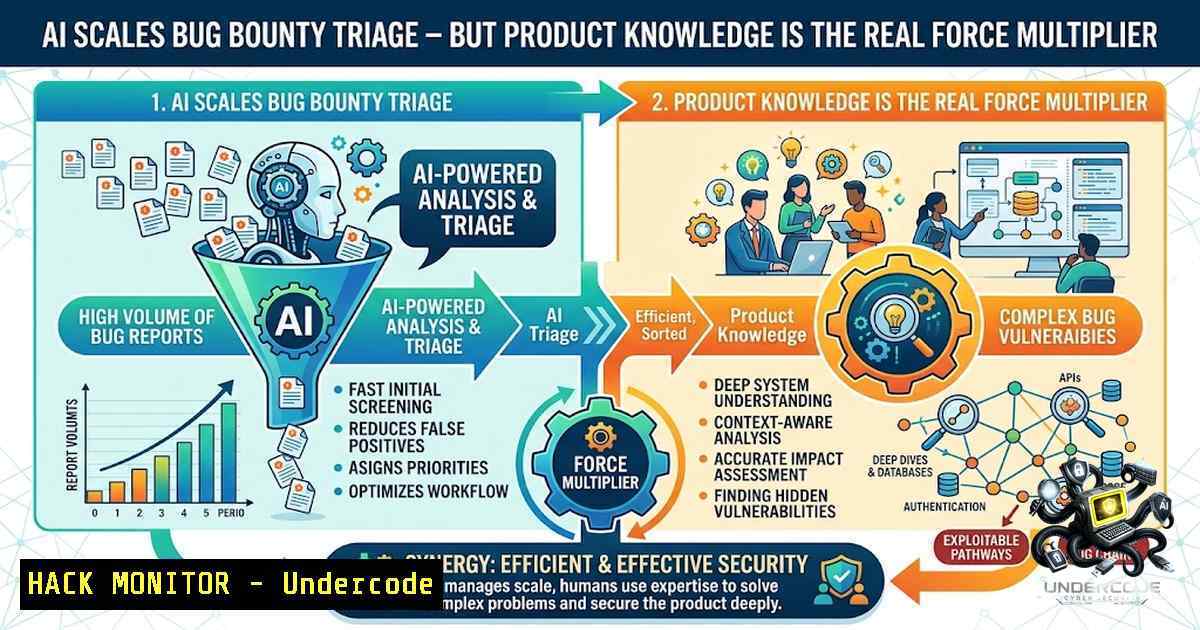
A generic large language model can summarize a bug bounty report, but it cannot reliably triage one until you teach it the product: its architecture, documentation, known false positives, duplicate rules, severity expectations, and evidence gates. As AI-powered reconnaissance and payload generation accelerate the volume of submissions—HackerOne reported 46,947 submissions in March 2026, up 76% year-over-year, while Intigriti saw 328% growth from 2022 to 2025—the pressure on triage teams has never been higher. The solution isn’t a better model; it’s teaching AI your team’s product judgment so it can handle the evidence-heavy lifting while humans retain final verdict authority.
Learning Objectives & Secrets:
- Objective 1: Build a Product-Aware Triage Skill – Learn how to structure AI skills around your team’s existing workflows, incorporating product architecture, documentation, false positive libraries, duplicate detection rules, and evidence gates into the model’s reasoning.
-
Objective 2 Secret Tip: The “No Evidence, No Verdict” Gate – Implement a hard stop when evidence is missing. The AI should propose verdicts only when supporting proof exists, and flag gaps explicitly for human review. This prevents hallucinations from becoming security decisions.
-
Objective 3 Secret Tip: Structured Verdicts, Not AI Prose – Design the skill to output clear, structured verdicts—confirmed, duplicate, false positive, customer configuration, fixed, partially fixed, or not fixed—with every conclusion pointing to its supporting evidence. This eliminates the “wall of AI-generated prose” and makes human review efficient.
You Should Know:
1. Why Better Models Can’t Replace Product Judgment
A stronger or more expensive LLM might reason better in general, but it still does not know your product boundaries, recurring bug patterns, known false positives, supported configurations, duplicate rules, severity expectations, fix-validation processes, customer configuration misconceptions, or the weird edge cases your team learned the hard way. Product judgment has to be taught. Think of it as the playbook you would hand to a new teammate—it shows the AI how your team does the work, what evidence it needs, and when it should stop and ask for help.
In practice, this means curating a knowledge base that includes:
- Product architecture diagrams and component boundaries
- Historical bug patterns and their root causes
- Known false positives and why they were rejected
- Severity calibration guidelines (CVSS overrides, business impact context)
- Fix-validation checklists – what constitutes a verified fix vs. a partial fix
Step‑by‑Step Guide: Building a Product-Aware Triage Skill
- Audit your existing triage workflow – Map every step from report intake to final verdict. Document decision points, evidence requirements, and handoff criteria.
- Curate your “product knowledge” corpus – Gather architecture docs, past triage decisions (with rationale), false positive examples, and severity guidelines. Structure this as retrievable context for the LLM.
- Define verdict taxonomy – Standardize on the seven verdict types: confirmed, duplicate, false positive, customer configuration, fixed, partially fixed, or not fixed.
- Build evidence gates – For each verdict type, define what evidence is required. Example: “confirmed” requires reproduction steps, affected product, root cause, sensitive operation reached, and attack prerequisites.
- Implement the “no evidence, no verdict” rule – Code a hard gate that prevents verdict proposal if required evidence fields are empty.
- Add human-in-the-loop review – The skill posts a proposed verdict to the ticket with all evidence attached. A human reviews, approves, or revises.
- Iterate and calibrate – Validate against a corpus of past reports with known outcomes. Elastic, for example, validated their AI triage agent against 764 known-outcome reports, achieving 85% alignment with human decisions.
-
Automating Triage with AI Agents – Tools and Architecture
Several production-ready frameworks now exist for AI-assisted triage:
- Splunk’s Triage Agent (Alpha) evaluates, prioritizes, and explains alerts, reducing workload and highlighting critical issues.
- Elastic’s AI triage agent processes HackerOne reports for approximately $2 each, matching human decisions 85% of the time, validated against over 3,300 reports.
- PatchTriage ingests raw scanner output, deduplicates findings, enriches them with EPSS, CISA KEV, and NVD data, then applies analyst-grade reasoning.
- AgenticVM integrates LLMs with security tools to automate vulnerability aggregation, enrichment, and triage.
- CrowdStrike’s Charlotte AI Detection Triage triages detections with over 98% accuracy, eliminating over 40 hours of manual work per week on average.
Architecture Pattern for AI Triage Automation:
[Report Intake] → [Pre-processing/Validation] → [Context Retrieval (product knowledge)]
→ [LLM Reasoning with Evidence Gates] → [Structured Verdict Proposal] → [Human Review] → [Final Verdict]
3. API Security Automation in Bug Bounty Programs
APIs are a primary target in modern bug bounty programs, with OWASP API Security Top 10 risks like BOLA/IDOR, broken authentication, and excessive data exposure dominating submissions. AI-assisted tools are now automating API discovery and fuzzing:
- API Hunter is an AI-powered tool specifically designed for discovering and exploiting API vulnerabilities, including business logic flaws and complex vulnerability chains.
- Bugcrowd’s Savant Pathseeker provides autonomous API fuzzing, application testing, and attack-path reasoning.
- api-fuzzing-bug-bounty skills enable automated endpoint discovery and parameter fuzzing.
Linux Command Example – API Endpoint Discovery with ffuf:
 Fuzz API endpoints with common paths
ffuf -u https://target.com/api/FUZZ -w /usr/share/wordlists/api-endpoints.txt -fc 404

Fuzz parameters for IDOR/BOLA
ffuf -u https://target.com/api/users/FUZZ -w /usr/share/wordlists/user-ids.txt -fc 404,403

Rate-limited fuzzing with delay
ffuf -u https://target.com/api/v1/FUZZ -w endpoints.txt -t 10 -p 0.5
Windows Command Example – API Testing with PowerShell:
 Test API authentication bypass
$headers = @{ "Authorization" = "Bearer invalid_token" }
Invoke-RestMethod -Uri "https://target.com/api/admin/users" -Headers $headers -Method Get

Check for excessive data exposure
$response = Invoke-RestMethod -Uri "https://target.com/api/users/1?include=all" -Method Get
$response | ConvertTo-Json -Depth 10
4. Cloud Hardening and AI-Generated Attack Patterns
AI-generated attack patterns are increasingly targeting cloud misconfigurations. Proactive cloud hardening is essential:
- Cain Agent is an AI penetration-testing engineer with built-in cloud modules covering AWS, Azure, GCP, Aliyun, Tencent, and Huawei clouds.
- NEX is an autonomous purple-team tool for Splunk that finds and closes detection blind spots, attacking your own Splunk data the way a bug-bounty hunter would.
- Aegis Foundry is a ten-agent autonomous detection-engineering platform for Splunk.
Step‑by‑Step Guide: Cloud Hardening Against AI-Generated Attacks
- Conduct an AI threat modeling exercise – Map how an AI-powered attacker would approach your cloud estate (reconnaissance → privilege escalation → data exfiltration).
- Implement strict input validation – Sanitize and validate all data received by AI models. Use strict regex filters.
- Enforce least-privilege IAM – Audit all roles and policies. Remove overly permissive grants.
- Enable comprehensive logging – Ensure CloudTrail, GuardDuty, and Security Hub are actively monitoring.
- Automate misconfiguration detection – Use tools like ScoutSuite or Prowler to continuously scan for cloud misconfigurations.
- Implement contextual guardrails – Add protective measures around AI model inputs and outputs to prevent prompt injection and data leakage.
5. Fix Validation and the “Partially Fixed” Verdict
One of the most critical—and often overlooked—aspects of triage is fix validation. The AI skill must verify not just that a fix was applied, but that it actually works. This includes:
- Evidence showing why the issue is fixed – Code diffs, configuration changes, or deployment records.
- Remaining gaps – Any bypasses or edge cases not addressed.
- Successful bypass testing – Attempts to circumvent the fix using the original or variant attack vectors.
Linux Command Example – Fix Validation with Diff and Regression Testing:
 Compare pre-fix and post-fix code
diff -u pre-fix/vulnerable.php post-fix/patched.php

Run regression test suite on the patched component
pytest tests/security/test_vulnerable_component.py -v

Attempt exploit against the patched version
curl -X POST https://target.com/vulnerable/endpoint -d "payload=malicious" -v
Step‑by‑Step Guide: Implementing Fix Validation in AI Triage
- Define fix criteria – What constitutes “fixed” for each vulnerability type?
- Collect fix evidence – Require code diffs, deployment logs, or configuration changes.
- Run automated regression tests – Execute test cases that previously triggered the vulnerability.
- Attempt bypasses – Use the AI skill to generate variants of the original exploit and test them.
- Document remaining gaps – If any bypass succeeds, the verdict becomes “partially fixed” with clear documentation.
6. The Human-in-the-Loop Imperative
Despite automation, human oversight remains non-1egotiable. As one security researcher noted, “An AI-assisted finding that’s been verified, reproduced, and submitted with a working proof of concept is a great submission. An unvalidated output submitted as-is without reproduction or demonstrated impact is not”. The AI skill should:
- Propose verdicts, not finalize them – Humans always sign the final verdict.
- Show its work – Every conclusion points to supporting evidence.
- Stop when uncertain – If evidence is missing or ambiguous, the skill flags the report for human priority review.
What Undercode Say:
- Key Takeaway 1: Product Knowledge > Model Size – A generic LLM cannot replace the product-specific judgment that comes from years of understanding your architecture, edge cases, and false positive patterns. The force multiplier is teaching AI your team’s institutional knowledge, not upgrading to a more expensive model.
-
Key Takeaway 2: Trust but Verify – Evidence Is Everything – The “no evidence, no verdict” rule is the single most important safeguard. AI hallucinations are a real threat in security research, and automated triage must be designed to fail safely when proof is missing. Human review of evidence-backed proposals ensures quality while achieving 20x speed improvements.
-
Analysis: The cybersecurity industry is at an inflection point. AI-generated bug reports are overwhelming traditional triage workflows, but AI-assisted triage offers a path forward—if implemented correctly. The organizations that succeed will be those that treat AI as a junior teammate that needs training, not as an oracle. They will curate product knowledge, enforce evidence gates, and maintain human oversight. Those that simply throw better models at the problem without teaching product judgment will drown in false positives and missed vulnerabilities. The clock still has only 24 hours in a day—AI doesn’t change that, but it can make every hour count.
Prediction:
-
+1 AI-assisted triage will become the industry standard within 18–24 months, with major bug bounty platforms embedding product-aware skills as default offerings. Organizations that adopt early will gain a significant competitive advantage in vulnerability response times.
-
+1 The “no evidence, no verdict” paradigm will emerge as a best practice across all security automation, not just bug bounty. SOCs, vulnerability management, and incident response will adopt similar evidence-gated AI workflows.
-
-1 Organizations that treat AI triage as a commodity “plug-and-play” solution—without investing in product knowledge curation—will see increased false positive rates and missed vulnerabilities, potentially leading to security incidents.
-
-1 The gap between AI-assisted hunters and defenders will widen. Attackers will continue to use AI to accelerate discovery, and defenders who fail to adopt AI-assisted triage will fall further behind.
-
+1 The role of the security engineer will evolve from manual triage to AI skill curation and verdict oversight—a more strategic, higher-value function that leverages human judgment where it matters most.
▶️ Related Video (80% Match):
https://www.youtube.com/watch?v=1_D3hExVVBM
🎯Let’s Practice For Free:
🎓 Live Courses & Certifications:
Join Undercode Academy for Verified Certifications
🚀 Request a Custom Project:
Secure, high-velocity infrastructure and disruptive technological engineering. Contact our engineering team for high-tier development and proprietary systems:
[email protected]
💎 Smart Architecture | 🛡️ Secure by Design | ⭐ Trusted by Thousands
IT/Security Reporter URL:
Reported By: https://lnkd.in/p/e85_Zpw7 – Hackers Feeds
Extra Hub: Undercode MoN
Basic Verification: Pass ✅


