Listen to this Post
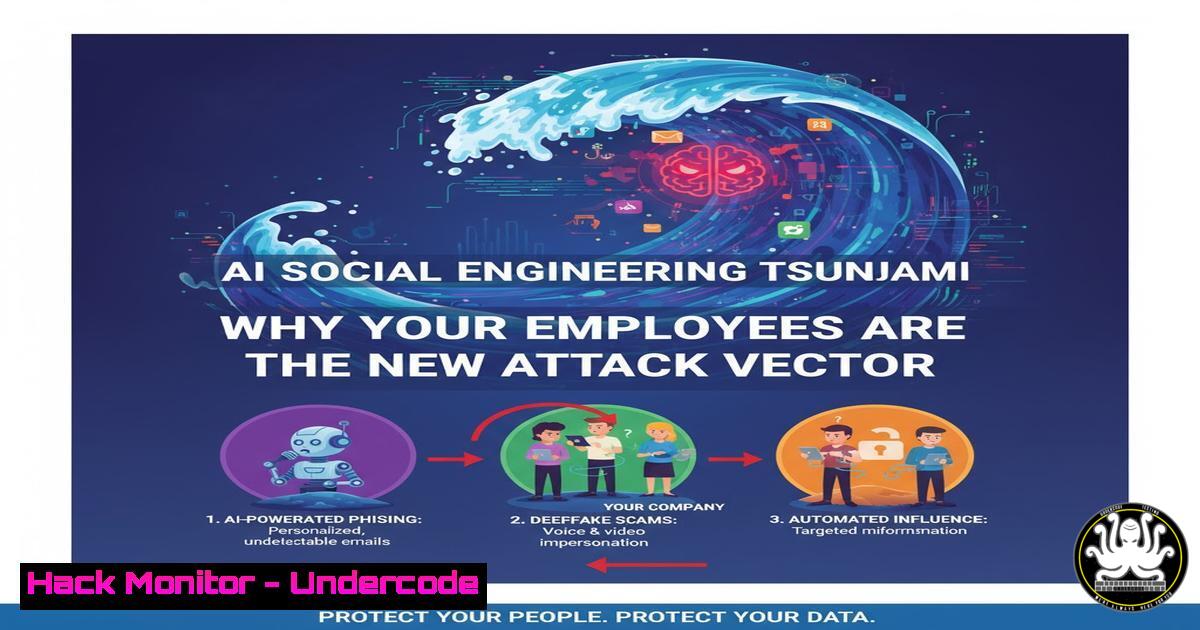
Introduction:
A recent ISACA survey has pinpointed AI-powered social engineering as the projected top cyber threat for 2026. This evolution moves beyond clumsy phishing emails into a realm of hyper-personalized, automated attacks that are increasingly difficult to distinguish from legitimate communication. Organizations must now fortify their human layer with the same rigor as their technical infrastructure.
Learning Objectives:
- Understand the technical mechanisms behind AI-driven social engineering attacks.
- Implement proactive detection and hardening strategies for email, collaboration platforms, and cloud identities.
- Develop a response playbook for suspected AI-generated credential harvesting and business email compromise (BEC).
You Should Know:
1. Detecting AI-Generated Phishing Emails with Header Analysis
While AI can craft convincing body text, email headers often reveal the true origin. Analyzing these headers is a first line of defense.
Verified Commands & Techniques:
`grep -E “(from|by|with) [a-zA-Z0-9.-]+” email_source.txt` – Extracts key “from,” “by,” and “with” SMTP servers from a raw email source.
`dig +short txt
`nslookup -type=mx
Step-by-step guide:
First, obtain the raw source of the suspicious email (e.g., “Show Original” in Gmail). Save this as a text file. Use the `grep` command to isolate the receiving and sending mail server paths. Cross-reference the originating IP addresses and domain names with the purported sender. Use `nslookup` to verify the legitimate MX records of the sender’s domain. Finally, use `dig` to check if the originating IP is listed in the sender domain’s SPF (Sender Policy Framework) TXT record, a common failure point in spoofed emails.
2. Hardening Microsoft 365 Against AI-BEC Attacks
AI can now mimic executive writing styles perfectly. Strengthening M365’s native security settings is critical.
Verified Commands & Configurations:
`Get-MsolUser -UserPrincipalName
`Get-AuthenticationPolicy` (Azure AD PowerShell Module) – Lists existing authentication policies.
`New-AuthenticationPolicy -Name “BlockLegacyAuth” -BlockLegacyAuthEnabled $true` – Creates a policy to block legacy authentication protocols, which are often exploited by attackers.
Step-by-step guide:
Connect to MSOnline and Azure AD using `Connect-MsolService` and Connect-AzureAD. Audit all user MFA statuses, focusing on high-privilege accounts. Enforce MFA universally, using conditional access policies to require compliant devices. Create and apply an authentication policy named “BlockLegacyAuth” to disable older, less secure protocols like Basic Authentication for Exchange ActiveSync, POP3, and IMAP4, which are frequently used in automated attacks.
3. Simulating AI Voice Phishing (Vishing) Defenses
AI-generated voice clones are used to bypass MFA via phone calls. Protecting against this requires technical controls.
Verified Commands & Configurations:
`Get-CsOnlineVoiceRoutingPolicy` (Microsoft Teams PowerShell Module) – Views current voice routing policies.
`New-CsOnlineVoiceRoutingPolicy -Identity “RestrictInternational” -OnlinePstnUsages “International”` – Creates a custom routing policy.
`(Get-MsolUser -UserPrincipalName
Step-by-step guide:
Within the M365 admin center, navigate to the Teams Voice settings. Create a new voice routing policy that restricts international dialing for users who do not require it. Assign this policy to relevant users. Furthermore, mandate that all users register for MFA using an authenticator app (like Microsoft Authenticator) instead of SMS or voice calls, as these are susceptible to SIM-swapping and AI vishing.
4. Monitoring for Credential Theft via Canary Tokens
AI-driven attacks often harvest credentials from fake internal sites. Canary tokens can alert you to this activity.
Verified Commands & Code Snippet:
`curl -I http://
`wget –spider http://
`(New-Object System.Net.WebClient).DownloadString(“http://
Step-by-step guide:
Visit canarytokens.org and generate a “Web Bug” token. Deploy this URL in a seemingly sensitive but fake document or intranet page accessible only internally, such as “IT Department Password Reset Portal.” When an attacker’s AI scrapes this link, it will call home to the Canary service, immediately alerting you to a credential theft campaign in progress, often before the credentials are even used.
5. Analyzing Network Traffic for AI-Crawler Activity
Malicious AIs scour public sources for employee data. Identifying and blocking this scraping activity reduces your attack surface.
Verified Linux Commands:
`tcpdump -i eth0 -w scrape_capture.pcap host
`awk ‘{print $1}’ /var/log/nginx/access.log | sort | uniq -c | sort -nr | head -20` – Shows the top 20 IPs accessing an Nginx web server.
`grep -i “python-requests\|curl\|wget” /var/log/apache2/access.log` – Searches for common web scraper user-agents in Apache logs.
Step-by-step guide:
Monitor your public-facing web server logs (Apache/NGINX) for unusual activity. Use the `awk` command to identify IPs making an excessive number of requests in a short time frame, indicative of scraping. Use `grep` to search for automated tool user-agents. Once a suspicious IP is identified, use `tcpdump` to capture its traffic for deeper analysis and then update your firewall rules (e.g., iptables -A INPUT -s <malicious-ip> -j DROP) or WAF to block it.
6. Securing APIs from AI-Driven Abuse
APIs are a prime target for AI to exploit at scale. Implementing strict rate limiting and monitoring is essential.
Verified Commands & Code Snippet:
`iptables -A INPUT -p tcp –dport 443 -m limit –limit 100/minute –limit-burst 200 -j ACCEPT` – Sets a basic rate limit on HTTPS traffic.
`awk ‘$9 ~ /4[0-9]{2}/ {print $1, $7, $9}’ /var/log/nginx/access.log | sort | uniq -c | sort -nr` – Finds clients causing 4xx (client) errors, potentially probing for API weaknesses.
`kubectl get pods -n
Step-by-step guide:
For API endpoints, move beyond network-level rate limiting. Implement application-level rate limiting based on API keys or user sessions. Use a tool like NGINX’s `limit_req_zone` to create a memory zone for tracking requests. Continuously monitor logs for patterns of 401 (Unauthorized) and 403 (Forbidden) errors, which can indicate automated credential stuffing or endpoint discovery attempts. In cloud environments, use native WAF services to create custom rules that block these anomalous patterns.
What Undercode Say:
- The human firewall is now the primary attack surface. Technical controls must be designed to compensate for the unprecedented plausibility of AI-generated deception.
- A paradigm shift from “trust but verify” to “zero trust and always verify” is no longer optional, especially for communication-based transactions.
The ISACA prediction is not an abstraction; it is a direct result of the commoditization of advanced AI by threat actors. Defensive strategies that worked against human-operated phishing campaigns will fail against AI systems that can generate thousands of unique, context-aware lures per hour, test them, and evolve in real-time. The core of the new defense must be the elimination of implicit trust in all digital interactions, enforced by robust technical policies like mandatory MFA without voice fallback, the blocking of legacy authentication, and sophisticated monitoring for automated reconnaissance and credential harvesting. The cost of inaction is a wave of breaches that are not the result of technical exploits, but of perfectly crafted deception.
Prediction:
By 2026, AI social engineering will lead to a 300% increase in successful Business Email Compromise (BEC) attacks, causing direct financial losses in the tens of billions. This will force a fundamental re-architecting of digital trust models, accelerating the adoption of passwordless FIDO2 authentication, decentralized identity standards, and AI-powered defensive systems designed specifically to detect AI-generated malicious content within enterprise communication channels. The cybersecurity arms race will fully enter the cognitive domain.
🎯Let’s Practice For Free:
IT/Security Reporter URL:
Reported By: Mikeferraridoppel Ai – Hackers Feeds
Extra Hub: Undercode MoN
Basic Verification: Pass ✅


