Listen to this Post
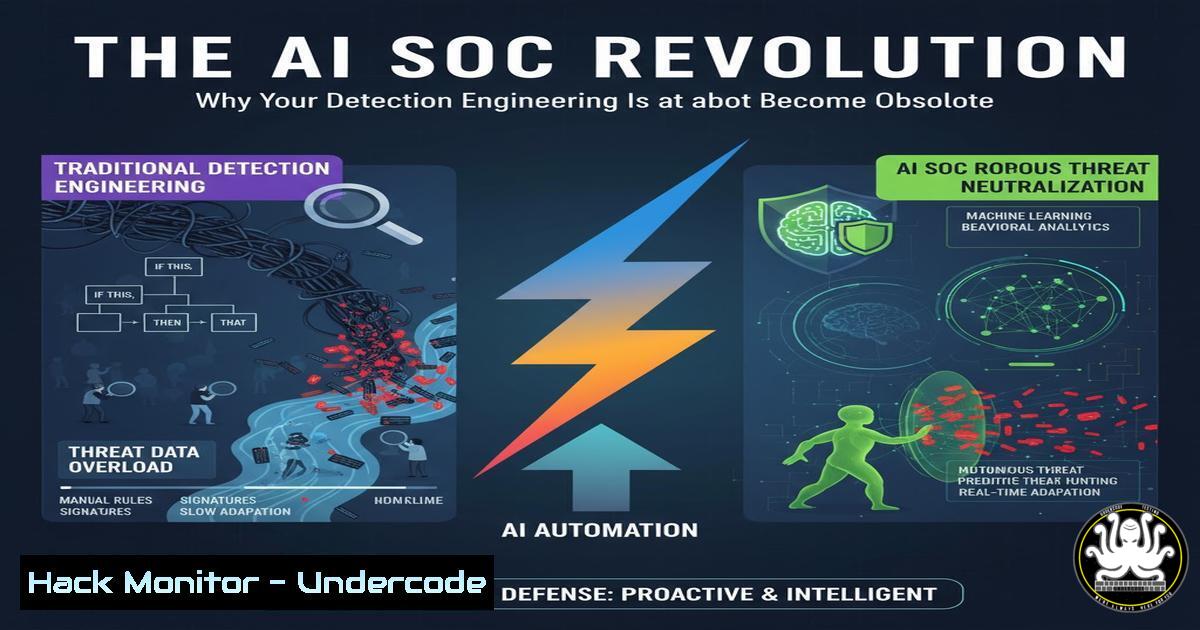
Introduction:
The Security Operations Center (SOC) is undergoing a seismic shift, moving beyond AI-powered alert triage to the very core of threat detection itself. Detection engineering, the manual process of creating and maintaining security alerts, is being fundamentally redefined by artificial intelligence. This evolution promises to solve chronic issues like alert fatigue and shallow threat coverage, potentially disrupting the traditional managed detection and response (MDR) market.
Learning Objectives:
- Understand how AI automates and enhances the detection engineering lifecycle, from creation to validation.
- Learn the practical commands and techniques for implementing AI-driven detection and validation.
- Evaluate the future impact of Autonomous SOCs on security team roles and outsourced services.
You Should Know:
1. AI-Generated Detection Rule Creation
Manually crafting detection rules for tools like Sigma is time-consuming. AI can generate high-quality, logically sound rules from natural language descriptions of attacker behaviors.
 Example AI-Generated Sigma Rule (Conceptual)
title: AI Generated - Suspicious PsExec Lateral Movement
logsource:
category: process_creation
product: windows
detection:
selection:
Image|endswith: '\PSEXESVC.exe'
ParentImage|endswith: '\PSEXEC.exe'
condition: selection
falsepositives:
- Legitimate administrative use of PsExec
level: high
tags:
- attack.lateral_movement
- attack.t1021.002
Step-by-step guide:
This Sigma rule detects the execution of PSEXESVC.exe, which is the service component of the PsExec lateral movement tool. The AI model is trained on MITRE ATT&CK techniques (T1021.002) and understands that the parent process being `PSEXEC.exe` is a key indicator. To use this, you would feed a prompt like “Detect PsExec being used for lateral movement” into an AI model fine-tuned on Sigma syntax and threat intelligence. The output must always be validated against a known-good baseline before deployment to a production SIEM.
2. Automated Detection Validation with Adversary Emulation
AI can continuously validate the efficacy of detection rules by automatically emulating adversary techniques, ensuring coverage remains effective as telemetry and threats evolve.
 Example Caldera AI Adversary Emulation Command
python3 caldera.py --operation "Detection Validation Run" --group "apt29" --adversary "Network Discovery" --obfuscate

Using Stratus Red Team for AWS-specific technique validation
./stratus detonate aws.credential-access.ec2-get-password-data
Step-by-step guide:
Adversary emulation tools like Caldera and Stratus Red Team allow an AI SOC to autonomously test its own defenses. The AI scheduler would initiate an operation mimicking a specific adversary group (e.g., APT29). As the emulation runs, the AI monitors which detection rules triggered, their fidelity, and the time to detection. This creates a continuous feedback loop, identifying gaps in coverage caused by changing log sources or new attacker tradecraft without manual red teaming.
3. Telemetry Quality Assurance via Automated Log Analysis
A primary cause of detection decay is changing or missing telemetry. AI can constantly monitor log sources to verify that the necessary fields for detection are present and populated.
// Kusto Query for Telemetry Health Check
SecurityEvent
| where TimeGenerated >= ago(24h)
| summarize TotalCount=count(),
DistinctEventIDs=dcount(EventID),
MissingAccountNames=countif(isempty(AccountName)),
MissingCommandLines=countif(isempty(CommandLine)) by Computer
| extend TelemetryHealthScore = case(
MissingCommandLines > TotalCount  0.1, "Poor",
MissingAccountNames > TotalCount  0.05, "Fair",
"Good")
Step-by-step guide:
This Kusto Query Language (KQL) statement, which could be scheduled and analyzed by an AI, assesses the health of Windows Security Event logs. It calculates a “TelemetryHealthScore” based on the prevalence of critical fields like `CommandLine` and AccountName. An AI system would run this daily, automatically creating tickets for endpoints with “Poor” scores and even proactively disabling detections that rely on missing fields to reduce false positives.
4. AI-Powered False Positive Reduction through Context Enrichment
A major SOC pain point is noisy, low-fidelity alerts. AI models can enrich alert data with contextual information to automatically suppress false positives.
 Pseudocode for AI Alert Context Enrichment
def evaluate_alert(alert):
 Enrich with process context
process_info = get_process_tree(alert.pid)

Enrich with network context
network_connections = get_net_conns(alert.pid)

Enrich with user context
user_risk_score = get_user_risk(alert.username)

AI Model makes final determination
features = [
process_info.is_signed,
process_info.prevalence,
network_connections.has_external_ips,
user_risk_score,
alert.technique_id
]

return ai_model.predict(features)

If confidence > 95%, auto-close as benign
Step-by-step guide:
This Python pseudocode illustrates how an AI model can be integrated into the alert pipeline. When a detection rule triggers, the alert is not immediately sent to an analyst. Instead, the AI gathers additional contextual features—Is the process signed? Is it common in the environment? Does the user have a high-risk score? The model then predicts the true positive probability, auto-closing alerts with high confidence of being false positives and dramatically reducing analyst workload.
5. Automated TTP Mapping and Detection Gap Analysis
AI can continuously map existing detection rules to the MITRE ATT&CK framework, identifying coverage gaps and recommending new detections for unmonitored techniques.
 Using the MITRE ATT&CK Navigator to visualize coverage (conceptual AI-driven output)
python3 attack_gap_analysis.py --input detection_rules.json --output coverage_matrix.json

Sample output analysis
echo "Coverage Gaps Identified:"
echo "- T1134: Access Token Manipulation (No detections)"
echo "- T1543: Create or Modify System Process (Partial coverage)"
echo "- T1110: Password Guessing (No detections)"
Step-by-step guide:
An AI system can parse an organization’s entire corpus of detection rules (SIEM queries, EDR rules, etc.) and map them to specific ATT&CK techniques. It uses natural language processing to understand what each rule is detecting. The output is a coverage matrix highlighting techniques with no detection (critical gaps), partial detection (needs improvement), and robust detection. The AI can then prioritize gap filling based on the threat landscape relevant to the organization’s industry.
6. Generative AI for SIEM Query Optimization
Slow or inefficient SIEM queries can impact performance. Generative AI can analyze and rewrite complex queries for optimal performance.
// Original Inefficient Query
SecurityEvent
| where TimeGenerated >= ago(7d)
| where EventID == 4688
| where CommandLine contains "powershell"
| where CommandLine contains "-Enc"
| where CommandLine contains "DownloadString"

// AI-Optimized Query
SecurityEvent
| where TimeGenerated >= ago(1d) // Reduced time window based on AI analysis of data retention
| where EventID == 4688
| where CommandLine has_all ("powershell", "-Enc", "DownloadString") // Combined filters
Step-by-step guide:
The AI analyzes the original query’s performance characteristics and data patterns. It recognizes that a 7-day window is excessive for this high-volume event and reduces it to 1 day. It also combines multiple `contains` operators into a single `has_all` for better performance. These optimizations, performed automatically, reduce SIEM load and accelerate query execution, which is critical during incident investigation.
7. Behavioral Baselining with Machine Learning
Instead of static threshold-based alerts, AI can learn normal behavior for users and endpoints, detecting subtle anomalies that indicate compromise.
-- Example query for establishing a behavioral baseline
SELECT
user_identity_name,
AVG(duration_seconds) as avg_logon_time,
STDDEV(duration_seconds) as stddev_logon_time,
COUNT(DISTINCT client_ip) as typical_ip_count
FROM signin_logs
WHERE time_generated >= ago(30d)
AND result_type = 0
GROUP BY user_identity_name

-- AI would flag logons where duration is > 3 standard deviations from the mean
Step-by-step guide:
The AI system first establishes a 30-day baseline for each user, calculating metrics like average logon duration and typical IP addresses. It then monitors new logons in real-time, applying statistical methods to identify anomalies. A logon that takes significantly longer than the user’s baseline could indicate network issues or credential theft. This behavioral approach detects threats that would evade signature-based detections.
What Undercode Say:
- The MDR Reformation is Imminent: Traditional MDR services that rely on manual detection engineering and static rule sets will struggle to compete with AI-driven SOCs that offer continuous optimization, lower false positives, and adaptive coverage.
- The Human Role Evolves: Security analysts will transition from routine alert triage and rule tuning to overseeing AI systems, interpreting complex AI-driven findings, and handling exceptional cases that require human intuition and context.
The paradigm shift towards AI-driven detection engineering addresses the fundamental scalability problem that has plagued SOCs for years. While current MDR providers offer relief from 24/7 monitoring, they often inherit the same underlying inefficiencies—static rules, alert fatigue, and detection decay. The AI SOC doesn’t just automate analysts; it automates the entire detection lifecycle. This creates a self-improving system where detection quality increases over time without proportional increases in human effort. The most immediate impact will be felt in co-managed SIEM arrangements, where clients pay premium rates for what often amounts to alert regurgitation without substantive engineering. AI brings the engineering expertise in-house, continuously and at scale.
Prediction:
Within three years, AI-driven detection engineering will become the standard for mature security programs, rendering manual rule maintenance economically non-viable. This will force a consolidation in the MDR market, with providers either adopting true AI SOC capabilities or competing solely on price for low-maturity clients. The definition of “managed detection” will shift from human analysts reviewing alerts to AI systems guaranteeing detection coverage against the latest adversary techniques, with human experts reserved for incident response and strategic oversight. Organizations that delay adoption will face a growing “detection debt,” leaving them vulnerable to novel attacks that their static rules cannot see.
🎯Let’s Practice For Free:
IT/Security Reporter URL:
Reported By: Itai Tevet – Hackers Feeds
Extra Hub: Undercode MoN
Basic Verification: Pass ✅


