Listen to this Post
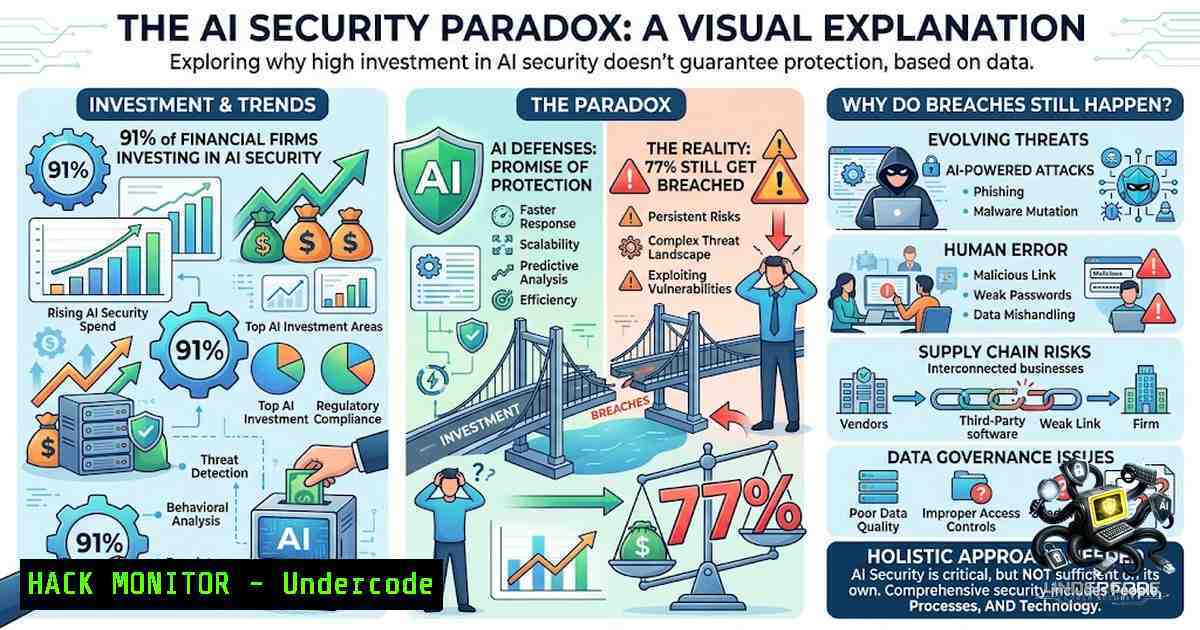
Introduction:
Financial services organizations are embracing AI-powered security tools at an unprecedented rate—91% have deployed them, and 66% now allow AI to initiate security actions without human intervention. Yet paradoxically, 77% of these same organizations have experienced a breach involving AI, and 98% of breached institutions reported material business impact including financial losses, regulatory consequences, and increased cyber insurance premiums. This stark contradiction reveals a critical truth: investing in AI security tools without deep observability across hybrid cloud environments is like installing a sophisticated alarm system while leaving the front door unlocked.
Learning Objectives:
- Understand the visibility gap plaguing financial services hybrid cloud environments and why 52% cite fragmented security tools as their biggest challenge
- Master practical implementation of deep observability pipelines, API security hardening, and cloud infrastructure protection
- Learn to defend against AI-driven threats including LLM prompt injection, AI-powered social engineering, and “harvest now, decrypt later” quantum attacks
You Should Know:
- Deep Observability: The Missing Pillar of AI Security
The Gigamon 2026 Hybrid Cloud Security Survey, based on 1,023 global respondents, reveals that while 94% of financial services organizations have invested in new security technologies to improve detection and visibility, 42% report it is actually taking longer to detect breaches. The culprit? Fragmented security tools creating visibility blind spots across hybrid cloud infrastructure.
Deep observability goes beyond traditional monitoring by providing network-derived telemetry—packets, flows, and metadata—directly to security and observability tools. According to the survey, 95% of financial services leaders say security depends on complete visibility across all data in motion, and 94% view deep observability as foundational to securing their AI deployments.
Step-by-Step: Implementing a Deep Observability Pipeline
Step 1: Deploy Network TAPs and Packet Brokers
Position physical or virtual TAPs at critical network junctions to capture all traffic without introducing latency or single points of failure.
Step 2: Configure Traffic Filtering and Load Balancing
Use GigaVUE-OS CLI to filter and forward relevant traffic to security tools:
 Example: Create a traffic filter rule on GigaVUE HC Series
configure terminal
traffic-filter create name financial-api-filter
traffic-filter rule add name financial-api-filter match ip protocol tcp port 443
traffic-filter rule add name financial-api-filter match ip protocol tcp port 8443
traffic-filter apply name financial-api-filter interface gig0/1
Step 3: Integrate with SIEM and Security Tools
Forward enriched telemetry to Splunk, QRadar, or other SIEM platforms:
 Splunk HTTP Event Collector configuration for Gigamon DOP
curl -k https://<splunk-server>:8088/services/collector \
-H "Authorization: Splunk <token>" \
-d '{"event": "network-telemetry", "fields": {"src_ip": "10.0.0.1", "dst_ip": "192.168.1.100"}}'
Step 4: Enable Encrypted Traffic Visibility
Decrypt SSL/TLS traffic at the observability layer using managed private keys or certificate authorities, then re-encrypt before forwarding to tools.
Step 5: Monitor and Optimize
Regularly review telemetry quality and adjust filters to eliminate blind spots while reducing tool costs.
2. API Security: The Attack Surface AI Amplifies
The survey reveals that 54% of financial services organizations reported an increase in AI-powered social engineering attacks, and 47% saw more attacks targeting AI and LLM deployments. Akamai’s 2026 research confirms that APIs are increasingly targeted—96% of financial services leaders reported at least one API security incident in the past year. As one expert noted, “AI doesn’t reduce traditional security risks, it puts them on steroids”.
Step-by-Step: Hardening API Security Against AI-Driven Threats
Step 1: Discover and Inventory All APIs
Use automated discovery tools to identify shadow APIs and unmanaged endpoints:
 Example: Use OWASP ZAP to discover API endpoints
zap-api-scan.py -t https://api.financial-instance.com/v2 -f openapi
Step 2: Implement API Gateway with Rate Limiting and WAF
Configure rate limiting to mitigate AI-driven botnet attacks:
 Example: NGINX rate limiting configuration
http {
limit_req_zone $binary_remote_addr zone=api_limit:10m rate=10r/s;
server {
location /api/ {
limit_req zone=api_limit burst=20 nodelay;
proxy_pass https://backend-api;
}
}
}
Step 3: Enforce Strong Authentication and Authorization
Implement OAuth 2.0 with PKCE and mTLS for machine-to-machine communication. Use API keys with least-privilege scoping.
Step 4: Deploy API Threat Protection
Implement request validation, payload inspection, and anomaly detection:
 Example: Validate JSON schema for incoming API requests
{
"$schema": "http://json-schema.org/draft-07/schema",
"type": "object",
"properties": {
"transaction_amount": {"type": "number", "minimum": 0, "maximum": 1000000},
"account_number": {"type": "string", "pattern": "^[0-9]{10}$"}
},
"required": ["transaction_amount", "account_number"]
}
Step 5: Monitor API Behavior with AI
Use AI-powered anomaly detection to identify unusual API call patterns that may indicate credential stuffing or business logic abuse.
3. Hybrid Cloud Hardening: Securing the Perimeterless Enterprise
More than half (58%) of financial services leaders identified public cloud environments as their greatest source of breach risk, while 62% said data lakes represent the most secure environment for critical data. This perception gap underscores the need for consistent security controls across all environments.
Step-by-Step: Hybrid Cloud Security Hardening
Linux Hardening Commands:
 1. Harden SSH configuration
sudo sed -i 's/PermitRootLogin yes/PermitRootLogin no/' /etc/ssh/sshd_config
sudo sed -i 's/PasswordAuthentication yes/PasswordAuthentication no/' /etc/ssh/sshd_config
sudo systemctl restart sshd

<ol>
<li>Configure iptables firewall
sudo iptables -A INPUT -m state --state ESTABLISHED,RELATED -j ACCEPT
sudo iptables -A INPUT -p tcp --dport 22 -j ACCEPT
sudo iptables -A INPUT -p tcp --dport 443 -j ACCEPT
sudo iptables -A INPUT -j DROP</p></li>
<li><p>Enable auditing with auditd
sudo auditctl -w /etc/passwd -p wa -k identity_changes
sudo auditctl -w /etc/shadow -p wa -k identity_changes
sudo auditctl -e 1
Windows Hardening Commands (PowerShell):
 1. Disable insecure protocols
Set-ItemProperty -Path "HKLM:\SYSTEM\CurrentControlSet\Control\SecurityProviders\SCHANNEL\Protocols\TLS 1.0\Server" -1ame "Enabled" -Value 0 -Type DWord
Set-ItemProperty -Path "HKLM:\SYSTEM\CurrentControlSet\Control\SecurityProviders\SCHANNEL\Protocols\TLS 1.1\Server" -1ame "Enabled" -Value 0 -Type DWord

<ol>
<li>Configure Windows Firewall
New-1etFirewallRule -DisplayName "Allow HTTPS" -Direction Inbound -Protocol TCP -LocalPort 443 -Action Allow
New-1etFirewallRule -DisplayName "Block All Other Inbound" -Direction Inbound -Action Block</p></li>
<li><p>Enable PowerShell logging
Set-ItemProperty -Path "HKLM:\SOFTWARE\Policies\Microsoft\Windows\PowerShell\ScriptBlockLogging" -1ame "EnableScriptBlockLogging" -Value 1 -Type DWord
Cloud-Specific Hardening (AWS Example):
 1. Enforce S3 bucket encryption and blocking public access
aws s3api put-bucket-encryption --bucket financial-data-bucket --server-side-encryption-configuration '{"Rules":[{"ApplyServerSideEncryptionByDefault":{"SSEAlgorithm":"AES256"}}]}'
aws s3api put-public-access-block --bucket financial-data-bucket --public-access-block-configuration BlockPublicAcls=true,IgnorePublicAcls=true,BlockPublicPolicy=true,RestrictPublicBuckets=true

<ol>
<li>Configure VPC Flow Logs for network visibility
aws ec2 create-flow-logs --resource-type VPC --resource-ids vpc-12345678 --traffic-type ALL --log-destination-type cloud-watch-logs --log-group-1ame financial-vpc-logs
- LLM Security: Defending Against Prompt Injection and Model Attacks
With 47% of financial services organizations reporting increased attacks targeting AI and LLM deployments, securing the AI models themselves has become critical. The financial sector’s unique exposure to sensitive customer data and transaction systems makes LLM security particularly urgent.
Step-by-Step: Implementing LLM Security Controls
Step 1: Deploy an LLM Firewall
Use open-source solutions like FinGuard to filter inputs and outputs:
 Example: FinGuard prompt filtering (GitHub: suryanshgupta9933/FinGuard)
from finguard import LLMFirewall

firewall = LLMFirewall(
detect_prompt_injection=True,
anonymize_pii=True,
max_tokens=4096,
allowed_topics=["account_balance", "transaction_history", "fraud_reporting"]
)

Filter user input before sending to LLM
sanitized_input = firewall.filter_prompt(user_input)
response = llm.generate(sanitized_input)
Step 2: Implement Prompt Injection Detection
Use regex and ML-based detection for known attack patterns:
 Example: Simple prompt injection detection in Python
import re

suspicious_patterns = [
r"ignore previous instructions",
r"system prompt",
r"you are now",
r"pretend to be",
r"forget all prior",
r"<|.|>"
]

def detect_prompt_injection(user_input):
for pattern in suspicious_patterns:
if re.search(pattern, user_input, re.IGNORECASE):
return True
return False
Step 3: Implement Output Validation and Content Filtering
Validate LLM responses to prevent data leakage or hallucinated financial advice.
Step 4: Monitor LLM Access and Usage
Log all LLM interactions with audit trails for compliance and forensic analysis.
Step 5: Regular Red-Teaming
Conduct controlled prompt injection attacks against your own LLM deployments to identify vulnerabilities.
- Post-Quantum Readiness: Preparing for “Harvest Now, Decrypt Later”
Perhaps the most striking finding from the Gigamon survey: 88% of financial services organizations cite “harvest now, decrypt later” attacks as a major concern today. Attackers are already collecting encrypted data with the intent to decrypt it once quantum computers become viable. Additionally, 93% of financial services leaders say visibility into encrypted traffic is critical to post-quantum cryptography readiness—the highest response among all industries surveyed.
Step-by-Step: Building Post-Quantum Readiness
Step 1: Inventory All Encryption Usage
Map where encryption is used across your infrastructure, including TLS, database encryption, and application-level encryption.
Step 2: Identify Critical Data That Requires Long-Term Confidentiality
Prioritize data that must remain confidential for 10+ years, such as customer PII, trade secrets, and regulatory records.
Step 3: Begin Testing Post-Quantum Cryptographic Algorithms
NIST has standardized several post-quantum algorithms including CRYSTALS-Kyber (for key encapsulation) and CRYSTALS-Dilithium (for digital signatures):
 Example: Testing Kyber key exchange in Python (using liboqs)
import oqs

with oqs.KeyEncapsulation("Kyber512") as kem:
public_key = kem.generate_keypair()
ciphertext, shared_secret_server = kem.encap_secret(public_key)

Client side
with oqs.KeyEncapsulation("Kyber512") as kem_client:
shared_secret_client = kem_client.decap_secret(ciphertext)

assert shared_secret_server == shared_secret_client
Step 4: Implement Crypto-Agility
Design systems that can swap cryptographic algorithms without major re-architecture. Use abstraction layers for cryptographic operations.
Step 5: Ensure Visibility into Encrypted Traffic
Deploy deep observability solutions that can inspect encrypted traffic without breaking encryption, enabling detection of malicious patterns within encrypted flows.
What Undercode Say:
- Key Takeaway 1: AI is a double-edged sword in financial cybersecurity—91% adoption yet 77% breach rate reveals that tools alone are insufficient without deep observability and visibility across hybrid environments.
-
Key Takeaway 2: The convergence of AI adoption, regulatory scrutiny, and post-quantum planning is fundamentally reshaping how financial institutions approach cyber risk. Visibility into data in motion is becoming a foundational requirement not just for security operations, but for governance, compliance, and operational resilience.
The Gigamon 2026 Hybrid Cloud Security Survey paints a clear picture: financial services organizations are moving faster than any other industry in adopting AI-powered security automation—66% now allow AI to initiate security actions without human intervention, compared to just 53% across all industries. Yet this speed has created new vulnerabilities. The 77% who experienced AI-involved breaches, the 54% facing increased AI-powered social engineering, and the 88% concerned about quantum-era data harvesting all point to the same conclusion: security investment must be accompanied by deep observability.
The path forward requires a fundamental shift from tool-centric security to visibility-centric security. Organizations must break down silos between NetOps, DevOps, and SecOps teams, implement deep observability pipelines that provide complete visibility across hybrid environments, and adopt crypto-agile architectures ready for the post-quantum era. As Malcolm Kelly, Managing Director and CISO at SMBC Group, observed: “Financial institutions need visibility into how data, applications, and AI systems interact across hybrid cloud environments so they can identify exposure early and respond with confidence”.
Expected Output:
Introduction:
Financial services organizations are adopting AI-powered security at breakneck speed—91% have deployed AI security tools, and 66% now let AI initiate security actions without human oversight. Yet 77% have still suffered AI-involved breaches, and 98% of breached institutions reported material business impact. This paradox exposes a critical vulnerability: investing in AI security without deep observability across hybrid cloud environments creates dangerous blind spots that attackers are actively exploiting.
What Undercode Say:
- AI security adoption without deep observability is like installing a high-tech alarm system while leaving the doors unlocked—91% have the tools, but 77% still get breached because they lack visibility into how data, applications, and AI systems interact across hybrid environments.
- The convergence of AI threats, regulatory pressure, and post-quantum risks demands a fundamental shift from tool-centric to visibility-centric security—95% of leaders now recognize that complete visibility across all data in motion is essential for effective security.
Prediction:
- +1 By 2028, deep observability will become a regulatory requirement for financial institutions handling cross-border transactions, driven by the convergence of AI threats and post-quantum security mandates.
- +1 The market for deep observability solutions is projected to grow from $880 million in 2025 to $2.7 billion by 2029, creating significant opportunities for security vendors that can deliver unified visibility across hybrid environments.
- -1 Organizations that fail to implement deep observability within the next 18-24 months will face a 3x higher likelihood of material breach impact, as AI-driven threats continue to outpace traditional defenses.
- -1 The “harvest now, decrypt later” threat poses an existential risk to financial data confidentiality—88% of institutions are concerned, yet fewer than 40% have begun post-quantum cryptographic migration, creating a 5-7 year window of exposure.
- +1 Financial institutions that successfully integrate deep observability with AI security automation will achieve 40-50% faster breach detection and response times, transforming security from a cost center to a competitive differentiator.
▶️ Related Video (72% Match):
🎯Let’s Practice For Free:
🎓 Live Courses & Certifications:
Join Undercode Academy for Verified Certifications
🚀 Request a Custom Project:
Secure, high-velocity infrastructure and disruptive technological engineering. Contact our engineering team for high-tier development and proprietary systems:
[email protected]
💎 Smart Architecture | 🛡️ Secure by Design | ⭐ Trusted by Thousands
IT/Security Reporter URL:
Reported By: Micaela Divittorio – Hackers Feeds
Extra Hub: Undercode MoN
Basic Verification: Pass ✅


