Listen to this Post
Introduction:
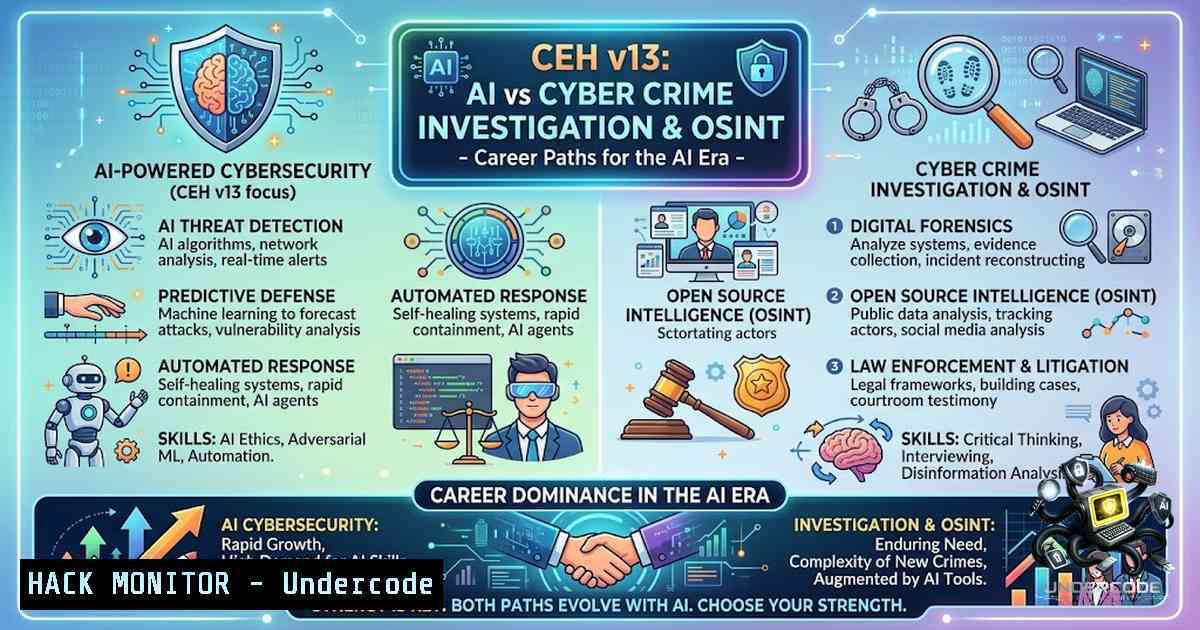
The cybersecurity industry stands at a pivotal crossroads where traditional ethical hacking methodologies are being rapidly transformed by artificial intelligence, while digital forensics and open-source intelligence (OSINT) have become indispensable weapons in the fight against sophisticated cybercrime. As attackers increasingly leverage AI to automate reconnaissance, generate polymorphic malware, and launch phishing campaigns at machine scale, defenders must choose their specialization wisely—between mastering AI-augmented penetration testing or becoming a digital forensics and OSINT expert who traces the digital footprints of cybercriminals. This article provides a comprehensive technical deep-dive into both career paths, equipping you with the knowledge, tools, and commands to make an informed decision.
Learning Objectives:
- Understand the technical architecture and AI integration within EC-Council’s CEH v13 AI certification, including the five-phase ethical hacking framework enhanced by machine learning
- Master OSINT gathering techniques and digital forensics methodologies using industry-standard tools like theHarvester, Maltego, Volatility, and Autopsy
- Execute practical command-line operations across Linux and Windows environments for reconnaissance, memory analysis, and evidence collection
- Evaluate which career path aligns with your technical strengths and long-term professional goals in the AI-driven cybersecurity landscape
- CEH v13 AI: The World’s First AI-Powered Ethical Hacking Certification
EC-Council’s CEH v13 AI represents a paradigm shift in cybersecurity education—it is the world’s first ethical hacking certification that fully integrates artificial intelligence across all 20 learning modules, covering over 550 attack techniques. Unlike previous versions where AI was treated as an add-on module, CEH v13 weaves AI into every stage of the ethical hacking lifecycle, redefining the entire discipline.
What makes CEH v13 AI different:
The certification introduces AI-driven penetration testing where machine learning algorithms assist in identifying vulnerabilities and exploiting them to test system defenses. This is not theoretical—practitioners gain access to 221 hands-on labs with over 4,000 commercial-grade hacking tools in a cloud-based cyber range. The program claims to deliver up to 40% greater efficiency in cyber defense operations and double productivity through automated threat detection, adaptive learning, and enhanced reporting.
AI integration across the five phases of ethical hacking:
Reconnaissance: AI-powered tools analyze vast amounts of data from multiple sources, detecting patterns, anomalies, and indicators of vulnerabilities that would take human analysts hours or days to uncover.
Scanning: Machine learning algorithms automate the detection of vulnerable services and open ports, prioritizing them based on risk levels to ensure no attack vector is overlooked.
Gaining Access: AI automates complex attack strategies and adapts to security defenses in real-time, enabling ethical hackers to execute sophisticated exploitation techniques with higher success rates while minimizing detection risks.
Maintaining Access: AI continuously analyzes system behaviors and adjusts tactics to avoid detection, adapting to environmental changes and utilizing stealth techniques to keep connections intact.
Covering Tracks: AI-powered tools automate log cleaning, timestamp modification, and trace deletion, with the ability to mimic legitimate user behavior to complicate detection efforts.
Critical technical skills you’ll develop:
- Hacking AI systems: Learn to identify and exploit vulnerabilities in AI systems, including prompt injection attacks, model poisoning, and adversarial attacks on ML-based security models
- AI-assisted malware analysis: Use machine learning to detect and analyze evolving malware threats, including fileless malware, ransomware, and AI-generated malware that bypasses traditional antivirus
- Cloud and IoT security: Apply AI techniques to address vulnerabilities in cloud environments and IoT devices—expanded coverage reflecting modern attack surfaces
- OWASP Top 10 AI Attacks: Gain expertise in mitigating threats like prompt injection, insecure output handling, and training data poisoning
Linux/Windows Commands for AI-Enhanced Penetration Testing:
 AI-assisted reconnaissance with theHarvester (Kali Linux)
theharvester -d targetcompany.com -b all -l 1000

Automated network scanning with Nmap
nmap -sV -sC -O -A target.com

AI-powered vulnerability scanning with OpenVAS
gvm-cli --gmp-username admin --gmp-password password socket --socketpath /var/run/gvmd.sock --xml "<get_tasks/>"

System hacking - password cracking with Hashcat (GPU-accelerated)
hashcat -m 0 -a 0 hashes.txt /usr/share/wordlists/rockyou.txt

Windows privilege escalation enumeration (PowerShell)
Get-WmiObject -Class Win32_UserAccount -Filter "LocalAccount=True"
- Cyber Crime Investigation & OSINT: The Art of Digital Forensics and Open-Source Intelligence
While CEH v13 AI focuses on offensive security and penetration testing, the Cyber Crime Investigation and OSINT path centers on digital forensics, incident response, and intelligence gathering. This career track is essential for law enforcement, corporate investigation teams, and security analysts who need to trace attacks back to their sources, collect admissible evidence, and understand the threat landscape through publicly available information.
Core competencies of this path:
Open-Source Intelligence (OSINT): OSINT involves gathering and analyzing publicly available information from search engines, social media, domain registrations, and public databases to build threat intelligence profiles. This is a critical pre-engagement phase for both penetration testers and investigators.
Digital Forensics: This discipline encompasses the recovery and investigation of material found in digital devices, including memory analysis, disk forensics, network forensics, and mobile device examination.
OSINT Tools and Commands:
theHarvester – Email and domain reconnaissance tool:
 Basic theHarvester syntax
theHarvester -d example.com -l 500 -b google

Using multiple data sources
theHarvester -d example.com -b all -l 1000

Save results to file
theHarvester -d example.com -b all -l 1000 -f results.html
Maltego – Visual link analysis and entity mapping platform that transforms scattered data into intelligence maps. Maltego accelerates complex cyber investigations by mining, merging, and mapping relationships between domains, email addresses, social media profiles, and IP addresses.
ReconSpider – Advanced OSINT framework for scanning IP addresses, emails, websites, and organizations to find deep information about targets:
 Install ReconSpider on Kali Linux
git clone https://github.com/bhavsec/reconspider.git
cd reconspider
python3 setup.py install

Basic usage
python3 reconspider.py -d target.com
Digital Forensics Tools and Commands:
Volatility Framework – Memory forensics for analyzing RAM dumps from Windows, Linux, and macOS systems:
 Install Volatility 3
pip3 install volatility3

Identify the operating system profile
vol -f memory.dmp windows.info

List running processes
vol -f memory.dmp windows.pstree

Dump suspicious process memory
vol -f memory.dmp windows.dumpfiles --pid 1234

Extract network connections
vol -f memory.dmp windows.netscan

Check for malicious injected code
vol -f memory.dmp windows.malfind
Autopsy – Digital forensics platform for hard drive and disk image analysis:
 Install Autopsy on Kali Linux
sudo apt-get install autopsy

Launch Autopsy
sudo autopsy

Access via browser at http://localhost:9999/autopsy
Dissect Framework – Digital forensics and incident response framework by Fox-IT (NCC Group) for accessing forensic artifacts from various disk and file formats:
 Install Dissect
pip install dissect

Target-query for forensic collection
target-query --help

Collect Windows Event Logs
target-query -f eventlog target.dd
Host Collector – CLI tool for collecting process, network, log, and startup item evidence from Windows/Linux hosts:
 Linux host collection
./host-collector-linux --all --output report.json

Windows host collection
host-collector.exe --all --output report.json
Cross-Platform RAM Dump Collection:
 Linux memory acquisition with LiME
insmod lime.ko "path=/root/memory.dmp format=raw"

Windows memory acquisition with WinPMEM
winpmem.exe memory.dmp
3. Hands-On Lab: Practical OSINT Investigation Workflow
This step-by-step guide demonstrates a real-world OSINT investigation workflow that combines multiple tools and techniques:
Step 1: Passive Reconnaissance with theHarvester
theHarvester -d example.com -b google,bing,yahoo -l 500 -f recon_results.html
Analyze the output for email addresses, subdomains, and employee names that could be used in social engineering attacks.
Step 2: Visual Intelligence Mapping with Maltego
- Launch Maltego and create a new graph
- Add a domain entity and run transforms for DNS names, email addresses, and social media profiles
- Map relationships to identify key personnel and infrastructure
Step 3: Advanced Search with Google Dorks
 Find exposed documents
site:example.com filetype:pdf "confidential"

Find login portals
site:example.com intitle:"login" | intitle:"sign in"

Find subdomains
site:.example.com
Step 4: Shodan Network Scanning
 Search for exposed devices in the target organization's IP range
shodan search "org:TargetCompany" --fields ip_str,port,org,hostnames
Step 5: Forensic Evidence Collection
- Create a forensic case in Autopsy
- Load the disk image or physical drive
- Run ingest modules for file type identification, hash calculation, and keyword searching
- Export findings as a comprehensive report
4. Career Trajectory and Industry Demand Analysis
Both career paths offer distinct opportunities, but the decision depends on your technical preferences and long-term goals:
CEH v13 AI Path:
- Best suited for professionals who enjoy offensive security, penetration testing, and staying ahead of attackers
- Strong demand in red team operations, security consulting, and compliance-driven roles
- CEH holds DoD 8140 recognition, making it valuable for government and cleared-contractor roles
- The certification is the most specified offensive certification in public-sector tenders in regions like KSA and UAE
- Recommended to stack CEH with CPENT and LPT for a complete offensive security profile
Cyber Crime Investigation & OSINT Path:
- Ideal for professionals who enjoy investigative work, attention to detail, and building intelligence from disparate data sources
- Essential for law enforcement, corporate incident response, and threat intelligence roles
- Combines well with DFIR (Digital Forensics and Incident Response) specializations
- Increasingly critical as organizations need to understand the “who, how, and why” behind attacks
What Undercode Say:
- CEH v13 AI is the offensive weapon of the AI era – it transforms ethical hackers from manual operators into AI-augmented cyber warriors capable of automating reconnaissance, exploitation, and reporting with unprecedented efficiency. The integration of AI across all five phases of ethical hacking represents a fundamental shift in how penetration testing is conducted.
- OSINT and digital forensics are the defensive intelligence backbone – while offensive skills are critical, organizations are equally desperate for professionals who can trace attacks, collect legally admissible evidence, and build threat intelligence from open sources. The rise of AI-generated attacks makes this skill set even more valuable.
- Neither path is mutually exclusive – the most formidable cybersecurity professionals combine offensive and defensive capabilities. Understanding how attackers operate (CEH v13 AI) makes you a better investigator, and knowing forensic techniques makes you a more thorough penetration tester.
- The AI chasm is real – attackers are already using AI to automate reconnaissance, generate exploits, and launch machine-scale phishing campaigns. Defenders who rely solely on manual methods are falling behind. CEH v13 AI directly addresses this gap by embedding AI skills throughout the curriculum.
- Industry recognition matters – CEH’s DoD 8140 recognition and its prevalence in government tenders provide a clear career advantage for those targeting public-sector or defense roles. OSINT and forensics skills, while equally valuable, are often validated through complementary certifications like CHFI, GCFE, or specialized training.
Prediction:
- +1 CEH v13 AI will become the baseline certification for offensive security roles within 3-5 years, as employers increasingly demand AI-augmented skills rather than traditional manual testing capabilities
- +1 The integration of AI in ethical hacking will drive a 40-50% increase in productivity for certified professionals, making them significantly more valuable to organizations
- +1 OSINT and digital forensics skills will become mandatory for all cybersecurity roles, not just specialized investigators, as organizations seek to understand the threat landscape proactively
- -1 The rapid evolution of AI-generated attacks will outpace traditional forensic tools, requiring constant upskilling and adaptation from digital forensics professionals
- +1 The CEH v13 AI curriculum’s focus on hacking AI systems, including prompt injection and model poisoning, will position certified professionals at the forefront of AI security
- -1 Organizations that fail to invest in AI-augmented security training will face a widening skills gap, making them increasingly vulnerable to AI-powered cyberattacks
- +1 The Cyber Crime Investigation path will see growing demand from law enforcement and corporate legal teams as cybercrime becomes more sophisticated and requires specialized investigative skills
- +1 The combination of CEH v13 AI and OSINT/forensics skills will create the most sought-after cybersecurity professionals—those who can both hack and investigate
▶️ Related Video (72% Match):
🎯Let’s Practice For Free:
🎓 Live Courses & Certifications:
Join Undercode Academy for Verified Certifications
🚀 Request a Custom Project:
Secure, high-velocity infrastructure and disruptive technological engineering. Contact our engineering team for high-tier development and proprietary systems:
[email protected]
💎 Smart Architecture | 🛡️ Secure by Design | ⭐ Trusted by Thousands
IT/Security Reporter URL:
Reported By: Mohammad Ibrahim – Hackers Feeds
Extra Hub: Undercode MoN
Basic Verification: Pass ✅


