Listen to this Post
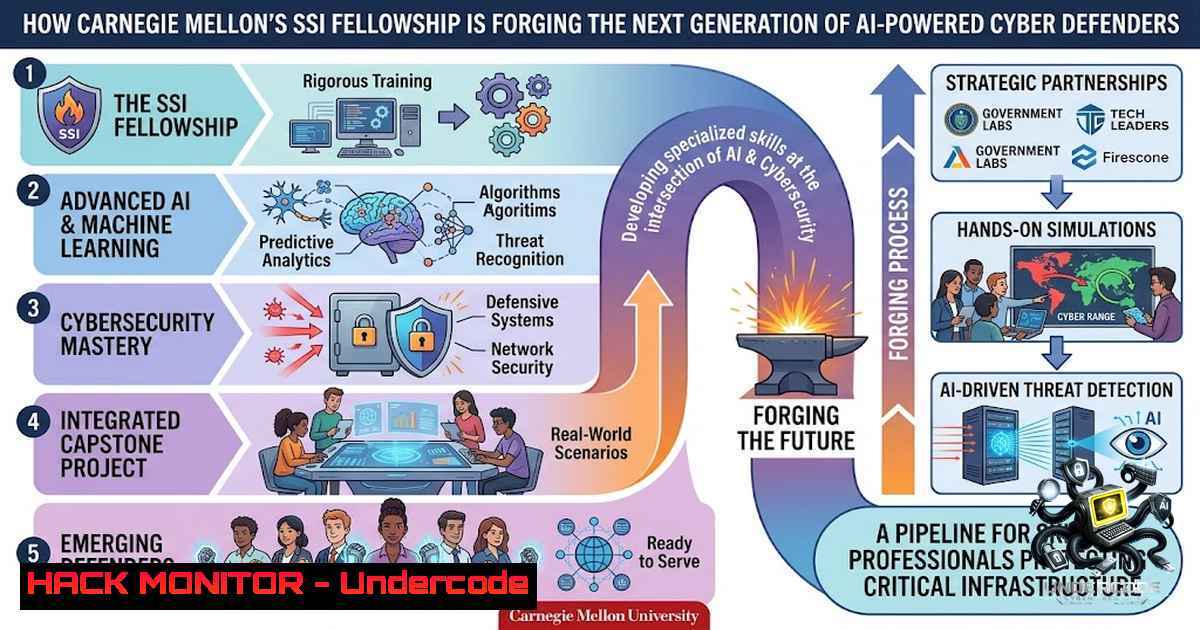
In an era where adversarial AI is evolving at machine speed and the average enterprise struggles to keep pace with automated attacks, the need for defenders who can think like both engineers and adversaries has never been more critical. Carnegie Mellon University’s Heinz College IT Lab: Summer Security Intensive (SSI) addresses this challenge head-on by compressing graduate-level cybersecurity, AI, and network defense curricula into a seven-week, all-expenses-paid fellowship. This program, run in conjunction with the world-renowned CERT Division of the Software Engineering Institute (SEI), is not merely an internship but an intensive crucible designed to produce security leaders capable of leveraging AI to defend against increasingly sophisticated threats.
Learning Objectives:
- Objective 1: Master foundational and advanced concepts in information security, including risk management, cryptography, and access controls, through the lens of a security engineering perspective.
- Objective 2: Develop hands-on proficiency in network defense tactics, including traffic analysis, intrusion detection, and firewall configuration using industry-standard tools in live virtual environments.
- Objective 3: Understand the cybersecurity implications of Artificial Intelligence and Machine Learning, learning how to secure AI/ML systems and, conversely, how to use AI as a force multiplier for cyber defense.
You Should Know:
- The AI Security Frontier: Securing the Machine Learning Pipeline
The integration of AI into enterprise workflows has introduced a new wave of security challenges that traditional cybersecurity frameworks struggle to address. The course Cybersecurity for AI & ML, taught by Thomas Scanlon—a Principal Researcher who leads the CERT Data Science technical program—focuses on the unique vulnerabilities inherent in AI/ML development. Unlike traditional software, ML models are susceptible to data poisoning, adversarial inputs, and model inversion attacks. In response to these emerging threats, the CERT Division established the first Artificial Intelligence Security Incident Response Team (AISIRT) in November 2023. AISIRT is specifically designed to identify, analyze, and respond to AI-related incidents, flaws, and vulnerabilities.
Step-by-Step Guide: Hardening an AI/ML Pipeline
- Threat Model Your Data Pipeline: Map the flow of data from collection to model deployment. Identify points where an attacker could inject malicious data (poisoning) or manipulate inputs (evasion).
- Implement Robust Data Validation: Before ingesting training data, implement checksums and anomaly detection to filter out outliers that could skew model behavior.
- Adopt Adversarial Training: Augment your training dataset with adversarial examples to make the model more resilient to evasion attacks.
- Secure the MLOps Lifecycle: Apply traditional security principles (e.g., least privilege, secure coding) to the infrastructure that builds, tests, and deploys models.
- Establish an AISIRT-like Capability: Even if you don’t have a dedicated team, integrate AI-specific incident response playbooks into your existing Computer Security Incident Response Team (CSIRT) framework.
-
Network Defense in Practice: Hands-On with Live Virtual Systems
The Network Defense course, led by Senior Cyber Security Engineer Toby Meyer, takes a pragmatic, hands-on approach to security. It covers the basics of network security through lectures and direct interaction with live virtual systems. The curriculum is designed for students to move beyond theory, requiring them to deploy and configure firewalls, intrusion detection systems (IDS), and network sniffers in a live lab environment. The capstone of this course involves a group exercise where teams must identify and detect live attacks occurring on a virtual network. This practical focus ensures that students are not just familiar with concepts but are proficient in the tools and techniques required for modern network defense.
Step-by-Step Guide: Setting Up a Basic Network Defense Lab
1. Deploy a Virtual Environment: Use virtualization software (e.g., VMware, VirtualBox) to set up a small network with a victim machine (e.g., a vulnerable Linux server) and an attacker machine (e.g., Kali Linux).
2. Configure a Firewall: Set up a firewall (e.g., using `iptables` on Linux or Windows Firewall) to restrict inbound and outbound traffic. For example, to block all incoming traffic on a Linux system, use:
sudo iptables -P INPUT DROP
sudo iptables -A INPUT -m state --state ESTABLISHED,RELATED -j ACCEPT
3. Implement an Intrusion Detection System (IDS): Install and configure Snort or Suricata to monitor network traffic for malicious signatures. A basic command to start Snort in packet logger mode is:
sudo snort -dev -l ./log
4. Analyze Network Traffic: Use Wireshark or tcpdump to capture and analyze network packets. For instance, to capture all HTTP traffic on a specific interface, use:
sudo tcpdump -i eth0 port 80 -w http_traffic.pcap
5. Perform Traffic Analysis: Use tools like `NTop` to monitor real-time network flow and identify anomalies.
3. Foundational Information Security: Bridging Technical and Policy
The Introduction to Information Security course, directed by Randy Trzeciak, who leads the CERT Insider Threat Center, provides the essential technical and policy foundations of information security. The main objective is to enable students to reason about information systems from a security engineering perspective, taking into account technical, economic, and policy factors. This includes foundational concepts of cyber and information security, risk management, access controls, and incident management. By grounding students in these core principles, the program ensures that future cybersecurity professionals can not only execute technical tasks but also translate security into a business driver that is critical to meeting an organization’s mission.
Step-by-Step Guide: Implementing a Basic Risk Management Framework
- Asset Identification: Catalog all critical assets (hardware, software, data) within the organization.
- Threat and Vulnerability Assessment: Identify potential threats (e.g., insider threats, malware, natural disasters) and vulnerabilities that could be exploited.
- Risk Analysis: Analyze the likelihood and potential impact of each identified risk. Use a qualitative or quantitative approach to prioritize risks.
- Risk Mitigation: Implement controls to reduce the identified risks to an acceptable level. This could include technical controls (e.g., firewalls, encryption), administrative controls (e.g., policies, training), and physical controls (e.g., locks, badge access).
- Continuous Monitoring and Review: Security is not a one-time event. Continuously monitor the environment for new threats and vulnerabilities, and regularly review the risk management program to ensure it remains effective.
4. Professional Development and Industry Engagement
A unique aspect of the SSI program is its integration of professional development and industry exposure. Fellows attend weekly lunch-and-learn sessions with cybersecurity professionals, providing invaluable networking and mentorship opportunities. Additionally, they attend conferences like BSidesPGH, a community-driven event for information security practitioners. This exposure allows students to see the practical application of their skills, learn from real-world case studies, and build a professional network.
- The Capstone Project: AI as a Force Multiplier for Defense
The program culminates in a capstone project focused on how cyber defenders can leverage AI to defend against attacks. This project is not an academic exercise; it is a substantive piece of research that is slated for publication on Carnegie Mellon’s KiltHub institutional repository. This requirement forces students to apply the concepts from all three courses to a complex, real-world problem, demonstrating how AI can be used to augment human-led defense, which operates much slower than machine-speed systems. This focus on actionable, research-backed solutions is what sets the SSI apart, producing graduates who are ready to shape the future of cybersecurity.
What Undercode Say:
- The IT Lab: SSI demonstrates that the most effective cybersecurity training is interdisciplinary, combining rigorous technical skills with policy awareness and practical application.
- By requiring a publishable capstone, the program emphasizes that cybersecurity is not just about defense but also about contributing to the broader body of knowledge and advancing the field.
- The program’s structure, which includes professional development and industry events like BSidesPGH, highlights the critical importance of soft skills and networking in launching a successful cybersecurity career.
- The involvement of the CERT Division of the SEI ensures that the curriculum is informed by the latest research and real-world threat intelligence, making it highly relevant to current industry needs.
- The fellowship’s model of an all-expenses-paid, intensive summer program serves as a benchmark for how to effectively and inclusively develop top-tier cybersecurity talent.
Expected Output:
Introduction:
The cybersecurity landscape is facing a critical shortage of professionals capable of defending against AI-driven threats. Carnegie Mellon University’s Heinz College IT Lab: Summer Security Intensive (SSI) is an all-expenses-paid, seven-week fellowship designed to address this gap by equipping students with graduate-level skills in AI security, network defense, and policy. By combining rigorous coursework with hands-on labs and a publishable capstone project on AI-powered defense, the SSI is setting a new standard for cybersecurity education.
What Undercode Say:
- Key Takeaway 1: The future of cybersecurity lies in the confluence of AI and traditional security. Programs like the SSI are essential for developing defenders who can secure AI systems and use AI to automate and enhance defense strategies.
- Key Takeaway 2: Effective cybersecurity education must be experiential and research-driven. The SSI’s use of live virtual environments, industry engagement, and a publishable capstone ensures that graduates are not just knowledgeable but are capable contributors to the field.
Prediction:
- +1 The continued success and expansion of programs like the SSI will help alleviate the global cybersecurity talent shortage by providing a pipeline of highly skilled, AI-literate professionals.
- +1 The AISIRT model pioneered by CMU’s CERT Division will be increasingly adopted by enterprises and government agencies as AI-specific threats become more prevalent.
- -1 As AI tools become more accessible, the speed and scale of cyberattacks will continue to outpace human-led defense, increasing the demand for AI-powered security solutions.
- -1 The increasing complexity of AI systems and the proliferation of agentic workflows will introduce new, unforeseen vulnerabilities that current security frameworks are ill-equipped to handle.
- +1 The open-access publication of research from programs like the SSI on platforms like KiltHub will democratize knowledge, allowing smaller organizations to benefit from cutting-edge AI security research.
▶️ Related Video (80% Match):
🎯Let’s Practice For Free:
🎓 Live Courses & Certifications:
Join Undercode Academy for Verified Certifications
🚀 Request a Custom Project:
Secure, high-velocity infrastructure and disruptive technological engineering. Contact our engineering team for high-tier development and proprietary systems:
[email protected]
💎 Smart Architecture | 🛡️ Secure by Design | ⭐ Trusted by Thousands
IT/Security Reporter URL:
Reported By: Tyler Frailey – Hackers Feeds
Extra Hub: Undercode MoN
Basic Verification: Pass ✅


