Listen to this Post
Introduction
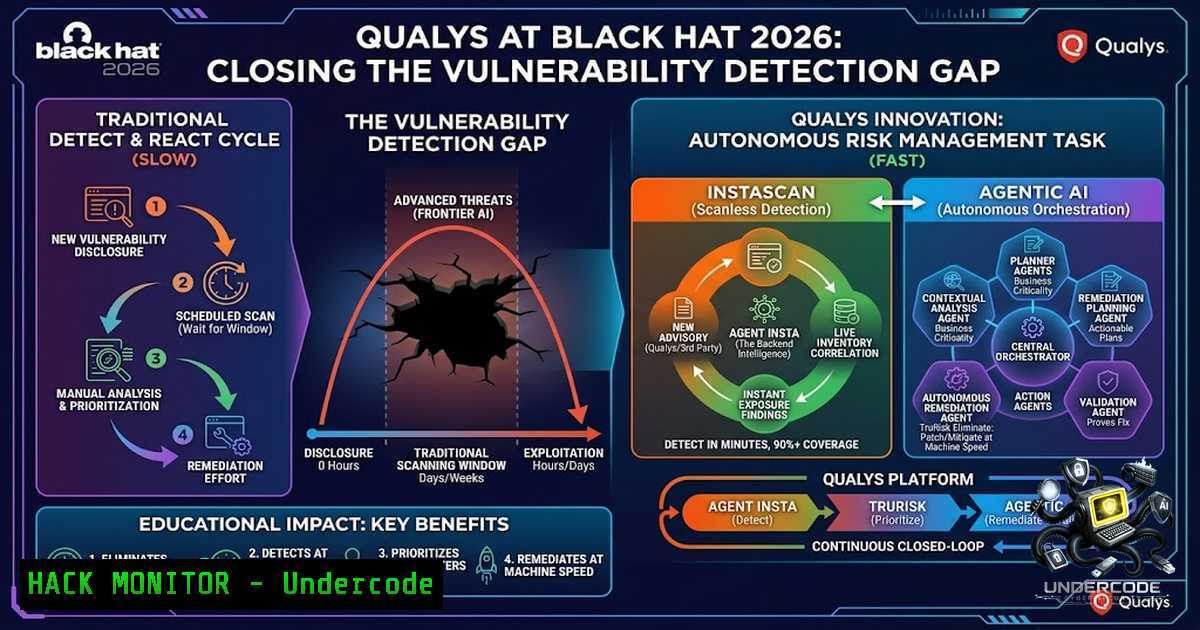
The cybersecurity industry has reached an inflection point where the gap between vulnerability disclosure and exploitation has compressed from weeks to mere hours, rendering traditional scan-driven detection models dangerously obsolete. At Black Hat USA 2026, Qualys unveiled a trifecta of innovations—the Enterprise TruRisk Platform, Agentic AI fabric, and InstaScan—designed to fundamentally rewire how organizations identify, prioritize, and eliminate cyber risk at machine speed. This article dissects the technical architecture, operational workflows, and security implications of these capabilities, providing security practitioners with actionable insights and command-level guidance for implementation.
Learning Objectives
- Understand the architectural shift from scan-based to scanless vulnerability detection and how InstaScan leverages existing telemetry for near-instantaneous exposure identification
- Master the agentic AI framework powering autonomous risk prioritization, exploit validation, and remediation orchestration across hybrid environments
- Implement practical CLI and API-based workflows for integrating TruRisk scoring, automated patching, and continuous compliance monitoring into existing SecOps pipelines
You Should Know
1. InstaScan: Scanless Detection at AI Speed
The fundamental premise of InstaScan challenges two decades of vulnerability management orthodoxy. Rather than waiting for scheduled scan windows, Agent Insta continuously correlates newly published advisories with existing asset inventory, exposure data, and threat telemetry to deliver confidence-scored detections within minutes of disclosure. With 90%+ coverage across technologies representing 60–70% of enterprise vulnerability volume, InstaScan operates 24/7, transforming the detection paradigm from periodic to continuous.
Why this matters: The median time from CVE disclosure to first working exploit collapsed from 56 days in 2024 to 23 days in 2025, and now stands at just hours—with AI-assisted attackers weaponizing new advisories in as little as 4 to 12 hours. With 46,048 CVEs published in the first seven months of 2026 alone and vulnerability exploitation now accounting for 31% of all breaches according to Verizon’s 2026 DBIR, the 24-to-36-hour latency of traditional scanning is no longer a bottleneck—it is a severe strategic risk.
Step-by-step guide to operationalizing InstaScan:
- Enable Agent Insta within your Qualys ETM instance—this is a configuration toggle, not a separate deployment. The agent operates on existing Cloud Agent telemetry without additional footprint.
-
Configure correlation rules to define which asset groups and exposure contexts trigger InstaScan detections. The platform correlates new advisories with your organization’s specific inventory and threat data.
-
Integrate with existing workflows—InstaScan findings feed directly into prioritization, validation, and remediation pipelines. No third-party stitching required.
-
Audit and validate—InstaScan’s real-time findings can be fed directly into audit logs, providing defensible, time-stamped proof of due diligence for compliance reporting.
Linux/Windows Commands for Validation:
 Query InstaScan detection status via Qualys API
curl -X GET "https://<qualys_base_url>/api/5.0/fo/asset/host/?action=list&instascan=true" \
-H "Authorization: Bearer <your_auth_token>" \
-H "Content-Type: application/json"

PowerShell equivalent for Windows environments
Invoke-RestMethod -Uri "https://<qualys_base_url>/api/5.0/fo/asset/host/?action=list&instascan=true" `
-Headers @{Authorization = "Bearer <your_auth_token>"}
2. Agentic AI: Autonomous Risk Prioritization and Decision Support
Qualys has embedded agentic AI natively into the Enterprise TruRisk Management (ETM) fabric, introducing a composable architecture where specialized AI agents handle discrete security functions with minimal human oversight. Unlike traditional AI that performs isolated, reactive tasks, agentic AI brings contextual awareness, multi-step reasoning, and goal-driven behavior to enterprise processes.
Agent Nyra exemplifies this paradigm: a prebuilt autonomous Cyber Risk Agent that constantly scans, analyzes, correlates, and automatically prioritizes risk based on real-time adversary behavior and unique customer environment context. It tracks adversary tactics, techniques, and procedures (TTPs) around the clock, automatically mapping threat intelligence to impacted assets.
Intelligent Decision Support serves as a self-learning analytical engine that continuously adapts to emerging threats and shifting business needs, factoring in asset criticality, regulatory exposure, and operational impact. The Natural Language Query (NLQ) interface democratizes access, enabling anyone from technical analysts to business leaders to ask questions and initiate actions using conversational language.
Step-by-step guide to deploying Agentic AI capabilities:
1. Enable Agentic AI within ETM—this is a native capability, not an add-on. The AI fabric is integrated into the platform core.
2. Configure Agent Nyra for adversary threat monitoring. Define which threat intelligence sources (25+ available) and business context parameters should inform prioritization.
3. Set autonomous response thresholds—define the conditions under which agents can independently initiate playbooks for patch deployment, network segmentation, or alert escalation.
4. Establish validation loops—configure Agent Val (powered by TruConfirm) to validate exploitability in production environments using business context and asset criticality, reducing remediation noise by 90%+.
API-Based Automation Example:
 Query TruRisk scores for prioritized remediation via API
curl -X GET "https://<qualys_base_url>/api/5.0/fo/asset/host/?action=list&trurisk_details=true" \
-H "Authorization: Bearer <your_auth_token>"

 Python script for automated risk prioritization
import requests
import json

url = "https://<qualys_base_url>/api/5.0/fo/asset/host/"
params = {"action": "list", "trurisk_details": "true"}
headers = {"Authorization": "Bearer <token>"}

response = requests.get(url, params=params, headers=headers)
assets = response.json()

for asset in assets.get('host_list', []):
if asset.get('trurisk_score', 0) >= 70:
print(f"Critical asset: {asset.get('ip')} - Score: {asset.get('trurisk_score')}")
3. TruRisk Quantification: From Vulnerability Counts to Business Impact
The Qualys TruRisk scoring model represents a fundamental departure from CVSS and EPSS-based prioritization. While these foundational metrics remain inputs, TruRisk aggregates ALL risk factors from 73,000 vulnerability signatures, 25+ sources of threat intelligence, and integrations with non-Qualys products to achieve an 85% reduction in critical vulnerabilities.
The TruRisk formula combines three core parameters:
– Asset Criticality Score (ACS): Business context and importance of each asset
– Qualys Detection Score (QDS): Vulnerability severity ranging from 1-100 with four severity levels (Critical: 90-100, High: 70-79, Medium: 40-69, Low: 1-39)
– Qualys Vulnerability Score (QVS): Technical severity assessment
The platform recommends prioritizing vulnerabilities with a TruRisk-QDS score of 70 or higher. This risk-based approach enables organizations to reduce critical vulnerabilities by 85% by focusing on what matters most.
Step-by-step guide to TruRisk implementation:
1. Define asset criticality—tag assets based on business function, data sensitivity, and regulatory exposure. Auto-assignment of asset risk levels is powered by TruRisk AI.
2. Configure TruRisk scoring within the platform—the system automatically calculates scores based on ACS, QDS, and QVS parameters.
3. Generate prioritized reports—use the TruRisk Report to highlight critical vulnerabilities and offer strategic guidance for mitigation.
4. Track risk reduction trends—monitor TruRisk scores over time to measure program effectiveness and communicate progress to stakeholders.
API Query for TruRisk Details:
 Retrieve TruRisk details for specific assets
curl -X GET "https://<qualys_base_url>/api/5.0/fo/asset/host/?action=list&ips=10.115.126.190&show_trurisk=true" \
-H "Authorization: Bearer <your_auth_token>"

 List assets with TruRisk score above threshold
curl -X GET "https://<qualys_base_url>/api/5.0/fo/asset/host/?action=list&trurisk_min=70" \
-H "Authorization: Bearer <your_auth_token>"
4. TruRisk Eliminate: Automated Remediation and Zero-Day Mitigation
Remediation has historically been the weakest link in vulnerability management, with critical vulnerabilities still open at Day 7 increasing despite a 6.5x growth in known exploited vulnerabilities over four years. TruRisk Eliminate addresses this through a comprehensive remediation solution extending beyond patching to include mitigation and isolation.
Key safeguards ensure automated remediation earns operational trust:
– AI-powered patch reliability scores
– Phased deployment waves
– Robust rollback capabilities
– Patchless mitigation support for unpatchable gaps
Agent Sara operationalizes this framework, remediating or mitigating vulnerabilities using multiple risk elimination strategies. Security teams simply ask a question, and Sara interprets it, executes relevant VMDR and TruRisk Eliminate queries, and delivers contextual, actionable insights.
Step-by-step guide to automated remediation:
1. Deploy TruRisk Eliminate—this application includes Patch Management, Mitigation, and Isolation support.
2. Configure patch deployment policies—define waves, rollback conditions, and success criteria for automated patching.
3. Set mitigation rules for unpatchable vulnerabilities—configure isolation and compensating controls where patching is not feasible.
4. Enable autonomous remediation—define thresholds where Agent Sara can independently execute remediation actions without human approval.
PowerShell Commands for Windows Patch Management:
 Query patch status via Qualys API
$headers = @{
"Authorization" = "Bearer <your_auth_token>"
"Content-Type" = "application/json"
}
$uri = "https://<qualys_base_url>/api/5.0/fo/asset/host/?action=list&patch_status=true"
Invoke-RestMethod -Uri $uri -Headers $headers -Method Get

 Trigger automated patch deployment for critical vulnerabilities
$body = @{
"action" = "deploy_patch"
"asset_ids" = @("asset1", "asset2")
"vulnerability_ids" = @("CVE-2026-XXXX")
} | ConvertTo-Json
Invoke-RestMethod -Uri "https://<qualys_base_url>/api/5.0/remediation/patch" `
-Headers $headers -Method Post -Body $body
- Risk Operations Center (ROC): The Unified Command Framework
The Risk Operations Center (ROC) represents the evolution from reactive Security Operations Centers (SOC) to proactive, business-aligned risk management. Powered by agentic AI and built on the Enterprise TruRisk Platform, the ROC unifies visibility, prioritization, remediation, and validation into a continuous loop.
The ROC framework enables organizations to:
- Continuously assess, prioritize, and mitigate risks in real-time
- Unify risk management across security, IT, and compliance functions
- Translate cyber risk into business language—dollars, impact, and ROI
- Orchestrate cross-functional collaboration through coordinated real-time risk management
Step-by-step guide to ROC implementation:
- Consolidate data sources—aggregate risk findings from Qualys and third-party products into a unified inventory.
-
Define business context—tag assets, map business units, and establish regulatory compliance requirements.
-
Configure ROC dashboards—create dynamic CISO dashboards that capture TruRisk across the environment.
-
Integrate with ITSM/CMDB—keep IT and Security teams in lockstep on critical priorities.
-
Establish continuous validation loops—use Agent Val to revalidate exploit paths after remediation to confirm risk reduction.
Cloud Hardening Commands (AWS/Azure/GCP):
 AWS CLI - Query cloud security posture
aws configservice get-compliance-details-by-config-rule --config-rule-1ame <rule-1ame>

Azure CLI - Check security recommendations
az security assessment-metadata list

GCP CLI - View security posture
gcloud scc assets list --filter="securityMarks.marks.risk='high'"
6. API Security and Cloud Hardening Integration
The Qualys Enterprise TruRisk Platform provides extensive API capabilities for integrating security workflows across the enterprise. Recent releases have introduced token-based authentication for Cloud Agent APIs, expanded SNMPv3 authentication and encryption algorithm support, and enhanced container security APIs.
API Security Best Practices:
- Use token-based authentication—prepend tokens with “Bearer ” for all API requests.
-
Implement role-based access control (RBAC)—define permissions for viewing and modifying custom attributes based on user roles.
-
Validate API inputs—implement proper validation to prevent injection attacks and data exfiltration.
-
Monitor API usage—track API calls for anomalous patterns that may indicate abuse or compromise.
Cloud Security Posture Management (CSPM) Commands:
 Query Qualys CSPM for misconfigurations
curl -X GET "https://<qualys_base_url>/api/5.0/cloud/cspm/findings" \
-H "Authorization: Bearer <your_auth_token>"

List compliance violations across cloud environments
curl -X GET "https://<qualys_base_url>/api/5.0/cloud/cspm/compliance" \
-H "Authorization: Bearer <your_auth_token>" \
-d "cloud_providers=AWS,Azure,GCP"
What Undercode Say:
- Detection latency is the new vulnerability. The 24-to-36-hour gap between CVE disclosure and detection has become the primary attack surface in modern cybersecurity. InstaScan’s scanless approach effectively closes this window, shifting the detection paradigm from periodic to continuous.
-
Automation without validation is noise. Agent Val’s 90%+ reduction in remediation noise demonstrates that exploitability validation is the critical differentiator between effective and ineffective vulnerability management. The industry must move from assumption-driven prioritization to evidence-based execution.
-
The ROC represents a fundamental organizational shift. Moving from SOC to ROC isn’t just a technology upgrade—it’s a cultural transformation that aligns security operations with business risk, requiring cross-functional collaboration between security, IT, finance, and compliance teams.
The convergence of agentic AI, scanless detection, and unified risk quantification positions the Qualys Enterprise TruRisk Platform as a comprehensive answer to the AI-accelerated threat landscape. Organizations that adopt these capabilities can reduce critical vulnerabilities by 85%, remediate 60% faster, and achieve 70% faster time-to-remediate on confirmed exploitable findings. The question is no longer whether to automate—it’s whether your organization can afford not to.
Prediction:
- +1 The scanless detection model pioneered by InstaScan will become the industry standard within 24 months, rendering scheduled vulnerability scans obsolete for organizations with mature security programs. The competitive advantage will shift from “who scans fastest” to “who detects first.”
-
+1 Agentic AI will evolve from autonomous task execution to strategic risk advisors, with AI agents making independent decisions about resource allocation, patch prioritization, and even incident response without human intervention—driving MTTR reductions of 80%+ by 2028.
-
-1 Organizations that fail to adopt scanless detection and automated remediation will face exponentially increasing breach risk as attacker AI capabilities continue to compress weaponization timelines from hours to minutes, creating an unbridgeable gap between detection and exploitation.
-
-1 The consolidation of security tools onto unified platforms like Qualys will accelerate, forcing point solution vendors to either integrate or perish—creating short-term integration chaos but long-term operational efficiency gains.
-
+1 The Risk Operations Center framework will emerge as the dominant organizational model for enterprise security, with 60%+ of Fortune 500 companies establishing formal ROC structures by 2028, fundamentally reshaping cybersecurity career paths and organizational reporting structures.
▶️ Related Video (78% Match):
https://www.youtube.com/watch?v=0XZM3OazLIQ
🎯Let’s Practice For Free:
🎓 Live Courses & Certifications:
Join Undercode Academy for Verified Certifications
🚀 Request a Custom Project:
Secure, high-velocity infrastructure and disruptive technological engineering. Contact our engineering team for high-tier development and proprietary systems:
[email protected]
💎 Smart Architecture | 🛡️ Secure by Design | ⭐ Trusted by Thousands
IT/Security Reporter URL:
Reported By: Mitsufusa Black – Hackers Feeds
Extra Hub: Undercode MoN
Basic Verification: Pass ✅


