
Listen to this Post
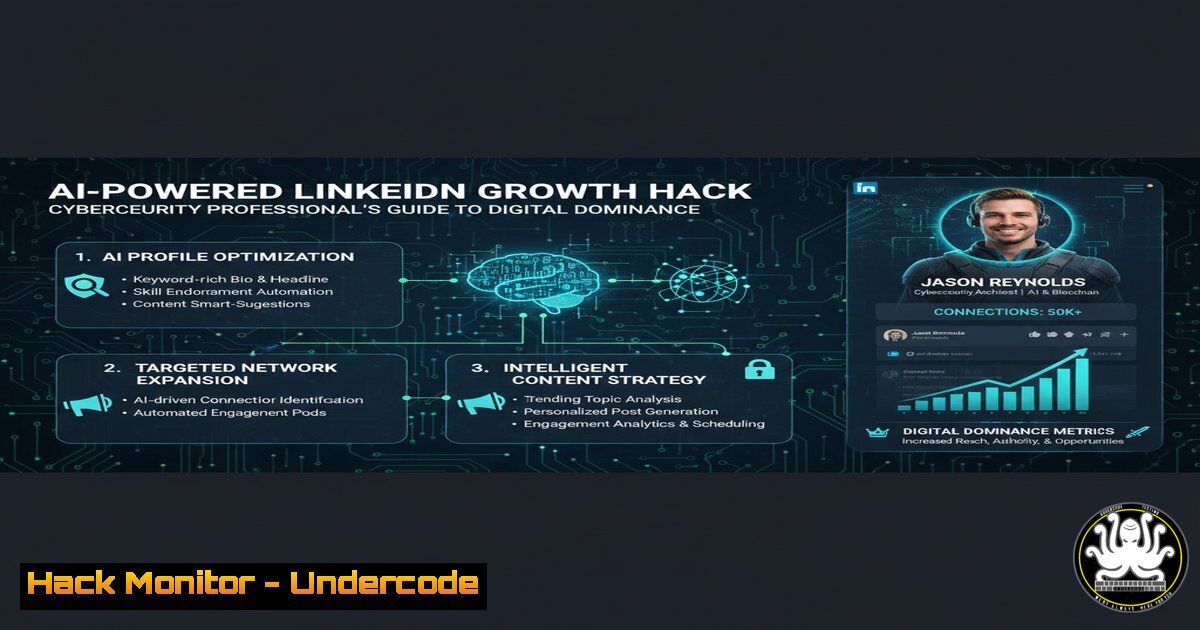
Introduction:
In the evolving digital landscape, LinkedIn has become a prime target for AI-driven social engineering and sophisticated phishing campaigns. Understanding the tools and methodologies behind rapid audience growth is no longer just a marketing concern—it’s a critical cybersecurity imperative. This article deconstructs the technical infrastructure enabling AI-powered LinkedIn automation and provides security professionals with the commands and techniques to both understand and defend against these emerging threats.
Learning Objectives:
- Analyze the security implications of AI-driven LinkedIn growth tools and APIs
- Implement defensive configurations to protect organizational LinkedIn assets
- Develop monitoring strategies to detect automated engagement and connection attempts
You Should Know:
1. API Security: LinkedIn Automation Detection
LinkedIn employs sophisticated detection mechanisms to identify automated activity. Understanding these signals is crucial for both offensive security testing and defensive posture.
 LinkedIn API Rate Limit Monitoring Script
import requests
import time
from datetime import datetime

def monitor_linkedin_activity(api_endpoint, headers):
activity_log = []
for i in range(10):
response = requests.get(api_endpoint, headers=headers)
if response.status_code == 429:
print(f"Rate limit hit at {datetime.now()}")
 Analyze rate limiting headers
retry_after = response.headers.get('Retry-After', 60)
print(f"Retry after: {retry_after} seconds")
activity_log.append({'timestamp': datetime.now(), 'status': 'rate_limited'})
elif response.status_code == 200:
activity_log.append({'timestamp': datetime.now(), 'status': 'success'})
time.sleep(2)
return activity_log
This Python script monitors LinkedIn API interactions, detecting when rate limiting triggers—a key indicator of automated activity that security teams should monitor for compromised accounts.
2. Browser Automation Detection with Selenium
Attackers often use browser automation tools for mass connection requests and content posting.
 Selenium-based automation detection evasion
from selenium import webdriver
from selenium.webdriver.chrome.options import Options
import random
import time

def configure_stealth_browser():
chrome_options = Options()
chrome_options.add_argument("--disable-blink-features=AutomationControlled")
chrome_options.add_experimental_option("excludeSwitches", ["enable-automation"])
chrome_options.add_experimental_option('useAutomationExtension', False)
driver = webdriver.Chrome(options=chrome_options)
driver.execute_script("Object.defineProperty(navigator, 'webdriver', {get: () => undefined})")
return driver

def human_like_interaction(driver, url):
driver.get(url)
 Random delays between actions
time.sleep(random.uniform(2, 5))
 Human-like mouse movements
actions = webdriver.ActionChains(driver)
actions.move_by_offset(random.randint(10, 100), random.randint(10, 100))
actions.perform()
Security teams can use this code to understand how automation tools evade detection, enabling better defensive monitoring and detection rule development.
3. AI Content Generation API Security
The referenced tools (Perplexity.ai, EasyGen.io) leverage AI APIs that could expose sensitive data.
 Curl command to test AI API security headers
curl -I https://api.perplexity.ai/chat/completions \
-H "Authorization: Bearer $API_KEY" \
-H "Content-Type: application/json"

Expected security headers check
echo "Checking security headers:"
echo "X-Content-Type-Options: nosniff"
echo "Strict-Transport-Security: max-age=31536000"
echo "Content-Security-Policy: default-src 'self'"
This command checks for essential security headers when interacting with AI APIs, ensuring proper data protection and preventing content injection attacks.
4. LinkedIn Profile Data Scraping Protection
 Detect and block profile scraping attempts
import re
from flask import Flask, request, jsonify

app = Flask(<strong>name</strong>)

def detect_scraping_patterns(user_agent, request_rate):
scraping_indicators = [
r'bot|curl|scraper|python|selenium',
r'headless',
r'automation'
]

for pattern in scraping_indicators:
if re.search(pattern, user_agent.lower()):
return True

if request_rate > 10:  More than 10 requests per minute
return True

return False

@app.route('/api/profile')
def profile_endpoint():
user_agent = request.headers.get('User-Agent', '')
request_rate = calculate_request_rate(request.remote_addr)

if detect_scraping_patterns(user_agent, request_rate):
return jsonify({'error': 'Access denied'}), 403

return jsonify(profile_data)
This Flask endpoint demonstrates how to detect and block automated scraping attempts targeting LinkedIn profile data.
5. OAuth Token Security for LinkedIn Integrations
 Secure OAuth token management for LinkedIn API
 Generate token with minimal permissions
curl -X POST https://www.linkedin.com/oauth/v2/accessToken \
-H "Content-Type: application/x-www-form-urlencoded" \
-d "grant_type=client_credentials" \
-d "client_id=$CLIENT_ID" \
-d "client_secret=$CLIENT_SECRET" \
-d "scope=r_liteprofile%20r_emailaddress"

Token validation and security checks
openssl x509 -in linkedin_cert.pem -text -noout
jwt decode $ACCESS_TOKEN
These commands ensure proper OAuth token management and validation, preventing unauthorized access to LinkedIn APIs and protecting user data.
6. AI-Generated Content Watermarking
 Detect AI-generated content using statistical analysis
import numpy as np
from sklearn.feature_extraction.text import TfidfVectorizer
from sklearn.ensemble import RandomForestClassifier

class AIContentDetector:
def <strong>init</strong>(self):
self.vectorizer = TfidfVectorizer(ngram_range=(1, 2))
self.classifier = RandomForestClassifier()

def detect_ai_patterns(self, text):
features = self.vectorizer.transform([bash])
prediction = self.classifier.predict_proba(features)
return prediction[bash][1]  Probability of AI-generated content

Usage for security monitoring
detector = AIContentDetector()
ai_probability = detector.detect_ai_patterns(post_content)
if ai_probability > 0.8:
print("Potential AI-generated content detected")
This machine learning approach helps identify AI-generated content that might be used in coordinated influence campaigns or automated social engineering attacks.
7. Network Traffic Analysis for LinkedIn Automation
 Monitor LinkedIn network traffic for automation patterns
tcpdump -i any -w linkedin_traffic.pcap host linkedin.com or host www.linkedin.com

Analyze traffic patterns for automation
tshark -r linkedin_traffic.pcap -Y "http.request.uri contains '/voyager/api/'" \
-T fields -e frame.time -e ip.src -e http.request.uri

Detect suspicious API call frequencies
echo "Analyzing API call patterns:"
tshark -r linkedin_traffic.pcap -Y "http" | grep "voyager-api" | \
awk '{print $3}' | sort | uniq -c | sort -nr
These network analysis commands help security teams detect automated LinkedIn activity by monitoring API call patterns and frequencies that indicate bot behavior.
What Undercode Say:
- The convergence of AI content generation and LinkedIn automation creates new attack vectors for social engineering and corporate espionage
- Security teams must treat AI-powered growth tools as potential threats to organizational digital assets
The technical analysis reveals that AI-driven LinkedIn growth strategies rely on sophisticated automation tools that bypass traditional security controls. These tools create perfect conditions for large-scale social engineering campaigns, as they enable attackers to build credible profiles and establish trust rapidly. The referenced platforms (Perplexity.ai, EasyGen.io, Mission-GPT) represent a new class of AI-as-a-Service tools that lower the barrier to entry for sophisticated influence operations. Security professionals must implement advanced behavioral analytics and API monitoring to detect these automated patterns before they can be weaponized for corporate espionage or credential harvesting campaigns.
Prediction:
Within 18-24 months, AI-powered LinkedIn automation will evolve into fully autonomous social engineering platforms capable of conducting targeted spear-phishing campaigns at scale. These platforms will leverage generative AI to create highly personalized connection requests and messages, making traditional security awareness training insufficient. Organizations will need to deploy AI-powered defense systems that can detect synthetic relationships and artificial engagement patterns in real-time. The arms race between AI-driven influence operations and defensive security measures will define the next generation of corporate digital risk management, with LinkedIn emerging as the primary battleground for AI-vs-AI cybersecurity warfare.
🎯Let’s Practice For Free:
IT/Security Reporter URL:
Reported By: Ruben Hassid – Hackers Feeds
Extra Hub: Undercode MoN
Basic Verification: Pass ✅


