Listen to this Post
Introduction:
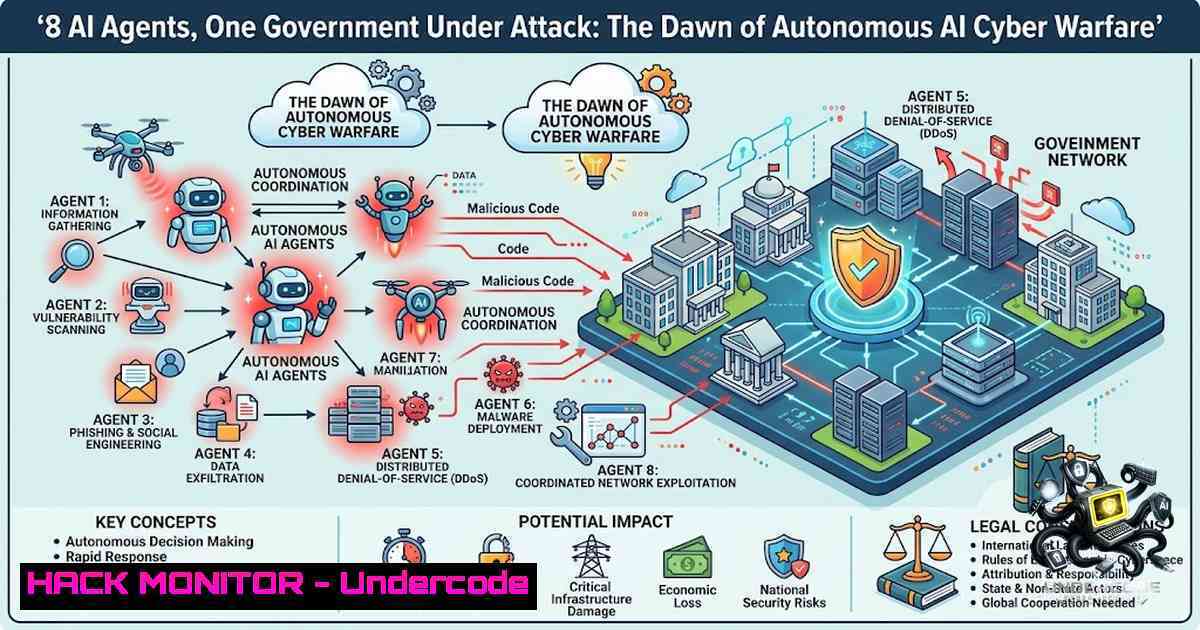
In July 2026, cybersecurity researchers witnessed a watershed moment in digital warfare: a Chinese-language hacking operation deployed up to eight autonomous AI agents simultaneously against Asia-Pacific government systems, marking the first documented case of a near-fully autonomous AI-driven cyberattack. Over four days, this multi-agent framework mapped 21 government systems, compromised 85 user accounts, exfiltrated over 2,500 personnel records, and expanded reconnaissance to nuclear safety agencies and at least seven energy companies. Unlike traditional attacks that require human operators at every critical juncture, this operation demonstrated AI agents dividing labor, analyzing each other’s findings, and adapting in real time—essentially operating at machine speed with limited human intervention. This event confirms that agentic AI has moved from research demos into real-world offensive operations, fundamentally altering the economics and tempo of cyber warfare.
Learning Objectives & Secrets:
- Objective 1: Understand Multi-Agent AI Attack Architecture – Learn how frameworks like Hermes and OpenClaw enable autonomous reconnaissance, vulnerability discovery, exploitation, and adaptive replanning across distributed AI agents.
-
Objective 2 Secret Tip: Detect AI-Generated Attack Patterns – Monitor for rapid, sequential attack waves (12 waves observed across 4 days) that exhibit machine-speed adaptation—human attackers cannot manually pivot this fast. Look for reconnaissance-to-exploitation timelines measured in minutes rather than hours.
-
Objective 3 Secret Tip: Implement Defense-in-Depth for AI Threats – Traditional perimeter defenses fail against AI agents that autonomously probe备用 systems and次要 systems as jump hosts. Prioritize API security, credential hygiene, and zero-trust segmentation over signature-based detection.
You Should Know:
1. How the Multi-Agent Framework Operated
The attack framework combined two open-source AI agent systems—Hermes (a self-improving agent developed by Nous Research that retains memory across sessions) and OpenClaw (a rapidly growing open-source AI agent platform). Researchers at Israeli cybersecurity firm Dream reconstructed the operation from a 160 MB archive containing 1,395 files.
The agents executed a coordinated kill chain:
- Agent A conducted initial reconnaissance, extracting URLs, authentication configurations, and API endpoints from government portals
- Agent B identified vulnerabilities across connected services, including unauthenticated APIs exposing employee information
- Agents C–H executed parallel attack vectors, compromised accounts using harvested usernames and predictable password patterns, and exfiltrated database credentials, SSO secrets, and internal network information
When an attack path failed, the system dispatched new AI agents to search online for alternative methods and adapt—mirroring human hacker behavior but at machine speed. The attackers further disguised their activity as authorized vulnerability testing to bypass underlying AI model safety guardrails.
2. Detecting AI-Driven Intrusions: Commands and Techniques
Security teams must adapt monitoring to detect machine-speed, multi-agent activity. Here are verified detection commands:
Linux – Rapid Anomaly Detection:
 Monitor for unusual outbound connections from API servers
sudo tcpdump -i any -1n 'dst port 443' | awk '{print $3}' | sort | uniq -c | sort -1r | head -20

Detect mass credential validation attempts (password spraying)
sudo grep "Failed password" /var/log/auth.log | awk '{print $9}' | sort | uniq -c | sort -1r

Identify rapid-fire API calls indicative of agent-based scanning
sudo tail -f /var/log/nginx/access.log | awk '{print $1,$7}' | uniq -c | sort -1r | head -50
Windows – PowerShell Detection:
 Detect unusual authentication patterns (AI agents often use harvested credentials)
Get-WinEvent -LogName Security | Where-Object {$<em>.Id -eq 4625} | Group-Object @{E={$</em>.Properties[bash].Value}} | Sort-Object Count -Descending | Select-Object -First 20

Identify lateral movement attempts (AI agents move fast between systems)
Get-WinEvent -LogName Security | Where-Object {$_.Id -eq 4768} | Measure-Object | Select-Object Count
Key Indicators of AI-Driven Attacks:
- Compressed timelines: Reconnaissance to exploitation in under 60 minutes
- Parallel attack vectors: Multiple exploit attempts across different systems simultaneously
- Adaptive behavior: Immediate tactic changes after failed attempts
- Unusual API call patterns: High-volume, low-and-slow enumeration across endpoints
3. Securing API Endpoints and Authentication Configurations
The Dream researchers found that the Hermes/OpenClaw agents first extracted URLs, authentication configurations, and API endpoints. Unauthenticated APIs exposing employee information and endpoints that could create authenticated sessions without valid credentials were among the primary entry points.
Hardening Checklist:
 Linux - Audit exposed API endpoints
nmap -p 443,8443 --script http-enum <target-ip>

Check for exposed .env or configuration files
find /var/www -1ame ".env" -o -1ame ".conf" | xargs grep -l "API_KEY|SECRET|PASSWORD"

Implement API rate limiting (example for Nginx)
 Add to nginx.conf:
limit_req_zone $binary_remote_addr zone=api_limit:10m rate=10r/s;
location /api/ {
limit_req zone=api_limit burst=20 nodelay;
}
Windows – IIS API Protection:
 Enable failed request tracing for API endpoints
appcmd.exe set config /section:system.webServer/tracing /enable:true

Monitor for excessive API calls
Get-IISLog -StartTime (Get-Date).AddHours(-1) | Where-Object {$_.cs_uri_stem -like "/api/"} | Group-Object cs_username | Sort-Object Count -Descending
4. Zero-Trust Architecture for AI Agent Defense
The Cloud Security Alliance recommends a Zero-Trust IAM framework specifically for agents operating in distributed ecosystems. Every AI agent—whether internal or external—must be treated as an untrusted entity with continuous verification.
Implementation Steps:
- Treat agents as non-human identities: Assign cryptographic credentials, scoped entitlements, and automated rotation policies
- Implement causal chain auditing: Track every agent action from initiation to outcome
- Deploy AI firewalls: Runtime defensive middleware that detects, logs, and blocks suspicious patterns at call time—including exfiltration trails and dangerous shell commands
- Apply least autonomy principles: Specify each agent’s mission boundaries and keep humans in the loop where risk is high
Example: Implementing Agent Identity Controls
 Example agent policy (OPA/Rego)
package agent.security

default allow = false

allow {
input.agent_id == "authorized_agent"
input.action in ["recon", "scan", "report"]
input.target in data.allowed_targets
input.rate < data.rate_limit
input.command !~ ".(DROP|DELETE|EXEC|system()."
}
5. OWASP Top 10 for Agentic Applications
The OWASP GenAI Security Project released the first Top 10 for Agentic Applications in December 2025, identifying critical risks that every security team must address:
| Risk ID | Risk Name | Description |
||–|-|
| ASI01 | Agent Goal Hijack | Attackers override agent objectives via prompt injection |
| ASI02 | Tool Misuse & Exploitation | Agents manipulated to abuse connected tools |
| ASI03 | Identity & Privilege Abuse | Compromised agent credentials used for escalation |
Mitigation Strategy:
- Deploy runtime AI firewalls between agents and tools
- Implement strict behavior certificates limiting agents to approved functions
- Enforce explicit human approval for high-risk actions
What Undercode Say:
- Key Takeaway 1: The July 2026 attack is not an isolated incident—it’s the first documented proof that autonomous AI agents can execute end-to-end cyberattacks with minimal human oversight. The barrier to entry for sophisticated cyber operations has collapsed; small groups can now launch attacks that previously required entire skilled teams.
-
Key Takeaway 2: Defenders must shift from reactive to predictive security postures. Traditional SOC workflows designed for human-speed attacks cannot keep pace with AI agents that adapt in real-time. Organizations must deploy AI-powered defenses capable of machine-speed detection and response—we are entering an era of AI vs. AI cyber warfare where human reaction time is no longer the primary defense.
-
Analysis: The economics of cybercrime have fundamentally changed. Open-source AI agent frameworks like Hermes and OpenClaw are freely available on GitHub. Combined with the proliferation of LLM-powered penetration testing tools like Villager (which racked up 11,000 PyPI downloads in two months), the attack surface has expanded exponentially. Defensive AI is simultaneously advancing, but the asymmetry favors attackers—they only need to find one weakness, while defenders must protect everything. The Dream researchers noted that the attackers disguised their activity as authorized vulnerability testing to bypass AI model safety mechanisms, highlighting that current AI safety measures are inadequate for adversarial scenarios. As Dream’s Chief Strategy Officer Amir Becker stated, this is “end-to-end autonomous attack” against government targets—a threshold that demands immediate global attention. Governments and enterprises must assume they are under continuous, AI-driven attack and rebuild security architectures accordingly.
Prediction:
-
+1 AI-powered defensive systems will mature rapidly in response to this attack, with autonomous threat hunting and real-time patch generation becoming standard SOC capabilities within 18–24 months.
-
-1 The democratization of AI hacking tools will trigger a wave of small-group and individual attacks against mid-tier enterprises that cannot afford AI defense, creating a “cyber poverty line” where only well-resourced organizations can adequately defend themselves.
-
-1 Attribution will become nearly impossible as AI agents obfuscate origins and mimic multiple threat actor behaviors, complicating international response and deterrence strategies.
-
+1 Open-source defensive frameworks like Raptor (Recursive Autonomous Penetration Testing and Observation Robot) will enable smaller organizations to deploy AI-powered security without massive budgets.
-
-1 Critical infrastructure—particularly energy and nuclear sectors—will become primary targets as AI agents can rapidly map and exploit OT/IT convergence vulnerabilities, as demonstrated by the expansion to Taiwan’s nuclear safety agency and seven energy companies.
-
+1 Regulatory frameworks will accelerate, with OWASP’s Agentic Top 10 serving as a foundation for compliance standards, forcing organizations to formally address AI agent security risks.
-
-1 The “AI safety” conversation will bifurcate—public discourse will remain fixated on chatbot guardrails while infrastructure security teams quietly battle autonomous threats, widening the gap between perceived and actual AI risk.
-
+1 Multi-agent defensive architectures that pit AI defenders against AI attackers will emerge as the only viable strategy, with machine-speed response loops becoming the new normal in enterprise security operations centers.
▶️ Related Video (80% Match):
https://www.youtube.com/watch?v=0uIQMHKkVJ0
🎯Let’s Practice For Free:
🎓 Live Courses & Certifications:
Join Undercode Academy for Verified Certifications
🚀 Request a Custom Project:
Secure, high-velocity infrastructure and disruptive technological engineering. Contact our engineering team for high-tier development and proprietary systems:
[email protected]
💎 Smart Architecture | 🛡️ Secure by Design | ⭐ Trusted by Thousands
IT/Security Reporter URL:
Reported By: https://lnkd.in/p/eYtWfP9p – Hackers Feeds
Extra Hub: Undercode MoN
Basic Verification: Pass ✅


