
Listen to this Post
Introduction:
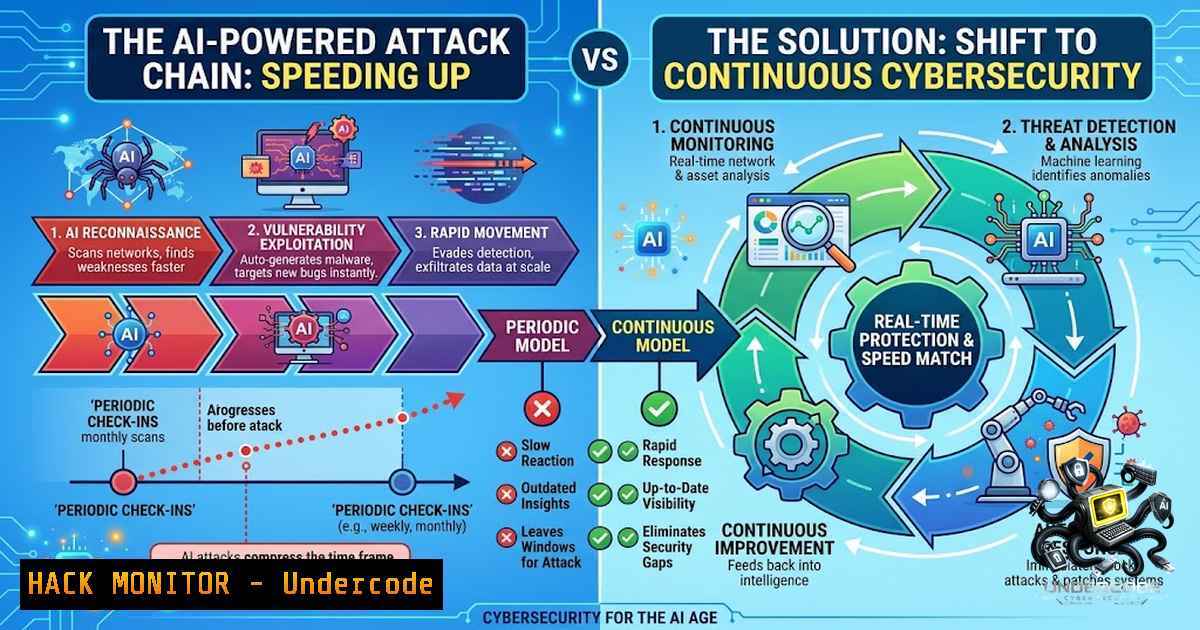
The cyber threat landscape is undergoing a fundamental transformation, not because artificial intelligence can now generate malicious code, but because it can replicate the intricate reasoning of a skilled human attacker. Modern AI systems have evolved to perform the complex, multi-step process of vulnerability research, chaining minor weaknesses—such as a weak password, a misconfigured permission, or an exposed service—into a cohesive and devastating breach. For nations like India, where digital infrastructure underpins banking, payments, government services, telecom, and critical utilities, this evolution renders traditional, periodic security checks dangerously obsolete, demanding a shift towards continuous, AI-powered defense and proactive resilience.
Learning Objectives & Secrets:
- Objective 1: Master Automated Vulnerability Chaining. Understand how AI can correlate low-risk indicators (e.g., “a weak password here”) to map attack paths that are invisible to siloed security tools, enabling preemptive mitigation of multi-vector threats.
- Objective 2 Secret Tip: Implement Continuous Identity and Access Management (IAM) Hygiene. Rather than conducting quarterly access reviews, leverage AI to continuously analyze user behavior and permission anomalies, automatically flagging and revoking “misconfigured permissions” in real-time.
- Objective 3 Secret Tip: Adopt a “Living Off the Land” Defense Strategy. Train your security operations center (SOC) to use AI for mimicking attacker behavior, constantly testing internal systems against attack chains similar to those AI could generate, effectively turning your environment into an active cyber-range.
You Should Know:
1. The Mechanics of AI-Driven Attack Chaining
The post highlights a critical shift: AI can now perform the “difficult work” of reading code and testing exploit variations. This is far more dangerous than simple script-kiddie attacks. Attackers can utilize large language models (LLMs) to analyze source code repositories for logic flaws and then cross-reference these with network scans to identify “exposed services.” To understand this, consider a standard penetration testing workflow now accelerated by AI. A Linux-based AI agent might use `nmap -sV -p-
Step‑by‑step guide explaining what this does and how to use it:
– Step 1 (Scanning): On a Linux attacker machine, run `nmap -sV -p 443,8080,3306
– Step 2 (Analysis): Feed the service names (e.g., “Apache Tomcat 9.0.54”) into an AI model via an API to retrieve known CVE associations and potential exploit code snippets.
– Step 3 (Exploitation): The AI can dynamically write a Python script to test a weak default credential combination. For example, using the `requests` library to attempt login to a web admin panel, iterating through a password list. If successful, the AI moves to find adjacent misconfigurations.
– Step 4 (Persistence): After initial access, the AI scans internal network ranges (192.168.1.0/24) to identify “a misconfigured permission” on a file share, using `smbclient` to enumerate shares with weak NTFS permissions. This step-by-step chaining is what makes the threat so potent.
- Hardening IAM and Software Supply Chain Against AI-Enabled Threats
The post explicitly calls for “better identity and access management (IAM) and controls” and “stronger software supply-chain security.” AI can now automate the discovery of overly permissive roles and insecure dependencies. For defenders, this means using AI to scan Infrastructure-as-Code (IaC) templates for “misconfigured permission[bash].” On a Windows system, administrators must move beyond manual AD checks. Implementing a tool like BloodHound Enterprise, or using PowerShell to query for high-risk privileges, is essential. For supply chain security, consider the use of software bills of materials (SBOMs) and AI-driven analysis to detect suspicious code changes before they are merged.
Step‑by‑step guide explaining what this does and how to use it:
– Step 1 (IAM Audit on Windows): Open PowerShell as Administrator and run `Get-ADGroupMember -Identity “Domain Admins”` to list privileged accounts. Cross-reference this list with a continuous monitoring system that flags inactive or stale accounts.
– Step 2 (Permission Analysis): Use `icacls “C:\SensitiveData”` on Windows to view current permissions. An AI defender could analyze this output against a policy and automatically alert if “Everyone” has read access.
– Step 3 (Supply Chain): For Linux, configure dependency scanning in your CI/CD pipeline. Use `trivy fs –security-checks vuln,secret .` on your repository to scan for vulnerabilities in open-source libraries. Pair this with an AI layer that prioritizes fixes based on exploitability, not just CVSS score.
– Step 4 (API Security): Since modern apps rely on APIs, implement AI to parse API logs. Use a command like `grep “403” /var/log/nginx/access.log` to find unauthorized access attempts, but let AI correlate this with user behavior to detect “exposed services” that are being probed.
3. Building an AI-Powered Security Operations Center (SOC)
The post’s core argument—that if attackers operate continuously, defenders must do the same—is the blueprint for the modern SOC. This requires a shift from “check periodically” to a real-time, data-driven posture. On a Linux server hosting your SIEM, you can deploy open-source AI frameworks like Apache Spark or TensorFlow to analyze netflow data and syslogs for anomalies. The key is not just collecting logs, but utilizing AI to create a baseline of “normal” behavior and flag deviations that indicate the early stages of a chain attack.
Step‑by‑step guide explaining what this does and how to use it:
– Step 1 (Data Ingestion): Configure your SIEM (e.g., using the ELK stack on Linux) to ingest firewall logs via `filebeat` and Windows Event Logs via winlogbeat.
– Step 2 (Anomaly Detection): Write a Python script using the `scikit-learn` library to apply an Isolation Forest algorithm to the log data, identifying rare events that could signal reconnaissance.
– Step 3 (Integration): Use an API gateway to feed high-priority alerts (like a user login from an unusual location followed by an attempt to access an “exposed service”) into a generative AI model. The AI can then generate a natural language summary of the attack chain for the SOC analysts, significantly reducing the mean time to detection (MTTD).
– Step 4 (Automated Response): Implement automated playbooks using tools like TheHive or Shuffle. If AI confirms a high-confidence chain, trigger a script on a Windows domain controller to temporarily disable the compromised user account via Disable-ADAccount -Identity "username".
4. Securing India’s Critical Infrastructure with Sovereign AI
The post specifically mentions India’s digital transformation in banking, telecom, and government services. These sectors are prime targets for state-sponsored and financially motivated attackers using AI. Defenders in these sectors should invest in “AI capabilities that we can inspect, test and deploy ourselves.” This means moving away from black-box AI security products to open-source or transparent models that can be validated against national standards.
Step‑by‑step guide explaining what this does and how to use it:
– Step 1 (Model Selection): Choose an open-source LLM (like Llama 3 or Mistral) to deploy on-premises within your VPC, ensuring data sovereignty.
– Step 2 (Fine-Tuning): Use a Linux server with GPU support (e.g., `nvidia-smi` to check status) to fine-tune the model on internal threat intelligence and incident reports. This creates a contextual AI that understands your specific architecture.
– Step 3 (Testing): Implement a red-team protocol where the AI itself is tested. Use commands like `curl` to send adversarial prompts to the API to test for prompt injection, a growing threat where attackers trick the AI into revealing data or granting unauthorized access.
- The Economics of Defense: Bug Bounties and AI-Driven Resilience
The post advocates for “stronger bug-bounty programs.” With AI lowering the barrier to finding vulnerabilities, the economics of defense must adapt. A robust bug bounty program acts as a “continuous” testing mechanism. Combine this with AI to triage incoming bug reports. On a Linux machine, you can set up a Python script using `pandas` to analyze the CSV output of your bug bounty platform, automatically categorizing findings and prioritizing those that suggest a “chain.”
Step‑by‑step guide explaining what this does and how to use it:
– Step 1 (Triage Automation): Write a script that fetches bug reports via API and uses a keyword search to identify low-severity issues that, when combined, are dangerous (e.g., grep -E "XSS|CORS|IDOR" report.csv).
– Step 2 (Patching Automation): For Windows-based environments, use the `Invoke-WebRequest` cmdlet to query security patch repositories and cross-reference them with discovered weaknesses, ensuring that known exploitable “misconfigured permission[bash]” are patched immediately.
What Undercode Say:
Key Takeaway 1: The threat is not AI’s ability to create malware, but its efficiency in orchestrating complex attack paths from mundane, overlooked vulnerabilities.
Key Takeaway 2: For countries heavily digitizing their infrastructure, the defense strategy must evolve from periodic checks to a continuous, AI-augmented state of operation, leveraging sovereign capabilities.
Analysis around 10 lines:
Atul Kumar’s post correctly identifies the paradigm shift in cybersecurity. The “small weaknesses” he mentions are the foundational elements of a “Living Off the Land” attack, where attackers blend in with normal traffic. The urgency for India is palpable; as the nation builds its Digital Public Infrastructure, the stakes are exceptionally high. The suggestion to focus on bug bounties, IAM, and supply chain security is not just a list of best practices but a necessity. The post implicitly criticizes the “buy a product” mentality, urging a proactive, skill-based, and continuous defense posture. The analysis suggests that the future lies in AI fighting AI, requiring a new cadre of defenders who understand not just networks, but machine learning and code analysis. The call for sovereign AI capability is critical to avoid dependence on foreign tech that might not align with national security interests. Finally, the economic argument—that AI changes the cost-benefit ratio for attackers—means that defenders must leverage the same technology to level the playing field.
Prediction:
-1: The democratization of AI-powered vulnerability chaining will lead to a “dumb” attacker surge, where even unskilled criminals can execute complex breaches, increasing the overall volume of attacks globally.
+1: The cybersecurity industry will see a surge in demand for defensive AI engineers and SOC analysts, creating a new job market and skills revolution, particularly in tech-heavy nations like India.
+N: Unless India rapidly develops and deploys sovereign, transparent AI defense systems, its critical sectors may face a cyber-9/11 scenario, as traditional perimeter defenses fail against AI-driven attacks.
+1: The continuous operation model will force a consolidation of security tools into unified, AI-driven platforms, making security operations more efficient and proactive rather than reactive.
+N: The latency in updating regulations and compliance frameworks will lag behind the technology, leaving a significant gap where attackers can exploit “misconfigured permissions” before new laws mandate their closure.
+1: This crisis will accelerate the adoption of zero-trust architectures and immutable infrastructure, as organizations realize that “periodic checks” cannot compete with “continuous” AI.
▶️ Related Video (84% Match):
🎯Let’s Practice For Free:
🎓 Live Courses & Certifications:
Join Undercode Academy for Verified Certifications
🚀 Request a Custom Project:
Secure, high-velocity infrastructure and disruptive technological engineering. Contact our engineering team for high-tier development and proprietary systems:
[email protected]
💎 Smart Architecture | 🛡️ Secure by Design | ⭐ Trusted by Thousands
IT/Security Reporter URL:
Reported By: https://lnkd.in/p/eV-ra5FV – Hackers Feeds
Extra Hub: Undercode MoN
Basic Verification: Pass ✅


