
Listen to this Post
Introduction:
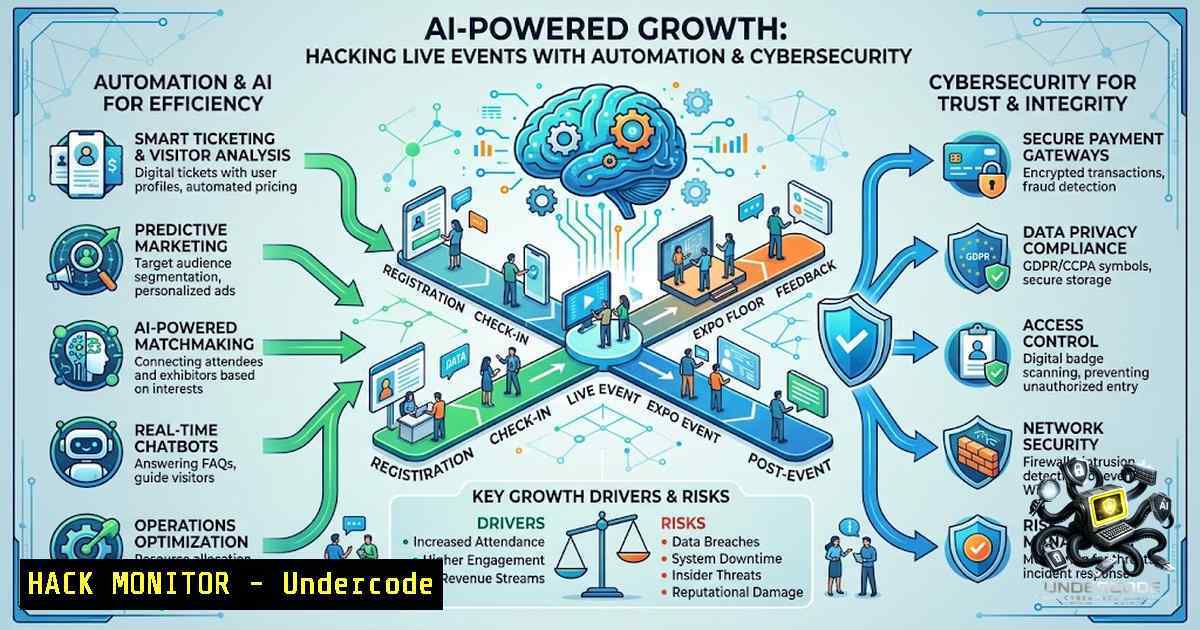
The recent “Growth Hacking Live” event in Dallas, which attracted 400-500 entrepreneurs, underscores a critical shift in business strategy: leveraging Automation and Artificial Intelligence (AI) to scale operations and acquire customers. However, this rapid adoption of AI and automated systems introduces a complex web of cybersecurity, IT infrastructure, and data privacy challenges that must be addressed to ensure sustainable growth. This article provides a technical deep-dive into securing the very tools that power modern business expansion.
Learning Objectives & Secrets:
- Objective 1: Secure Marketing Automation APIs. Understand how to harden API keys and endpoints used to connect CRM, email, and social media automation tools to prevent data breaches.
- Objective 2: Implement AI Model Access Controls. Learn to apply role-based access control (RBAC) and network policies to protect proprietary AI models and training data from internal and external threats.
- Objective 3: Audit Cloud Infrastructure for Scaling. Master the use of cloud-1ative tools to identify and remediate misconfigurations that can be exploited during rapid infrastructure scaling.
You Should Know:
1. API Security for Automation Stack
Modern growth hacking relies heavily on interconnected APIs (e.g., Zapier, Make, HubSpot, Salesforce). A compromised API key can expose sensitive customer data and allow attackers to manipulate automated workflows. To secure this, you must implement a zero-trust model for API access.
Step‑by‑step guide for securing API keys:
- Inventory and Rotate: Identify all API keys in use. Use a secrets management tool like HashiCorp Vault or AWS Secrets Manager to store them.
- Principle of Least Privilege: For each key, restrict permissions to the absolute minimum required. For example, a Zapier connection to your CRM should only have `read` access to contacts and `write` access to tasks, not `delete` or
admin. - Use Short-Lived Tokens: Implement OAuth 2.0 with refresh tokens instead of long-lived static API keys.
- Monitor Usage: Enable CloudTrail or Azure Monitor to log all API calls. Set up alerts for unusual activity, like a sudden spike in data extraction or access from anomalous IP addresses.
Linux Command for Secret Rotation:
 Example: Rotating an API key stored in an environment variable on a Linux server.
 Assume the old key is in $OLD_API_KEY. Generate a new one using a secure method.
NEW_API_KEY=$(openssl rand -base64 32)
 Update the environment variable file (e.g., .env)
sed -i "s/API_KEY=$OLD_API_KEY/API_KEY=$NEW_API_KEY/g" .env
 Export the new key for the current session
export API_KEY=$NEW_API_KEY
 Kill existing processes to force a reload (check your process manager)
pm2 restart all
Windows Command (PowerShell) for Environment Variable Update:
 Generate a new secure key using PowerShell
$newKey = [bash]::ToBase64String([System.Text.Encoding]::UTF8.GetBytes([System.Guid]::NewGuid().ToString()))
 Set the variable permanently for the current user
[bash]::SetEnvironmentVariable("API_KEY", $newKey, "User")
 Reload the environment variables in the current session
$env:API_KEY = $newKey
2. Hardening AI-Powered CRM and Data Platforms
AI tools require vast datasets, often residing in cloud data warehouses or lakes. The security of this data—whether in transit or at rest—is paramount. A misconfiguration in storage buckets or databases is a primary vector for data leaks.
Step‑by‑step guide for data platform hardening:
- Data Encryption: Ensure all data, including backups, is encrypted at rest using AES-256 and in transit using TLS 1.3.
- Network Segmentation: Place your data warehouse (e.g., Snowflake, BigQuery) in a private subnet. Use VPC Service Controls or Azure Private Link to prevent exposure to the public internet.
- Data Masking: Implement dynamic data masking for non-production environments. This ensures that developers working on AI models do not have access to PII (Personally Identifiable Information).
- Audit Logging: Enable audit logs to track all data access. This is crucial for compliance with GDPR, CCPA, and HIPAA.
3. Securing Your Web Application’s Attack Surface
With events and marketing campaigns, web applications face increased traffic and, consequently, a larger attack surface. A simple SQL injection or XSS vulnerability can lead to a complete takeover.
Step‑by‑step guide for application vulnerability mitigation:
- Input Validation: Implement server-side input validation for all user inputs. Use allowlists over denylists.
- Web Application Firewall (WAF): Deploy a WAF (e.g., Cloudflare WAF, AWS WAF) to filter malicious traffic. Enable custom rules to block SQLi and XSS attacks.
- Security Headers: Enforce strict transport security (HSTS), Content Security Policy (CSP), and X-Frame-Options headers.
- Regular Penetration Testing: Schedule automated and manual penetration tests, especially before a major marketing campaign.
4. API Gateway Security and Rate Limiting
To handle a flood of traffic (like 400-500 registrations hitting your backend), your API gateway must be robust and secure. Rate limiting prevents denial-of-service (DoS) attacks, and proper authentication ensures only legitimate requests are processed.
Step‑by‑step guide for gateway configuration:
- Authentication: Use JWT (JSON Web Tokens) passed in the `Authorization` header for stateless authentication.
- Rate Limiting: Configure rate-limiting rules per user or IP address. For example, allow 100 requests per minute for authenticated users and 20 for unauthenticated users.
- Payload Inspection: Inspect incoming JSON payloads against a strict schema to prevent malformed data from crashing your services.
- CORS (Cross-Origin Resource Sharing): Restrict CORS policies to a specific set of authorized domains (e.g., your frontend application’s domain) to prevent cross-site request forgery.
5. Secure Infrastructure Provisioning (IaC)
Automation and scaling mean using Infrastructure as Code (IaC) like Terraform or AWS CloudFormation. While powerful, IaC scripts can contain hardcoded secrets or insecure configurations. These must be scanned and validated as part of the CI/CD pipeline.
Step‑by‑step guide for IaC security:
- Secret Scanning: Integrate a secret scanning tool (like TruffleHog or GitLeaks) into your pre-commit hooks to prevent secrets from being committed.
- Static Analysis: Use tools like Checkov or Terrascan to analyze your IaC scripts for misconfigurations (e.g., open S3 buckets, overly permissive security groups).
- Plan Reviews: Always perform a `terraform plan` review before
apply. Ensure that no unintended changes, such as opening port 22 to0.0.0.0/0, are introduced. - Version Control: Store all IaC in a private repository with strict access controls and branch protection rules.
6. Continuous Monitoring and Incident Response (IR)
Having these security measures is only half the battle. You need a plan to detect and respond to incidents quickly. This is especially critical during a high-profile event when attackers are more likely to target your infrastructure.
Step‑by‑step guide for setting up an IR plan:
- SIEM Integration: Centralize logs from all sources (servers, APIs, databases, WAF) into a SIEM (Security Information and Event Management) like Splunk or a cloud-1ative solution like AWS Security Hub.
- Alerting: Set up alerts for critical events such as multiple failed logins, unauthorized data exports, or malware detection.
- Playbooks: Develop and rehearse playbooks for common scenarios (e.g., data leak, ransomware, DDoS). Ensure the team knows who is responsible for each action.
- Backup and Recovery: Test your backup and recovery procedures regularly. Ensure you can restore data and services within your agreed Recovery Time Objective (RTO).
7. Linux and Server Hardening for Production Environments
Your application servers are the backbone of your growth stack. They must be hardened to withstand attacks.
Linux Hardening Steps:
- SSH Hardening: Disable root login, use key-based authentication, and change the default SSH port.
Edit the SSH config file
sudo nano /etc/ssh/sshd_config
Set these parameters:
PermitRootLogin no
PasswordAuthentication no
Port 2222  Change to a non-standard port
Restart the SSH service
sudo systemctl restart sshd
- Firewall Configuration: Use `ufw` or `iptables` to only open necessary ports (e.g., 80, 443, and your custom SSH port).
sudo ufw default deny incoming
sudo ufw default allow outgoing
sudo ufw allow 80/tcp
sudo ufw allow 443/tcp
sudo ufw allow 2222/tcp
sudo ufw enable
- Regular Updates: Automate security patches using `unattended-upgrades` on Debian/Ubuntu.
sudo apt-get install unattended-upgrades
sudo dpkg-reconfigure --priority=low unattended-upgrades
Choose "Yes" to enable automatic updates
- Intrusion Detection: Install and configure a tool like `fail2ban` to block IP addresses after multiple failed login attempts.
What Undercode Say:
- Key Takeaway 1: The success of a live event growth hack is directly correlated with the resilience and security of the underlying tech stack. A single vulnerability can turn a marketing win into a PR and legal disaster.
- Key Takeaway 2: Automation without security is a double-edged sword. It can scale your business operations, but it also scales your attack surface and potential blast radius of a breach.
- Key Takeaway 3: The human element is the weakest link. Continuous training on security best practices for the entire marketing and development team is not optional; it is a prerequisite for safe growth.
Prediction:
- +1: Businesses that prioritize cybersecurity in their automation and AI strategies will gain a significant competitive advantage by building trust with their customer base, leading to higher customer lifetime value and brand loyalty.
- +1: The adoption of “Security-as-Code” practices (IaC scanning, automated compliance checks) will become the standard for high-growth startups, turning security from a bottleneck into an enabler of rapid, safe innovation.
- -1: As AI and automation become more accessible, the frequency and sophistication of API-based attacks and data poisoning attempts will rise, leading to more significant financial and reputational damage for unprepared organizations.
- -1: Without a corresponding increase in security investment, the next major data breach could very well originate from a poorly secured marketing automation tool, exposing millions of customer records and triggering massive regulatory fines.
▶️ Related Video (90% Match):
🎯Let’s Practice For Free:
🎓 Live Courses & Certifications:
Join Undercode Academy for Verified Certifications
🚀 Request a Custom Project:
Secure, high-velocity infrastructure and disruptive technological engineering. Contact our engineering team for high-tier development and proprietary systems:
[email protected]
💎 Smart Architecture | 🛡️ Secure by Design | ⭐ Trusted by Thousands
IT/Security Reporter URL:
Reported By: https://lnkd.in/p/eA3HMFbc – Hackers Feeds
Extra Hub: Undercode MoN
Basic Verification: Pass ✅


