Listen to this Post
Introduction:
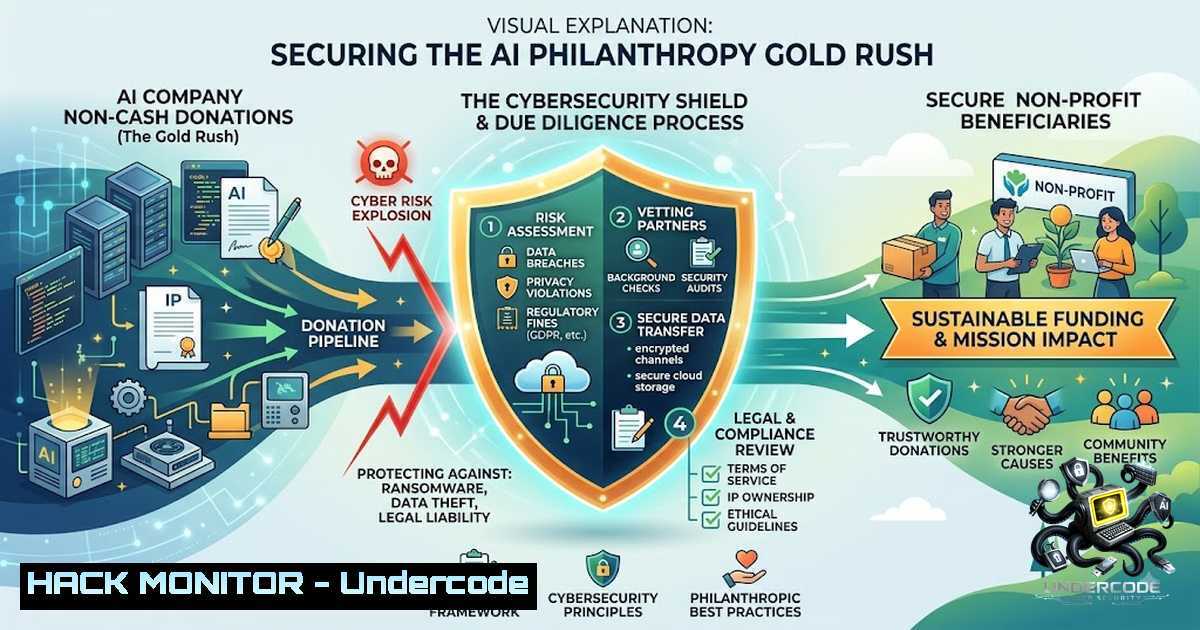
The artificial intelligence boom is generating unprecedented wealth, and Silicon Valley’s elite are channeling billions into philanthropy through Donor-Advised Funds (DAFs)—financial vehicles that allow donors to contribute appreciated private company shares, receive immediate tax deductions, and recommend grants over time. While this influx of non-cash assets is transforming the charity sector, it also introduces significant cybersecurity and financial technology risks. Platforms managing these complex transactions must contend with API vulnerabilities, cloud misconfigurations, and insider threats, making security hardening as critical as the financial engineering driving this new era of giving.
Learning Objectives:
- Understand the cybersecurity implications of Donor-Advised Fund (DAF) platforms processing non-cash assets like pre-IPO stock.
- Identify common vulnerabilities in donation platforms, including stored XSS, information disclosure, and authorization bypass flaws.
- Implement practical security hardening measures across Linux, Windows, and cloud environments to protect donor data and financial integrity.
- Apply API security best practices and fraud detection mechanisms to safeguard non-profit financial infrastructure.
You Should Know:
1. Understanding the Donor-Advised Fund (DAF) Security Landscape
The rapid growth of DAFs—nearly doubling since 2020 to over $320 billion in assets—has made them attractive targets for cybercriminals. Unlike traditional cash donations, these funds handle complex assets like pre-IPO shares, requiring robust validation and verification processes. Platforms like DAF Giving 360 report that three-quarters of all gifts this year were non-cash assets, creating a sprawling attack surface that includes payment APIs, donor portals, and financial reconciliation systems.
Recent vulnerabilities in donation platforms underscore the risks. The GiveWP plugin, for instance, has been found vulnerable to stored cross-site scripting (CVE-2025-7205) due to insufficient input sanitization, unauthenticated stored XSS (CVE-2025-13206), and information exposure (CVE-2025-11227) via missing capability checks. Another vulnerability (CVE-2026-4650) in FundPress allows unauthorized users to access AJAX interfaces due to missing permission validation and sequential donation IDs that can be enumerated.
These flaws highlight a critical reality: as charity platforms become more sophisticated financial intermediaries, they inherit the same security challenges as fintech companies. Non-profit directors must now understand not just fundraising strategy, but also API security, access controls, and vulnerability management.
Step‑by‑step guide to assessing donation platform security:
- Inventory all public-facing endpoints – Identify donation forms, API gateways, and admin interfaces. Use `nmap -sV -p-
` to scan for open ports and services. - Test for common web vulnerabilities – Use OWASP ZAP or Burp Suite to scan for XSS, SQL injection, and CSRF. Pay special attention to donor notes fields and form inputs.
- Review API authentication – Ensure that all AJAX endpoints (like `wp_ajax_nopriv` in WordPress) enforce proper nonce validation and capability checks.
- Check for information disclosure – Verify that functions returning donor data (e.g.,
registerGetForm,registerGetCampaigns) include proper permission checks. - Monitor for enumeration risks – If donation IDs are sequential integers, implement UUIDs or rate-limiting to prevent IDOR attacks.
2. Cloud Hardening for Donation Platforms
Most modern fundraising platforms are hosted in cloud environments like AWS or Azure. Misconfigured S3 buckets or Azure Blob Storage can leak sensitive donor information, including names, addresses, and donation histories. The shared responsibility model means that while cloud providers secure the infrastructure, charities must secure their applications and data configurations.
Key cloud security practices include enabling AWS WAF with rate-based rules to prevent DDoS attacks on donation endpoints, implementing AWS IAM with least-privilege access and MFA for all users, and encrypting donor documents stored in S3 with access logging enabled. Non-profits should also centralize security logging and consider AI-assisted DevOps for rapid threat detection.
Step‑by‑step guide to hardening cloud environments:
- Audit storage permissions – Run `aws s3api get-bucket-acl –bucket
` to check public access. Ensure buckets are private unless explicitly required. - Enable encryption at rest – Use `aws s3api put-bucket-encryption –bucket
–server-side-encryption-configuration ‘{“Rules”:[{“ApplyServerSideEncryptionByDefault”:{“SSEAlgorithm”:”AES256″}}]}’` to enforce encryption. - Configure WAF rules – In AWS Console, create a Web ACL with rate-based rules (e.g., limit 100 requests per 5 minutes per IP) to protect donation endpoints.
- Set up access logging – Enable S3 server access logging to track all requests:
aws s3api put-bucket-logging --bucket <your-bucket> --bucket-logging-status file://logging.json. - Implement IAM least privilege – Create roles with minimum required permissions. Use `aws iam list-attached-user-policies –user-1ame
` to audit existing permissions.
3. Linux Security Auditing for Financial Systems
Linux servers powering donation platforms and financial databases require rigorous auditing to detect unauthorized access and configuration changes. The Linux audit framework (auditd) provides granular monitoring of system calls, file access, and user activity. For PCI-DSS compliance, organizations must enable system audit logging and monitor for failed login attempts, privilege escalation, and changes to critical financial directories.
Step‑by‑step guide to Linux security auditing:
- Install and configure auditd – On Debian/Ubuntu:
sudo apt install auditd -y. On RHEL/CentOS:sudo yum install audit -y. - Monitor failed login attempts – Use `sudo grep “Failed password” /var/log/auth.log` to review authentication failures.
- Audit sudo usage – Run `sudo journalctl -q | grep “sudo.COMMAND”` to see all commands executed with elevated privileges.
- Track file integrity – Install AIDE (Advanced Intrusion Detection Environment): `sudo yum install aide -y` on RHEL, or `sudo apt install aide -y` on Debian. Initialize the database:
sudo aideinit && sudo mv /var/lib/aide/aide.db.new.gz /var/lib/aide/aide.db.gz. Run daily checks:sudo aide --check. - Monitor process execution – Add a rule to track all `execve` system calls:
sudo auditctl -a always,exit -F arch=b64 -S execve -k process_monitoring. View logs withsudo ausearch -k process_monitoring. - Secure SSH configuration – Disable root login:
sudo sed -i 's/PermitRootLogin yes/PermitRootLogin no/' /etc/ssh/sshd_config. Configure UFW to allow only necessary ports:sudo ufw default deny incoming && sudo ufw allow 443/tcp && sudo ufw enable.
4. Windows Security Auditing and PowerShell Commands
Windows environments hosting donation management systems require similar scrutiny. PowerShell provides powerful native auditing capabilities to assess user accounts, permissions, and security configurations. The Windows Security Audit Module offers 58 production-ready PowerShell functions across 14 modules for enterprise-grade security assessment and compliance validation.
Step‑by‑step guide to Windows security auditing:
- Audit local user accounts – Run as Administrator: `Get-LocalUser | Select Name, Enabled, Description, PrincipalSource | Format-Table -AutoSize` to identify disabled or suspicious accounts.
- Review PowerShell audit logs – Use `Get-EventLog -LogName “Windows PowerShell” -1ewest 50` to see recent PowerShell activity.
- Check running processes – `Get-Process | Sort-Object -Property CPU -Descending | Select-Object -First 20` to identify resource-intensive or suspicious processes.
- Enable advanced audit policies – Use `auditpol /set /subcategory:”Detailed File Share” /success:enable /failure:enable` to track file access.
- Generate a comprehensive security report – Use community tools like WINspect or the Windows Security Audit Module to produce structured HTML reports.
-
API Security and Fraud Detection for Donation Platforms
As donation platforms increasingly rely on APIs for payment processing, donor management, and grant recommendations, API security becomes paramount. Best practices include end-to-end encryption of donation form data, PCI-compliant payment processing, and tokenized storage of sensitive information. Fraud detection mechanisms like real-time fraud scoring, billing ZIP code validation, and rate-limiting can significantly reduce fraudulent transactions.
Step‑by‑step guide to API security hardening:
- Implement token-based authentication – Use OAuth 2.0 or JWT with short-lived access tokens and refresh mechanisms.
- Enforce rate limiting – Configure API gateways (e.g., AWS API Gateway, Cloudflare) to limit requests per IP or user.
- Validate all inputs – Sanitize donor notes, names, and form fields to prevent XSS and injection attacks.
- Use digital signatures for transaction integrity – Implement SHA-256 signatures to verify financial transactions.
- Conduct regular penetration testing – Use tools like `ffuf` with wordlists to fuzz API endpoints for hidden vulnerabilities.
- Monitor for anomalous behavior – Set up alerts for unusual donation patterns, such as multiple small donations from the same IP or unusually large non-cash contributions.
6. Mitigating Insider Threats and Privileged Access Risks
The concentration of tech wealth in DAFs creates new insider threat vectors. Employees with access to financial systems, donor databases, and asset valuation tools could exploit their privileges. Native database auditing often lacks visibility into OS-level terminal activity, allowing administrators to execute powerful CLI commands that could modify or delete sensitive financial records.
Step‑by‑step guide to mitigating insider threats:
- Implement privileged access management (PAM) – Restrict and monitor all administrative sessions.
- Enable comprehensive session logging – Record all terminal sessions (SSH, RDP) with tools like `script` or commercial PAM solutions.
- Audit all privileged commands – On Linux, use `auditctl` to monitor `sudo` usage and sensitive file access. On Windows, enable PowerShell transcription logging.
- Enforce separation of duties – Ensure no single individual has both donation approval and asset transfer capabilities.
- Conduct regular access reviews – Quarterly, review all user permissions and remove unnecessary privileges.
What Undercode Say:
- Key Takeaway 1: The AI-driven surge in non-cash donations is forcing charities to become de facto financial institutions, inheriting all the cybersecurity risks of fintech without necessarily having the expertise to manage them.
- Key Takeaway 2: Donor-Advised Fund platforms are vulnerable to the same classes of web application flaws—XSS, IDOR, information disclosure—that plague e-commerce and banking systems. These are not theoretical risks; they are documented, exploitable CVEs.
- Analysis: The convergence of AI wealth, complex financial instruments, and under-resourced non-profit IT departments creates a perfect storm. While billionaires optimize tax efficiency, the platforms processing their donations must rapidly mature their security postures. Cloud misconfigurations, unpatched plugins, and insufficient API authentication are the new threat vectors in philanthropy. The sector needs not just financial advisors but also security architects who understand both the technology and the unique constraints of charitable organizations. Training courses in cloud security, API protection, and financial system auditing should become mandatory for non-profit IT staff. The charity sector is getting richer, but it is also becoming a more attractive target—and the cost of a breach extends beyond financial loss to donor trust and mission credibility.
Prediction:
- -1 As DAF assets continue to grow, cybercriminals will increasingly target donation platforms for data exfiltration and financial fraud, potentially leading to high-profile breaches that erode public trust in tech-driven philanthropy.
- -1 The complexity of non-cash asset processing will outpace the security capabilities of many non-profits, creating a widening gap between the value of assets managed and the rigor of security controls.
- +1 Regulatory bodies will introduce new compliance frameworks specifically for DAF platforms, driving investment in security automation and third-party audits.
- +1 The demand for cybersecurity training tailored to the non-profit and fintech sectors will surge, creating new opportunities for IT professionals specializing in financial system security.
- -1 Insider threats will emerge as a critical concern, as employees with access to pre-IPO share data and donor information become targets for recruitment by competitors or malicious actors.
▶️ Related Video (82% Match):
🎯Let’s Practice For Free:
🎓 Live Courses & Certifications:
Join Undercode Academy for Verified Certifications
🚀 Request a Custom Project:
Secure, high-velocity infrastructure and disruptive technological engineering. Contact our engineering team for high-tier development and proprietary systems:
[email protected]
💎 Smart Architecture | 🛡️ Secure by Design | ⭐ Trusted by Thousands
IT/Security Reporter URL:
Reported By: https://lnkd.in/p/e4VeZuQi – Hackers Feeds
Extra Hub: Undercode MoN
Basic Verification: Pass ✅


