Listen to this Post
Introduction:
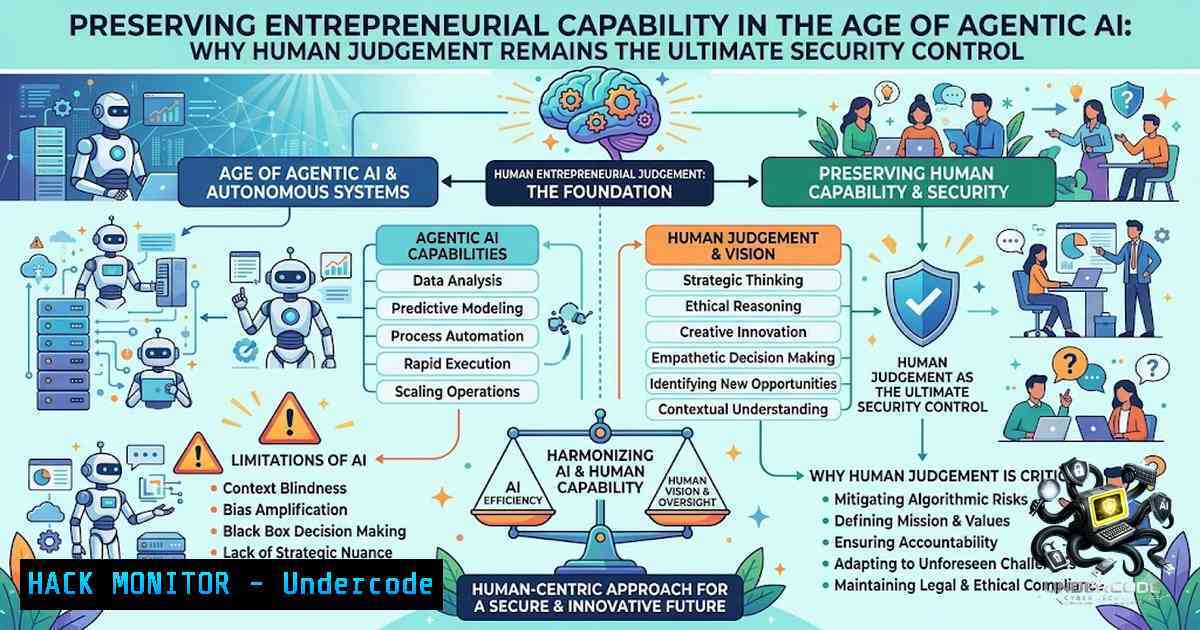
The rapid proliferation of agentic artificial intelligence across marketing, growth hacking, and cybersecurity has created what researchers Liliana Caimacan and Professor Nikhil Soi term “AI adolescence”—a developmental phase where AI systems can generate ideas, structure experimentation, and automate workflows, yet remain incapable of replicating human judgement, contextual wisdom, and accountability. As organisations scale and integrate AI into their entrepreneurial marketing capabilities, the preservation of human-centric decision-making becomes not merely a competitive advantage but a critical security imperative in an era where adversaries leverage the same AI tools to compromise infrastructure in minutes.
Learning Objectives:
- Understand the concept of “AI adolescence” and its implications for entrepreneurial marketing capability preservation during scaleup and acquisition transitions
- Identify the security risks introduced by AI automation across marketing technology stacks and DevSecOps pipelines
- Master practical commands and configurations for securing AI-powered marketing and growth infrastructure
- Implement guardrails that preserve human judgement while leveraging AI for operational efficiency
- Develop a framework for balancing AI automation with human oversight in entrepreneurial environments
You Should Know:
- The Rise of Agentic AI in Marketing and Cybersecurity: A Double-Edged Sword
Agentic AI—systems that use large language models to reason, plan, and execute actions with minimal human guidance—has become embedded across both legitimate business operations and adversary toolkits. The CrowdStrike 2026 Threat Hunting Report reveals that AI agent-triggered detection leads now grow at 2.5 times the rate of human-triggered leads, with 88% of observed attacks incorporating AI-generated payloads and shell commands. Threat actors operationalize AI to exploit vulnerabilities within hours, compressing the traditional cyber kill chain from days to minutes.
For entrepreneurial marketing teams, this creates a paradox: the same AI tools that enable rapid experimentation, content generation, and customer intimacy also introduce attack surfaces that adversaries can exploit. Marketing automation platforms, CRM systems, and AI-powered content generators have become prime targets for credential theft, data exfiltration, and brand impersonation.
Step-by-Step Guide: Auditing Your Marketing AI Stack for Security Gaps
Step 1: Inventory all AI-powered tools in your marketing technology stack, including CRM, email automation, social media management, and content generation platforms.
Step 2: Review API key permissions and access controls using the principle of least privilege. For example, on Linux:
 Audit API keys and secrets in environment variables
env | grep -E "API_KEY|SECRET|TOKEN" > api_audit.log

Check for exposed credentials in version control
git log -p | grep -E "api_key|secret|password" --context=3

Scan for hardcoded secrets using Gitleaks (CI/CD integration)
gitleaks detect --source . --verbose --report-format json --report-path gitleaks-report.json
Step 3: Verify SPF, DKIM, and DMARC configurations to prevent domain spoofing:
 Linux: Check SPF/DMARC records
dig TXT example.com | grep -E "spf|dmarc"

Windows: Using nslookup
nslookup -type=TXT example.com | findstr "spf dmarc"
Step 4: Implement continuous monitoring of third-party integrations. AI-driven Data Loss Prevention (DLP) tools can detect outbound data that violates policy or moves to unauthorized destinations.
- The AI Adolescence Gap: When Automation Outpaces Governance
The concept of “AI adolescence” captures a critical vulnerability: organisations deploy AI systems at machine speed while governance frameworks lag behind. The OWASP Agentic AI Security Maturity Framework, introduced in June 2026, defines six levels of agentic AI adoption, highlighting that most organisations remain at early maturity stages where autonomous systems operate without adequate oversight.
Caimacan and Soi’s research on “Building to Last – Growth Hacking Frameworks, AI Adolescence, and the Preservation of Entrepreneurial Marketing Capability Through Scaleup and Acquisition Transitions” identifies that entrepreneurial capabilities—agility, experimentation, customer intimacy, resource creativity, and fast learning—are fragile. They disappear when teams change, systems become heavier, metrics become standardised, or founder judgement is no longer present.
In security terms, this fragility manifests as “security debt”—the accumulation of unpatched vulnerabilities, misconfigurations, and inadequate access controls that accumulate as organisations scale rapidly. AI can help structure experimentation and make patterns easier to observe, but it cannot replace the contextual wisdom required to prioritise risks and make accountability-driven decisions.
Step-by-Step Guide: Implementing AI Security Guardrails
Based on best practices from Microsoft, Datadog, and CISA’s joint guidance on agentic AI security:
Step 1: Define content standards and policy frameworks for AI tool usage. Establish clear guidelines for what data can be processed by AI systems, what outputs require human review, and what constitutes acceptable use.
Step 2: Implement input and output filtering:
 Example: Basic input sanitisation for AI prompts
import re

def sanitise_prompt(prompt):
 Remove potential prompt injection patterns
prompt = re.sub(r'ignore (previous|all) instructions', '[bash]', prompt, flags=re.IGNORECASE)
prompt = re.sub(r'system:\s', '[bash]', prompt, flags=re.IGNORECASE)
return prompt

Example: Output filtering for sensitive data
def filter_pii_output(output):
 Redact email addresses
output = re.sub(r'[a-zA-Z0-9._%+-]+@[a-zA-Z0-9.-]+.[a-zA-Z]{2,}', '[bash]', output)
 Redact phone numbers
output = re.sub(r'\d{3}[-.]?\d{3}[-.]?\d{4}', '[bash]', output)
return output
Step 3: Deploy guardrails with progressive enforcement—start with moderate thresholds and increase based on testing and feedback:
 Example: guardrails-config.yaml
guardrails:
input_filters:
- type: prompt_injection
action: block
threshold: high
- type: pii_detection
action: annotate
sensitivity: moderate
output_filters:
- type: toxic_content
action: block
- type: factual_accuracy
action: review
require_human: true
Step 4: Schedule periodic audits of configurations and logs. Assign unique identities to every agent and tool; authorise actions with least privilege and short-lived credentials.
- AI-Powered Defensive Tools: Automating Security Without Losing Control
The cybersecurity industry has responded to AI-enabled threats with AI-powered defensive platforms. OpenAI launched Daybreak, an AI-powered cybersecurity platform that secures software repositories, automates vulnerability remediation, and embeds continuous cyber defence directly into DevSecOps workflows. Daybreak combines GPT-5.5 cyber-focused models with Codex Security, an agentic coding system capable of interacting directly with repositories, generating patches, testing fixes in isolated environments, and producing audit-ready remediation reports.
Check Point’s Infinity AI Copilot, trained on 30 years of accumulated cybersecurity intelligence, can cut routine administrative tasks by up to 90%, manage and deploy security policies automatically, and enhance incident mitigation through AI-driven correlation. Tenable Hexa AI automates exposure management with advanced multi-step reasoning, automated remediation workflows, and support for the Model Context Protocol (MCP).
However, as Tenable’s Chief Product Officer Eric Doerr notes: “AI Agents operating without the right guardrails and harness can be unpredictable, brittle, or unsafe in real-world enterprise environments”. The solution is not to avoid automation but to wrap powerful models in the structure, controls, and oversight they need to act reliably and safely at scale.
Step-by-Step Guide: Integrating AI Security Tools into DevSecOps
Step 1: Scan for AI-specific vulnerabilities in your codebase:
 Using ai-security-scan (npm package)
npx ai-security-scan . --report console,sarif --output report.sarif --fail-on high

Using thothctl for infrastructure-as-code scanning
thothctl scan iac -t checkov -t trivy -t opa --enforcement hard
thothctl ai-review analyze -d ./terraform -p ollama
Step 2: Implement AI-assisted security reviews in your CI/CD pipeline:
 .github/workflows/security.yml
name: AI Security Scan
on: [push, pull_request]
jobs:
security-scan:
runs-on: ubuntu-latest
steps:
- uses: actions/checkout@v3
- name: Run AI Security Scan
run: npx ai-security-scan ./src --fail-on high
- name: Run SAST
run: bandit -r ./src -f json -o bandit-report.json
- name: Check dependencies
run: pip-audit --format json --output dependency-audit.json
Step 3: Configure automated vulnerability remediation workflows. Tools like Tenable Hexa AI can create and route tickets, generate tailored policies, and produce audit-ready reports as part of an automated workflow.
Step 4: Implement Model Context Protocol (MCP) support for custom agent development, allowing organisations to build workflows that fit existing processes rather than relying solely on fixed vendor-defined actions.
- The Human Element: Preserving Entrepreneurial Judgement in an AI-Driven World
The most critical insight from Caimacan and Soi’s research is that AI can support entrepreneurial marketing capability, but only if leaders understand what must be preserved, not only what can be automated. Entrepreneurial marketing capability—the ability to experiment rapidly, maintain customer intimacy, exercise resource creativity, and learn quickly—cannot be outsourced to AI systems.
In cybersecurity terms, this means recognising that human judgement remains the ultimate security control. AI can generate ideas, support growth systems, structure experimentation, and make patterns easier to observe. But it cannot replace human judgement, contextual wisdom, accountability, or entrepreneurial instinct.
The OWASP Top 10 for Agentic Applications 2026 identifies “Excessive Agency” as a critical security risk. When AI systems are granted too much autonomy without appropriate oversight, they can make decisions that undermine security, compliance, and business objectives. The CISA and NSA joint guidance recommends that current agentic deployments be limited to low-risk, non-sensitive tasks, with the expectation that this threshold will rise as the security community matures its controls.
Step-by-Step Guide: Building Human-in-the-Loop AI Governance
Step 1: Establish clear accountability structures. Assign an overall owner for AI use and develop an AI strategy that includes risk management processes.
Step 2: Implement a co-pilot model where AI speeds up execution but humans retain final decision authority:
 Example: Human-in-the-loop approval workflow
def process_ai_recommendation(recommendation, risk_score):
if risk_score < 0.3:
 Low risk: auto-approve with logging
auto_approve(recommendation)
log_action("auto_approved", recommendation)
elif 0.3 <= risk_score < 0.7:
 Medium risk: flag for human review
create_review_ticket(recommendation, priority="medium")
else:
 High risk: require human approval
create_approval_request(recommendation, required_signoff="security_lead")
Step 3: Regularly review AI output to catch bias, prevent deviation from instructions, ensure inclusivity, and verify personalisation aligns with brand standards.
Step 4: Maintain audit trails and real logging for all AI-driven decisions. Implement review flags on sensitive content and ensure explainability in AI systems.
5. Practical Commands for Securing AI-Powered Marketing Infrastructure
Linux Commands for Security Auditing:
 Audit all running processes for AI-related services
ps aux | grep -E "python|node|ollama|llama|gpt" | grep -v grep

Check open ports and listening services
netstat -tulpn | grep LISTEN

Monitor API call logs in real-time
tail -f /var/log/nginx/access.log | grep -E "api|v1|graphql"

Scan for vulnerabilities in dependencies
pip-audit --format json --output dependency-audit.json
npm audit --json > npm-audit.json

Check for exposed environment variables
find . -1ame ".env" -o -1ame ".env." | xargs cat | grep -E "API_KEY|SECRET"
Windows Commands for Security Auditing:
 Check for running AI-related processes
Get-Process | Where-Object {$_.ProcessName -match "python|node|ollama"}

Audit open ports
netstat -an | findstr LISTENING

Search for credentials in files
Get-ChildItem -Recurse -Include .env,.json,.config | Select-String -Pattern "api_key|secret|password"

Check Windows Event Logs for suspicious activity
Get-WinEvent -LogName Security -MaxEvents 50 | Where-Object {$_.Id -in (4624,4625,4672)}
API Security Configuration:
 Generate a secure API key
openssl rand -base64 32

Validate JWT tokens
 Example using jq to decode JWT
echo "eyJhbGciOiJIUzI1NiIsInR5cCI6IkpXVCJ9..." | jq -R 'split(".") | .[bash] | @base64d | fromjson'

Test API endpoint security
curl -X GET https://api.example.com/v1/health -H "Authorization: Bearer $API_KEY" -v
What Undercode Say:
- Key Takeaway 1: AI is a tool, not a replacement. Entrepreneurial marketing capability—agility, experimentation, customer intimacy, resource creativity, and fast learning—must be preserved through human judgement. AI can augment these capabilities but cannot replicate the contextual wisdom and accountability that founders and leaders bring.
-
Key Takeaway 2: Governance must scale with automation. As organisations adopt AI at machine speed, governance frameworks must evolve to match. The OWASP Agentic AI Security Maturity Framework and CISA’s joint guidance provide essential roadmaps for balancing AI automation with human oversight.
Analysis:
The convergence of AI-driven marketing automation and AI-powered cyber threats creates a unique challenge for entrepreneurial organisations. The same AI tools that enable rapid growth and experimentation also introduce attack surfaces that adversaries can exploit with machine-speed precision. The CrowdStrike 2026 Threat Hunting Report’s finding that AI agent-triggered detections grew at 2.5 times the rate of human-triggered leads underscores the urgency of this challenge.
However, the solution is not to abandon AI but to implement it with appropriate guardrails. Tools like OpenAI’s Daybreak, Check Point’s Infinity AI Copilot, and Tenable’s Hexa AI demonstrate that AI can be harnessed for defence as effectively as it is used for offence. The key is maintaining human oversight, implementing least-privilege access controls, and preserving the entrepreneurial judgement that made organisations valuable in the first place.
The research presented by Caimacan and Soi at the 39th Global Research Conference on Marketing and Entrepreneurship provides a crucial framework for understanding this balance. As organisations scale and integrate AI, the preservation of human-centric decision-making becomes not merely a competitive advantage but a critical security imperative. AI adolescence is a phase that organisations must navigate carefully—embracing AI’s capabilities while maintaining the human judgement that ultimately determines success or failure.
Prediction:
- +1 Organisations that successfully implement human-in-the-loop AI governance frameworks will achieve 40-60% faster incident response times while maintaining higher accuracy in threat prioritisation, as AI handles routine analysis while humans focus on complex decision-making.
-
+1 The integration of AI-powered security tools like Daybreak and Hexa AI into DevSecOps pipelines will reduce mean time to remediation (MTTR) for critical vulnerabilities from days to hours, enabling entrepreneurial teams to maintain agility without compromising security.
-
-1 Organisations that fail to implement adequate AI guardrails will experience a 3x increase in security incidents related to prompt injection, data leakage, and excessive agency, as adversaries increasingly target AI-powered marketing and growth infrastructure.
-
-1 The gap between AI-powered attacks and human-paced defence will widen, with CrowdStrike projecting that AI agent-triggered threats will outpace human-triggered threats by a factor of 5:1 by 2027, forcing organisations to either adopt AI defence or face inevitable compromise.
-
+1 The emergence of standardised frameworks like OWASP’s Agentic AI Security Maturity Framework and CISA’s joint guidance will enable organisations to benchmark their AI security posture and implement progressive controls, reducing the governance gap between AI deployment and security oversight.
-
+1 Entrepreneurial organisations that preserve human judgement while leveraging AI for operational efficiency will outperform competitors by 2:1 in both growth metrics and security resilience, as they maintain the agility and customer intimacy that AI alone cannot replicate.
▶️ Related Video (74% Match):
https://www.youtube.com/watch?v=0oUFQFdm7Fc
🎯Let’s Practice For Free:
🎓 Live Courses & Certifications:
Join Undercode Academy for Verified Certifications
🚀 Request a Custom Project:
Secure, high-velocity infrastructure and disruptive technological engineering. Contact our engineering team for high-tier development and proprietary systems:
[email protected]
💎 Smart Architecture | 🛡️ Secure by Design | ⭐ Trusted by Thousands
IT/Security Reporter URL:
Reported By: https://lnkd.in/p/eZJ6dNcq – Hackers Feeds
Extra Hub: Undercode MoN
Basic Verification: Pass ✅


