Listen to this Post
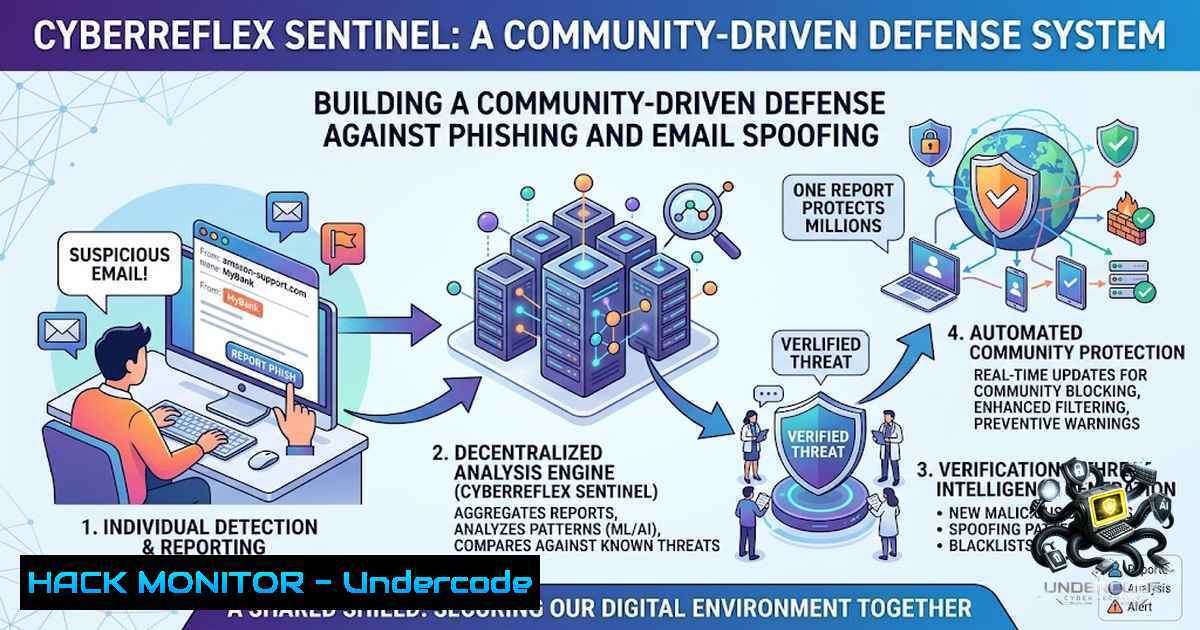
Introduction:
As cybercriminals increasingly leverage sophisticated social engineering and domain impersonation, the traditional human eye is no longer sufficient to distinguish legitimate institutional communications from fraudulent ones. The CyberReflex initiative addresses this critical gap by building a collaboratively curated, verified database of official email senders and known phishing domains, enabling real-time visual certification of email authenticity directly within the user’s inbox.
Learning Objectives:
- Understand the architecture and operational methodology of community-driven email authentication databases like CyberReflex.
- Master technical techniques for email header analysis, SPF/DKIM/DMARC validation, and phishing detection using both manual and automated tools.
- Learn to implement organizational defenses against business email compromise (BEC), spoofing, and social engineering attacks.
You Should Know:
1. The CyberReflex Methodology: Community-Curated Email Intelligence
The core innovation behind CyberReflex is its collaborative approach to email security. Unlike traditional spam filters that rely on algorithmic pattern matching, CyberReflex builds a verified database of legitimate institutional senders—including banks, government agencies, and service providers—alongside a constantly updated blacklist of known phishing domains. As highlighted in the recent update, the database now includes official email addresses from Banque Populaire Région Ouest, Crédit Agricole Anjou Maine, ANTS, CPAM de Loire-Atlantique, CAF de Loire-Atlantique, Orange, SFR, Free, EDF, and Octopus Energy, among others.
How It Works:
- When an email arrives, the CyberReflex browser extension checks the sender’s signature against its secure database.
- A visual badge is displayed directly in the email list, certifying institutional and official senders.
- Phishing attempts—such as fake fine notifications (ANTAI) or compromised Ameli account alerts—are flagged instantly.
- The database is enriched daily through user reports and manual verification by security professionals.
Step-by-Step Guide to Contributing to CyberReflex:
- Visit the official website at www.cyberreflex.fr to install the browser extension.
- Upon receiving a suspicious email, use the extension to flag it for review.
- For organizations, submit official email coordinates and client-facing website URLs to help expand the verified database.
- Each submission undergoes meticulous verification to ensure data accuracy before integration.
- The extension currently supports Gmail, Orange Mail (Webmail), and IONOS Webmail, with Outlook and SFR in development.
-
Email Header Forensics: The Technical Foundation of Phishing Detection
To truly understand why tools like CyberReflex are necessary, one must grasp the technical underpinnings of email authentication. Email headers contain a treasure trove of forensic data that can reveal spoofing attempts, malicious routing, and authentication failures.
Key Header Fields to Analyze:
- Return-Path: The actual sender’s domain, often different from the “From” field.
- Received-SPF: Shows whether the sending server is authorized by the domain’s SPF record.
- DKIM Signature: Cryptographic signature verifying the email’s integrity and authenticity.
- Authentication-Results: Contains DMARC, SPF, and DKIM results from the receiving server.
- Message-ID: Unique identifier that can be traced across mail servers.
Linux Command-Line Email Analysis:
 Extract raw email headers from an .eml file
cat suspicious_email.eml | grep -E "^Received:|^Return-Path:|^From:|^DKIM-Signature:|^Authentication-Results:"

Parse and validate SPF records for a domain
dig -t TXT example.com | grep "spf"

Check DMARC policy for a domain
dig -t TXR _dmarc.example.com

Use WhatMail for comprehensive header analysis
git clone https://github.com/z0m31en7/WhatMail.git
cd WhatMail
python3 whatmail.py -f suspicious_email.eml
The WhatMail tool provides detailed information about fields like Message-ID, Return-Path, Reply-To, X-Headers, MIME Version, Received-SPF, DKIM Signature, Authentication-Results, and DMARC Results.
Windows PowerShell Email Header Analysis:
 Extract headers from an .eml file
Get-Content suspicious_email.eml | Select-String -Pattern "^Received:|^From:|^Return-Path:"

Use Python-based tools like Elyzer
python elyzer.py -f suspicious_email.eml -pa
Elyzer is a Python-based email header analyzer capable of detecting potential spoofing attempts.
- Implementing SPF, DKIM, and DMARC for Organizational Defense
Organizations must move beyond reactive measures and implement proactive email authentication protocols. SPF (Sender Policy Framework), DKIM (DomainKeys Identified Mail), and DMARC (Domain-based Message Authentication, Reporting & Conformance) form the trifecta of email security.
SPF Configuration:
- SPF specifies which servers are authorized to send emails on behalf of your domain.
- Example SPF record: `v=spf1 mx include:spf.protection.outlook.com -all`
– Use `dig -t TXT yourdomain.com` to verify existing SPF records.
DKIM Implementation:
- DKIM adds a digital signature to outgoing emails.
- Generate a 2048-bit RSA key pair and publish the public key in your DNS.
- Example DKIM record: `default._domainkey.yourdomain.com` with the public key.
DMARC Policy:
- DMARC tells receiving servers what to do with emails that fail SPF or DKIM checks.
- Policies: `none` (monitor only), `quarantine` (mark as spam), or `reject` (block entirely).
- Example DMARC record: `v=DMARC1; p=reject; rua=mailto:[email protected]`
– Missing or weak DMARC policies leave domains highly vulnerable to spoofing.
Automated SPF/DKIM/DMARC Validation:
 Using Spoof Checker (GitHub: pentestfunctions/spoof_checker)
git clone https://github.com/pentestfunctions/spoof_checker.git
cd spoof_checker
python3 spoof_checker.py -d example.com
This tool automatically discovers subdomains and analyzes their email security configurations, identifying those vulnerable to spoofing attacks.
- Advanced Phishing Detection: AI and Machine Learning Integration
The next generation of email security leverages artificial intelligence to detect threats that evade traditional signature-based filters. CyberReflex is actively developing an AI-powered diagnostic engine that learns from each new threat to predict future attacks.
AI-Driven Detection Techniques:
- Natural Language Processing (NLP): Analyzes email content for urgency, threats, and psychological manipulation cues.
- Anomaly Detection: Identifies deviations from normal communication patterns.
- URL Reputation Analysis: Checks links against real-time threat intelligence feeds.
- Attachment Sandboxing: Executes suspicious attachments in isolated environments.
Practical AI Integration for Security Teams:
 Example: Using Python for basic email phishing detection
import re
import dns.resolver

def check_spf(domain):
try:
answers = dns.resolver.resolve(domain, 'TXT')
for rdata in answers:
if 'v=spf1' in str(rdata):
return str(rdata)
except:
return "SPF record not found"
return "No SPF record"

def analyze_email_headers(eml_file):
 Extract and analyze headers for spoofing indicators
with open(eml_file, 'r') as f:
content = f.read()
 Check for common phishing indicators
if 'urgent' in content.lower() or 'immediate action' in content.lower():
print("Warning: Urgency language detected")
 Extract authentication results
auth_match = re.search(r'Authentication-Results:.?(spf|dkim|dmarc)', content, re.IGNORECASE)
if auth_match:
print(f"Authentication found: {auth_match.group(0)}")
- Building a Security Awareness Culture: Training and Simulations
Technology alone cannot prevent phishing; human vigilance remains the last line of defense. Organizations must implement comprehensive security awareness training programs that simulate real-world attacks and provide contextual remediation.
Key Training Components:
- Phishing Simulations: Regularly test employees with realistic phishing emails.
- Social Engineering Awareness: Educate staff on BEC, voice phishing (vishing), and SMS phishing (smishing).
- Incident Reporting: Establish clear procedures for reporting suspicious emails.
- Continuous Assessment: Measure risk at the individual level rather than through population-level click rates.
Recommended Training Resources:
- CISA’s Phishing Email Analysis course.
- CYRUS Email Header Analysis training.
- Montimage Phishing Detection Training Platform.
- Incident Response: What to Do When Phishing Succeeds
Despite best efforts, breaches occur. A well-defined incident response plan minimizes damage.
Immediate Actions:
1. Isolate: Disconnect affected systems from the network.
- Preserve Evidence: Save the phishing email with full headers (.eml format).
- Analyze: Determine the scope—was it a credential harvest, malware delivery, or wire transfer request?
- Contain: Reset compromised credentials, revoke session tokens, and block malicious domains.
5. Report: Notify relevant authorities (e.g., CERT, Cybermalveillance.gouv.fr).
- Remediate: Apply patches, update security controls, and retrain affected users.
Forensic Command Examples:
 Extract all URLs from a phishing email
grep -oE 'https?://[^ ]+' suspicious_email.eml

Check domain reputation
whois suspicious-domain.com

Trace email routing
cat suspicious_email.eml | grep "Received:" | tail -1 10
What Undercode Say:
- Key Takeaway 1: Community-driven intelligence sharing is a powerful force multiplier in cybersecurity. Platforms like CyberReflex demonstrate that collective vigilance—where every reported email strengthens the entire user base—can outpace isolated, siloed defenses. The daily enrichment of the database with verified official senders and scam attempts creates a dynamic, self-improving security ecosystem.
-
Key Takeaway 2: The human element remains both the weakest link and the greatest asset. While technical controls like SPF, DKIM, and DMARC are essential, they are not foolproof. Attackers increasingly exploit psychological manipulation—urgency, authority, and fear—to bypass technical safeguards. Continuous, contextual security awareness training is non-1egotiable. The CyberReflex approach of providing immediate visual certification directly addresses this by giving users a simple, actionable signal they can trust.
Analysis: The evolution of phishing attacks from crude, easily detectable scams to highly personalized, context-aware spear-phishing campaigns demands a multi-layered defense strategy. CyberReflex’s hybrid model—combining a curated database with AI-driven analysis—represents a pragmatic response to this reality. However, its effectiveness hinges on two critical factors: the breadth and accuracy of its database, and user adoption. The manual verification process described ensures data integrity, but scalability will require automation. Furthermore, the extension’s current limitation to specific webmail interfaces (Gmail, Orange, IONOS) restricts its impact. The planned expansion to Outlook, SFR, and a proprietary secure messaging service suggests a clear roadmap toward broader protection. Organizations should view tools like CyberReflex as complementary to—not a replacement for—robust email authentication protocols and ongoing employee training.
Expected Output:
Introduction:
The CyberReflex initiative exemplifies how community collaboration can fortify email security against increasingly sophisticated phishing campaigns. By maintaining a verified database of official senders and known threats, it provides users with real-time, visual authentication that bridges the gap between technical complexity and human decision-making.
What Undercode Say:
- Community-sourced threat intelligence, when properly verified, creates a powerful, self-reinforcing defense network.
- Technical controls must be paired with user-friendly interfaces and continuous awareness training to effectively mitigate phishing risks.
Prediction:
- +1 The integration of AI-driven threat prediction into platforms like CyberReflex will dramatically reduce detection latency, enabling preemptive blocking of zero-day phishing campaigns.
- +1 As regulatory frameworks (e.g., NIS2, DORA) mandate stricter email authentication, adoption of DMARC and collaborative threat intelligence platforms will become a compliance imperative.
- +1 The shift toward browser-based security extensions and secure messaging services signals a broader trend of embedding security directly into user workflows, rather than relying on perimeter defenses.
- -1 The proliferation of AI-generated phishing content—including deepfake voices and perfectly crafted emails—will outpace traditional detection methods, making community-driven databases even more critical but also harder to maintain.
- -1 Without universal adoption and interoperability standards, fragmented security solutions will leave gaps that attackers can exploit, particularly in cross-organizational communications.
This article is based on the CyberReflex initiative and general cybersecurity best practices. For the latest updates, visit www.cyberreflex.fr.
▶️ Related Video (78% Match):
🎯Let’s Practice For Free:
🎓 Live Courses & Certifications:
Join Undercode Academy for Verified Certifications
🚀 Request a Custom Project:
Secure, high-velocity infrastructure and disruptive technological engineering. Contact our engineering team for high-tier development and proprietary systems:
[email protected]
💎 Smart Architecture | 🛡️ Secure by Design | ⭐ Trusted by Thousands
IT/Security Reporter URL:
Reported By: Steven Triballeau – Hackers Feeds
Extra Hub: Undercode MoN
Basic Verification: Pass ✅


