Listen to this Post
Introduction:
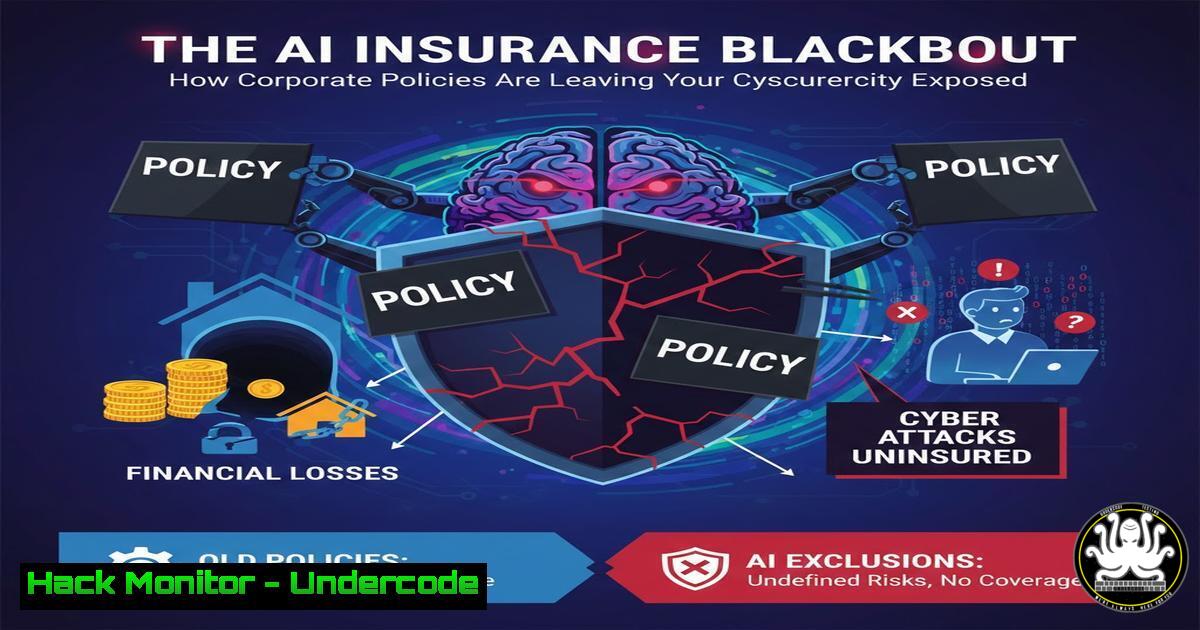
A seismic shift is occurring in the cyber insurance landscape as major providers like AIG, Great American, and WR Berkley seek regulatory approval to exclude artificial intelligence-related liabilities from corporate policies. This move creates a critical coverage gap for businesses that have already integrated AI tools like chatbots and autonomous agents into their core operations, leaving them financially exposed to novel threats and multibillion-dollar claims. The insurance industry’s retreat signals a fundamental recognition of AI’s unquantifiable risks, effectively stranding corporations with a technology they cannot control or adequately secure.
Learning Objectives:
- Understand the specific AI-related liabilities being excluded from modern cyber insurance policies
- Learn technical methods to monitor and control unauthorized AI usage within corporate environments
- Develop mitigation strategies for AI-enabled cyber threats that may no longer be covered by insurance
You Should Know:
- The Expanding Attack Surface: AI Tools in Your Environment
The insurance exclusions specifically target AI tools including chatbots and autonomous agents that have proliferated across corporate departments without proper governance. Most organizations lack visibility into where these tools are deployed, creating unknown liabilities.
Step-by-step guide:
First, conduct a comprehensive inventory using these methods:
Linux/MacOS Command Line Discovery:
 Find Python AI/ML packages in environment
pip list | grep -i "tensorflow|pytorch|transformers|openai|langchain"

Check for AI-related processes and network connections
ps aux | grep -i "chatbot|ai|ml"
lsof -i | grep -E "(openai|anthropic|cohere)"

Scan for unauthorized AI API keys in code and config files
grep -r "sk-" /path/to/codebase/ --include=".py" --include=".env"
Windows PowerShell Commands:
 Check for AI-related installed applications
Get-WmiObject -Class Win32_Product | Select-Object Name,Version | Where-Object {$_.Name -match "AI|Machine Learning"}

Monitor network connections to AI service providers
Get-NetTCPConnection | Where-Object {$_.RemoteAddress -match "..(openai|anthropic).com"}
2. API Security Hardening for AI Services
AI exclusions often apply to data breaches through compromised AI APIs. Implementing robust API security controls becomes essential when insurance coverage disappears.
Step-by-step guide:
Configure your API gateways and middleware with these security measures:
 Example: AI API security wrapper with rate limiting and input validation
from flask import Flask, request, jsonify
from flask_limiter import Limiter
import re
import os

app = Flask(<strong>name</strong>)
limiter = Limiter(app, key_func=lambda: request.remote_addr)

Rate limit AI API calls to prevent cost-based attacks
@app.route('/api/chatbot', methods=['POST'])
@limiter.limit("10 per minute")
def chatbot_proxy():
user_input = request.json.get('message', '')

Input validation and sanitization
if len(user_input) > 1000:
return jsonify({"error": "Input too long"}), 400

Prevent prompt injection attacks
malicious_patterns = [r"ignore previous", r"system:", r"human:"]
for pattern in malicious_patterns:
if re.search(pattern, user_input, re.IGNORECASE):
return jsonify({"error": "Invalid input detected"}), 400

Add your AI service call here with proper error handling
return jsonify({"response": "Processed securely"})

if <strong>name</strong> == '<strong>main</strong>':
app.run(ssl_context='adhoc')  Always use HTTPS
3. Monitoring AI-Generated Code and Scripts
Insurance policies may exclude incidents stemming from AI-generated code containing vulnerabilities. Implement rigorous code analysis pipelines.
Step-by-step guide:
Integrate these security checks into your CI/CD pipeline:
 GitHub Actions example for AI code scanning
name: Security Scan for AI-Generated Code
on: [push, pull_request]
jobs:
code-analysis:
runs-on: ubuntu-latest
steps:
- uses: actions/checkout@v3
- name: Semgrep SAST Scan
uses: returntocorp/semgrep-action@v1
with:
config: "p/security-audit"
- name: AI Code Detection
run: |
 Detect likely AI-generated patterns
grep -r "as an AI language model" src/ && exit 1
grep -r "I cannot" src/ && exit 1
- name: Dependency Check
uses: dependency-check/Dependency-Check_Action@main
with:
project: 'AI-Security-Check'
path: '.'
4. Data Loss Prevention for AI Interactions
Sensitive data exposure through AI chatbots represents a significant uninsured liability. Implement comprehensive DLP controls.
Step-by-step guide:
Deploy these monitoring rules and technical controls:
Linux Data Monitoring:
 Monitor outbound data to AI service IP ranges
tcpdump -i any -A 'host api.openai.com and port 443' | \
grep -E "(SSN|credit|password|secret)" &

Real-time log monitoring for sensitive data
tail -f /var/log/ai-applications.log | \
grep -E "\b\d{3}-\d{2}-\d{4}\b|\b[A-Za-z0-9._%+-]+@[A-Za-z0-9.-]+.[A-Z|a-z]{2,}\b"
Windows Data Monitoring:
 Monitor clipboard for sensitive data being copied to AI tools
Add-Type -AssemblyName System.Windows.Forms
while($true) {
if([Windows.Forms.Clipboard]::ContainsText()) {
$text = [Windows.Forms.Clipboard]::GetText()
if($text -match "\b\d{3}-\d{2}-\d{4}\b") {
Write-EventLog -LogName Application -Source "AI DLP" -EntryType Warning -EventId 1001 -Message "PII detected in clipboard"
}
}
Start-Sleep -Seconds 5
}
5. AI-Specific Incident Response Planning
With insurance exclusions in place, organizations need specialized incident response procedures for AI-related security events.
Step-by-step guide:
Develop and test these AI-specific IR procedures:
!/bin/bash
 AI Incident Response Checklist - Automated portions

<ol>
<li>Immediate containment
echo "Containing AI system access..."
iptables -I OUTPUT -d api.openai.com -j DROP
iptables -I OUTPUT -d api.anthropic.com -j DROP</p></li>
<li><p>Preserve AI interaction logs
echo "Preserving AI audit trails..."
tar -czf /var/backups/ai-logs-$(date +%Y%m%d-%H%M%S).tar.gz \
/var/log/ai- /var/log/chatbot- 2>/dev/null</p></li>
<li><p>Assess data exposure
echo "Scanning for sensitive data in AI contexts..."
find /opt/ai-applications -name ".log" -exec grep -l "SSN|credit|secret" {} \;</p></li>
<li><p>Kill unauthorized AI processes
ps aux | grep -E "chatbot|ai-agent" | grep -v grep | awk '{print $2}' | xargs kill -9
6. Third-Party AI Vendor Security Assessment
Insurance exclusions extend to third-party AI services, requiring rigorous vendor security assessments.
Step-by-step guide:
Implement this technical assessment framework:
 Automated vendor security scoring tool
import requests
import ssl
import socket
from datetime import datetime

def assess_ai_vendor_security(domain):
results = {}

Check TLS configuration
try:
context = ssl.create_default_context()
with socket.create_connection((domain, 443), timeout=10) as sock:
with context.wrap_socket(sock, server_hostname=domain) as ssock:
cert = ssock.getpeercert()
results['tls_valid'] = True
expiry_date = datetime.strptime(cert['notAfter'], '%b %d %H:%M:%S %Y %Z')
results['days_to_expiry'] = (expiry_date - datetime.now()).days
except Exception as e:
results['tls_valid'] = False

Check security headers
try:
response = requests.get(f"https://{domain}", timeout=10)
security_headers = ['Strict-Transport-Security', 'Content-Security-Policy', 'X-Content-Type-Options']
results['security_headers'] = {header: response.headers.get(header) for header in security_headers}
except Exception as e:
results['security_headers'] = str(e)

return results

Usage example
vendor_score = assess_ai_vendor_security("api.aiservice.com")
print(f"Vendor Security Assessment: {vendor_score}")
7. AI Model Integrity Verification
Malicious or compromised AI models represent another uninsured risk vector that requires technical verification controls.
Step-by-step guide:
Implement these model integrity checks:
 AI model checksum and behavior verification
import hashlib
import json
import numpy as np

class AIModelVerifier:
def <strong>init</strong>(self, trusted_hashes_file="trusted_model_hashes.json"):
self.trusted_hashes = self.load_trusted_hashes(trusted_hashes_file)

def verify_model_integrity(self, model_path):
 Calculate current model hash
model_hash = self.calculate_file_hash(model_path)

Compare against trusted baseline
if model_path in self.trusted_hashes:
if model_hash != self.trusted_hashes[bash]:
raise SecurityError(f"Model integrity compromised: {model_path}")

return True

def behavioral_baseline_test(self, model, test_inputs):
"""Test model behavior against known good outputs"""
expected_responses = self.load_expected_responses()

for test_input, expected in zip(test_inputs, expected_responses):
actual = model.predict(test_input)
if not self.responses_match(actual, expected):
raise BehavioralDriftError(f"Model behavior changed for input: {test_input}")

def calculate_file_hash(self, filepath):
sha256_hash = hashlib.sha256()
with open(filepath, "rb") as f:
for byte_block in iter(lambda: f.read(4096), b""):
sha256_hash.update(byte_block)
return sha256_hash.hexdigest()
What Undercode Say:
- The insurance industry’s AI exclusions create a cybersecurity accountability gap that forces organizations to implement technical controls where financial risk transfer previously existed
- Organizations must now treat AI systems with the same security rigor as internet-facing critical infrastructure, as the safety net of insurance coverage has been removed
The insurance retreat from AI coverage represents a watershed moment in enterprise risk management. Rather than simply avoiding AI technologies, organizations must develop sophisticated technical governance frameworks that can demonstrate due diligence to boards, regulators, and potentially future insurers. The core challenge lies in implementing monitoring and control systems for technologies that are inherently designed to be autonomous and adaptive. This shift will likely accelerate the development of AI-specific security tools and create new specializations within cybersecurity focused exclusively on AI risk mitigation. Companies that successfully navigate this new landscape will treat AI security not as a compliance exercise but as a fundamental operational requirement.
Prediction:
The AI insurance gap will catalyze a new cybersecurity market segment focused exclusively on AI risk quantification and technical mitigation, driving innovation in behavioral monitoring, model verification, and API security technologies. Within two years, we predict the emergence of AI-specific security frameworks that will become mandatory for any organization deploying production AI systems, potentially creating a new certification ecosystem similar to SOC2 or ISO27001 for AI governance. This technical specialization will eventually enable insurers to re-enter the market with data-driven underwriting models, but only for organizations that can demonstrate verifiable AI security controls through continuous technical validation.
🎯Let’s Practice For Free:
IT/Security Reporter URL:
Reported By: Activity 7398449879980777472 – Hackers Feeds
Extra Hub: Undercode MoN
Basic Verification: Pass ✅


