Listen to this Post
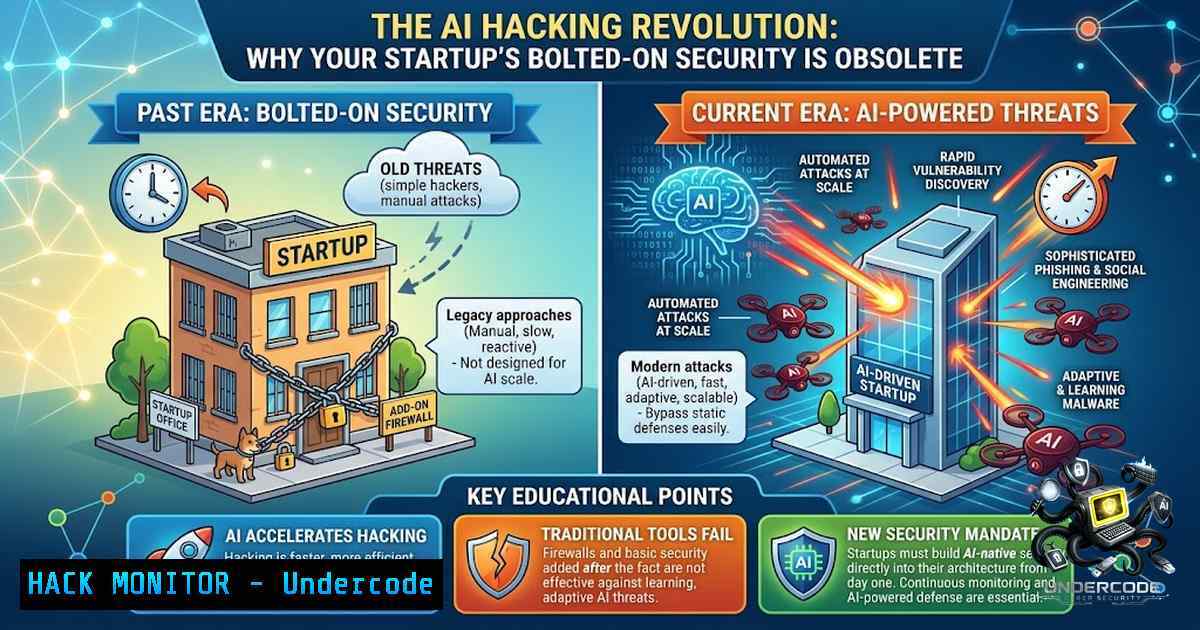
Introduction
The traditional trade-off in startup security—where resource constraints force organizations to layer security responsibilities onto existing roles like sysadmins or ops leads—has been fundamentally broken by the rapid advancement of offensive AI capabilities. Recent demonstrations at Black Hat, DEF CON, and BSidesLV have confirmed what security researchers have long feared: frontier AI models are now capable of discovering zero-day vulnerabilities and automating attack chains at speeds that render conventional “bolted-on” security measures ineffective, creating an urgent need for AI-1ative defensive strategies.
Learning Objectives
- Understand how offensive AI capabilities are automating vulnerability discovery and exploitation, including practical demonstrations of AI-assisted penetration testing
- Identify critical gaps in traditional “bolted-on” security models and learn to implement AI-powered defensive countermeasures
- Master hands-on implementation of AI-driven security tools, including automated threat hunting, log analysis, and incident response workflows
You Should Know
- Offensive AI Capabilities: Automated Vulnerability Discovery and Exploitation
The cybersecurity landscape has shifted dramatically as AI models demonstrate proficiency in offensive operations. Recent research presented at hacker summer camp revealed that modern language models can analyze source code repositories, identify memory corruption vulnerabilities, and even craft functional exploits with minimal human intervention. This represents a paradigm shift from traditional vulnerability research, which required months of manual code auditing and fuzzing.
Practical Demonstration: AI-Assisted Reconnaissance and Exploitation
For Linux environments, security teams can now leverage AI-enhanced reconnaissance tools that automate the initial stages of penetration testing:
 Install AI-powered reconnaissance framework
git clone https://github.com/AI-Security-Labs/offensive-ai-toolkit
cd offensive-ai-toolkit
pip install -r requirements.txt

Automated subdomain enumeration with AI pattern recognition
python3 ai_enum.py -d targetdomain.com --ai-model gpt-4 --threads 20

AI-assisted vulnerability scanning with adaptive payload generation
python3 ai_scanner.py -t 192.168.1.0/24 --scan-type comprehensive --ai-enhancement
Windows Command Line Equivalent:
 Deploy AI-powered reconnaissance agent
Invoke-WebRequest -Uri "https://github.com/AI-Security-Labs/windows-ai-scanner/releases/latest/ai-scanner.exe" -OutFile "C:\Tools\ai-scanner.exe"

Execute AI-assisted network discovery
C:\Tools\ai-scanner.exe -target 192.168.1.0/24 -mode reconnaissance -ai-enhanced

AI-powered credential harvesting simulation (authorized testing only)
C:\Tools\ai-scanner.exe -target dc01.internal.local -mode credential-enumeration -ai-optimization
Step-by-Step Implementation Guide:
- Deploy the AI reconnaissance toolkit in an isolated lab environment
- Configure API keys for AI model integration (ensure proper access controls)
- Run initial automated discovery to map attack surfaces
- Use AI-generated payload suggestions to test identified vulnerabilities
5. Document findings and implement AI-enhanced detection rules
- AI-Powered Defensive Countermeasures: Building Your Virtual Security Team
The same AI capabilities that enhance offensive operations can be repurposed for defense, effectively providing startups with a virtual security analyst that operates 24/7. Modern AI-based security information and event management (SIEM) systems can analyze terabytes of log data, identify anomalous patterns, and suggest remediation steps in real-time—functions that traditionally required a dedicated security team.
Implementing AI-Driven Security Orchestration
 Deploy open-source AI-powered SIEM solution
docker pull security-ai/wazuh-ai:latest
docker run -d --1ame wazuh-ai -p 55000:55000 -p 1514:1514 security-ai/wazuh-ai:latest

Configure AI threat detection rules
curl -X POST http://localhost:55000/ai-rules \
-H "Content-Type: application/json" \
-d '{"rule_type":"anomaly_detection","model":"gpt-4","threshold":0.85,"action":"alert"}'

Run automated threat hunting report
python3 ai_threat_hunter.py --start-date "2026-08-01" --end-date "2026-08-14" --output report.html
Advanced AI Incident Response Configuration:
 ai_incident_response.yaml
incident_response:
ai_orchestration:
enabled: true
model: claude-3
auto_containment: true
notification_channels:
- slack
- email
- pagerduty

playbooks:
- name: ai_detected_malware
steps:
- isolate_host
- capture_memory_dump
- analyze_with_ai
- generate_containment_plan
- Zero-Day Vulnerability Mitigation: When AI Finds What Humans Miss
Frontier AI models have demonstrated the ability to discover previously unknown vulnerabilities (zero-days) by analyzing code patterns that humans overlook. This capability necessitates a new approach to vulnerability management that incorporates AI-powered code analysis into the development lifecycle.
AI-Assisted Code Security Scanning
 Install AI-powered static analysis tool
npm install -g ai-code-scanner

Scan React application for vulnerabilities
ai-code-scanner scan --directory ./src --language javascript --ai-model gpt-4 --output json

Analyze Docker container vulnerabilities with AI recommendations
docker run -v /var/run/docker.sock:/var/run/docker.sock ai-container-analyzer \
--image your-app:latest --ai-enhancement --output security_report.pdf
Windows Environment Command:
 Deploy AI-powered binary analysis
Invoke-Expression "& 'C:\Program Files\AI-Security\binary-analyzer.exe' -file C:\Deploy\application.exe -ai-analysis -deep-scan"

AI-assisted memory corruption detection
C:\Tools\ai-memory-analyzer.exe -process "critical-app.exe" -monitor-allocation -ai-detection
4. The Human-AI Security Symbiosis: Guardrails and Verification
While AI enhances security capabilities, human oversight remains essential for setting strategic goals, defining guardrails, and validating AI-generated recommendations. This symbiosis creates a powerful security framework where AI handles the volume of routine analysis while humans focus on strategic decision-making.
Implementing AI-Human Collaboration Workflow
 Deploy AI validation framework
git clone https://github.com/security-ai/human-ai-workflow
cd human-ai-workflow
./setup.sh --ai-provider openai --validation-threshold 0.90

Configure automated AI recommendation review system
python3 workflow_engine.py --config ai-human-config.yaml --mode continuous
Configuration Template:
 ai-human-config.yaml
workflow:
ai_analysis:
enabled: true
confidence_threshold: 0.85
escalation_required: true

human_review:
required_for_threshold: 0.70-0.85
automated_for_above: 0.85
manual_override: true

guardrails:
- prevent_ai_from_modifying_production
- require_human_approval_for_patch_deployment
- maintain_audit_trail_of_ai_decisions
5. Real-World Threat Modeling: AI-Enhanced Security Assessment
Implementing effective security requires continuous threat modeling that accounts for AI-enhanced attack vectors. Security teams must regularly assess their exposure to AI-powered threats and adjust defensive postures accordingly.
Threat Modeling with AI Assistance
 Run comprehensive AI threat assessment
python3 threat_model_ai.py \
--domain yourcompany.com \
--assets "web_app,api_gateway,cloud_infra" \
--ai-model gpt-4 \
--output threat_model.json

Generate mitigation strategies
python3 mitigation_generator.py --input threat_model.json --ai-enhanced --output strategies.md
Windows PowerShell Threat Assessment:
 AI-powered threat intelligence gathering
Get-AIThreatIntel -TargetDomain "yourdomain.com" -ThreatModel "advanced-persistent" -AIEnhancement

Automated vulnerability impact analysis
Analyze-AIVulnerabilityImpact -DiscoveredVuln "CVE-2026-XXXX" -BusinessCriticality "high" -AIRecommendations
What Undercode Say
- Key Takeaway 1: The traditional security trade-off that allowed startups to bolt security onto existing roles is no longer viable; AI has democratized offensive capabilities while defensive AI is becoming increasingly accessible.
-
Key Takeaway 2: AI is not a replacement for human security expertise but rather an augmentation that allows lean teams to achieve enterprise-grade security monitoring and response capabilities.
Analysis
The fundamental shift highlighted in the post reflects a broader trend in cybersecurity: the compression of time and resources required to conduct effective attacks. Where once zero-day discovery required elite skills and significant time investment, AI now lowers the barrier to entry for sophisticated attacks. For startups and scaleups operating with limited security resources, this means reassessing risk postures and embracing AI-powered defensive tools as essential infrastructure rather than optional enhancements.
The cost-benefit analysis has shifted dramatically: investing in AI security tools now represents a more efficient allocation of limited resources than attempting to maintain a traditional security team that cannot match AI scalability. However, this transition requires careful implementation—organizations must maintain human oversight to prevent false positives from disrupting operations and to ensure AI-generated recommendations align with business objectives.
The integration of AI into security operations also introduces new risks: AI models themselves become attack surfaces, requiring additional protection against prompt injection, data poisoning, and model extraction attacks. Organizations implementing AI security solutions must consider these emerging threats as part of their overall security strategy.
Prediction
+1 AI-driven security automation will become the standard for startup security teams, with AI-powered tools handling 80% of routine monitoring and incident response tasks within 24 months, allowing security professionals to focus on strategic initiatives.
+1 The democratization of offensive AI will paradoxically improve overall security by forcing organizations to adopt more robust, AI-enhanced defensive postures, creating a positive feedback loop in security innovation.
-1 The AI security arms race will accelerate the gap between organizations that can afford advanced AI security tools and those that cannot, potentially creating new cybersecurity inequalities similar to current resource disparities.
+1 As AI models improve, the integration of defensive AI into DevSecOps pipelines will enable “security by design” at scale, reducing the incidence of common vulnerabilities before they reach production environments.
-1 The increased reliance on AI security systems may create new single points of failure, with sophisticated attackers potentially targeting the AI models themselves rather than the underlying infrastructure.
+1 Continuous AI-driven security validation will become a compliance requirement, with frameworks emerging to standardize AI security tool effectiveness metrics and establish best practices.
-1 The shortage of professionals skilled in AI security orchestration will create a talent bottleneck, making it challenging for organizations to implement and maintain AI security systems effectively.
+1 Open-source AI security tools will proliferate, making enterprise-grade security capabilities accessible to startups and scaleups, fulfilling the democratization promise of AI in cybersecurity.
▶️ Related Video (86% Match):
🎯Let’s Practice For Free:
🎓 Live Courses & Certifications:
Join Undercode Academy for Verified Certifications
🚀 Request a Custom Project:
Secure, high-velocity infrastructure and disruptive technological engineering. Contact our engineering team for high-tier development and proprietary systems:
[email protected]
💎 Smart Architecture | 🛡️ Secure by Design | ⭐ Trusted by Thousands
IT/Security Reporter URL:
Reported By: https://lnkd.in/p/e3XwukcY – Hackers Feeds
Extra Hub: Undercode MoN
Basic Verification: Pass ✅


