Listen to this Post
Introduction:
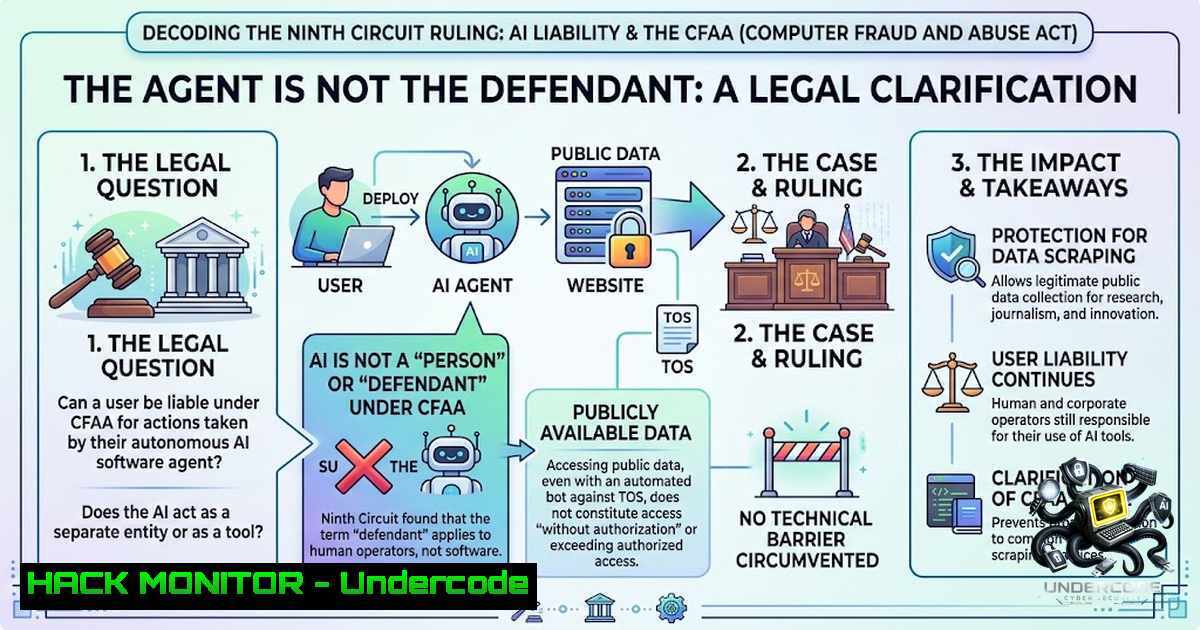
The US Court of Appeals for the Ninth Circuit recently delivered a pivotal ruling in Amazon v. Perplexity AI, establishing that for the purpose of the Computer Fraud and Abuse Act (CFAA), an AI agent operating on a user’s behalf is legally considered a “tool” of the user, not an independent entity. This decision creates a critical legal distinction where the human user bears the liability for “accessing” a protected computer, thereby insulating the AI developer from anti-hacking claims when the agent acts under instruction. For cybersecurity professionals, this ruling reshapes the threat landscape regarding automated scraping, browser automation, and agentic AI, fundamentally altering how we approach API security, access control lists, and terms of service enforcement.
Learning Objectives:
- Understand the legal precedent set by the Ninth Circuit regarding the CFAA and the definition of “access” in the context of AI agents.
- Identify the technical and legal distinctions between a user-controlled “tool” and an autonomous “actor” in automated browsing.
- Learn how to implement technical controls (e.g., WAF rules, IP blacklisting, and bot management) to enforce terms of service against unauthorized automated agents.
You Should Know:
- The “Tool” vs. “Actor” Dichotomy in Access Control
The court’s ruling hinged on the interpretation that the AI agent is an “instrument” of the user, much like a conventional browser autofilling payment details. This means that under the CFAA, Perplexity is not “intentionally accessing” Amazon’s servers; the user is. From a technical standpoint, this aligns with how web requests are structured—the User-Agent header may identify the browser or bot, but the source IP and authentication tokens (cookies, OAuth) belong to the user. To mitigate liability or enforce restrictions, platforms must focus on blocking the user’s credentials or the specific request patterns rather than simply suing the developer.
Step‑by‑step guide explaining what this does and how to use it:
– Step 1: Audit User-Agent Strings and Headers – Review server logs to identify the specific headers used by the Perplexity AI agent. Look for patterns like User-Agent: Perplexity-Agent/.
– Step 2: Implement Rate Limiting Per User – Since liability shifts to the user, enforce rate limits based on API keys or session IDs. Use Redis or a similar in-memory store to track request counts.
Linux Command (Nginx Rate Limiting):
limit_req_zone $binary_remote_addr zone=mylimit:10m rate=5r/s;
server {
location / {
limit_req zone=mylimit burst=10 nodelay;
}
}
– Step 3: Deploy Web Application Firewall (WAF) Rules – Configure a WAF to inspect the `User-Agent` and `X-Forwarded-For` headers. If a “bot-like” header is detected alongside high request frequency, serve a 403 Forbidden or a CAPTCHA challenge.
AWS WAF Example Rule: Create a rule to block requests with a `User-Agent` string that contains “Perplexity” OR “AI-Agent” AND a request rate > 100 per 5 minutes.
2. Hardening Authentication and Session Management
Since the user is legally responsible for the agent’s actions, the technical burden falls on the platform to ensure that the user’s credentials are not misused. The ruling implies that if a user’s credentials are compromised and used by an AI agent to scrape data, the user remains liable. This necessitates robust multi-factor authentication (MFA) and anomaly detection.
Step‑by‑step guide explaining what this does and how to use it:
– Step 1: Enforce MFA on all accounts – For platforms concerned about unauthorized access via AI agents, requiring MFA for every login prevents agents from automating logins without user interaction.
– Step 2: Implement Behavioral Biometrics or Device Fingerprinting – Use JavaScript to collect client-side data (canvas fingerprinting, WebGL) to ensure that the session matches the user’s usual device. If a script is driving the browser, the fingerprint will differ.
– Step 3: Session Binding – Bind the session token to the user’s IP address and User-Agent. If the session is reused with a different IP (indicating a server-side AI agent), terminate the session.
Windows Command (Flush DNS to test local changes): `ipconfig /flushdns` (use if testing local host file modifications for developer scenarios).
- Leveraging the Rule of Lenity for Compliance Policies
The court applied the “rule of lenity” to avoid criminalizing ordinary users. This legal principle suggests that ambiguous penal statutes should be interpreted in favor of the defendant. For compliance officers, this means that terms of service (ToS) must be crystal clear. To enforce ToS against AI agents, the technical implementation must be equally specific.
Step‑by‑step guide explaining what this does and how to use it:
– Step 1: Update Terms of Service – Explicitly define what constitutes “unauthorized access” by automated agents. Include specific language about “bots,” “crawlers,” and “AI-assisted browsing.”
– Step 2: Implement Robots.txt with New Directives – While not legally binding, `robots.txt` signals intent. Add specific disallow rules for “Perplexity” or generic “AI-Agent” crawlers.
– Step 3: Generate API Security Keys with Restrictions – If you provide an API, restrict keys to specific IPs (Restrict API Key in Google Cloud or AWS API Gateway) to ensure that even if an agent uses the key, it operates from a permitted environment.
4. Mitigating “Autonomous” Agent Risks (Future-Proofing)
The court explicitly left the door open for future cases where an agent is “more autonomous.” If an AI agent deviates from the user’s instruction, liability could shift to the developer. To prepare, security engineers must implement “Guardrails” for their own agents. If you are building an AI agent, you must ensure the agent cannot issue unintended commands.
Step‑by‑step guide explaining what this does and how to use it:
– Step 1: Implement Command Whitelisting – For agents that can execute commands (e.g., via APIs), create a strict whitelist of allowed endpoints (e.g., `GET /products` allowed, `DELETE /products` blocked).
– Step 2: Monitor Agent Decision Logs – Log every “thought” and “action” taken by the AI agent. This provides forensic evidence to prove that the agent was acting on a specific user instruction, not autonomously deciding to hack.
Linux Command to monitor logs in real-time:
tail -f /var/log/agent_audit.log | grep "ACTION_TAKEN"
– Step 3: Set Execution Timeouts and Session Limits – To prevent an agent from engaging in a “shopping spree” or a DDoS-like behavior, set maximum transaction limits per session.
5. API Security and Scraping Detection
Given that the CFAA claim failed due to the “access” definition, companies like Amazon must pivot to contract law (breach of ToS) and technological barriers. This is a victory for “Private Ordering” (technical controls). Security teams should focus on API versioning and “honeytokens.”
Step‑by‑step guide explaining what this does and how to use it:
– Step 1: Deploy Honeytoken Endpoints – Add hidden links in the HTML that are invisible to humans but detectable by bots. If an AI agent browses the page and follows this hidden link, you instantly know a bot is accessing the page.
– Step 2: Track API Versioning – Force agents to use the latest API version. Often, scrapers target old, unversioned endpoints.
– Step 3: Implement JavaScript Challenges (e.g., Cloudflare Turnstile) – Require a challenge to be solved before content is rendered. Since AI agents often bypass standard CSS selectors, a JavaScript puzzle differentiates humans from simple scripts.
What Undercode Say:
- Key Takeaway 1: The Ninth Circuit has defined AI agents as “tools” for CFAA liability, meaning developers cannot currently be sued for “hacking” via a user’s interaction. This shifts the burden of policing automated access to ToS and technical barriers.
- Key Takeaway 2: The “autonomy” of the agent is the critical pivot point. As AI moves from “executing user commands” to “making decisions,” the legal status will likely invert, placing liability on the developers for the “intentional access” of the agent.
Analysis: The court’s decision is a masterclass in statutory interpretation, avoiding the “slippery slope” of criminalizing ordinary browser usage while simultaneously protecting Perplexity. However, this is not a “get out of jail free” card for AI companies. The court explicitly acknowledged that tort claims (like trespass to chattels) or breach of contract remain viable. Technically, this forces platforms to invest heavily in Bot Management solutions like PerimeterX or Akamai Bot Manager, as legal recourse under the CFAA is currently dead. For security teams, the immediate takeaway is that “obfuscation” and “behavioral analysis” are now superior defenses to legal threats for scraping. Moreover, the ruling underscores the need for session-layer security; if the user is the accessor, then the user’s device and IP are the vectors to block. Predictions for the future include a rise in “agent credentials” and “delegated authentication” protocols (like OAuth) specifically for AI, where the agent uses a separate, revocable token, distinguishing its liability from the human user.
Prediction:
+N Legal clarity provides a safe harbor for AI browsing developers, encouraging innovation in agentic technology without immediate fear of federal criminal charges.
-1 Technical controls will intensify, leading to a “Browser Wars 2.0” where websites deploy aggressive anti-bot measures that degrade user experience for legitimate customers, increasing the cost of web service operations.
+N This ruling will likely push AI companies to formalize “Terms of Service for Agents,” creating a new sub-industry of AI compliance, thus generating employment for security consultants.
-1 The ambiguity regarding “autonomous agents” could lead to inconsistent state-level legislation, creating a fragmented compliance landscape that is difficult for international companies to navigate.
+1 We can expect a surge in the development of “Delegated Trust” protocols, such as OAuth for AI, which will standardize how agents present credentials, ultimately improving API security standards across the board.
▶️ Related Video (72% Match):
🎯Let’s Practice For Free:
🎓 Live Courses & Certifications:
Join Undercode Academy for Verified Certifications
🚀 Request a Custom Project:
Secure, high-velocity infrastructure and disruptive technological engineering. Contact our engineering team for high-tier development and proprietary systems:
[email protected]
💎 Smart Architecture | 🛡️ Secure by Design | ⭐ Trusted by Thousands
IT/Security Reporter URL:
Reported By: https://lnkd.in/p/edpDzYTW – Hackers Feeds
Extra Hub: Undercode MoN
Basic Verification: Pass ✅


