Listen to this Post
Introduction
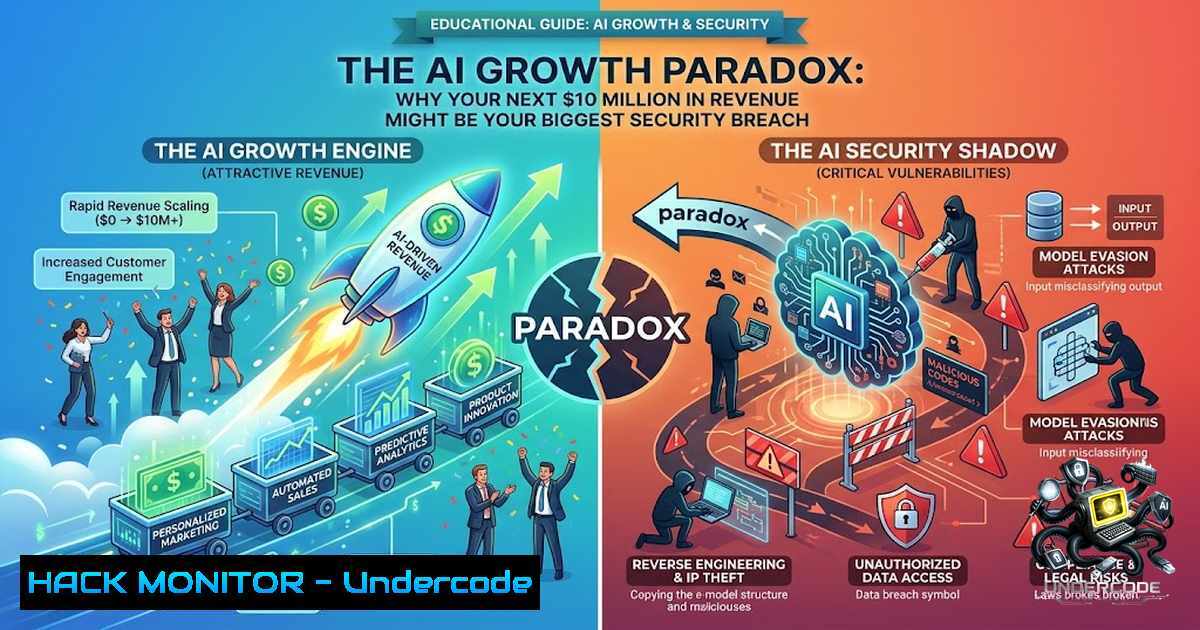
The digital growth landscape is undergoing a fundamental transformation. As Matteo Aliotta, CEO of LTV, recently articulated on the Variabile Umana podcast, sustainable business growth no longer comes from “trucchetti” or momentary shortcuts, but through a rigorous, analytical approach built on three pillars: Acquisition, Retention, and Monetization. However, this data-driven growth engine—increasingly powered by artificial intelligence—has created a dangerous blind spot. While organizations aggressively scale their AI capabilities to drive predictable revenue, security controls are struggling to keep pace. The very tools designed to accelerate growth are rapidly becoming the fastest-growing attack surface for enterprises worldwide.
Learning Objectives
- Understand the intersection of AI-driven growth strategies and the expanding cybersecurity threat landscape
- Identify and mitigate critical AI-specific vulnerabilities including prompt injection, model poisoning, and shadow AI
- Implement practical security controls across Linux, Windows, and cloud environments to protect AI infrastructure
- Develop a governance framework that balances rapid innovation with robust security postures
You Should Know
- The Shadow AI Crisis: When Growth Tools Become Data Leak Vectors
The most immediate threat to organizations embracing AI for growth is what security experts call “shadow AI.” In the name of productivity, employees have poured sensitive corporate knowledge into public AI tools, creating an ungoverned data spill that has become an enormous legal and security liability. This quiet data bleed extends beyond intellectual property—it exposes customer data, financial projections, growth strategies, and proprietary algorithms to third-party servers outside organizational control.
What This Means for Your Organization:
Every AI tool integrated into your growth stack—from ChatGPT for content generation to AI-powered analytics platforms—represents a potential data exfiltration channel. The challenge is compounded by the fact that 53% of organizations lack GenAI-specific security controls. This gap between AI adoption and security governance is the single greatest vulnerability in modern growth strategies.
Step-by-Step Guide: Auditing Your Shadow AI Footprint
- Discover and Inventory: Run a network audit to identify unauthorized AI tool usage. On Linux, use:
sudo tcpdump -i any -1 'port 443' | grep -E "(chat.openai|anthropic|claude|bard|gemini)"
On Windows (PowerShell):
Get-1etTCPConnection | Where-Object {$_.RemotePort -eq 443} | Select-Object RemoteAddress, OwningProcess
- DNS Monitoring: Enable DNS monitoring to detect suspicious domains with which AI agents may attempt to communicate:
sudo tcpdump -i any -1 'udp port 53' | grep -E "(openai|anthropic|cohere|replicate)"
-
Create an AI Inventory: Document every AI tool, its purpose, data access level, and vendor security posture. Implement vendor tiering with contract clause checklists for AI procurement.
-
Implement Data Loss Prevention (DLP): Configure DLP policies that flag attempts to paste sensitive data into AI interfaces.
-
AI Agent Security: The New Identity Attack Surface
The rapid adoption of enterprise AI tools has created a new class of digital identities—AI agents and assistants that operate with varying degrees of autonomy. These agentic AI systems can plan, call tools, inspect code, interact with web applications, and coordinate multi-step workflows. Each of these capabilities represents a potential attack vector.
The Critical Risk:
Sophos’s AI Security 2026 Report warns that AI identities have become a new attack surface as AI agents are adopted in the workplace. Attackers are now using advanced AI models to identify security vulnerabilities at unprecedented speed. The share of high-risk actors leveraging AI for cyberattacks jumped from 33% to 56% in just one year.
Step-by-Step Guide: Securing AI Agent Identities
- Apply Least Privilege by Default: AI agents should operate with minimal permissions necessary for their function:
Linux: Create a restricted service account for AI agents
sudo useradd -r -s /bin/false -m -d /opt/ai-agent ai_agent
sudo setfacl -m u:ai_agent:r-x /path/to/required/data
-
Implement Phishing-Resistant Authentication: All AI agent access should require MFA or certificate-based authentication.
-
Enable Comprehensive Telemetry: Monitor all AI agent actions:
Linux audit logging for AI agent activities
sudo auditctl -w /opt/ai-agent -p rwxa -k ai_agent_activity
sudo ausearch -k ai_agent_activity
-
Keep Humans in the Loop: Critical decisions—especially those involving data access or system modifications—should require human approval.
-
Prompt Injection and Model Poisoning: The New Exploit Vectors
As AI becomes more embedded in workflows, new classes of cyber threats are emerging. Prompt injection and model poisoning are expanding rapidly, raising governance, security, and compliance demands. Microsoft’s Defender team recently identified a fraudulent campaign using “memory poisoning”—a technique where attackers corrupt an AI assistant’s memory persistently to influence future responses.
Understanding the Attack Surface:
- Prompt Injection: Malicious input that manipulates an AI model’s behavior, potentially exposing sensitive data or causing the model to execute harmful actions
- Model Poisoning: Corruption of training data that causes the AI to produce compromised outputs
- Memory Poisoning: Persistent corruption of an AI agent’s context memory
Step-by-Step Guide: Defending Against AI Manipulation Attacks
- Input Validation and Sanitization: Implement strict input filtering for all AI model inputs:
Python example: Basic prompt injection detection import re def sanitize_prompt(input_text): dangerous_patterns = [ r'ignore previous instructions', r'disregard your training', r'you are now', r'system prompt', r'override' ] for pattern in dangerous_patterns: if re.search(pattern, input_text, re.IGNORECASE): raise ValueError("Potential prompt injection detected") return input_text -
Implement Output Filtering: Scan AI outputs for sensitive data patterns:
Linux: Use grep to scan logs for potential data leaks grep -E "(\b[A-Z0-9._%+-]+@[A-Z0-9.-]+.[A-Z]{2,}\b|ssn|password|secret|key)" /var/log/ai-output.log -
Threat Model AI Workflows: Identify probable and painful risks in 30 minutes or less. Prioritize the most critical attack vectors.
-
Establish Guardrails and Logging: Implement comprehensive logging of all AI interactions:
{
"timestamp": "2026-08-13T10:00:00Z",
"user_id": "user123",
"ai_model": "gpt-4",
"input_hash": "sha256...",
"output_hash": "sha256...",
"risk_score": 0.85,
"action_taken": "blocked"
}
4. Container and CI/CD Security for AI Workloads
AI workloads increasingly run in containerized environments, with continuous integration and deployment pipelines automating model updates. These environments present unique security challenges that require specialized hardening.
Step-by-Step Guide: Hardening AI Container Environments
1. Linux Container Hardening:
 Docker security best practices for AI containers
docker run --security-opt=no-1ew-privileges:true \
--cap-drop=ALL \
--cap-add=NET_BIND_SERVICE \
--read-only \
--tmpfs /tmp \
your-ai-image:latest
- Implement Image Scanning: Scan all container images for vulnerabilities before deployment:
Using Trivy for container scanning
trivy image --severity CRITICAL,HIGH your-ai-image:latest
-
Secure CI/CD Pipelines: Ensure all model updates and code changes undergo security review:
Git hook example for pre-commit security checks
!/bin/bash
.git/hooks/pre-commit
if grep -r "API_KEY|SECRET|PASSWORD" --include=".py" --include=".js" .; then
echo "❌ Potential secrets found in commit. Aborting."
exit 1
fi
-
Patch Velocity: Maintain a strict patch management schedule for all AI infrastructure components.
5. Cloud Hardening for AI Growth Infrastructure
As organizations scale their AI capabilities, cloud infrastructure becomes the backbone of growth operations. However, misconfigured cloud resources remain one of the leading causes of data breaches.
Step-by-Step Guide: Cloud Security for AI Workloads
1. Enable Comprehensive Cloud Logging:
 AWS CLI: Enable CloudTrail for all regions
aws cloudtrail create-trail --1ame ai-growth-trail --s3-bucket-1ame your-bucket --is-multi-region-trail
aws cloudtrail start-logging --1ame ai-growth-trail
2. Implement Least Privilege IAM Policies:
{
"Version": "2012-10-17",
"Statement": [
{
"Effect": "Allow",
"Action": [
"s3:GetObject",
"sagemaker:InvokeEndpoint"
],
"Resource": "arn:aws:s3:::your-ai-bucket/",
"Condition": {
"IpAddress": {"aws:SourceIp": "192.168.1.0/24"}
}
}
]
}
- Network Segmentation: Isolate AI workloads in dedicated VPCs with strict security groups.
-
Encryption at Rest and in Transit: Ensure all AI data—training data, model weights, inference results—is encrypted.
6. Governance and Compliance: The Human Element
The intersection of AI and growth requires a governance framework that balances innovation with security. As Aliotta emphasizes, the key to scalable growth lies in methodological experimentation driven by data and real-world contexts. The same principle applies to security—methodical, data-driven security practices that scale with your growth.
Step-by-Step Guide: Building an AI Governance Framework
- Establish an AI Security Council: Include representatives from security, legal, compliance, and business units.
-
Develop AI Usage Policies: Create clear guidelines for AI tool usage, including approved tools, data handling requirements, and reporting procedures.
-
Implement Regular Security Training: Educate all employees on AI-specific security risks, including prompt injection, data leakage, and social engineering.
-
Conduct Regular Audits: Perform quarterly security audits of all AI infrastructure and usage.
What Undercode Say
-
Sustainable growth requires security by design, not as an afterthought. Organizations that embed security into their AI growth strategies will outperform those that treat security as a compliance checkbox. The data is clear: 89% of AI-assisted cyberattacks have surged while breakout times have decreased. Security must scale with growth.
-
The human element remains the critical variable. As Aliotta notes, tools and markets change, but responsibility and real impact on people remain the true “Variabile Umana”. In the context of AI security, this means fostering a culture of security awareness, ethical AI use, and continuous learning. The most sophisticated technical controls are useless if employees circumvent them through shadow AI or careless data handling.
Analysis: The convergence of AI-driven growth and cybersecurity represents both the greatest opportunity and the most significant risk for modern enterprises. Organizations that view security as an enabler rather than an inhibitor of growth will build sustainable competitive advantages. The technical controls outlined above—from container hardening to prompt injection defense—provide a practical foundation. However, the real differentiator will be cultural: organizations that cultivate “umiltà studentesca” (student-like humility) toward both AI capabilities and security threats will adapt faster and more effectively than those that rely on outdated mental models. The future belongs to organizations that can grow aggressively while maintaining ironclad security postures—not through fear, but through methodical, data-driven excellence in both domains.
Prediction
- +1 Organizations that proactively implement AI-specific security controls will capture disproportionate market share as clients demand verified security postures from their vendors.
-
-1 Companies that continue to prioritize growth velocity over security will experience catastrophic data breaches, with AI-assisted attacks becoming the primary vector for data exfiltration by 2027.
-
+1 The emergence of AI security as a distinct discipline will create new career opportunities and certification pathways, with demand for AI security specialists outpacing supply by 3:1 within 18 months.
-
-1 Regulatory frameworks like the EU AI Act will impose significant compliance costs on organizations that have not already embedded security into their AI development lifecycle.
-
+1 Organizations that successfully integrate security into their growth strategies will achieve both higher valuation multiples and lower insurance premiums, creating a virtuous cycle of investment in security infrastructure.
-
-1 The current gap in GenAI-specific security controls (53% of organizations lacking them) will result in a wave of regulatory actions and class-action lawsuits, particularly affecting publicly traded companies.
▶️ Related Video (74% Match):
https://www.youtube.com/watch?v=4BfHoyOP7CA
🎯Let’s Practice For Free:
🎓 Live Courses & Certifications:
Join Undercode Academy for Verified Certifications
🚀 Request a Custom Project:
Secure, high-velocity infrastructure and disruptive technological engineering. Contact our engineering team for high-tier development and proprietary systems:
[email protected]
💎 Smart Architecture | 🛡️ Secure by Design | ⭐ Trusted by Thousands
IT/Security Reporter URL:
Reported By: https://lnkd.in/p/efuCNNTR – Hackers Feeds
Extra Hub: Undercode MoN
Basic Verification: Pass ✅


