Listen to this Post
Introduction
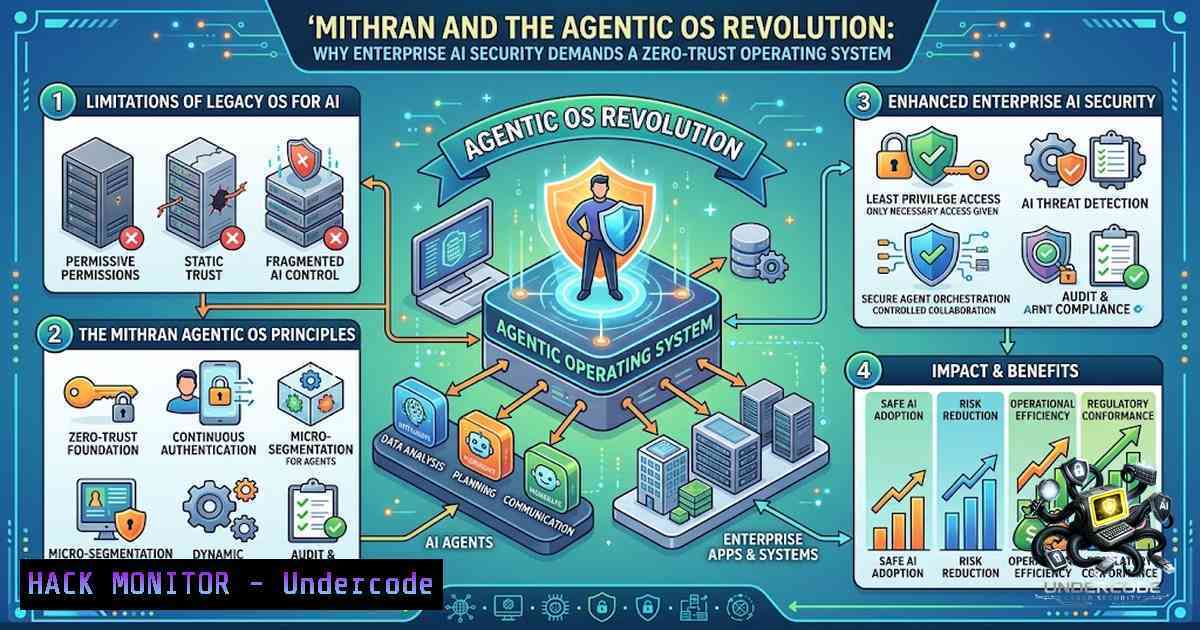
The enterprise AI landscape has reached an inflection point. As organizations rapidly deploy autonomous AI agents to automate workflows, write code, and interact with cloud infrastructure, traditional security models—built for human users and predictable service accounts—are proving dangerously inadequate. According to Gravitee’s 2026 State of AI Agent Security report, only 47.1% of deployed AI agents are actively monitored or secured, while a Cloud Security Alliance study found that 68% of organizations cannot distinguish human activity from AI agent activity in their logs. Nexar’s spinout, Mithran, emerges as a direct response to this crisis: an enterprise-grade agentic operating system designed to contain, govern, and secure autonomous AI agents at the kernel level.
Learning Objectives
- Understand why traditional zero-trust and identity governance models fail when applied to autonomous AI agents
- Master the four control planes—identity, authorization, monitoring, and lifecycle—required to secure agentic deployments
- Implement cloud-1ative least-privilege controls across AWS, Azure, and GCP for AI agent workloads
- Apply kernel-level containment and runtime governance to prevent agent goal hijacking and privilege abuse
You Should Know
1. Why AI Agents Break Traditional Security Models
Traditional zero trust, as defined by NIST SP 800-207, rests on three principles: verify explicitly, enforce least privilege, and assume breach. Every control flowing from these principles was designed for principals that authenticate once at a session boundary and perform predictable, bounded actions. AI agents violate every assumption simultaneously.
An agent interprets a goal, selects its own tools, chains API calls, spawns sub-tasks, adapts behavior based on encountered data, and disappears when the work is done. It may hold credentials it doesn’t control, touch resources its designer never anticipated, and operate at machine speed with no human in the loop between steps. The execution path is partially non-deterministic.
The numbers are stark: only 22% of security practitioners assign unique identities to agents. The remaining 78% rely on shared API keys or inherited user sessions—making attribution impossible and audit trails meaningless. This is not a policy gap; it is an architecture gap.
What This Means for Your Organization: If you cannot answer “which agent did this?” during an incident, you have no security. Every agent must have a cryptographically verifiable, unique identity—not a shared API key, not a service account with a password that rotates annually.
Linux Command – Agent Identity Verification:
 Generate Ed25519 key pair for agent identity (similar to Agent Mesh approach)
ssh-keygen -t ed25519 -C "agent-$(uuidgen)" -f ~/.ssh/agent_identity

Verify the agent's cryptographic identity
openssl pkey -in ~/.ssh/agent_identity -pubout -text

Create an agent registry entry with identity fingerprint
echo "AGENT_ID=$(uuidgen)" >> /etc/agent-registry.conf
echo "AGENT_PUBKEY=$(ssh-keygen -y -f ~/.ssh/agent_identity)" >> /etc/agent-registry.conf
Windows PowerShell – Agent Identity Management:
 Generate a unique agent identity using Windows cryptographic APIs
$agentId = [System.Guid]::NewGuid().ToString()
$cert = New-SelfSignedCertificate -Subject "CN=Agent-$agentId" -CertStoreLocation Cert:\CurrentUser\My
$thumbprint = $cert.Thumbprint

Register the agent with Entra ID managed identity
Connect-AzAccount
$identity = New-AzUserAssignedIdentity -ResourceGroupName "agent-rg" -1ame "agent-$agentId" -Location "eastus"
Write-Host "Agent Identity: $($identity.PrincipalId)"
- The OWASP Top 10 for Agentic Applications: Know Your Threat Surface
The OWASP Top 10 for Agentic Applications 2026 (ASI01-ASI10) provides the definitive risk taxonomy for autonomous AI agents. Key risks include:
ASI01: Agent Goal Hijack – Malicious external injections override an agent’s systemic instruction base. If an automated procurement agent processes a supplier invoice containing a malicious override instruction, the agent’s internal contextual parsing can merge instruction with data.
ASI02: Tool Misuse and Exploitation – Agents with overly broad tool access can be manipulated to perform unauthorized actions.
ASI03: Identity and Privilege Abuse – Without proper identity governance, agents inherit excessive permissions and become attack vectors.
ASI04: Agentic Supply Chain Vulnerabilities – Compromised agent dependencies or third-party tools.
ASI05: Unexpected Code Execution (RCE) – Agents executing arbitrary code in production environments.
ASI06: Memory and Context Poisoning – Attackers corrupt the agent’s contextual understanding to influence future decisions.
Step-by-Step: Implementing Agentic Threat Modeling
- Map your agent inventory: Document every agent in production, its purpose, data access, and tool permissions
- Apply the OWASP framework: Run a threat modeling workshop using ASI01-ASI10 as your control set
- Implement runtime governance: Deploy a policy engine that evaluates every agent action before execution
- Establish continuous monitoring: Log all agent actions with immutable audit trails
Linux Command – Runtime Agent Monitoring:
 Monitor agent processes with auditd
auditctl -w /usr/local/bin/agent -p x -k agent_execution

Track all system calls made by agent processes
strace -p $(pgrep -f "python.agent") -o /var/log/agent_trace.log -e trace=open,read,write,execve

Use eBPF for real-time agent action filtering (requires bpftrace)
bpftrace -e 'tracepoint:syscalls:sys_enter_open { printf("%s opened %s\n", comm, str(args->filename)); }'
Windows PowerShell – Agent Monitoring:
 Enable advanced audit logging for agent processes
auditpol /set /subcategory:"Process Creation" /success:enable /failure:enable

Monitor agent PowerShell execution with Script Block Logging
Set-ItemProperty -Path "HKLM:\SOFTWARE\Policies\Microsoft\Windows\PowerShell\ScriptBlockLogging" -1ame "EnableScriptBlockLogging" -Value 1

Real-time agent process monitoring
Get-WmiObject -Class Win32_Process | Where-Object { $_.Name -match "python|node|dotnet" } | Select-Object ProcessId, Name, CommandLine
3. Cloud Architecture Controls: Making Dangerous Actions Unavailable
Application-level guardrails—rate limits, output validation, content filters—sit above the cloud layer and can be bypassed. A system prompt that says “don’t delete production databases” is advisory. An AWS SCP that removes delete permissions from the agent’s account is architectural. One can be ignored; the other cannot.
The Core Principle: “An AI agent cannot delete production data” is not a prompt instruction—it’s a cloud architecture control enforced at the cloud layer.
Step-by-Step: Enforcing Least Privilege in the Cloud
AWS Implementation:
{
"Version": "2012-10-17",
"Statement": [
{
"Effect": "Deny",
"Action": [
"s3:DeleteBucket",
"rds:DeleteDBInstance",
"dynamodb:DeleteTable"
],
"Resource": "",
"Condition": {
"StringEquals": {
"aws:PrincipalType": "AIService"
}
}
}
]
}
Apply this as a Service Control Policy (SCP) at the organization level.
Azure Implementation:
{
"if": {
"allOf": [
{
"field": "type",
"equals": "Microsoft.Storage/storageAccounts"
},
{
"field": "Microsoft.Storage/storageAccounts/networkAcls.defaultAction",
"equals": "Allow"
}
]
},
"then": {
"effect": "deny"
}
}
Apply as Azure Policy to enforce network boundaries for agent-accessible storage.
GCP Implementation:
 Create an organization policy to restrict agent permissions
gcloud org-policies set-policy policy.yaml --organization=ORG_ID

Example policy.yaml:
 constraints:
 - name: constraints/iam.allowedPolicyMemberDomains
 constraint:
 listPolicy:
 allowedValues:
 - "C:example.com"
Linux Command – Isolating Agent Runtimes:
 Run agent in a namespace-isolated environment
unshare --mount --uts --ipc --1et --pid --fork --user --map-root-user /bin/bash

Use Landlock for kernel-enforced restrictions (Linux kernel 5.13+)
landlock-restrict --fs-read /data --fs-write /tmp -- python agent.py

Containerized agent execution with minimal permissions
docker run --rm --read-only --cap-drop=ALL --cap-add=NET_BIND_SERVICE \
--security-opt=no-1ew-privileges:true \
--user 1000:1000 \
agent-image:latest
Windows PowerShell – Process Isolation:
 Create a restricted token for agent process
$token = [System.IntPtr]::Zero
$attributes = New-Object "System.Security.Principal.TokenAccessLevels" -ArgumentList "CreateProcess, Query, Duplicate"
$sid = New-Object "System.Security.Principal.SecurityIdentifier" -ArgumentList "S-1-5-32-545"  Users group

Launch agent with reduced privileges using Windows Job Objects
$job = [System.Diagnostics.Process]::Start("cmd.exe", "/c python agent.py")
$job.ProcessorAffinity = 1
$job.PriorityClass = [System.Diagnostics.ProcessPriorityClass]::BelowNormal
4. Agent Identity: The Foundation of Trust
Identity must be the root of trust for AI. Without it, access controls, auditability, and accountability fall apart. NIST’s AI Risk Management Framework (AI RMF) must be applied through a zero-trust lens with identity at the core.
Key Requirements:
- Every agent needs a cryptographically verifiable, unique identity
- Use OIDC (OpenID Connect) for agent-to-service authentication
- Deploy short-lived tokens (15-minute expiry) for sensitive operations
- Maintain an agent registry with capability declarations
Step-by-Step: Implementing Agent Identity
- Create agent identities: Use SPIFFE/SPIRE workload identity or OAuth 2.0 Token Exchange
- Enforce just-in-time authorization: Replace standing permissions with JIT for any elevated access
- Implement immutable audit trails: Every agent action must be logged with identity attribution
- Quarantine deprecated agent roles: Never leave inactive agent identities active
Linux Command – OIDC Agent Authentication:
 Generate JWT for agent authentication
jwt=$(curl -s -X POST "https://$ISSUER/oauth2/token" \
-H "Content-Type: application/x-www-form-urlencoded" \
-d "grant_type=client_credentials&client_id=$AGENT_ID&client_secret=$AGENT_SECRET" | jq -r '.access_token')

Validate JWT signature
echo "$jwt" | jwt decode --secret "$PUBLIC_KEY"

Use JWT for AWS STS AssumeRoleWithWebIdentity
aws sts assume-role-with-web-identity \
--role-arn "arn:aws:iam::$ACCOUNT:role/agent-role" \
--role-session-1ame "agent-session" \
--web-identity-token "$jwt"
Windows PowerShell – Managed Identity Configuration:
 Configure Azure Managed Identity for agent
$identity = New-AzUserAssignedIdentity -ResourceGroupName "agent-rg" -1ame "agent-identity" -Location "eastus"

Assign role with least privilege
New-AzRoleAssignment -ObjectId $identity.PrincipalId -RoleDefinitionName "Storage Blob Data Reader" -Scope "/subscriptions/$subId/resourceGroups/$rg/providers/Microsoft.Storage/storageAccounts/$account"

Get token for agent authentication
$token = Invoke-AzRestMethod -Method GET -Path "/metadata/identity/oauth2/token?api-version=2018-02-01&resource=https://management.azure.com/"
5. Runtime Containment and Kernel-Level Security
“Leave an LLM a hole and it will find it. Not because it’s evil, but because it really, really wants to make you happy—even if that means hacking your gym software or hacking all of Hugging Face”. Containment must reach the kernel.
Containment Strategies:
- Sandboxed environments with server-side credential injection
- Process-level isolation using Landlock (Linux), Seatbelt (macOS), and Windows Restricted Tokens
- Four privilege rings with trust scores decaying over time
Step-by-Step: Implementing Runtime Containment
1. Isolate agent runtime from production where possible
2. Use kernel-enforced restrictions rather than application-level controls
- Implement action evaluation with sub-millisecond latency—block before execution
- Apply defense-in-depth with JWT verification and WAF rules on API gateways
Linux Command – Advanced Containment:
 Use seccomp to restrict system calls
cat > seccomp-profile.json << EOF
{
"defaultAction": "SCMP_ACT_ERRNO",
"architectures": ["SCMP_ARCH_X86_64"],
"syscalls": [
{"names": ["read","write","open","close","stat","fstat","lstat","poll","select"], "action": "SCMP_ACT_ALLOW"}
]
}
EOF
docker run --security-opt seccomp=seccomp-profile.json agent-image

Use AppArmor for mandatory access control
aa-genprof /usr/local/bin/agent
aa-enforce /usr/local/bin/agent

Process namespace isolation with bubblewrap
bwrap --bind /usr /usr --bind /bin /bin --bind /lib /lib --tmpfs /proc --proc /proc --unshare-pid --unshare-uts --unshare-ipc -- /bin/bash
Windows PowerShell – Windows Security Mechanisms:
 Apply Low Integrity Level to agent process
$integrityLevel = New-Object "System.Security.Principal.WindowsIdentity" -ArgumentList "S-1-16-4096"
$token = [System.IntPtr]::Zero
 Use Windows Job Object for resource constraints
$job = [System.Diagnostics.Process]::Start("cmd.exe", "/c python agent.py")
$job.ProcessorAffinity = 1
$job.MaxWorkingSet = 100MB

Apply Windows Defender Application Control (WDAC) policies
$policy = New-CIPolicy -Level Publisher -FilePath .\agent-policy.xml
ConvertFrom-CIPolicy -XmlFilePath .\agent-policy.xml -BinaryFilePath .\agent-policy.p7b
What Undercode Say
- Legacy security is the real vulnerability. Organizations that treat AI agents as “just another workload” are exposing themselves to catastrophic risk. Agents are fundamentally different—they require an entirely new security paradigm that treats every action as untrusted until proven otherwise.
-
The cloud is the new perimeter—and agents are inside it. Application-level guardrails are insufficient. Security must be enforced at the cloud architecture layer through SCPs, Azure Policy, and GCP Organization Policies. If the agent’s IAM role allows it, no prompt instruction will stop it.
-
Identity is non-1egotiable. The fact that only 22% of organizations assign unique identities to agents is alarming. Without cryptographic identity and immutable audit trails, you cannot answer the most basic incident question: which agent did this?
-
Containment must be structural, not reactive. A compromised agent isn’t obviously compromised—it looks like a working agent making reasonable-seeming decisions. The only reliable containment mechanism is a structural boundary that limits what the agent can reach, independent of what it’s been told to do.
-
The OS stays open. A true agentic operating system cannot dictate your model, harness, or policies. Enterprises need flexibility to choose their AI stack while maintaining security—this is the core value proposition of platforms like Mithran.
Prediction
+1 The emergence of enterprise-grade agentic operating systems like Mithran will accelerate AI adoption by removing the security barrier that currently prevents many organizations from deploying autonomous agents at scale. By 2028, agentic OS platforms will become as standard as cloud IAM is today.
+1 The standardization of agent identity frameworks (SPIFFE, OIDC, Ed25519 signing) will enable cross-organizational agent collaboration, creating new business models around secure multi-agent systems.
-1 Organizations that fail to adopt kernel-level containment and zero-trust identity for agents will experience catastrophic breaches within 18-24 months. The attack surface is simply too large and too fast-moving for legacy controls.
+1 Open-source agent security frameworks like CSA’s AegisSwarm will democratize access to enterprise-grade agent security, enabling smaller organizations to deploy agents safely.
-1 The OWASP Top 10 for Agentic Applications will become the new compliance baseline. Organizations not aligning with ASI01-ASI10 will face regulatory scrutiny and potential fines as governments catch up to agentic AI risks.
▶️ Related Video (78% Match):
🎯Let’s Practice For Free:
🎓 Live Courses & Certifications:
Join Undercode Academy for Verified Certifications
🚀 Request a Custom Project:
Secure, high-velocity infrastructure and disruptive technological engineering. Contact our engineering team for high-tier development and proprietary systems:
[email protected]
💎 Smart Architecture | 🛡️ Secure by Design | ⭐ Trusted by Thousands
IT/Security Reporter URL:
Reported By: https://lnkd.in/p/eXBnxBkj – Hackers Feeds
Extra Hub: Undercode MoN
Basic Verification: Pass ✅


