Listen to this Post
Introduction:
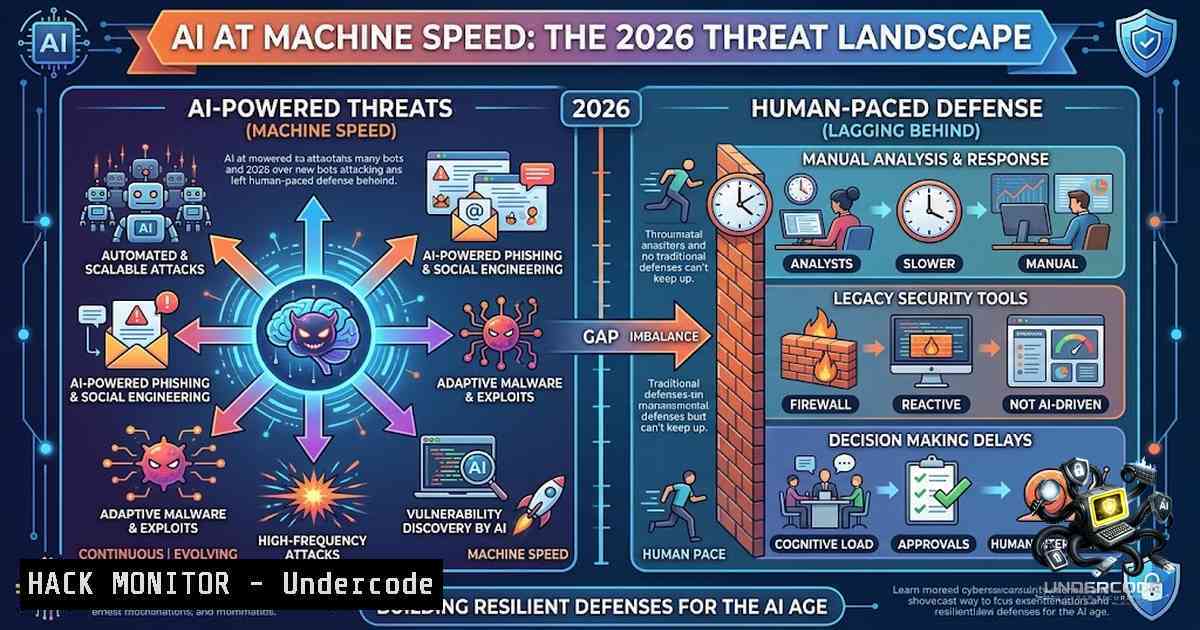
The global threat landscape reached an operational inflection point in the first half of 2026. According to Flashpoint’s 2026 Global Threat Intelligence Report: Midyear Edition, threat operations have fundamentally transitioned from human-led campaigns to machine-speed, AI-driven exploitation. With over 22 million illicit posts discussing or advertising criminal AI toolkits, 1.7 billion credentials harvested across 7.4 million compromised hosts, and 19% of all vulnerability disclosures arriving with ready-made exploit code, organizations can no longer afford to defend at human speed. This article breaks down the converging threats—AI automation, infostealer proliferation, vulnerability velocity, and Ransomware-as-a-Service expansion—and provides actionable defensive strategies, commands, and configurations to help security teams keep pace.
Learning Objectives:
- Understand how adversaries are deploying locally hosted, safeguard-stripped AI models to automate phishing, malware development, exploit creation, and social engineering at scale
- Identify the four converging threat vectors—AI-driven automation, infostealer credential harvesting, accelerated vulnerability exploitation, and RaaS expansion—and their compound risk impact
- Implement defensive measures including credential hygiene, zero-trust architecture, AI-aware security training, and intelligence-driven vulnerability prioritization
You Should Know:
- AI as a Force Multiplier: From Experimentation to Operational Scale
Criminals have moved artificial intelligence out of testing and into daily operations. Flashpoint tracked more than 22 million threat actor posts discussing, sharing, or advertising AI toolkits for criminal deployment in H1 2026 alone. Adversaries are no longer relying on mainstream AI platforms with ethical safeguards; instead, they are running custom, locally hosted large language models with safety guardrails stripped out, on private infrastructure they control.
These malicious LLMs allow even unsophisticated threat actors to automate complex phases of the attack lifecycle, including target profiling, malware evasion script creation, phishing content generation, and zero-day exploit generation. As Josh Lefkowitz, Flashpoint Co-Founder & CEO, stated: “AI is compressing the time between opportunity and exploitation. Capabilities that once took significant expertise, coordination, and time to develop are becoming faster to build, easier to scale, and harder to detect.”
How to Defend Against AI-Powered Attacks:
Organizations must move beyond traditional perimeter defenses and implement layered controls:
- Deploy AI-aware security training: Train employees to recognize AI-generated phishing, deepfake voice/video impersonation, and synthetic identity attacks
- Implement non-phishable credentials: Move aggressively to passwordless authentication, including passkeys and number-matching-based MFA
- Adopt zero-trust architecture: Verify every identity, message, and system interaction by design—behavioral biometrics and out-of-band confirmations are becoming non-1egotiable
- Deploy AI-driven defensive tools: Use AI-powered security solutions that can detect anomalies at machine speed to counter machine-speed attacks
Linux Command: Monitor for Unusual Outbound AI/ML Traffic
 Monitor outbound connections to suspicious IPs associated with known C2 infrastructure
sudo tcpdump -i any -1 'tcp[bash] & (tcp-syn) != 0 and dst port 443' | \
awk '{print $3}' | sort | uniq -c | sort -1r | head -20

Check for unauthorized Python ML libraries or suspicious AI tool installations
sudo find / -1ame ".py" -exec grep -l "transformers|torch|tensorflow|openai" {} \; 2>/dev/null | \
xargs ls -la | awk '{print $9, $5}' | sort -k2 -1r

Audit running processes for unauthorized AI/ML workloads
ps aux | grep -E "python.(transformers|torch|tensorflow|llama|ollama)" | grep -v grep
Windows PowerShell: Detect Suspicious AI Tool Installation
 Check for recently installed AI/ML packages in Python environments
Get-ChildItem -Path C:\Users\AppData\Local\Programs\Python\Python\Lib\site-packages -Recurse -ErrorAction SilentlyContinue |
Where-Object { $_.Name -match "transformers|torch|tensorflow|openai" } |
Select-Object FullName, LastWriteTime | Sort-Object LastWriteTime -Descending

Audit scheduled tasks for unusual AI-related executions
Get-ScheduledTask | Where-Object { $<em>.TaskPath -1otlike "Microsoft" -and $</em>.TaskPath -1otlike "Windows" } |
ForEach-Object { $<em>.TaskName; $</em>.Actions } | Select-String -Pattern "python|powershell|cmd"
- The Identity Crisis: Infostealers and the 1.7 Billion Credential Heist
Infostealer malware has become the primary entry point for enterprise intrusions. In H1 2026 alone, infostealers compromised more than 7.4 million unique hosts globally, extracting over 1.7 billion credentials and identity data points. Leading families including Vidar, StealC, and Lumma operate on subscription models, quietly harvesting active browser session tokens from infected machines. Attackers who possess a live session token do not need the password—they can simply authenticate as the legitimate user.
For cloud-first organizations, the emphasis on identity over perimeter breaches has particular significance. Weak credential hygiene, poor access controls, and exposed identity artifacts now pose a more immediate risk than traditional forms of intrusion. The report argues that stolen credentials let attackers sign in as legitimate users rather than break into systems through software flaws alone, helping them evade traditional security measures by blending malicious activity into normal authentication traffic.
How to Harden Against Infostealer Attacks:
- Enforce credential hygiene: Implement multi-factor authentication (MFA) on all remote access, admin accounts, and email; enforce strong password policies
- Monitor for compromised credentials: Use credential monitoring services to detect exposed corporate credentials on illicit markets
- Audit endpoint telemetry: Look for anomalous outbound connections matching infostealer communication patterns
- Harden delivery vectors: Review email, download, and software distribution controls to block typical lures such as cracked installers and fake updates
- Enable tamper protection: Prevent attackers from disabling security services or adding unauthorized exclusions
Linux Command: Detect Credential Exfiltration Attempts
 Monitor for unusual outbound connections to known infostealer C2 patterns
sudo ss -tunap | grep ESTAB | awk '{print $5}' | cut -d: -f1 | sort | uniq -c | sort -1r

Check for browser credential store access anomalies
sudo ausearch -ts today -m avc -k credential_access 2>/dev/null | tail -20

Identify unusual processes accessing /etc/passwd or /etc/shadow
sudo auditctl -w /etc/passwd -p rwa -k passwd_access
sudo auditctl -w /etc/shadow -p rwa -k shadow_access
sudo ausearch -k passwd_access -k shadow_access -ts today
Windows PowerShell: Detect Infostealer Activity
 Check for browser credential dumping attempts
Get-Process | Where-Object { $<em>.ProcessName -match "chrome|firefox|edge|opera" } |
ForEach-Object { Get-Process -Id $</em>.Id -Module | Where-Object { $_.FileName -match "sqlite|dll" } }

Audit scheduled tasks for persistence mechanisms used by infostealers
Get-ScheduledTask | Where-Object { $<em>.State -eq "Ready" } |
ForEach-Object { $</em>.Actions } | Select-String -Pattern "powershell|wscript|cscript|mshta"

Monitor for credential harvesting via registry
Get-ChildItem -Path "HKCU:\Software\Microsoft\Windows\CurrentVersion\Run" -ErrorAction SilentlyContinue
Get-ChildItem -Path "HKLM:\Software\Microsoft\Windows\CurrentVersion\Run" -ErrorAction SilentlyContinue
- Vulnerability Velocity: When Exploit Code Ships with the CVE
Flashpoint tracked 21,667 disclosed vulnerabilities between January and June 2026, with nearly one in five (19%, or 4,015 vulnerabilities) already linked to public or functional exploit code at the time of disclosure. More than 34% of vulnerabilities were rated critical or high on the CVSS scale, and Flashpoint noted that this volume has left security teams unable to work a patching queue sorted by severity alone.
The window between vulnerability discovery and mass exploitation has effectively vanished. AI tools make it easier to refine exploit code and speed testing against likely targets. The report concludes that vulnerability management is becoming less about headline severity scores and more about whether flaws can be exploited in practice. Flashpoint logged 6,808 vulnerabilities before they even reached the National Vulnerability Database, creating a significant intelligence gap for defenders relying on public sources.
How to Prioritize Vulnerability Remediation at Machine Speed:
- Adopt threat-informed prioritization: Move beyond CVSS scores and prioritize based on real-world exploitability, asset criticality, and evidence of active exploitation in the wild
- Monitor exploit chatter: Track underground discussions for emerging exploit code and proof-of-concept releases
- Implement automated patch management: Reduce mean time to remediation (MTTR) with automated patching for critical and actively exploited vulnerabilities
- Deploy virtual patching: Use web application firewalls (WAF) and intrusion prevention systems (IPS) to mitigate vulnerabilities before patches are available
Linux Command: Vulnerability Assessment and Patching
 Check for known vulnerabilities in installed packages (Debian/Ubuntu)
sudo apt update && sudo apt upgrade --dry-run | grep -E "Inst|Upgraded"

Check for known vulnerabilities in installed packages (RHEL/CentOS)
sudo yum check-update | grep -E "Security|Critical"

Scan for open ports and services that may be vulnerable
sudo nmap -sV -p- localhost 2>/dev/null | grep -E "open|filtered"

Check for outdated kernel and critical system packages
sudo dpkg -l | grep -E "linux-image|openssl|apache|nginx|mysql" | awk '{print $3, $2}'
Windows PowerShell: Vulnerability Management
 Check for missing security patches
Get-HotFix | Sort-Object InstalledOn -Descending | Select-Object -First 20

Identify installed software with known vulnerabilities (requires PSWindowsUpdate module)
Get-WUList | Where-Object { $<em>.IsHidden -eq $false -and $</em>.IsInstalled -eq $false } |
Select-Object , Description, SecurityBulletinIDs

Check for services exposed to the network
Get-Service | Where-Object { $_.Status -eq "Running" } |
Select-Object Name, DisplayName, StartType
4. Ransomware-as-a-Service: The Franchise Model at Scale
Ransomware remained a major source of disruption in the first half of 2026. Flashpoint documented 6,256 verified ransomware victims, a 45% increase from the same period a year earlier. Ransomware-as-a-Service (RaaS) rose by 45% period-over-period, with the top five RaaS groups accounting for over 44% of all attacks. Leading the list was Qilin with 901 victims, followed by Akira, 0APT, The Gentlemen, and Dragon Force.
While fewer organizations are paying ransom demands—victim payout rates dropped to a historic low of 28%—operators are compensating by increasing the volume of attacks. Automated access tooling has pushed the average price of initial access sold on criminal markets down 69%, to $439. The RaaS model has lowered the barrier to launching attacks, meaning actors without the technical skills to build their own tools can now buy access and infrastructure from established criminal groups.
How to Defend Against Ransomware:
- Maintain immutable, offline backups: Ensure backups cannot be encrypted or deleted by ransomware
- Implement application allowlisting: Use AppLocker or Windows Defender Application Control (WDAC) to prevent unauthorized executables
- Enforce least-privilege access: Limit user and system privileges on a necessity basis
- Deploy endpoint detection and response (EDR): Use behavioral detection to identify ransomware encryption patterns before widespread damage occurs
- Conduct regular incident response drills: Test response plans against ransomware scenarios
Linux Command: Ransomware Defense Configuration
 Configure immutable backup directories (requires chattr)
sudo chattr +i /backup/critical_data/

Monitor for suspicious file encryption patterns
sudo inotifywait -m -r -e modify,create,delete /home /var/www 2>/dev/null | \
grep -E ".encrypted$|.locked$|.crypt$" &

Implement file integrity monitoring (AIDE)
sudo aide --init
sudo mv /var/lib/aide/aide.db.new.gz /var/lib/aide/aide.db.gz
sudo aide --check

Restrict execution of binaries from world-writable directories
sudo mount -o remount,noexec /tmp
sudo mount -o remount,noexec /var/tmp
Windows PowerShell: Ransomware Hardening
 Enable Windows Defender Attack Surface Reduction rules
Set-MpPreference -AttackSurfaceReductionRules_Ids 75668C1F-73B5-4CF0-BB93-3ECF5CB7CC84 -AttackSurfaceReductionRules_Actions Enabled

Configure Controlled Folder Access to protect critical directories
Set-MpPreference -EnableControlledFolderAccess Enabled
Add-MpPreference -ControlledFolderAccessProtectedFolders "C:\Users\Documents"
Add-MpPreference -ControlledFolderAccessProtectedFolders "C:\Users\Desktop"

Disable PowerShell script execution from untrusted sources
Set-ExecutionPolicy -ExecutionPolicy RemoteSigned -Scope LocalMachine

Enable Windows Defender real-time protection and cloud-delivered protection
Set-MpPreference -DisableRealtimeMonitoring $false
Set-MpPreference -CloudBlockLevel High
Set-MpPreference -CloudTimeout 50
- Building a Proactive Defense Strategy for the Converged Threat Era
The data from the first half of 2026 suggests that cybercrime continues to operate as a service economy, with specialization at every stage. Ian Gray, Vice President of Intelligence at Flashpoint, emphasized: “Disrupting individual campaigns remains important, but understanding the relationships between these actor ecosystems provides a much stronger indicator of where threats are heading next.”
Strategic Recommendations for Security Leaders:
- Operationalize primary-source threat intelligence: Move beyond reactive incident response by leveraging threat intelligence that surfaces adversary behavior before attacks unfold
- Adopt business-aligned priority intelligence requirements (PIRs): Connect threat data to organizational assets, business priorities, and risk tolerance
- Implement threat-informed External Attack Surface Management (EASM) : Continuously discover and monitor external-facing assets for vulnerabilities and misconfigurations
- Conduct regular threat horizon scanning: Stay ahead of emerging AI-driven attack techniques, deepfake-based KYC bypass, and agentic AI attack chains
- Build cross-functional response capabilities: Ensure security, IT, fraud, and risk teams collaborate on threat intelligence sharing and incident response
What Undercode Say:
- Key Takeaway 1: The 2026 threat landscape has reached an inflection point where AI-driven automation has compressed attack timelines from weeks to minutes. Organizations still operating on human-paced defense cycles are already behind—the only way to keep pace is with machine-speed intelligence and automated response capabilities.
-
Key Takeaway 2: Identity is the new perimeter. With 1.7 billion credentials stolen in just six months and infostealer infections at 7.4 million hosts, credential hygiene and zero-trust architecture are no longer optional—they are foundational defensive requirements. The shift from perimeter-based to identity-based security must happen now, not after the next breach.
Analysis: The convergence of AI automation, credential theft, vulnerability velocity, and RaaS expansion represents a compound risk that multiplies the impact of each individual threat vector. Attackers are no longer choosing between phishing, malware, or ransomware—they are using AI to orchestrate all three simultaneously. The 69% drop in initial access prices on criminal marketsmeans that even low-skill actors can now launch sophisticated, multi-stage attacks. Defenders must respond by integrating threat intelligence, automation, and zero-trust principles into a unified defensive framework. The organizations that will survive this era are those that treat security not as a cost center but as a business enabler—one that can operate at the speed of the adversary.
Prediction:
- -1: As AI-powered attack toolkits become more accessible and affordable, the barrier to entry for cybercrime will continue to drop. We can expect a surge in attacks from previously non-technical actors, including organized crime groups and state-aligned operatives, leading to a broader and more diverse threat landscape through 2027.
-
-1: The 45% increase in ransomware victims coupled with declining payout rates suggests ransomware operators will pivot to new monetization strategies—including data extortion without encryption, dual extortion, and supply chain compromise—making detection and response significantly more complex.
-
-1: With 19% of vulnerabilities dropping with functional exploit code and AI accelerating exploit refinement, the window for patch deployment will shrink from days to hours. Organizations without automated patching and virtual patching capabilities will face unprecedented exposure.
-
+1: The Flashpoint report’s emphasis on primary-source intelligence and proactive defense signals a maturation of the cybersecurity industry. Organizations that invest in threat intelligence, automation, and zero-trust architecture will be better positioned to defend against AI-driven threats, potentially reducing the average cost and impact of breaches.
-
+1: The decline in ransomware payout rates to 28% suggests that organizations are increasingly refusing to pay ransoms—a positive trend that could weaken the RaaS business model over time if sustained with improved backup strategies and incident response capabilities.
-
-1: The geopolitical dimension of cybercrime, with state-aligned operations targeting supply chains, financial institutions, and industrial control systems, will intensify. The convergence of cybercrime and state-sponsored activity creates a hybrid threat environment where attribution becomes nearly impossible and defensive strategies must account for both criminal and nation-state adversaries simultaneously.
▶️ Related Video (82% Match):
https://www.youtube.com/watch?v=-1FpFw_RXLM
🎯Let’s Practice For Free:
🎓 Live Courses & Certifications:
Join Undercode Academy for Verified Certifications
🚀 Request a Custom Project:
Secure, high-velocity infrastructure and disruptive technological engineering. Contact our engineering team for high-tier development and proprietary systems:
[email protected]
💎 Smart Architecture | 🛡️ Secure by Design | ⭐ Trusted by Thousands
IT/Security Reporter URL:
Reported By: https://lnkd.in/p/ecccjUtV – Hackers Feeds
Extra Hub: Undercode MoN
Basic Verification: Pass ✅


