
Listen to this Post
Introduction:
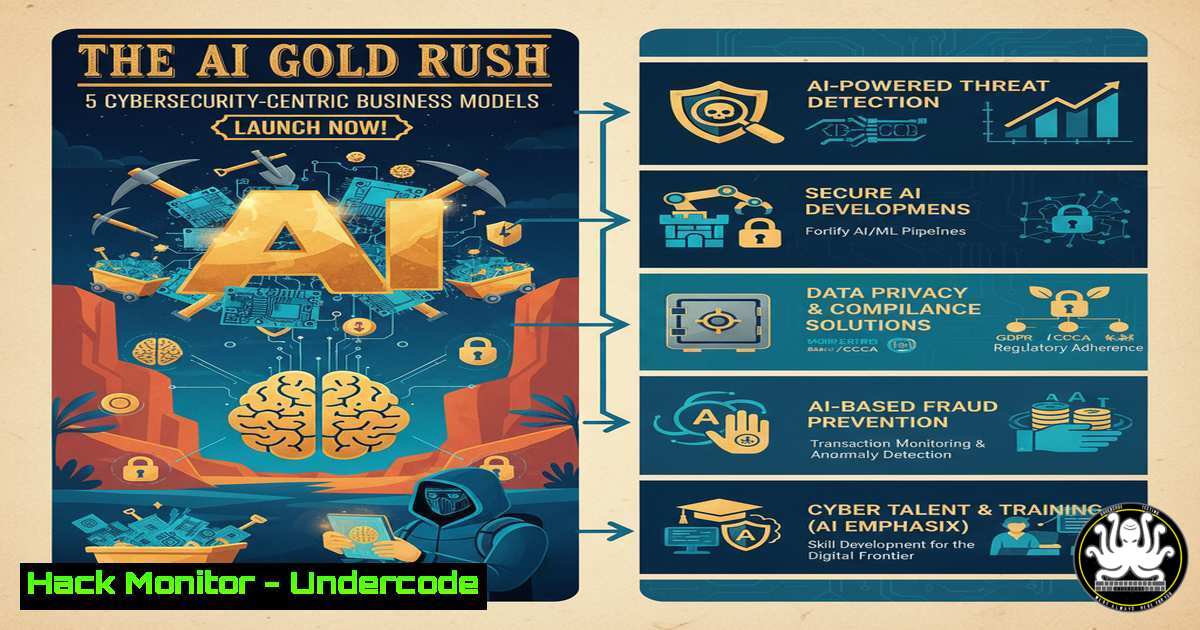
The massive $160B+ investment in AI infrastructure has created a fertile ground for agile entrepreneurs, but it has also opened a Pandora’s box of new cyber threats and opportunities. For cybersecurity professionals and IT specialists, this wave represents a unique chance to build businesses that not only leverage AI but also secure it, addressing critical vulnerabilities in the emerging digital landscape.
Learning Objectives:
- Identify five viable AI business models with inherent cybersecurity value propositions.
- Understand the core technical components and potential attack vectors for each model.
- Acquire practical, verified commands and code snippets to prototype and secure these AI-driven services.
You Should Know:
1. Securing GPT Wrappers and API Integrations
GPT wrappers are vulnerable to prompt injection, data exfiltration, and API key leakage. Securing the data flow between your application and the AI provider is paramount.
Verified Command/Code Snippet:
 Python example using environment variables and input sanitization
import os
import openai
from flask import Flask, request, jsonify
import re

app = Flask(<strong>name</strong>)
openai.api_key = os.environ.get("OPENAI_API_KEY")  Never hardcode keys

def sanitize_input(user_prompt):
 Basic sanitization to prevent prompt injection
blacklist = ['system:', 'sudo', 'admin', '--', '|', '&']
pattern = re.compile('|'.join(re.escape(word) for word in blacklist), re.IGNORECASE)
sanitized_prompt = pattern.sub("[bash]", user_prompt)
return sanitized_prompt[:1000]  Limit input length

@app.route('/get_ai_response', methods=['POST'])
def get_ai_response():
user_data = request.json
clean_prompt = sanitize_input(user_data.get('prompt', ''))
try:
response = openai.ChatCompletion.create(
model="gpt-3.5-turbo",
messages=[{"role": "user", "content": clean_prompt}],
max_tokens=150
)
return jsonify({"response": response.choices[bash].message['content']})
except Exception as e:
return jsonify({"error": "AI service error"}), 500
Step-by-step guide:
This snippet demonstrates a basic secure wrapper for an OpenAI API. It first loads the API key from an environment variable, preventing accidental exposure in code repositories. The `sanitize_input` function attempts to mitigate prompt injection attacks by redacting potentially dangerous commands or strings. It also imposes a length limit to prevent resource exhaustion attacks. The route handler uses a try-except block to prevent detailed error messages from being sent to the client, which could reveal internal system information.
2. Hardening AI Marketing Tool Infrastructure
AI tools that generate content often rely on multiple third-party APIs (e.g., 11Labs, RunwayML). Each integration point is a potential attack surface.
Verified Command/Code Snippet:
 Linux: Using UFW to restrict outgoing traffic to only necessary API endpoints
sudo ufw default deny outgoing
sudo ufw default deny incoming
sudo ufw allow out 443/tcp  Allow HTTPS traffic for APIs
sudo ufw allow in 80,443/tcp  Allow HTTP/S for your web service
sudo ufw allow ssh  Allow SSH for management
sudo ufw enable

Using curl to test API connectivity securely
curl -H "Authorization: Bearer $API_KEY" \
-H "Content-Type: application/json" \
-X POST https://api.elevenlabs.io/v1/text-to-speech/XYZ \
--data '{"text": "Hello world"}' \
--max-time 10  Set a timeout to avoid hanging requests
Step-by-step guide:
The Uncomplicated Firewall (UFW) commands create a “default deny” posture for both incoming and outgoing traffic. This is a critical security principle: only explicitly allowed traffic should flow. We then allow outbound HTTPS on port 443, which is necessary for communicating with most external AI APIs, while also opening ports 80 and 443 for incoming web traffic to our service. The `curl` command demonstrates a secure way to interact with an API, using headers for authentication and the `–max-time` flag to prevent the tool from hanging indefinitely on a slow or unresponsive endpoint, which could be a sign of an outage or a denial-of-service condition.
3. Implementing Secure Authentication for “AI Employee” Agents
Agentic AI that performs multi-step workflows requires robust, granular authentication and logging to prevent privilege escalation and ensure non-repudiation.
Verified Command/Code Snippet:
// Node.js snippet for JWT-based authentication and action logging
const jwt = require('jsonwebtoken');
const bcrypt = require('bcryptjs');

// Function to generate a secure token for an AI agent session
function generateAgentToken(agentId, permissions) {
return jwt.sign(
{ agentId: agentId, permissions: permissions },
process.env.JWT_SECRET,
{ expiresIn: '1h', issuer: 'ai-employee-platform' }
);
}

// Middleware to verify token and log actions
function authenticateAndLog(req, res, next) {
const token = req.header('Authorization')?.replace('Bearer ', '');
if (!token) {
return res.status(401).send('Access Denied');
}
try {
const verified = jwt.verify(token, process.env.JWT_SECRET);
req.agent = verified;
// Log the agent's action for audit
console.log(<code>[bash] Agent ${verified.agentId} attempted ${req.method} on ${req.path} at ${new Date().toISOString()}</code>);
next();
} catch (err) {
res.status(400).send('Invalid Token');
}
}
Step-by-step guide:
This code provides a foundation for securing “AI employee” access. The `generateAgentToken` function creates a JWT (JSON Web Token) that is digitally signed with a secret stored in an environment variable. The token includes the agent’s ID and its specific permissions, and it is set to expire after one hour, limiting the window of opportunity if a token is compromised. The `authenticateAndLog` middleware acts as a gatekeeper for all incoming requests. It verifies the token’s signature and expiry, and crucially, it logs every action attempt with a timestamp, creating a non-repudiable audit trail for security analysis and compliance.
4. Data Anonymization for Wellness AI Products
Wellness bots handle highly sensitive personal health data. Failure to properly anonymize this data can lead to major regulatory fines and loss of trust.
Verified Command/Code Snippet:
-- PostgreSQL commands for data management and anonymization
-- Create a separate table for PII (Personally Identifiable Information)
CREATE TABLE user_pii (
user_id UUID PRIMARY KEY DEFAULT gen_random_uuid(),
full_name TEXT NOT NULL,
email TEXT UNIQUE NOT NULL
);

-- Create a separate table for anonymized health data, linked by UUID
CREATE TABLE user_health_data (
data_id SERIAL PRIMARY KEY,
user_id UUID REFERENCES user_pii(user_id) ON DELETE CASCADE,
heart_rate INTEGER,
sleep_hours DECIMAL,
recorded_at TIMESTAMPTZ DEFAULT NOW()
);

-- A view or function to return fully anonymized data for analysis
CREATE VIEW anonymized_health_analytics AS
SELECT
MD5(user_id::text) as anonymous_id, -- Hash the UUID
heart_rate,
sleep_hours,
recorded_at
FROM user_health_data;
Step-by-step guide:
This database schema enforces data anonymization by design. By separating Personally Identifiable Information (PII) from health data, you minimize the risk of exposing sensitive information if the health data is queried directly. The `user_pii` table holds the sensitive data, while `user_health_data` only holds the metrics, linked by a UUID. The `anonymized_health_analytics` view is the key. It uses the `MD5` hash function (though for production, consider a stronger, non-reversible salt) to transform the user’s UUID into an anonymous identifier. This allows the AI to perform aggregate analysis on trends without ever knowing which specific user the data belongs to, complying with regulations like GDPR and HIPAA.
5. Vulnerability Scanning for Educational AI Tutor Platforms
AI tutoring platforms that interact with users, especially minors, must be rigorously scanned for web application vulnerabilities like XSS and SQLi to protect users.
Verified Command/Code Snippet:
 Using OWASP ZAP (Zed Attack Proxy) CLI for automated security scanning
 Start ZAP daemon
/zap/zap.sh -daemon -host 127.0.0.1 -port 8080 -config api.disablekey=true &

Run a quick active scan against your tutor platform's login page
docker run -t owasp/zap2docker-stable zap-baseline.py \
-t https://your-ai-tutor-site.com/login \
-r baseline_report.html

Check for common vulnerabilities in dependencies using npm audit
npm audit --audit-level high

Linux command to monitor for suspicious login attempts to your platform
sudo grep "Failed password" /var/log/auth.log | awk '{print $11}' | sort | uniq -c | sort -nr | head -10
Step-by-step guide:
This set of commands provides a multi-layered approach to security testing. The first command starts the OWASP ZAP daemon, a powerful web application scanner. The second command runs a `zap-baseline` scan inside a Docker container, targeting the critical login page of your tutoring platform and generating an HTML report. `npm audit` scans your Node.js project dependencies for known vulnerabilities, a common attack vector. Finally, the `grep` command on a Linux server parses the authentication log to show the top 10 IP addresses with failed login attempts, which is a primary indicator of a brute-force attack in progress, allowing for timely intervention such as blocking those IPs.
What Undercode Say:
- The Barrier to Entry is a Security Mirage. The ease of launching an “AI business” with simple wrappers creates a false sense of simplicity, often leading developers to neglect fundamental security practices like input validation, secret management, and audit logging. This will result in a surge of low-hanging fruit for attackers.
- The Real Value is in Trust, Not Just Technology. In a market flooded with similar AI capabilities, the businesses that will achieve long-term success and command premium pricing will be those that can demonstrably prove the security, privacy, and ethical handling of user data. Security is the new premium feature.
The analysis suggests that the initial wave of AI startups will face a brutal consolidation, not based on technological superiority, but on their ability to withstand their first significant security incident. The “move fast and break things” mentality, when applied to AI handling sensitive data, will lead to catastrophic breaks. The founders who invest in a “security-first” architecture from day one, even if it slows initial launch velocity, will be the ones who build durable, defensible businesses. The market will rapidly learn to distrust AI applications that suffer data leaks or prompt manipulation attacks, creating a winner-take-most environment for the most secure platforms.
Prediction:
Within the next 12-18 months, we will witness the first major regulatory crackdown and multi-million dollar fine levied against a seemingly “simple” AI wrapper business for a catastrophic failure in data protection or a widely exploited prompt injection attack that led to financial fraud. This event will act as a market-forcing function, rapidly shifting venture capital and customer demand towards AI solutions that can provide verifiable security audits, transparent data governance policies, and insurance against AI-specific failures. The “AI tidal wave” will not be stopped, but it will be channeled through the narrow gate of cybersecurity compliance.
🎯Let’s Practice For Free:
IT/Security Reporter URL:
Reported By: Adrian Lopez – Hackers Feeds
Extra Hub: Undercode MoN
Basic Verification: Pass ✅


