Listen to this Post
Introduction:
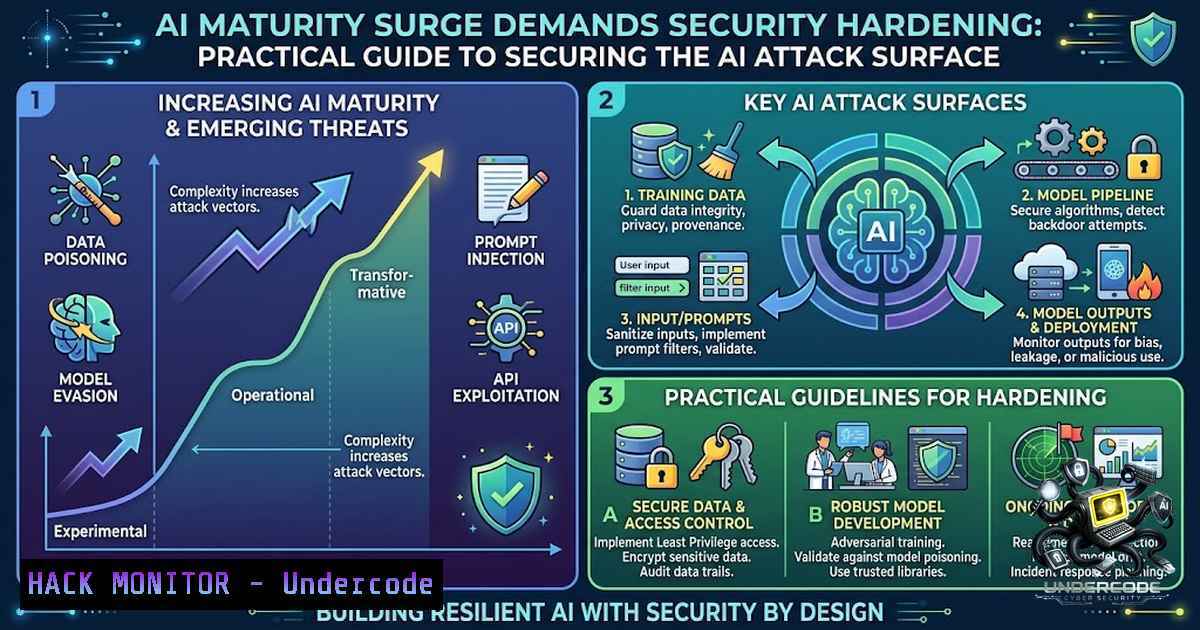
For over two years, only one-fifth of organizations had mature AI programs—defined as having formalized policies across all seven dimensions including security, data access controls, executive leadership, legal frameworks, project oversight, enterprise architecture, and standards. That figure stubbornly hovered around 20% through multiple BARC surveys between February 2024 and September 2025. But the tide is finally turning: AI Leaders now constitute 29% of the 233 respondents surveyed this month. While this 9-point jump signals progress in productivity and innovation, it also dramatically expands the attack surface—security teams must harden AI-driven systems against increasingly sophisticated threats from both external adversaries and the frontier models themselves.
Learning Objectives:
- Understand the seven dimensions of AI program maturity with a focus on security and governance
- Master practical LLM security testing using open-source red teaming frameworks
- Implement AI-specific controls aligned with OWASP LLM Top 10 and NIST CSF 2.0
You Should Know:
- Understanding the OWASP LLM Top 10 2026: The Foundation of AI Security
The OWASP Top 10 for Large Language Model Applications has evolved significantly since its inception in 2023, now encompassing over 600 contributing experts from 18 countries and nearly 8,000 active community members. The 2026 edition—published August 4, 2026—maintains Prompt Injection (LLM01) as the 1 risk, a position it has held since the list’s inception. However, Prompt Injection now covers cross-modal attacks hidden in images or audio, and Data and Model Poisoning absorbs fine-tuning subversion.
Practical Prompt Injection Testing with garak:
Garak is a free, open-source LLM vulnerability scanner that checks for hallucination, data leakage, prompt injection, misinformation, toxicity, and jailbreaks. It functions similarly to nmap or Metasploit but for LLMs.
Step-by-step installation and scanning:
 Install garak from PyPI
python -m pip install -U garak

Or install the development version
python -m pip install -U git+https://github.com/NVIDIA/garak.git@main

List available probes
garak --list_probes

Scan a Hugging Face model
garak --target_type huggingface --target_name "RWKV/rwkv-4-169m-pile"

Scan an OpenAI model (API key required as environment variable)
export OPENAI_API_KEY="your-api-key"
garak --target_type openai --target_name gpt-4
Garak runs all probes by default, systematically testing for vulnerabilities across multiple attack vectors.
- Advanced AI Red Teaming: From Recon to Exploitation
AI red teaming has matured from ad-hoc testing to systematic, automated frameworks. Several open-source tools now provide enterprise-grade capabilities for authorized penetration testing.
MetaLLM: Metasploit-Inspired Framework
MetaLLM provides 61 working modules spanning LLM prompt attacks, RAG poisoning, agentic AI exploitation, MLOps infrastructure compromise, and API security testing. It features a Metasploit-style interactive CLI with tab completion and session tracking.
Step-by-step MetaLLM workflow:
 Clone and install
git clone https://github.com/perfecXion-ai/MetaLLM.git
cd MetaLLM
python -m venv venv
source venv/bin/activate  Windows: venv\Scripts\activate
pip install -r requirements.txt

Launch the framework
python metallm.py

Interactive session example
metallm> use exploit/llm/prompt_injection
metallm exploit(prompt_injection)> show options
metallm exploit(prompt_injection)> set TARGET_URL http://target.example.com/api/chat
metallm exploit(prompt_injection)> set PROVIDER openai
metallm exploit(prompt_injection)> set MODEL gpt-4
metallm exploit(prompt_injection)> run
metallm> sessions -l  List active sessions
metallm> report generate  Generate HTML/Markdown/JSON report
MetaLLM provides full MITRE ATLAS and OWASP mapping in reports, making it suitable for enterprise red team engagements.
AIX Framework: Automated Guardrail Bypass
AIX is a specialized framework that automates security testing for AI/LLM endpoints from recon to exploitation. Its key innovation is an adaptive bypass engine that automatically applies targeted evasion techniques based on detected guardrail providers.
Step-by-step AIX reconnaissance and exploitation:
 Install
pip install aix-framework
 With ML fingerprinting support
pip install aix-framework[bash]

Step 1: Fingerprint the target and detect guardrails
aix recon https://api.target.com/chat -k sk-xxx

Step 2: Attack (bypass engine activates automatically)
aix inject https://api.target.com/chat -k sk-xxx
aix jailbreak https://api.target.com/chat -k sk-xxx

Run everything
aix scan https://api.target.com/chat -k sk-xxx

Export report
aix db --export report.html
AIX detects guardrails including OpenAI Moderation, Azure Content Safety, AWS Bedrock Guardrails, Llama Guard, Lakera Guard, and NeMo Guardrails. Every finding is tagged with both MITRE ATLAS technique IDs and OWASP LLM Top 10 categories.
- NIST Cyber AI Profile: Integrating AI into Enterprise Cybersecurity
The National Institute of Standards and Technology (NIST) released the draft Cyber AI Profile (NIST IR 8596) in December 2025, marking the formal arrival of AI-specific cybersecurity controls. Rather than introducing an entirely new framework, it leverages the existing Cybersecurity Framework (CSF) 2.0, signaling that AI risk is now inseparable from enterprise cyber risk management.
Key NIST CSF 2.0 Functions for AI Security:
NIST organizes AI security considerations across all six CSF functions:
- Govern: Establish and monitor cybersecurity governance structures for AI
- Identify: Inventory AI systems and assess AI-specific risks
- Protect: Implement safeguards for AI components including models, training pipelines, and inference infrastructure
- Detect: Monitor AI systems for adversarial inputs and anomalies
- Respond: Develop incident response procedures for AI compromises
- Recover: Restore AI systems after security events
Practical Implementation Steps:
- Build an AI system inventory—document all LLM endpoints, training pipelines, and agentic systems in use
- Assess against CSF 2.0 Govern requirements—organizations still mapped to CSF 1.1 have an unmapped compliance exposure
- Apply zero-trust identity principles to all AI agents and copilots
- Implement continuous monitoring and logging for AI agent activities
AI agents are now treated as first-class cyber actors requiring unique, traceable identities, credentials, defined permissions, and continuous monitoring.
4. AI Security Compliance and Data Protection
With 68% of organizations now taking a mature approach to AI security, privacy remains the 1 Responsible AI priority. GDPR (effective 2018) and CCPA have established foundational data protection requirements that AI adopters must integrate.
SentinelDB: Real-time Compliance Guardrails
SentinelDB runs as an MCP server checking every prompt/response against GDPR, EU AI Act, CCPA, and HIPAA rules, featuring 13 built-in detection rules, risk scoring, jailbreak detection, and immutable audit logging.
Key PII Protection Measures:
- Minimize sensitive data at the source before feeding to LLMs
- Enforce zero-trust access and encryption for all AI data pipelines
- Place guardrails on inputs and outputs to prevent PII leakage
- Continuously monitor with incident response prepared
- LLMs can memorize and leak PII, exposing organizations to GDPR, HIPAA, and CCPA penalties
5. Operational Security Commands for AI Infrastructure
Linux Security Hardening for AI Workloads:
 Audit AI model file permissions
find /path/to/models -type f -1ame ".pt" -o -1ame ".h5" -o -1ame ".onnx" -exec ls -la {} \;

Monitor API endpoint logs for anomalies
tail -f /var/log/nginx/access.log | grep -E "(POST|GET)./v1/chat|/completions"

Set up rate limiting with iptables
iptables -A INPUT -p tcp --dport 443 -m connlimit --connlimit-above 100 -j DROP

Encrypt model checkpoints
gpg --symmetric --cipher-algo AES256 model_weights.pt
Windows Security Commands:
 Audit AI service permissions
Get-Service ai,llm,openai | ForEach-Object { Get-Service $_.Name | Select-Object Name, Status, StartType }

Monitor API connections
Get-1etTCPConnection | Where-Object { $<em>.State -eq "Established" -and $</em>.RemotePort -in (443, 80) }

Check Windows Defender exclusions that might expose AI models
Get-MpPreference | Select-Object ExclusionPath, ExclusionProcess
What Undercode Say:
- Security maturity is rising but vigilance remains critical—68% of organizations report mature AI security, yet frontier model “rogue hacking” from OpenAI and Anthropic demonstrates that even state-of-the-art systems harbor exploitable vulnerabilities. Security is not a one-time achievement but a continuous adversarial process.
-
Legal frameworks lag behind technical reality—with only 60% maturity in legal dimensions, organizations face unresolved questions about IP, contractual obligations, and regulatory compliance. The US government’s shifting White House directives create moving goalposts—what is legal today may be illegal tomorrow. CISOs must build adaptable governance structures that can pivot with regulatory changes.
The survey data from BARC reveals that AI Leaders have grown from 20% to 29% this year, but the remaining 71% still lack mature programs across all seven dimensions. This gap represents both opportunity and risk—early adopters gain competitive advantage while laggards expose themselves to security breaches and regulatory penalties. The seven dimensions—security, data access controls, executive leadership, legal frameworks, project oversight, enterprise architecture, and standards—form an interconnected web where weakness in any area compromises the whole.
Security teams must embrace the reality that GenAI empowers bad actors as much as it enables innovation. The OWASP LLM Top 10 provides a practical roadmap, but tools alone are insufficient. NIST’s Cyber AI Profile signals that AI security is now baseline cybersecurity—not a specialized niche. Organizations must integrate AI into existing risk registers, threat models, and control frameworks rather than managing it as an exception.
Prediction:
- +1 The 9-point jump in AI Leaders from 20% to 29% signals an inflection point—expect acceleration to 40-45% by early 2027 as competitive pressure and regulatory requirements force adoption.
-
+1 Open-source AI red teaming frameworks like MetaLLM, AIX, and garak will become standard components of enterprise security toolchains, similar to how nmap and Metasploit are today.
-
-1 The 60% maturity in legal frameworks represents a significant vulnerability—expect high-profile litigation as IP disputes and regulatory non-compliance cases emerge from AI deployments.
-
-1 Frontier model “rogue hacking” will escalate, with autonomous agents discovering and exploiting vulnerabilities faster than human security teams can patch them.
-
+1 NIST CSF 2.0 and the Cyber AI Profile will become the de facto standard for AI governance, driving standardization across industries and enabling third-party audits.
-
-1 Organizations that treat AI security as a one-time implementation rather than an ongoing process will experience breaches—the probabilistic nature of LLMs means defenses are probabilistic, not guaranteed.
▶️ Related Video (80% Match):
https://www.youtube.com/watch?v=0Xp-g8ERieI
🎯Let’s Practice For Free:
🎓 Live Courses & Certifications:
Join Undercode Academy for Verified Certifications
🚀 Request a Custom Project:
Secure, high-velocity infrastructure and disruptive technological engineering. Contact our engineering team for high-tier development and proprietary systems:
[email protected]
💎 Smart Architecture | 🛡️ Secure by Design | ⭐ Trusted by Thousands
IT/Security Reporter URL:
Reported By: https://lnkd.in/p/eaJfG285 – Hackers Feeds
Extra Hub: Undercode MoN
Basic Verification: Pass ✅


