
Listen to this Post
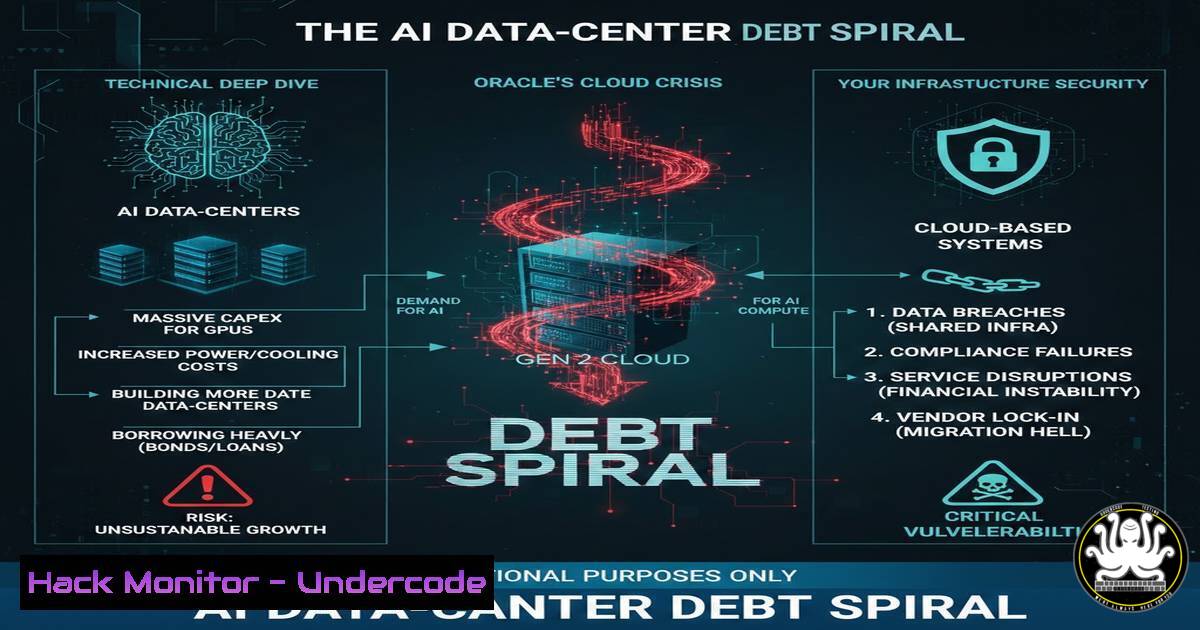
Introduction:
The hyperscale race for AI supremacy is creating a precarious financial model built on massive, debt-fueled data center expansion. As Oracle’s potential overbuild highlights, this isn’t just an economic risk; it creates systemic vulnerabilities in cloud security posture, operational stability, and compliance frameworks. When cloud providers face margin compression and cash flow issues, critical investments in security hardening, patch management, and threat detection can become early casualties, exposing enterprise workloads to increased risk.
Learning Objectives:
- Understand the technical and financial cascade from cloud overcapacity to degraded security and operational resilience.
- Learn to audit your cloud environment for signs of provider instability and implement defensive architectural patterns.
- Master FinOps and security tooling to maintain control and visibility in a potentially volatile multi-cloud landscape.
You Should Know:
1. The Technical Debt & Security Trade-off Cycle
When cloud providers engage in discounting to fill unused capacity, internal R&D and security budgets are often slashed. This can lead to delayed vulnerability patches, deprecated security features, and reduced incident response capabilities. For users, this manifests as longer exposure windows and increased risk.
Step‑by‑step guide:
Monitor Provider Health: Use APIs to track service health and patch release notes. Set up alerts for irregular maintenance windows.
 Example using OCI CLI to list service announcements (conceptual)
oci announcements service announcement list --compartment-id <your_compartment> --output table
 Monitor AWS Service Health Dashboard via CLI
aws health describe-events --filter '{"services": ["ec2", "s3"]}'
Implement a Vulnerability Lag Buffer: Don’t auto-update to the latest provider service version immediately. Stage updates in a sandbox environment to test for stability and security gaps introduced by rushed patches.
Enforce Zero-Trust Network Models: Assume the underlying platform may be compromised. Segment workloads rigorously using strict network policies and identity-aware proxying.
- Forensic FinOps: Detecting Provider Distress Through Your Bill
Sudden, aggressive discounting or changes in billing granularity can be early technical indicators of provider cash flow problems. Your billing data is a key telemetry source for forecasting platform risk.
Step‑by‑step guide:
Analyze Unit Cost Trends: Script regular analysis of your compute and storage unit costs (cost/GB-hour, cost/vCPU-hour).
 Pseudocode for analyzing cost trends from cloud billing exports
import pandas as pd
df = pd.read_csv('billing_export.csv')
 Calculate monthly unit cost for core services
df['vcpu_hourly_cost'] = df['compute_cost'] / df['vcpu_hours']
df.plot.line(x='month', y='vcpu_hourly_cost', title='Unit Cost Trend Analysis')
Audit Credit and Commitment Use: Track the percentage of your consumption covered by credits vs. actual spend. A provider pushing long-term commitments (CUDs) aggressively may signal desperation for locked-in cash flow.
Deploy Anomaly Detection on Billing: Use tools like the `GCP Billing Budget API` or `AWS Cost Anomaly Detection` to alert on unexpected cost changes that could indicate altered pricing tiers.
- Architecting for Cloud Agnosticism: The Container & IaC Escape Hatch
Lock-in is the greatest risk during provider instability. Your architecture must enable portability without a costly re-engineering lift.
Step‑by‑step guide:
Standardize on Kubernetes: Use vanilla Kubernetes distributions (e.g., upstream K8s, K3s) rather than proprietary managed services (e.g., OKE, EKS deeply customized features). Deploy using Helm charts.
 Generic Helm values.yaml minimizing cloud-specific dependencies
apiVersion: v2
name: my-app
description: A cloud-agnostic deployment
dependencies:
- name: postgresql
version: "12.x"
repository: "https://charts.bitnami.com/bitnami"
condition: postgresql.enabled
Enforce Infrastructure as Code (IaC) with Multi-Cloud Backends: Write Terraform or OpenTofu modules that can target different providers. Use Terragrunt for environment management.
 Terraform module variable structure for multi-cloud
variable "cloud_provider" {
description = "Target cloud (aws, azure, gcp, oci)"
type = string
validation {
condition = contains(["aws", "azure", "gcp", "oci"], var.cloud_provider)
error_message = "Unsupported provider."
}
}
Abstract Persistent Storage: Use CSI (Container Storage Interface) drivers or object storage with S3-compatible APIs to avoid proprietary storage lock-in.
4. Hardening for Reduced Provider Vigilance
Assume the provider’s SOC is understaffed. Double down on your own detective and preventive controls.
Step‑by‑step guide:
Enable Maximized Logging and Forward Off-Platform: Ensure all audit logs (CloudTrail, OCI Audit, Cloud Audit Logs) are exported in real-time to a separate, secure SIEM outside the primary cloud account.
 AWS CLI command to create a trail that logs all management events
aws cloudtrail create-trail --name All-Regions-Trail --s3-bucket-name my-secure-log-bucket --is-multi-region-trail true --enable-log-file-validation
Implement Network Egress Control: Restrict and monitor all outbound traffic from your VCN/VPC to prevent data exfiltration if control plane security is weakened. Use firewall rules and gateways.
Schedule Regular Configuration Drift Checks: Use tools like AWS Config, Azure Policy, or open-source `Cloud Custodian` to enforce security baselines and alert on any unauthorized changes.
- The API Security Frontier in a Volatile Ecosystem
A financially strained provider may delay updates to their API gateways and control plane, leaving known vulnerabilities unpatched. Your API calls become a larger attack surface.
Step‑by‑step guide:
Rotate Credentials and Keys Aggressively: Shorten the rotation cycle for IAM access keys, OAuth tokens, and service account keys. Automate this process.
 PowerShell example for rotating an Azure Service Principal key (conceptual)
$newCred = New-AzADSpCredential -ServicePrincipalName <appId> -EndDate (Get-Date).AddDays(90)
 Immediately update your CI/CD secrets vault
Update-AzKeyVaultSecret -VaultName 'my-vault' -Name 'spn-secret' -SecretValue $newCred.Secret
Implement API Call Signing and Validation: For critical management operations, require signed API requests and validate the signature on a proxy layer you control.
Monitor for Unusual API Traffic: Set up dashboards tracking ErrorRate, ThrottlingRate, and `SourceIP` for your cloud provider’s control plane APIs to detect reconnaissance or attack patterns.
What Undercode Say:
- Financial Engineering is a New Attack Vector: CFO-level decisions on capex and discounting can directly enable security vulnerabilities by starving platform security teams of resources. Infrastructure architects must now model financial risk as part of their threat assessment.
- Resilience is Multi-Cloud, Not Hybrid: True resilience against a single provider’s collapse isn’t about a slow migration path; it’s about maintaining parallel, low-cost standby capacity in a second cloud, enabled by the agnostic architecture outlined above. The cost of this standby capacity is your insurance premium.
Prediction:
The looming AI infrastructure glut will trigger a consolidation wave among second-tier cloud providers. This will not result in immediate outages but in a protracted period of “zombie cloud” platforms—operational but insecure, under-maintained, and desperate. Sophisticated threat actors will map these financially weak providers and target their customers, anticipating slower patch cycles and overwhelmed security teams. The next major cloud breach may not be due to a technical zero-day, but to an economic downturn that forced a provider to choose between paying its debt or its security engineers. The era of cloud computing is entering a risk maturity phase where due diligence must extend far beyond uptime SLAs to include analysis of the provider’s balance sheet and capital expenditure runway.
▶️ Related Video (74% Match):
🎯Let’s Practice For Free:
IT/Security Reporter URL:
Reported By: Davidlinthicum Oracle – Hackers Feeds
Extra Hub: Undercode MoN
Basic Verification: Pass ✅


