Listen to this Post
Introduction:
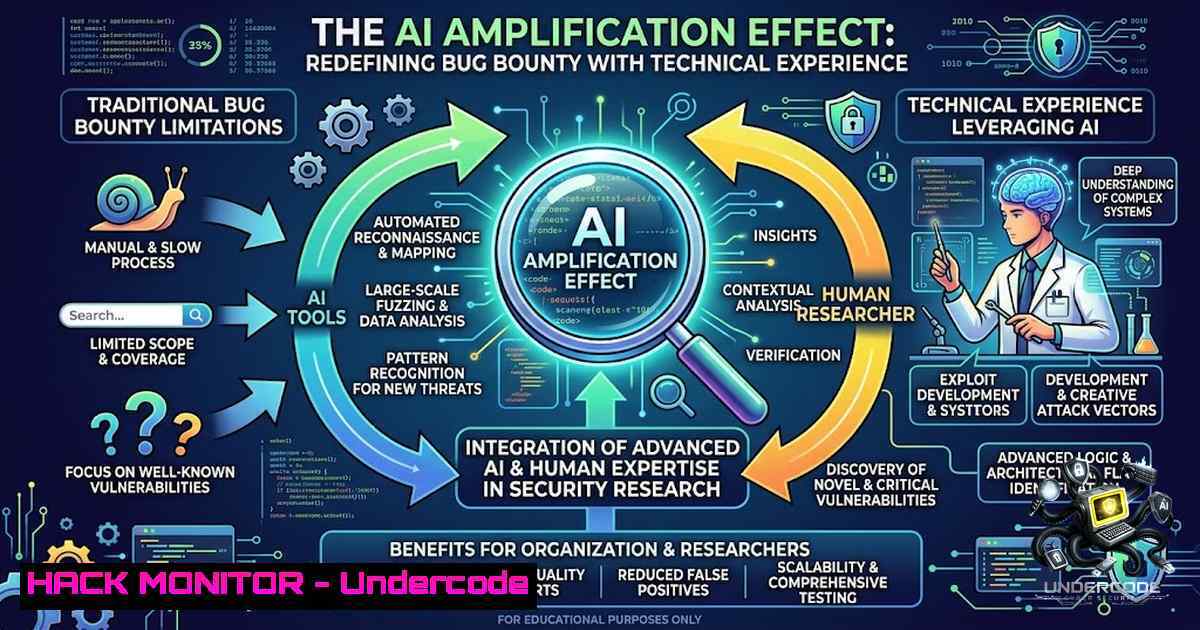
The intersection of artificial intelligence and cybersecurity has sparked considerable debate, with some projecting fully autonomous vulnerability discovery as an imminent reality. However, as demonstrated by recent hands-on experience, the true power lies not in replacing the human researcher but in creating a symbiotic relationship where AI amplifies technical expertise. This approach, centered on continuous, autonomous assistance guided by years of applied knowledge, is reshaping how modern bug bounty programs and security assessments are conducted, shifting the focus from pure automation to intelligent correlation and noise reduction.
Learning Objectives & Secrets:
- Objective 1: Master Hybrid Automation – Learn to build systems that operate autonomously to analyze attack surfaces, yet are fundamentally orchestrated by your personal methodology and experience, preventing the common pitfall of generating excessive false positives.
- Objective 2 Secret Tip: Contextual Correlation – The secret is not in finding vulnerabilities directly, but in programming AI to correlate thousands of data points, identifying abnormal patterns that human instinct alone might miss in a sea of information.
- Objective 3 Secret Tip: Strategic Noise Reduction – Implement dynamic filtering mechanisms that continuously adjust to reduce noise, ensuring that only critical, high-confidence leads are escalated for manual technical review.
You Should Know:
1. Building an Autonomous yet Guided Reconnaissance Pipeline
Establishing a system that continuously monitors targets requires a combination of open-source intelligence (OSINT) tools and AI-driven parsing. The goal is to automate the initial data gathering while applying intelligent filters to highlight high-value endpoints.
Step‑by‑step guide:
- Start by setting up a subdomain discovery loop using tools like `amass` and
subfinder. Run:amass enum -passive -d example.com -o subdomains.txt. Integrate this into a cron job for continuous monitoring. - Use AI models (via APIs) to parse the output and identify subdomains with high-value keywords (e.g., “api”, “admin”, “graphql”). Python script example:
import requests subdomains = open('subdomains.txt').read().splitlines() high_value = [s for s in subdomains if 'api' in s or 'admin' in s] print(high_value) - On Windows, use PowerShell to automate the download and parsing of new data:
Invoke-WebRequest -Uri "https://api.example.com/recon" | ConvertFrom-Json | Export-Csv -Path "recon.csv". - Configure alerting to notify you only when AI detects a significant change in the application’s structure or new high-value endpoints appear.
- Configuring AI for Contextual Anomaly Detection in HTTP Traffic
Instead of blindly fuzzing, configure your AI assistant to understand the ‘business logic’ and expected behavior of the application, looking for deviations that indicate issues like IDOR or privilege escalation.
Step‑by‑step guide:
- Set up a Burp Suite or OWASP ZAP proxy to capture all traffic for a target application. Export the request/response pairs to a JSON log file.
- Create a script that sends each request to a Large Language Model (LLM) via API, asking it to classify the response’s expected behavior.
- Example prompt for the AI: “Analyze this request changing the parameter ‘userId’ from 100 to 101. Determine if the response indicates data belonging to another user based on the context and return a confidence score.” This shifts the AI’s role from scanner to contextual analyzer.
- Implement a feedback loop: if the AI flags a potential issue, run a custom Python script to test for simple IDOR by incrementing ID values and comparing responses, using the `requests` library.
- For automation on Linux, use `jq` to parse logs:
cat burp_log.json | jq '.[] | select(.issue == "potential IDOR")', and pipe to your analysis script.
3. Implementing a Continuous Vulnerability Correlation Engine
This involves creating a central database to aggregate results from different scanners and the AI’s intelligent analysis to identify patterns and correlations.
Step‑by‑step guide:
- Set up a PostgreSQL or Elasticsearch database to store all scan results, including tool output (from Nuclei, Nmap, etc.) and AI analysis.
- Use a Python script to correlate findings. For instance, if AI identifies a non-standard header in a subdomain that’s running an outdated server (identified by Nmap), this becomes a high-priority lead.
- Script to trigger a manual review:
if AI_anomaly and vuln_server: send_alert("Critical lead: https://"+subdomain). - On Windows, use Task Scheduler to run the data aggregation script daily, ensuring your knowledge base is always current.
- The key is to use AI not for binary ‘vulnerable/not vulnerable’ conclusions, but to score leads on a scale of 1-10 based on how unusual the behavior is relative to the application’s baseline.
4. API Security Hardening and AI-Driven Misconfiguration Detection
By instructing AI to analyze API specifications and responses, we can identify misconfigurations like exposed sensitive data or improper access control, similar to the Critical 9.1 vulnerability mentioned.
Step‑by‑step guide:
- Extract the OpenAPI/Swagger specification for the target API. Use tools like `swagger-cli validate` to check for basic errors.
- Feed the API spec into an AI with the instruction: “List all endpoints that do not have a clear authorization scope defined and may require further hardening.”
- Create a script that actively tests these endpoints for common misconfigurations, such as accepting HTTP methods not defined in the spec (e.g., TRACE, OPTIONS).
- Use commands like `curl -X OPTIONS https://api.example.com/api/v1/users/ -v` to check for misconfigured CORS policies and cross-check the results with AI predictions.
- For cloud environments, ensure S3 buckets or Azure Blob storage permissions are not publicly accessible. Use `aws s3api get-bucket-acl –bucket example` and feed the output to AI for a security audit.
5. Exploitation and Mitigation: Understanding Business Logic Flaws
The final step is using AI to map the attack surface, allowing your technical skills to delve deep into business logic, finding critical vulnerabilities that automated scanners cannot.
Step‑by‑step guide:
- Use your autonomous system to map out the workflow of the application (e.g., “Add to Cart” -> “Apply Discount” -> “Checkout”).
- Ask the AI: “Given the sequence of steps for a transaction, identify state-changing requests that lack proper validation or CSRF tokens.” The AI will highlight potential targets.
- For mitigation, run a script to validate against the predicted weaknesses. For example, to test race conditions, write a concurrent bash script using `curl` inside a `for` loop: `for i in {1..100}; do curl -X POST … & done` to see if double-spending or multiple discount applications are possible.
- Rely on the AI’s continuous monitoring to alert you immediately if the application’s logic changes, allowing for quick reassessment of exploits.
- Finally, document all findings with clear remediation steps, using the AI to assist in writing the initial technical summary for the bug report.
What Undercode Say:
- Key Takeaway 1: The fusion of technical experience with AI is undeniably powerful. The real strength lies in AI’s ability to analyze vast attack surfaces continuously, allowing the researcher to focus their expertise on the most critical and complex anomalies.
- Key Takeaway 2: The “vision” is not a replacement of human researchers but a significant augmentation. AI serves as a tireless assistant that provides contextual intelligence, enabling a proactive and strategic approach to vulnerability discovery, rather than a reactive one.
The success of this hybrid model hinges on the researcher’s ability to transfer their methodology into the AI’s logic. It requires building adaptable systems that can understand the ‘why’ behind an action, significantly reducing false positives and escalating only credible threats. This evolution in approach means that the future of bug bounty belongs to those who can effectively bridge the gap between human intuition and machine learning.
Prediction:
- +1 The integration of AI into bug bounty programs will professionalize the field, shifting the focus from volume-based submissions to high-quality, complex vulnerability research, significantly increasing the value of skilled researchers.
- -1 An over-reliance on automated AI systems without a solid technical foundation will lead to an increase in false positive reports, potentially overwhelming security teams and diluting the reputation of bug bounty programs.
- +1 AI-driven correlation will lead to the discovery of more critical, logic-based vulnerabilities in complex cloud-1ative applications, with researchers able to submit more comprehensive and valuable reports for high bounties.
- +1 Security training will evolve to incorporate AI-assisted learning, allowing new researchers to gain context faster and develop the “instinct” that currently takes years to build, accelerating the growth of the talent pool.
- -1 As automation becomes more sophisticated, application security testing might become more expensive, requiring organizations to invest in advanced AI tools, creating a disparity in security capabilities between large and small enterprises.
▶️ Related Video (88% Match):
🎯Let’s Practice For Free:
🎓 Live Courses & Certifications:
Join Undercode Academy for Verified Certifications
🚀 Request a Custom Project:
Secure, high-velocity infrastructure and disruptive technological engineering. Contact our engineering team for high-tier development and proprietary systems:
[email protected]
💎 Smart Architecture | 🛡️ Secure by Design | ⭐ Trusted by Thousands
IT/Security Reporter URL:
Reported By: https://lnkd.in/p/eaFPRHWn – Hackers Feeds
Extra Hub: Undercode MoN
Basic Verification: Pass ✅


