
Listen to this Post
Introduction:
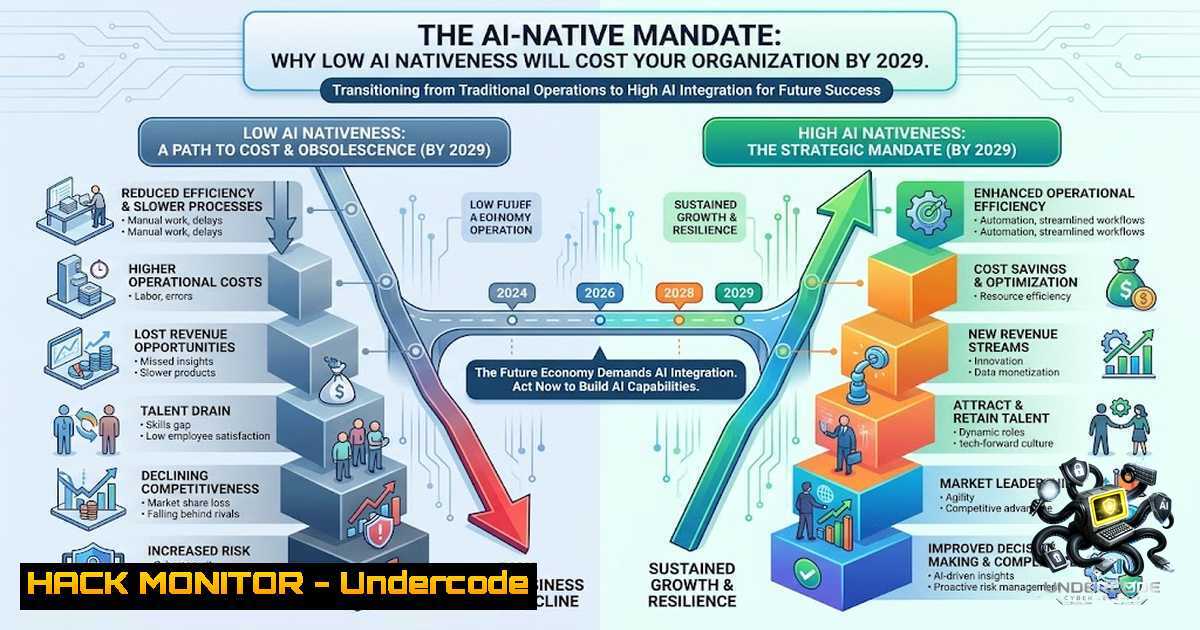
By as early as 2029, organizations with low AI nativeness could face existential competitive disadvantages, according to Gartner research. An AI-1ative business model represents a fundamental framework for embedding artificial intelligence at the core of how a business creates, delivers, and captures value—distinct from merely using AI to enhance existing operations. As Gartner anticipates the AI-1ative movement will rapidly extend beyond technology vendors to encompass enterprises across all industries, organizations must systematically assess, benchmark, and accelerate their journey toward AI-1ative business models before competitors gain the advantage.
Learning Objectives & Secrets:
- Objective 1: Assess Current AI Nativeness Maturity – Learn to systematically evaluate AI adoption across individual business components including channels, ecosystems and partnerships, supply chain, operations, and customer engagement. Use Gartner’s AI-1ative business model scorecard to visually track progress and calculate an overall AI nativeness maturity score, with each component weighted based on strategic importance.
-
Objective 2 Secret Tip: Map Your Organization to the Six-Stage Maturity Framework – Most organizations misidentify their AI maturity level. The spectrum ranges from Stage 0 (Not AI-enabled: traditional, static channels without AI) through Stage 3 (AI-integrated: data-driven resource allocation) to Stage 5 (AI-1ative: AI autonomously creates, adapts, and optimizes channels). Secret: Many enterprises claiming “AI-first” are actually at Stage 2 (AI-augmented) where human decision-making remains central—true AI-1ative requires autonomous orchestration.
-
Objective 3 Secret Tip: Define AI Ambition at the Executive Level – CIOs and innovation leaders must share real-world examples of AI-1ative business models to help fellow executives understand how AI creates value beyond traditional technology. Secret: Leadership alignment is the single most critical success factor—presenting the stages of AI nativeness supports strategic discussions and clarifies the organization’s vision, securing cross-functional buy-in before any technical implementation begins.
You Should Know:
1. The AI Security Gap: Intent vs. Execution
The 2026 Cloud Security Report reveals a staggering 51-point gap between AI security intent and execution: 77% of organizations have updated their security strategy in response to AI adoption, but only 26% have the infrastructure to enforce it. Even more concerning, only 12% of organizations have a documented, regularly tested process for shutting down or overriding AI systems when something goes wrong. This operational readiness gap represents the single greatest vulnerability in the AI-1ative transformation.
Step-by-Step Guide: AI Security Posture Assessment
- Inventory all AI assets: Identify all AI models, APIs, and agentic systems in production. Use `nmap -sV -p 8000-9000
` to discover exposed inference endpoints. -
Audit access controls: Enforce role-based access control (RBAC) separating inference consumers, prompt engineers, model administrators, and auditors. On Linux:
auditctl -w /etc/ai-models/ -p wa -k ai_model_access. -
Implement Data Loss Prevention for AI: Only 15% of organizations have DLP controls specifically configured for AI. Configure DLP policies:
splunk add alert "ai_data_exfiltration" -rule "source_type=ai_inference AND dest_port=443". -
Establish kill-switch procedures: Document and regularly test AI system override protocols—only 12% of organizations currently do this. Create a runbook:
echo "AI_OVERRIDE_ACTIVATED" | systemd-cat -t ai-killswitch -p emerg. -
Continuous validation: Use red-teaming tools like `garak –list_probes` to probe model vulnerabilities, and validate outputs before storing or executing them.
2. Shadow AI and the Quiet Data Bleed
In the name of productivity, employees have poured sensitive corporate knowledge into public AI tools, creating what security experts call “shadow AI”—intellectual property quietly bleeding onto third-party servers. This has become an enormous legal and security liability. The most immediate threat isn’t external attackers; it’s internal users unknowingly exposing proprietary algorithms, customer data, and strategic plans to public LLMs.
Step-by-Step Guide: Shadow AI Detection and Control
- Discover unauthorized AI usage: Monitor outbound traffic to known AI endpoints. Linux:
tcpdump -i eth0 -1 'dst port 443 and (host .openai.com or host .anthropic.com)'. -
Deploy network controls: Block unauthorized AI API access at the firewall level. Windows PowerShell:
New-1etFirewallRule -DisplayName "Block-Consumer-AI" -Direction Outbound -RemoteAddress <AI_IP_RANGES> -Action Block. -
Implement OPA/Rego policies for LLM access: Use Open Policy Agent to enforce granular access controls. Command:
opa eval -d llm_access_policy.rego -i input.example.json "data.ai.access.allow". -
Deploy content inspection: Scan outgoing requests for sensitive data patterns. Linux:
grep -r -E "(API_KEY|SECRET|PASSWORD)" /var/log/ai-proxy/. -
Establish approved AI tooling: Create an internal AI gateway that logs all requests and enforces data redaction. Configure redaction:
sed -i 's/[A-Za-z0-9._%+-]+@[A-Za-z0-9.-]+\.[A-Za-z]{2,}/[bash]/g' /var/log/ai-access.log. -
AI Supply Chain Vulnerabilities: The Hidden Attack Surface
The AI supply chain has become a primary attack vector in 2026. Malicious npm packages surged 451% year-over-year. Researchers identified 969 malicious AI agent skills carrying high-impact payloads, alongside 495 malicious AI models on Hugging Face and 56 malicious extensions on OpenVSX. Most alarmingly, “hallusquatting” attacks exploit AI coding assistants that hallucinate the same fake package names with up to 85% consistency across models, allowing attackers to pre-register malicious versions. In January 2026, a hallucinated package named “react-codeshift” spread into 237 repositories via AI-generated agent skills.
Step-by-Step Guide: AI Supply Chain Hardening
- Pin model weights by content hash, not tags: Never use
@latest. Always specify: `Llama-3.1-70B-Instruct@sha256:abc123…` notLlama-3.1-70B-Instruct@latest. -
Scan dependencies for malicious packages: Use vulnerability scanners. Command:
snyk test --severity=high --all-projects. -
Verify package integrity: Use `pip verify` and `npm audit` to check for known vulnerabilities. Linux:
find /usr/local/lib/python3.11/site-packages/ -1ame ".so" -exec sha256sum {} \; > model_hashes.txt. -
Monitor AI agent skill registries: Implement continuous monitoring for malicious skills. Windows:
Get-ChildItem -Path "C:\agent-skills\" -Recurse | Get-FileHash | Export-Csv skill_inventory.csv. -
Implement zero-trust for AI dependencies: Treat all third-party AI components as untrusted until verified. Configure:
export PIP_NO_INDEX=true && export PIP_FIND_LINKS=/trusted-mirror/. -
API Security and Cost Governance for AI Services
AI API security failures are increasingly costly. A notable incident saw a Korean developer receive a $16.62 million bill for zero API calls due to misconfigured keys and inadequate cost controls. The Five Eyes intelligence alliance released its first joint Agentic AI security guidelines in May 2026, mandating encrypted identity verification for every AI agent. Organizations must implement API key management, rate limiting, and cost monitoring as foundational security controls.
Step-by-Step Guide: AI API Security Hardening
- Rotate API keys regularly: Use separate keys per environment and service. Linux:
openssl rand -base64 32 | xargs -I {} echo "NEW_API_KEY={}" >> .env.production. -
Implement rate limiting per user, team, and route. Nginx configuration:
limit_req_zone $binary_remote_addr zone=ai_api:10m rate=10r/s;. -
Redact secrets and personal data from logs. Configure log scrubbing:
grep -v -E "(sk-[A-Za-z0-9]{48}|Bearer [A-Za-z0-9\-_]+)" /var/log/ai-gateway.log > sanitized.log. -
Track cost per successful task, not just request count. Implement usage metering:
curl -X POST https://api.cost-monitor.internal/record -d '{"task_id": "123", "tokens": 1500, "cost": 0.003}'. -
Deploy JWT-based authentication with scoped claims and short expiration windows on all inference endpoints. Generate token:
jwt encode --secret $JWT_SECRET --payload '{"role":"inference_consumer","exp":3600}'. -
Keep a tested fallback for provider or model failures. Configure failover:
export PRIMARY_MODEL="gpt-4" && export FALLBACK_MODEL="claude-3".
5. Autonomous Agents and the Privileged Access Crisis
As organizations deploy autonomous AI agents, gaps in identity governance, privileged access, and visibility become increasingly consequential. Security leaders are slowing agentic AI projects as organizations weigh the risks of granting autonomous systems access to corporate data and workflows. Human users now account for just 2.8% of managed identities within cloud environments, with AI agents dominating identity footprints.
Step-by-Step Guide: Agentic AI Access Governance
- Assign cryptographic identity to every agent. Generate agent identity:
openssl req -1ew -1ewkey rsa:2048 -1odes -keyout agent_private.pem -out agent_csr.pem -subj "/CN=agent-prod-01". -
Implement privilege separation: Create least-privilege roles for agents. AWS IAM policy example:
{"Version":"2012-10-17","Statement":[{"Effect":"Allow","Action":["s3:GetObject"],"Resource":"arn:aws:s3:::ai-data/"}]}. -
Monitor agent behavior baselines: Establish normal behavior patterns and detect anomalies. Command:
auditd -w /var/log/agent-actions.log -p wa -k agent_activity. -
Require explicit human approval for destructive, privileged, or networked operations. Implement approval workflow:
echo "APPROVAL_REQUIRED for $OPERATION" | systemd-cat -t agent-approval. -
Regularly test override procedures: Only 12% of organizations have tested AI shutdown processes. Run quarterly drills:
systemctl stop ai-orchestrator && systemctl start ai-fallback-mode.
What Undercode Say:
-
Key Takeaway 1: The AI-1ative transformation is not optional—by 2029, low AI nativeness will directly impact competitive positioning and valuation. Gartner research shows top 30 AI-1ative companies command valuation multiples of 40x, compared to 6-8x for non-AI-1ative peers. This isn’t about incremental efficiency; it’s about fundamental business model reinvention. Organizations must move beyond treating AI as a tool and instead redesign their entire value creation architecture around AI capabilities.
-
Key Takeaway 2: Security must evolve from perimeter defense to AI-1ative protection. Traditional security architectures cannot keep pace with the operational realities AI introduces. The massive gap between rapid adoption and mature AI security—with only 6% of organizations having an advanced strategy—will lead to the first major lawsuits holding executives personally liable for rogue AI actions. Organizations must implement AI Security Posture Management (AI-SPM), supply chain hardening, API governance, and agentic access controls as foundational requirements, not afterthoughts.
Analysis: The convergence of AI-1ative business models and enterprise security represents both unprecedented opportunity and existential risk. Organizations that successfully navigate this transformation will achieve 2x revenue multiples compared to traditional peers. However, the security landscape is evolving just as rapidly—supply chain attacks, shadow AI, and autonomous agent risks are creating vulnerabilities that traditional security frameworks cannot address. The key insight is that AI-1ative security isn’t about adding AI to existing security stacks; it’s about fundamentally reimagining security architecture with AI at its core. Organizations must assess their current AI nativeness maturity, define executive-level AI ambition, and systematically address security gaps across supply chain, API, and access governance dimensions. The organizations that treat AI-1ative transformation as a security-first initiative—not a feature rollout—will be the ones that capture the valuation premium while avoiding the liability trap.
Prediction:
- +1 AI-1ative startups will continue to outpace traditional SaaS companies by 40% in growth, concentrating 75% of venture capital funding in companies generating at least $1M ARR per employee.
-
-1 The AI security gap will widen before it narrows—77% of organizations have updated security strategies, but only 26% can enforce them, creating a widening attack surface through 2027.
-
+1 AI Security Posture Management (AI-SPM) will emerge as a critical new category, with organizations investing significantly in AI-1ative security tools that can keep pace with autonomous agent deployments.
-
-1 Supply chain attacks targeting AI dependencies will accelerate—with 451% growth in malicious npm packages and hallusquatting attacks achieving 85% success rates, the AI software supply chain will become the primary attack vector for enterprise breaches.
-
+1 Organizations that implement comprehensive AI governance aligned with ISO 42001 and Security for AI frameworks will gain competitive advantage through trust and regulatory compliance.
-
-1 The first major executive liability lawsuits for rogue AI actions will occur by 2027, forcing organizations to accelerate kill-switch and override protocol implementation.
-
+1 Agentic AI with proper identity governance and privilege separation will enable autonomous workflows that dramatically reduce human identity footprints (already at 2.8% of managed identities), fundamentally reshaping cloud security architecture.
▶️ Related Video (82% Match):
https://www.youtube.com/watch?v=alv7saoKeOE
🎯Let’s Practice For Free:
🎓 Live Courses & Certifications:
Join Undercode Academy for Verified Certifications
🚀 Request a Custom Project:
Secure, high-velocity infrastructure and disruptive technological engineering. Contact our engineering team for high-tier development and proprietary systems:
[email protected]
💎 Smart Architecture | 🛡️ Secure by Design | ⭐ Trusted by Thousands
IT/Security Reporter URL:
Reported By: https://lnkd.in/p/eU_zcpXw – Hackers Feeds
Extra Hub: Undercode MoN
Basic Verification: Pass ✅


