
Listen to this Post
Introduction:
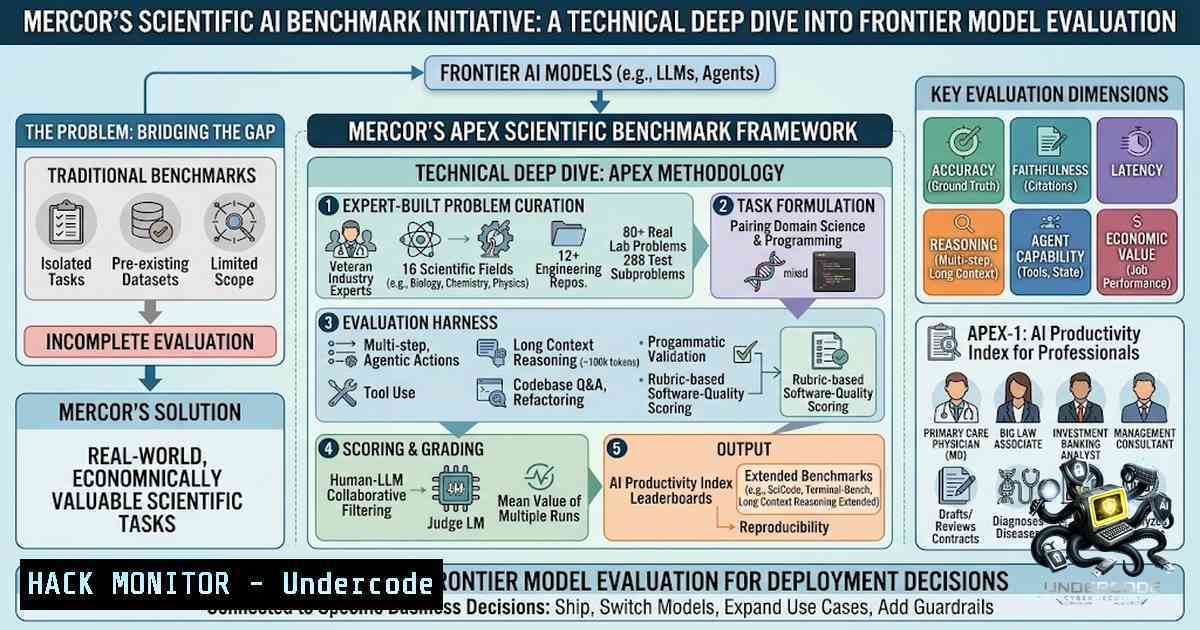
The rapid advancement of large language models (LLMs) has created a critical bottleneck: the lack of robust, domain-specific benchmarks that accurately measure genuine scientific reasoning and computational problem-solving capabilities. Mercor’s new initiative addresses this gap by recruiting PhD-level scientists to author original, executable research problems that today’s frontier models cannot solve, establishing a new benchmark for scientific computing. This article provides a comprehensive technical analysis of the initiative’s architecture, the required expertise in semiconductor materials and molecular modeling, and the practical workflows—including Git, Docker, and automated quality checks—that underpin the creation of next-generation AI evaluation tasks.
Learning Objectives & Secrets:
- Objective 1: Master the Art of Adversarial Prompt Engineering for Scientific Domains. Learn to craft prompts that exploit the known weaknesses of frontier models in semiconductor physics and molecular dynamics, ensuring tasks remain unsolvable by current AI.
- Objective 2 (Secret Tip): Calibrate Tasks Using an Iterative Failure-First Approach. The secret is to design grading criteria and then test against strong models; a task is only shipped when models fail it more often than they succeed, a reverse-engineering tactic for benchmark creation.
- Objective 3 (Secret Tip): Leverage Open-Source Repositories for Benchmark Material. Instead of creating scenarios from scratch, source material from published papers, Kaggle datasets, or open-source repositories to ensure scientific validity and complexity.
You Should Know:
1. Establishing the Development Environment for Benchmark Authoring
The foundation of this role is a robust, containerized development environment that ensures reproducibility and automated quality control. Authors are expected to be comfortable with Git/GitHub and running code in Docker, as the authoring process runs through a pull-request workflow with automated quality checks. To set up this environment, one must first install Docker and configure a container with the necessary scientific computing libraries. Below is a step-by-step guide to initialize a Docker container for Python-based scientific computing, which is essential for authoring and testing evaluation tasks.
- Step 1: Install Docker on your system (Linux:
sudo apt-get install docker.io, Windows: Download from Docker Desktop). - Step 2: Create a `Dockerfile` to define the environment. This file should include base images like `python:3.9-slim` and install dependencies such as
numpy,scipy,pandas, and `matplotlib` for materials science computations. - Step 3: Build the Docker Image using the command: `docker build -t sci-benchmark-env .`
– Step 4: Run the Container interactively:docker run -it -v ${PWD}:/workspace sci-benchmark-env /bin/bash. This mounts your current directory to `/workspace` inside the container, allowing you to edit code on your host and execute it within the container. - Step 5: Initialize a Git Repository for version control: `git init` and connect to a remote repository on GitHub to manage the pull-request workflow.
2. Implementing Automated Quality Checks with Pre-commit Hooks
To maintain code quality and consistency across the benchmark, automated checks are integrated into the pull-request workflow. This involves setting up pre-commit hooks that run linting, formatting, and basic test suites before code is merged. The following steps outline how to configure these checks for a Python project.
- Step 1: Install `pre-commit` using pip:
pip install pre-commit. - Step 2: Create a `.pre-commit-config.yaml` file in the root of your repository. Add hooks for `black` (code formatter), `flake8` (linter), and `pytest` (test runner).
- Step 3: Install the Git Hook Scripts by running:
pre-commit install. - Step 4: Define a Simple Test Suite in a `tests/` directory. For a scientific computing task, this might include tests to verify that the generated output from a prompt matches the expected data types and shapes.
- Step 5: Run the Hooks Manually before committing:
pre-commit run --all-files. This ensures that any code pushed to the repository passes the initial quality gates, reducing the burden on reviewers.
3. Designing Grading Criteria for Scientific Prompts
The core of the benchmark is the grading criteria that define a correct answer. For problems in semiconductor materials and molecular modeling, this often involves exact numerical outputs, specific code execution results, or logical proofs. The criteria must be deterministic to allow for automated evaluation. Below is a conceptual Python function that could serve as a grader for a molecular modeling task, comparing a candidate’s computed energy to a reference value.
def grade_molecular_energy(candidate_output, reference_energy, tolerance=1e-6):
"""
Grades a candidate's computed molecular energy against a reference.
Args:
candidate_output (float): The energy value computed by the candidate's code.
reference_energy (float): The known correct energy value.
tolerance (float): The acceptable absolute difference.
Returns:
bool: True if the candidate passes, False otherwise.
"""
return abs(candidate_output - reference_energy) < tolerance
This simple grading logic must be calibrated against frontier models to ensure they fail it, thereby validating the task’s difficulty.
4. Sourcing and Structuring Material from Research Papers
Authors are required to source their own material from published papers or open-source repositories. For a paper on semiconductor bandgap calculations, the author would extract the key equations and datasets, then design a prompt that asks the model to reproduce a specific result or apply the method to a new material. The process involves parsing the paper, identifying a computationally intensive problem, and translating it into a clear, executable prompt. This requires proficiency in Python or R for scientific computing.
5. Calibrating Tasks Against Frontier Models
The calibration phase is the most critical step. After writing a prompt and its grading criteria, the author must run it against state-of-the-art models. This involves using APIs from providers like OpenAI or Anthropic to submit the prompt and evaluate the responses. If a model succeeds, the task is too easy and must be refined. This iterative process ensures the benchmark remains challenging. A simple script to interact with an API and evaluate the response against the grading function is essential for this workflow.
What Undercode Say:
- Key Takeaway 1: The initiative represents a paradigm shift from traditional multiple-choice benchmarks to dynamic, code-based evaluation, directly testing a model’s ability to perform scientific research.
- Key Takeaway 2: The requirement for authors to have deep expertise in both semiconductor materials and molecular modeling ensures that the benchmark is not just a test of coding, but of genuine scientific intuition and problem-solving.
- Key Takeaway 3: The use of a pull-request workflow with automated checks institutionalizes software engineering best practices within the academic benchmark creation process, enhancing reliability and scalability.
- Key Takeaway 4: The calibration strategy—shipping tasks only when models fail—is a form of adversarial benchmarking that directly targets and exposes the limitations of current AI, driving the field forward.
- Key Takeaway 5: This model of human-in-the-loop benchmark creation could become the standard for evaluating AI in specialized domains, moving beyond general-purpose tests to niche, high-stakes fields like drug discovery and quantum computing.
Prediction:
- +1: This benchmark will likely accelerate the development of AI models specifically tailored for scientific discovery, as researchers will have a clear, quantifiable target to aim for.
- +1: The open-source nature of the material sourced (papers, Kaggle datasets) will foster collaboration and transparency, potentially leading to a community-driven standard for scientific AI evaluation.
- -1: There is a risk that models will be over-optimized for this specific benchmark, leading to a “Goodhart’s law” scenario where performance on the test does not equate to general scientific ability.
- +1: The initiative’s focus on executable research problems could democratize access to high-quality scientific computing tasks, allowing smaller labs to contribute to and benefit from the benchmark.
- -1: The requirement for PhD-level expertise may limit the pool of contributors, potentially slowing down the pace of benchmark expansion and introducing bias towards certain subfields.
- +1: By paying contributors $70 per hour, Mercor is setting a precedent for valuing domain expertise in AI training, which could lead to more equitable compensation models in the industry.
- -1: The 6-week, part-time engagement may not be sufficient for authors to deeply explore complex problems, potentially resulting in a benchmark that is broad but shallow.
- +1: The integration of automated quality checks ensures a high baseline of code quality, making the benchmark more usable and reliable for the broader research community.
- +1: This initiative could serve as a blueprint for similar projects in other scientific domains, such as biology or economics, creating a network of specialized AI benchmarks.
- -1: There is a potential for the benchmark to become outdated quickly as models improve, requiring constant and costly updates to maintain its difficulty.
▶️ Related Video (82% Match):
🎯Let’s Practice For Free:
🎓 Live Courses & Certifications:
Join Undercode Academy for Verified Certifications
🚀 Request a Custom Project:
Secure, high-velocity infrastructure and disruptive technological engineering. Contact our engineering team for high-tier development and proprietary systems:
[email protected]
💎 Smart Architecture | 🛡️ Secure by Design | ⭐ Trusted by Thousands
IT/Security Reporter URL:
Reported By: https://lnkd.in/p/eDtzNp7d – Hackers Feeds
Extra Hub: Undercode MoN
Basic Verification: Pass ✅


