
Listen to this Post
Introduction:
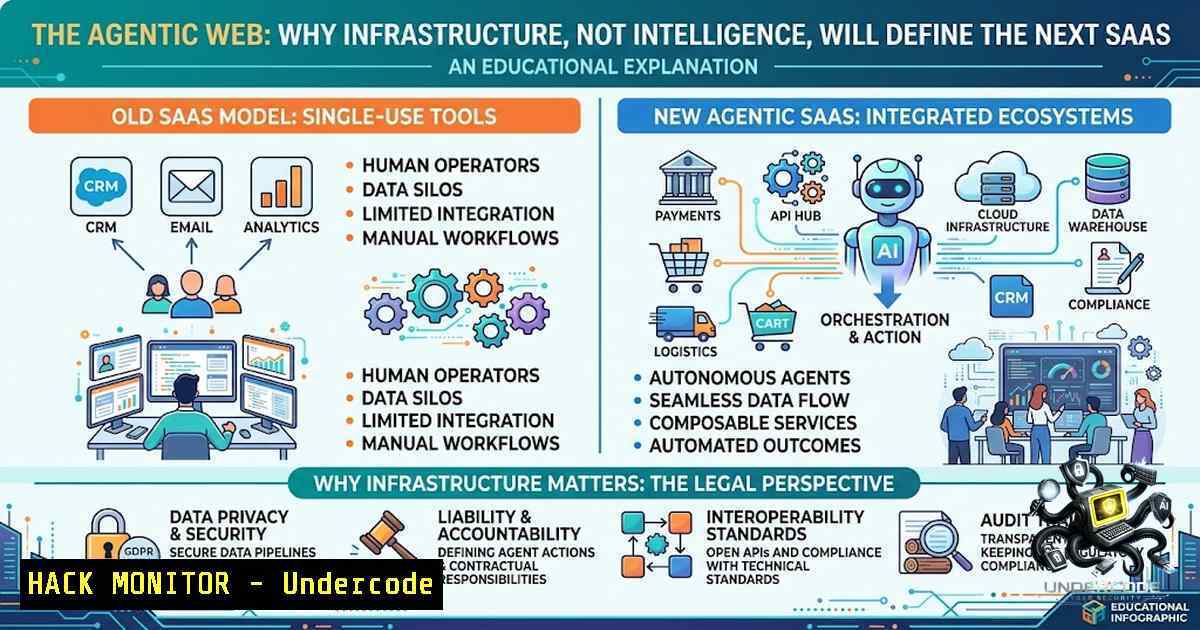
For the past two years, the artificial intelligence discourse has been dominated by a singular focus: model capability. The battle between GPT, Claude, and Gemini, the race for larger context windows, and the benchmarks of reasoning have captivated the industry. However, a fundamental shift is occurring beneath the surface. The conversation is moving from the “brain” of the AI to its “nervous system”—the infrastructure that allows agents to act, communicate, and transact in the digital world, effectively building an “agentic web” that could render traditional SaaS interfaces obsolete.
Learning Objectives & Secrets:
- Objective 1: Understand the Shift to Agentic Infrastructure. Learn why model performance is plateauing and why agent-to-agent communication, identity, and payments are the new competitive moats.
- Objective 2: Master the Protocol Stack for AI Agents. Secret Tip: Focus on interoperability. The real power of an agent isn’t its reasoning but its ability to discover and use tools like
MCP,A2A, and identity layers. The secret is to treat agents as microservices that require strict API governance. - Objective 3: Design for Machine-to-Machine SaaS. Secret Tip: Redesign your product’s UX for an API-first world. The “secret” is preparing for “Headless SaaS”—your product’s primary “user” will be an API key, not a human, requiring robust usage-based billing and security logging.
You Should Know:
- The Emerging Agentic Stack: From Chatbots to Web Orchestrators
The post outlines a critical evolution where agents are moving from isolated chat interfaces to fully integrated web citizens. This stack comprises discovery, identity, connection, collaboration, tool usage, and payment. This is a direct parallel to the early internet’s shift from static pages to the dynamic web 2.0. For security professionals and IT architects, this means the attack surface is expanding from user interfaces to APIs and agent-to-agent communication channels. The “agentic web” implies that software agents will interact with services the way humans currently do, but at machine speed and scale. This requires a new approach to Zero Trust architectures, specifically for non-human identities (NHIs). Traditional perimeter security fails here; we must move to a model where every agent request is authenticated and authorized in real-time, treating each agent session as a distinct, potentially compromised entity. The infrastructure must be resilient against agent-based denial-of-service attacks, where malicious agents could spawn thousands of instances to overwhelm systems.
2. Implementing Agent-to-Agent (A2A) Communication Security
The concept of A2A protocols suggests that agents will negotiate tasks and share data autonomously. This is a significant security challenge. Implementing this requires strict message signing and encryption. For a practical approach, consider using JSON Web Tokens (JWT) with specific claims for agent identity, similar to how OAuth 2.0 works for users but with machine-specific scopes.
- Linux Command to inspect a JWT (useful for debugging agent tokens):
echo "YOUR_JWT_HERE" | cut -d. -f2 | base64 -d | jq
- Windows Equivalent (PowerShell) for base64 decoding:
- Step-by-Step Guide for A2A Security:
- Define Agent Scopes: Instead of broad permissions, implement granular scopes in your authorization server (e.g.,
agent:read:financials). - Mutual TLS (mTLS): Enable mTLS for internal agent communication to ensure both client and server are verified.
- Implement Audit Logs: Log all agent interactions. Use `auditd` on Linux to track file accesses if agents interact with the filesystem.
- Rate Limiting: Use tools like `iptables` or `fail2ban` to limit connections from specific agent IPs, or better, implement rate limiting at the API gateway level using Redis to track agent usage quotas.
-
Tool Access and Data Privacy with MCP (Model Context Protocol)
The Model Context Protocol (MCP) is referenced as the bridge for agents to access tools. This introduces the risk of data leakage or tool misuse. If an agent has broad access to tooling, a compromised agent could exfiltrate data or perform destructive actions. The solution is to implement a “Tool Wrapper” that sanitizes inputs and outputs. For instance, if an agent can query a database, you should force it to use parameterized queries to prevent SQL injection.
- Python Example of a Secure Tool Wrapper using parameterized queries:
import sqlite3 def secure_query(agent_input): Sanitize the input if not isinstance(agent_input, str): return "Invalid input" Use parameterized query conn = sqlite3.connect('data.db') cursor = conn.cursor() cursor.execute("SELECT FROM users WHERE username = ?", (agent_input,)) return cursor.fetchall() - Step-by-Step Guide to Hardening Tool Access:
- Input Validation: Validate the agent’s request against a strict JSON schema before passing it to the tool.
- Role-Based Access Control (RBAC): Ensure the agent’s token includes a `role` claim. Map this role to specific tool functions.
- Implement a “Break Glass” Protocol: Monitor for anomalies. If an agent makes an unusual number of tool calls, trigger an alert and temporarily block its access.
- Encrypt Sensitive Data at Rest: If agents are storing data, ensure encryption using `gpg` or
openssl.
4. Identity and Trust: The New Perimeter
The post mentions identity layers—crucial for answering “who an agent is.” This is arguably the most critical aspect. Without robust identity, the agentic web is a playground for impersonation and fraud. We must move beyond simple API keys. We need to implement Digital Identity frameworks for machines, possibly leveraging standards like Decentralized Identifiers (DIDs) or Verifiable Credentials (VCs). This allows an agent to prove its “identity” and its “permissions” without relying on a central authority for every request. For example, an agent might present a Verifiable Credential stating it is authorized to process payments up to $500. The service provider can verify this credential cryptographically without contacting a central server for each transaction. This reduces latency and improves resilience.
5. Machine-1ative Payments and Financial Integrity
The idea of machine-1ative payments is the most disruptive. Agents paying for services autonomously requires automated billing and fraud detection systems that operate in milliseconds. This introduces the risk of “Rogue Agent Transactions” where a bug causes an agent to spend unlimited funds. To mitigate this, we need to implement “Hard Spending Caps” and “Circuit Breakers” in the payment infrastructure.
- Conceptual Code for a Spending Cap Middleware (Node.js):
class SpendingCap { constructor(agentId, maxSpend) { this.agentId = agentId; this.maxSpend = maxSpend; this.currentSpend = 0; } authorizePayment(amount) { if (this.currentSpend + amount > this.maxSpend) { return { authorized: false, message: "Spending cap exceeded" }; } this.currentSpend += amount; return { authorized: true }; } } - Step-by-Step Guide for Agent Payment Security:
- Implement Webhook Validation: Ensure payment confirmations are validated via webhooks with HMAC signatures to prevent spoofing.
- Use Escrow Services: For large transactions, use smart contracts or escrow APIs that hold funds until service delivery is confirmed by the agent.
- Monitor Transaction Velocity: Use `logwatch` or `splunk` to monitor the frequency and value of transactions from an agent ID.
- Disaster Recovery: Prepare for a “runaway” agent by having a “Kill Switch”—a manual override API endpoint that immediately revokes all tokens for that agent.
What Undercode Say:
- Key Takeaway 1: The market is shifting from competing on “model intelligence” to competing on “ecosystem integration.” The company that builds the most accessible and secure agentic infrastructure will win.
- Key Takeaway 2: Security is the primary bottleneck. Trust, permissions, and governance are not just compliance checkboxes but the core enablers of an autonomous agent economy.
-
Analysis: This post highlights a critical pivot for CIOs and CTOs. The bottleneck is no longer the AI’s IQ but its ability to navigate complex business ecosystems autonomously. This necessitates a new discipline: “Agentic Operations.” IT teams must prepare for a future where they are not managing user accounts but managing agent fleets. This involves advanced monitoring, anomaly detection, and identity verification at scale. The success of AI agents depends less on their reasoning power and more on the cybersecurity frameworks that dictate what they can touch. For the finance sector, this machine-1ative payment layer could reduce friction but also create systemic risks if unregulated. The industry must develop standards for agent identity and payment authorization to prevent chaos. This is a “build or be rendered obsolete” moment for SaaS providers. The focus must be on robust, well-documented APIs that cater to machines.
Prediction:
- -1: The rise of autonomous agents will inevitably lead to a “Wild West” period where poorly secured agents are exploited for fraud, leading to high-profile data breaches and financial losses, forcing regulatory bodies to step in with strict compliance laws.
- +1: The adoption of machine-1ative payments and agent-to-agent communication will create a hyper-connected economy, drastically reducing manual overhead in B2B transactions and enabling dynamic, real-time supply chains that optimize themselves without human intervention.
▶️ Related Video (84% Match):
https://www.youtube.com/watch?v=1LT15CdP_uQ
🎯Let’s Practice For Free:
🎓 Live Courses & Certifications:
Join Undercode Academy for Verified Certifications
🚀 Request a Custom Project:
Secure, high-velocity infrastructure and disruptive technological engineering. Contact our engineering team for high-tier development and proprietary systems:
[email protected]
💎 Smart Architecture | 🛡️ Secure by Design | ⭐ Trusted by Thousands
IT/Security Reporter URL:
Reported By: https://lnkd.in/p/e8SnuqFM – Hackers Feeds
Extra Hub: Undercode MoN
Basic Verification: Pass ✅


