
Listen to this Post
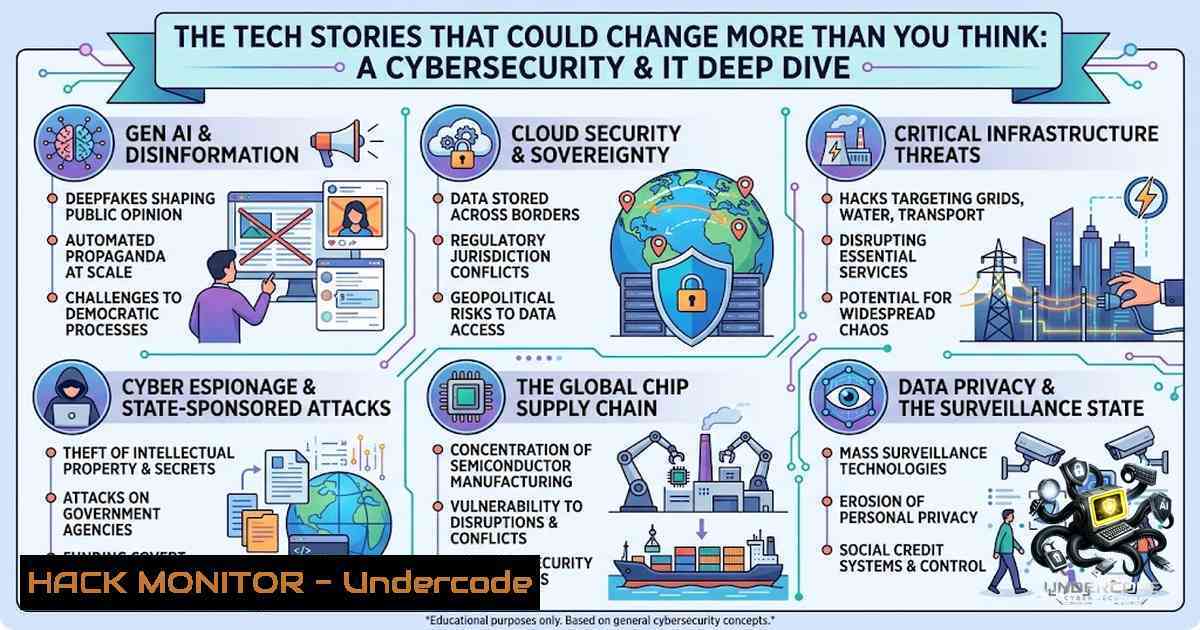
Introduction
Technology is no longer merely evolving—it is fundamentally rewriting the rules of privacy, security, identity, and accountability. From Apple developing a China-specific AI model that raises questions about whether geography will dictate what artificial intelligence can tell you, to a Windows Defender zero-day vulnerability that turns the very software meant to protect systems into a privilege-escalation vector, the convergence of AI, cybersecurity, and global policy is reshaping the digital landscape at an unprecedented pace. This article unpacks 14 major technology stories with far-reaching consequences, delivering actionable technical insights, verified commands, and strategic guidance for IT professionals, security teams, and AI practitioners.
Learning Objectives & Secrets
- Objective 1: Master Zero-Day Vulnerability Response – Learn to detect, mitigate, and remediate the newly disclosed Windows Defender ShieldBreak vulnerability (CVE-2026-69414) using both manual techniques and enterprise-grade vulnerability management platforms.
-
Objective 2 Secret Tip: AI Supply Chain Hardening – Understand how to audit AI models for geographic compliance and data sovereignty risks, with practical commands for inspecting model provenance and training data pipelines.
-
Objective 3 Secret Tip: Next-Gen Network Reliability Engineering – Implement Wi-Fi 8 readiness assessments using spectrum analysis tools and RF design methodologies to prepare for the 802.11bn Ultra-High Reliability standard.
You Should Know
- Windows Defender Zero-Day: ShieldBreak (CVE-2026-69414) – Detection and Mitigation
ShieldBreak is a zero-day elevation-of-privilege vulnerability in the Microsoft Malware Protection Engine used by Microsoft Defender. A public proof-of-concept (PoC) was released on August 12, 2026, and Microsoft assigned the CVE on August 14—yet no patch is available. The vulnerability allows a low-privilege local attacker to escalate to SYSTEM privileges by exploiting how Defender processes files during cloud-file hydration. The exploit uses a user-mode callback to interfere with file data Defender receives through the Cloud Filter API (CFAPI), combined with Windows filesystem and Object Manager mechanisms. The public PoC reportedly works on Windows 11 25H2 and Windows Server 2025.
Detection Commands (Windows):
 Check if system is vulnerable to CVE-2026-69414 via Windows Update history
Get-HotFix | Where-Object { $_.HotFixID -like "KB" } | Sort-Object InstalledOn -Descending

Check Defender engine version (vulnerable versions are those prior to the yet-unreleased patch)
Get-MpComputerStatus | Select-Object AntivirusEngineVersion, AntivirusSignatureVersion

Audit for suspicious processes attempting to escalate privileges
Get-WinEvent -LogName Security | Where-Object { $<em>.Id -eq 4672 -or $</em>.Id -eq 4624 } |
Select-Object TimeCreated, @{Name="User";Expression={$_.Properties[bash].Value}} -First 20

Check for unusual Defender scan activity (potential exploitation attempts)
Get-WinEvent -LogName "Microsoft-Windows-Windows Defender/Operational" |
Where-Object { $_.Id -in @(1000, 1001, 1002, 1116, 1117) } |
Select-Object TimeCreated, Id, Message -First 50
Mitigation Strategy:
- Immediate: Apply Qualys TruRisk Eliminate mitigation or equivalent endpoint protection platform (EPP) virtual patches.
- Short-term: Restrict local user privileges and implement application whitelisting to prevent unauthorized code execution.
- Long-term: Monitor Microsoft Security Response Center (MSRC) for patch availability at https://msrc.microsoft.com/update-guide/vulnerability/CVE-2026-69414.
- Detection: Use Qualys VMDR with QQL query:
vulnerabilities.vulnerability.cveIds:CVE-2026-69414.
This vulnerability is particularly concerning because it follows closely on the heels of the RoguePlanet vulnerability (CVE-2026-50656), suggesting that Microsoft’s initial patch was insufficient. Security teams should treat this as a critical incident requiring immediate attention.
- The Great French Tax Data Breach: Lessons in Government Security
In June and July 2026, the French Public Finance Directorate General (DGFiP) suffered two successive cyberattacks. The first breach compromised data from 678,000 individual and business taxpayers, including names, taxable income, family quotient information, and withholding tax rates. The second attack affected approximately 200,000 land registry accounts. A hacker group calling itself ZeroBytes claimed responsibility and reportedly sold the stolen data for “several thousand euros” to two buyers. The attackers gained access through a税务 official’s VPN—highlighting that the breach was less about sophisticated hacking and more about systemic vulnerabilities in government infrastructure.
Security Hardening for Government and Enterprise Systems:
 Linux: Audit VPN access logs for unusual patterns
sudo journalctl -u openvpn --since "2026-06-01" | grep -E "Connection|Auth|Failed" |
awk '{print $1, $2, $3, $9, $10}' | sort | uniq -c | sort -1r

Linux: Check for unauthorized SSH access attempts
sudo grep "Failed password" /var/log/auth.log | awk '{print $1, $2, $3, $11}' |
sort | uniq -c | sort -1r | head -20

Windows: Audit Remote Desktop and VPN connections
Get-WinEvent -LogName Security | Where-Object { $<em>.Id -in @(4624, 4625, 4648) } |
Select-Object TimeCreated, @{Name="User";Expression={$</em>.Properties[bash].Value}},
@{Name="IP";Expression={$_.Properties[bash].Value}} -First 100

Network: Check for data exfiltration patterns (large outbound transfers)
sudo tcpdump -i eth0 -1 'dst port 443 and src net <your-internal-1etwork>' -c 1000 |
awk '{print $3, $5}' | cut -d. -f1-4 | sort | uniq -c | sort -1r
Key Takeaways for Security Teams:
- Multi-factor authentication (MFA) is non-1egotiable for all VPN and administrative access.
- Zero-trust architecture would have prevented the VPN compromise from leading to full database access.
- Data loss prevention (DLP) tools should have flagged the exfiltration of 678,000 records.
- Incident response must include immediate victim notification—France began sending alerts only after the hackers publicly announced the breach.
The breach triggered a government investigation under “fraudulent data acquisition” and “criminal conspiracy” charges. French cybersecurity expert Clément Domingo (known as SaxX) warned that ZeroBytes subsequently attacked the French Ministry of Education, exfiltrating 43GB of data spanning 20 years and affecting over 1 million students and staff.
- Apple’s China-Specific AI Model: The Geopolitics of Artificial Intelligence
Apple is reportedly developing a large language model specifically for the Chinese market, developed in partnership with Alibaba Group. This marks a strategic pivot—Apple is no longer solely relying on third-party Chinese AI providers but is building its own localized model. The model will power Apple Intelligence features on iPhones, Macs, and Vision Pro devices in China. Unlike the global version, which was developed with Google’s Gemini technology, the China model must comply with local regulations and content restrictions.
AI Model Auditing and Security Commands:
 Python: Basic model provenance check (conceptual)
import hashlib
import json

def check_model_integrity(model_path, expected_hash):
"""Verify model file integrity against known hash"""
with open(model_path, 'rb') as f:
file_hash = hashlib.sha256(f.read()).hexdigest()
return file_hash == expected_hash

Check for embedded biases or restricted content patterns
def scan_model_outputs(model, test_prompts):
"""Audit model responses for geographic/content compliance"""
results = {}
for prompt in test_prompts:
response = model.generate(prompt)
results[bash] = {
'response': response,
'length': len(response),
'contains_restricted': any(kw in response.lower() for kw in restricted_keywords)
}
return results
 Linux: Monitor AI/ML training data pipelines for unauthorized access
sudo auditctl -w /data/training/ -p rwxa -k ai_training_data

Check for unusual model checkpoint exports
find /models/ -1ame ".ckpt" -o -1ame ".pth" -o -1ame ".h5" |
xargs ls -la | awk '{print $6, $7, $8, $9}' | sort

Monitor API calls to AI endpoints
sudo tcpdump -i any 'port 443 and (host api.apple.com or host alibaba.com)' -v
The implications are profound: if AI capabilities vary by geographic region, we are entering an era of “splinternet AI” where the quality, accuracy, and freedom of AI responses depend on where you live. Apple Intelligence is expected to launch in China in the coming months after an iOS update.
- Australia’s Social Media Ban: The Failure of Age Verification
Australia’s landmark under-16 social media ban, which took effect in December 2025, is failing. A peer-reviewed study published in the British Medical Journal found “insufficient evidence” that the ban had sharply reduced social media use. Research indicates that 85% of minors are still accessing platforms. Teenagers bypass restrictions by:
- Declaring themselves older than 16 during sign-up (two-thirds of underage users)
- Uploading fake selfies for age verification
- Using accounts registered to adults (9% to 29% of cases)
- Browsing via private/incognito modes (up to 11%)
Age Verification Bypass Detection (For Platform Engineers):
 Python: Basic anomaly detection for age verification fraud
import pandas as pd
from datetime import datetime, timedelta

def detect_suspicious_age_claims(user_data):
"""Flag users with statistically improbable age declaration patterns"""
suspicious = []
for user in user_data:
 Check for ages that cluster around the legal threshold (16)
if 16 <= user['declared_age'] <= 18:
 Check if account creation time suggests evasion
if user['created_at'] > datetime(2025, 12, 10):  ban effective date
 Check for lack of government ID verification
if not user.get('id_verified', False):
suspicious.append(user['user_id'])
return suspicious

Log analysis for private browser usage patterns
def analyze_incognito_usage(access_logs):
"""Identify users consistently accessing via private browsing"""
incognito_users = {}
for entry in access_logs:
if entry.get('browser_mode') == 'private' or entry.get('user_agent', '').find('Incognito') != -1:
incognito_users[entry['user_id']] = incognito_users.get(entry['user_id'], 0) + 1
return {u: count for u, count in incognito_users.items() if count > 10}
Australia responded by doubling fines for non-compliant platforms from AU$49.5 million to AU$99 million (approximately $31 million to $68 million USD). The eSafety Commissioner now has powers to demand documents and evidence from platforms, age-checking companies, and app stores.
- NASA’s Radiation Protection Vest: Cybersecurity Lessons in Critical Infrastructure
NASA’s AstroRad vest, tested on the Artemis I mission, can reduce astronaut radiation exposure by approximately 60% in a severe solar storm (like the 1972 event) and nearly 40% in a moderate storm (like 1989). The vest covers the most vulnerable human organs: lungs, stomach, bone marrow, breasts, and ovaries. This translates to an additional 193 days and 131 days, respectively, of permissible deep-space exposure.
Critical Infrastructure Protection Commands:
 Linux: Harden ICS/SCADA systems against cyber threats (water utilities, power grids)
 Disable unnecessary services
sudo systemctl disable --1ow telnet.socket
sudo systemctl disable --1ow rsh.socket
sudo systemctl disable --1ow rexec.socket

Implement strict firewall rules for industrial networks
sudo iptables -A INPUT -p tcp --dport 502 -s 192.168.1.0/24 -j ACCEPT  Modbus
sudo iptables -A INPUT -p tcp --dport 502 -j DROP
sudo iptables -A INPUT -p tcp --dport 44818 -s 192.168.1.0/24 -j ACCEPT  CIP
sudo iptables -A INPUT -p tcp --dport 44818 -j DROP

Monitor for unauthorized access to control systems
sudo auditctl -w /var/log/ -p wa -k scada_logs
sudo ausearch -k scada_logs --start recent
The cybersecurity angle is clear: if NASA can protect astronauts from radiation through layered defense (vest + shelter + monitoring), then critical infrastructure operators must adopt similar layered security approaches—never relying on a single control.
6. Wi-Fi 8: The Reliability Revolution
Wi-Fi 8 (802.11bn, branded Ultra High Reliability) represents a fundamental shift from speed-focused marketing to reliability-driven engineering. Technical targets include a 25% increase in throughput (rate over range), a 25% reduction in latency spikes, and roughly 25% lower packet loss. Key features include:
- Non-primary channel access: APs can transmit on cleaner secondary channels when the primary channel is congested
- Seamless Mobility Domain (SMD) roaming: Clients associate with a domain of APs rather than a single AP, eliminating the four-way handshake during roaming
- Unequal Modulation (UEQM): Each spatial stream adjusts independently—if one stream degrades, others maintain high performance
- New Modulation and Coding Schemes (MCS): Performance degrades gradually rather than sharply, preventing sudden connection drops
Wi-Fi 8 Readiness Assessment Commands:
 Linux: Assess current Wi-Fi network performance baseline
sudo iw dev wlan0 station dump | grep -E "signal|tx bitrate|rx bitrate"
sudo iw dev wlan0 link

Measure latency and packet loss under load
ping -c 100 -i 0.2 8.8.8.8 | grep -E "time=|loss"

Scan for interference in 5GHz and 6GHz bands
sudo iw dev wlan0 scan | grep -E "freq|signal|SSID" |
awk '{if($1=="freq:") freq=$2; if($1=="signal:") signal=$2; if($1=="SSID:") ssid=$0; if(freq && signal && ssid){print freq, signal, ssid; freq=signal=ssid=""}}' |
sort -k2 -1

Windows: WiFi analysis using netsh
netsh wlan show networks mode=bssid | findstr /i "SSID BSSID signal"
netsh wlan show interfaces
For Network Engineers: Channel planning will matter more than ever. RF design tools must model new behaviors like dynamic sub-band operation and dynamic bandwidth operation to accurately predict airtime and interference.
7. US Drone Tariffs and Supply Chain Security
The US announced sweeping tariffs of up to 100% on imported drones and components, targeting Chinese manufacturers. The highest tariffs apply to:
- Drones with maximum takeoff weight exceeding 25 kilograms
- Models equipped with thermal imaging cameras
- Associated docking stations and critical components
Smaller consumer drones face a 25% tariff, while imports from allies (EU, Japan, South Korea, UK, Switzerland) face 10-15% tariffs. The policy closes a supply-chain loophole that previously allowed domestic firms to import Chinese motors, rotors, and airframes for domestic assembly.
Supply Chain Security Audit Commands:
 Linux: Audit hardware supply chain for unauthorized components
 Check for unauthorized USB devices
lsusb -v | grep -E "idVendor|idProduct|iProduct" |
awk '{if($1=="idVendor:") vendor=$2; if($1=="idProduct:") product=$2; if($1=="iProduct") product_name=$0; if(vendor && product && product_name){print vendor, product, product_name; vendor=product=product_name=""}}'

Verify firmware integrity (example for network equipment)
sudo sha256sum /lib/firmware/.bin | sort > current_firmware_hashes.txt
 Compare against known-good hashes from vendor

Monitor for unauthorized kernel modules (potential backdoors)
lsmod | sort
sudo modinfo <suspicious_module> | grep -E "filename|description|author"
What Undercode Say:
- Key Takeaway 1: The convergence of AI, cybersecurity, and geopolitics means security professionals must now consider regulatory compliance and data sovereignty as core competencies—not just technical vulnerabilities. Apple’s China AI model and Australia’s social media ban both demonstrate that technology is increasingly shaped by where you live.
-
Key Takeaway 2: Zero-day vulnerabilities like ShieldBreak (CVE-2026-69414) and the French tax breach reveal that no single layer of protection is sufficient. Organizations must adopt defense-in-depth strategies: endpoint protection, network segmentation, zero-trust architecture, continuous monitoring, and rapid incident response.
Analysis: The stories covered in this episode collectively point to a fundamental truth: technology is no longer a neutral tool—it is a battleground for privacy, security, and control. From hackers selling French tax data for “a few thousand euros” to children bypassing Australia’s social media ban with fake selfies, the human element remains the weakest link. The Windows Defender vulnerability is particularly alarming because it weaponizes the very software meant to protect systems. Meanwhile, Apple’s China-specific AI model and Wi-Fi 8’s reliability focus signal that the future of technology will be defined by adaptation to local contexts—whether geographic, regulatory, or environmental.
Prediction:
- +1 The Wi-Fi 8 reliability standard will enable new mission-critical applications in healthcare, industrial automation, and autonomous systems, driving a $50B+ market for reliability-focused networking equipment by 2030.
-
-1 The fragmentation of AI models by geography (China vs. rest of world) will create security blind spots and compliance nightmares for multinational corporations, potentially leading to a “two-internet” reality where information access is determined by national borders.
-
-1 The frequency of government data breaches (France, Australia, US water utilities) indicates that public sector cybersecurity is critically underfunded and understaffed—expect more nation-state and cybercriminal attacks targeting government databases in 2026-2027.
-
+1 The ShieldBreak vulnerability will accelerate the adoption of virtual patching and runtime application self-protection (RASP) technologies, shifting the industry from reactive patching to proactive threat mitigation.
-
-1 US drone tariffs will increase costs for public safety agencies, law enforcement, and agriculture by 25-100%, potentially slowing innovation in emergency response and precision farming.
-
+1 NASA’s radiation vest technology will find civilian applications in nuclear disaster response, medical imaging protection, and high-altitude aviation, creating new markets for wearable radiation shielding.
-
-1 The failure of Australia’s social media ban demonstrates that age verification at scale is fundamentally broken. Unless new identity technologies emerge, similar bans in other countries will also fail, wasting regulatory resources and creating a false sense of security.
-
+1 The French tax breach will catalyze a new wave of government cybersecurity investments across Europe, with an estimated €5B+ in additional funding for national cybersecurity agencies and critical infrastructure protection over the next 24 months.
This article is based on Episode S5 of The JMOR Tech Talk Show, covering 14 technology stories with consequences far beyond the headlines. For the full podcast episode, visit www.podbean.com.
▶️ Related Video (76% Match):
🎯Let’s Practice For Free:
🎓 Live Courses & Certifications:
Join Undercode Academy for Verified Certifications
🚀 Request a Custom Project:
Secure, high-velocity infrastructure and disruptive technological engineering. Contact our engineering team for high-tier development and proprietary systems:
[email protected]
💎 Smart Architecture | 🛡️ Secure by Design | ⭐ Trusted by Thousands
IT/Security Reporter URL:
Reported By: https://lnkd.in/p/ewU8NkFm – Hackers Feeds
Extra Hub: Undercode MoN
Basic Verification: Pass ✅


