
Listen to this Post
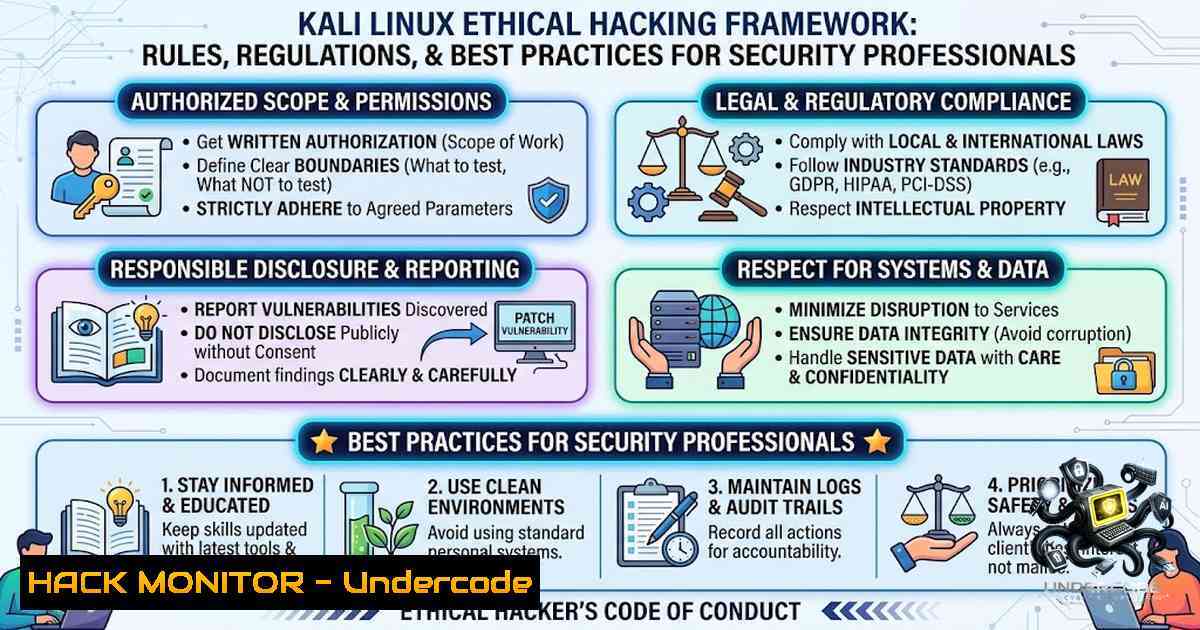
Introduction:
Kali Linux remains the industry-standard penetration testing distribution, pre-loaded with over 600 security tools for vulnerability assessment, digital forensics, and ethical hacking. However, its power demands strict operational governance to prevent misuse and ensure legal compliance. This article delineates the essential rules and regulations for Kali Linux usage, transforming it from a mere toolkit into a disciplined, legally defensible security practice.
Learning Objectives & Secrets:
- Objective 1: Legal Authorization Mastery – Learn to obtain and document formal written permission before any security testing, ensuring all scanning activities are protected under legal agreements.
- Objective 2 Secret Tip: Tool Update Automation – Implement cron jobs and aliases to automatically update Kali tools (e.g.,
apt update && apt full-upgrade -y) and exploit databases (e.g.,searchsploit -u) to ensure you are testing against the latest vulnerabilities and signatures. - Objective 3 Secret Tip: Scope Definition Secrets – Master the creation of detailed Rules of Engagement (RoE) documents that explicitly define target IP ranges, testing windows, and prohibited techniques (e.g., denial-of-service) to prevent operational disruption and scope creep.
You Should Know:
1. Authorized Testing Frameworks and Scope Definition
This rule emphasizes legal authorization, which is the cornerstone of ethical hacking. Without explicit written consent, all scanning activities are considered illegal. The use of Kali Linux must be confined to networks and systems you own or have explicit legal rights to test. To enforce this, create a `scope.txt` file containing your authorized target IPs and use `nmap -iL scope.txt` to ensure scans never deviate from approved assets. For cloud environments, always verify you have permission from the cloud service provider and the tenant owner before initiating any network scanning or vulnerability assessments. Additionally, implement a strict “check-in/check-out” procedure for testing: before launching any tool, document the current system state, and after testing, verify that no residual changes (like added users or modified firewall rules) remain. This practice not only ensures compliance but also preserves the integrity of the test environment for future assessments.
2. Network Integrity and Non-Disruption Policies
The rule against attacking systems without permission extends to unintentional disruption. Penetration tests should not degrade service availability or corrupt data. To mitigate this, use rate-limiting options in tools. For instance, in Nmap, use `–max-rate 100` to avoid flooding a network, and in Hydra, use `-t 4` to limit the number of parallel connections. For web application tests, utilize the `–delay` option in tools like `sqlmap` or `Burp Suite` Intruder to space out requests. It is also crucial to obtain a non-disruption assurance from the testing team; ensure all team members are trained on the difference between a vulnerability scan and a stress test. Keep logs of all scan timestamps and source IPs to correlate with system performance metrics, providing proof that your testing did not impact operations.
3. Privacy Protection and Confidential Data Handling
Kali Linux is capable of extracting sensitive data such as password hashes, personally identifiable information (PII), and proprietary source code. To respect privacy, any discovered confidential information must be handled with care. Use file hashing and encryption to secure results: `gpg –symmetric results.txt` to encrypt findings, or store them in an encrypted VeraCrypt volume. For password hashes, avoid cracking them unless explicitly allowed; instead, focus on identifying weak password policies. Use `echo “Confidential” | sha256sum` to generate checksums for verification. Destroy sensitive files securely using `shred -vfz -1 10 results.txt` after the reporting phase to prevent accidental exposure. Additionally, implement a data masking strategy before sharing reports with stakeholders, replacing real usernames or IP addresses with generic identifiers to maintain confidentiality.
4. Credential Management and Authentication Hardening
Kali Linux itself must be secured with strong passwords and multi-factor authentication (MFA). The default `root/toor` credentials should be changed immediately using passwd root. Furthermore, implement key-based SSH authentication for remote access. Generate an RSA key pair using `ssh-keygen -t rsa -b 4096` and copy the public key to authorized hosts. Disable password authentication in `/etc/ssh/sshd_config` by setting PasswordAuthentication no. On Windows systems that Kali may interact with (e.g., when using psexec), enforce the use of strong administrative passwords and restrict the use of local administrator accounts. To automate password hygiene, use tools like `chage` to enforce password expiration policies (chage -M 90 username), and audit for weak passwords using `john` with a custom wordlist, ensuring these audits are only run with explicit authorization.
5. Operational Hygiene: Updates and Vulnerability Databases
Keeping Kali Linux and its tools updated is non-1egotiable. Outdated tools contain known vulnerabilities that attackers can exploit, potentially compromising your testing environment. The command `sudo apt update && sudo apt full-upgrade -y` updates the entire system. For Metasploit, use msfupdate. For searchsploit, run `searchsploit -u` to update the Exploit-DB repository. Automate these updates by adding a cron job: `sudo crontab -e` and add `0 2 0 apt update && apt upgrade -y` for weekly updates. On the Windows side, if you are using Kali in a virtual machine, ensure the host system’s Windows Update is also current to prevent host-to-guest attacks. Additionally, verify the integrity of downloaded tools using GPG signatures (e.g., wget -q -O - https://archive.kali.org/archive-key.asc | gpg --import), ensuring you are not running compromised binaries.
6. Legal Compliance and Responsible Vulnerability Disclosure
The rule to “follow applicable cybersecurity laws” requires knowledge of local and international frameworks like the GDPR, HIPAA, or the Computer Fraud and Abuse Act (CFAA). When you discover a vulnerability, document everything with timestamps and screenshots. To report responsibly, use the `mail` command to send encrypted reports: mail -s "Vulnerability Report" [email protected] < report.txt. If the organization has a bug bounty platform, use their secure submission channels. Never disclose vulnerabilities publicly until the organization has had a reasonable time to patch, typically 90 days under Coordinated Vulnerability Disclosure (CVD) policies. Use `openssl enc -aes-256-cbc -salt -in report.txt -out report.enc` to encrypt reports before sending, and share the decryption password via a separate, secure channel.
7. Ethical Training and Continuous Skill Development
Mohan S A emphasizes “Learn ethically. Hack responsibly.” This underscores the importance of continuous education. Utilize authorized labs like Hack The Box, TryHackMe, and VulnHub, and use Kali within these platforms. For practice, set up a vulnerable virtual machine using tools like Metasploitable or DVWA. To document your learning, maintain a `learning_log.txt` and use `script` to record your terminal sessions: script -a session_$(date +%Y%m%d).log. This not only aids in retracing steps but also builds a portfolio for professional certifications like CEH, OSCP, or GPEN. Practice Linux commands daily, such as `netstat -tulpn` for network analysis, `ps aux` for process monitoring, and `journalctl -xe` for system logs, to build proficiency that enhances your ethical hacking skills and ensures you are always prepared for real-world scenarios.
What Undercode Say:
- Key Takeaway 1: The true power of Kali Linux lies not in its arsenal of tools but in the disciplined, legal, and ethical framework governing their use.
- Key Takeaway 2: Automation of updates, scope definition, and data encryption are not optional; they are essential operational controls that protect both the tester and the client.
Analysis: Mohan S A’s post serves as a crucial reminder that Kali Linux is a double-edged sword. The rules outlined are not merely bureaucratic hurdles but are designed to establish a professional, legally sound practice that differentiates ethical hackers from malicious actors. By adhering to these principles, security professionals can build trust, protect themselves from legal repercussions, and contribute positively to the overall security posture of the organizations they serve. The post effectively translates a complex legal and ethical landscape into actionable, technical steps, fostering a culture of responsibility.
Prediction:
- +1: Increased adoption of the “Rules & Regulations” framework will lead to higher success rates in bug bounty programs, as testers will operate more professionally and with greater efficiency.
- +1: Organizations will increasingly mandate such documented ethical frameworks before awarding penetration testing contracts, establishing a new industry standard.
- -1: Failure to strictly adhere to these rules will result in a surge of legal actions against individual security researchers, leading to significant financial penalties and potential prison sentences.
- -1: The misuse of Kali Linux for unauthorized access will further strain the relationship between security researchers and law enforcement, leading to more aggressive investigations and a chilling effect on ethical research.
- +1: The emphasis on continuous learning and documentation will produce a new generation of security professionals who are both technically proficient and legally astute.
- +1: Integration of these rules into formal certifications will make Kali Linux mastery a recognized compliance requirement, increasing the demand for certified Kali professionals.
- -1: The complexity of complying with these rules may deter some newcomers from ethical hacking, temporarily widening the industry’s skill gap.
- +1: Automated tools that enforce these rules (e.g., scope checkers, update notifiers) will become a new niche in cybersecurity software, leading to more secure and verifiable testing.
- +1: The cultural shift toward responsible use will enhance the overall public perception of the cybersecurity community, reducing stigma and promoting collaboration.
- +1: This disciplined approach will ultimately lead to stronger, more resilient networks, as vulnerabilities are found and fixed in a controlled, systematic manner.
▶️ Related Video (82% Match):
🎯Let’s Practice For Free:
🎓 Live Courses & Certifications:
Join Undercode Academy for Verified Certifications
🚀 Request a Custom Project:
Secure, high-velocity infrastructure and disruptive technological engineering. Contact our engineering team for high-tier development and proprietary systems:
[email protected]
💎 Smart Architecture | 🛡️ Secure by Design | ⭐ Trusted by Thousands
IT/Security Reporter URL:
Reported By: https://lnkd.in/p/e8bNW9ti – Hackers Feeds
Extra Hub: Undercode MoN
Basic Verification: Pass ✅


