Listen to this Post
Introduction:
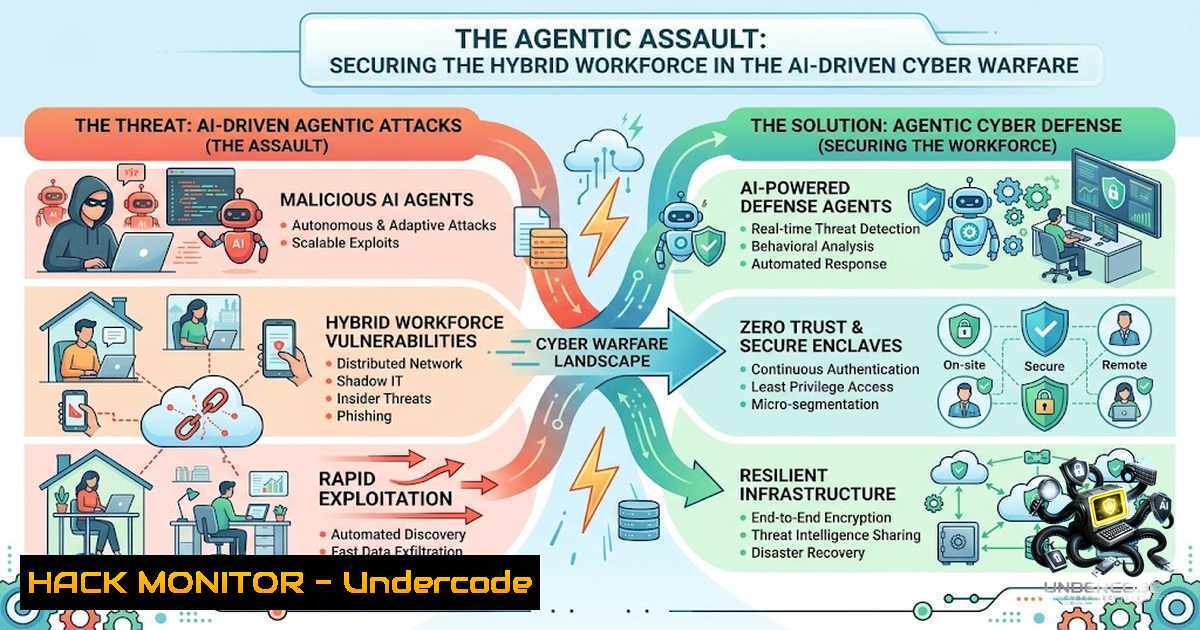
The cybersecurity battlefield of 2026 is defined by a profound paradox: artificial intelligence is simultaneously the most powerful weapon in the adversary’s arsenal and the most critical asset defenders must protect. As attackers industrialize AI for vulnerability discovery, exploit development, and hyper-personalized social engineering, the traditional perimeter has dissolved, giving way to a “dual-front war” where AI models themselves have become high-value targets. This new reality demands a fundamental shift from human-paced defense to AI-powered resilience, where autonomous agents, zero-trust architectures, and continuous validation are no longer optional but essential for survival.
Learning Objectives:
- Understand the dual-threat landscape of 2026: AI as an offensive engine and AI infrastructure as a primary attack surface.
- Master practical incident response and system hardening commands for both Linux and Windows environments.
- Learn to implement zero-trust principles for API security and non-human identity (NHI) governance.
- Develop a strategic framework for vulnerability management that accounts for AI-compressed exploitation windows.
You Should Know:
- The AI Attack Surface: From Agentic Offense to Supply Chain Compromise
The year 2026 marks a critical inflection point where AI-powered offense has moved from experimental proof-of-concepts to operational maturity. Google Threat Intelligence Group has documented, for the first time, a threat actor using a zero-day exploit believed to have been developed with AI, planned for mass exploitation. Attackers are now using large language models (LLMs) to scan massive datasets of public code, identifying “vibe coding” errors—logical flaws like Insecure Direct Object References (IDOR) that AI-assisted developers often overlook. This automated reconnaissance at scale has commoditized vulnerability exploitation.
Simultaneously, AI systems themselves have become direct targets. Attackers are compromising AI software dependencies, open-source agent skills, API connectors, and AI gateway tools such as LiteLLM. These supply-chain attacks can expose API secrets, enable ransomware activity, or allow intruders to use internal AI systems for reconnaissance and data theft. The Model Context Protocol (MCP) servers widely used by LLMs have emerged as a prominent attack surface, with browser-based agents and prompt-injection techniques dominating the vulnerability landscape.
To defend against this, organizations must implement Secure-by-Design principles for their data pipelines and use runtime monitoring to detect anomalies. The CERTIFIED AI SECURITY PROFESSIONAL (CAISP) course framework recommends mapping AI security risks against MITRE ATLAS (Adversarial Threat Landscape for Artificial-Intelligence Systems) and implementing secure AI development techniques including differential privacy, federated learning, and robust AI model deployment.
- The First 10 Minutes: Incident Response Triage on Linux and Windows
When a breach is suspected, the first ten minutes are critical. The average attacker dwell time is 11 days, but damage in a targeted attack often happens within the first few hours. Your goal in these initial minutes is triage—not containment—to understand what you’re dealing with before acting. Running the wrong commands (like pulling the network cable) can destroy volatile evidence and tip off the attacker.
Linux Triage Commands (Run as root):
 1. Check currently logged-in users and active sessions
w
 Look for sessions from unusual IPs or odd hours

<ol>
<li>Review recent successful and failed logins
last
lastb
lastb shows failed attempts—brute force leaves a trail here</p></li>
<li><p>Examine the full process tree with parent-child relationships
ps auxf
Malware often spawns from unusual parents (e.g., apache2 spawning /bin/bash)</p></li>
<li><p>Check recently started processes sorted by start time
ps -eo pid,ppid,cmd,lstart --sort=start_time | tail -20</p></li>
<li><p>Identify active network connections and listening ports
ss -tulpn  All listening ports with process names
ss -tnp state established  Active outbound/inbound connections
Look for connections to unusual IPs or ports (4444, 1337, 31337)</p></li>
<li><p>Check scheduled tasks for persistence mechanisms
crontab -l
ls -la /etc/cron
systemctl list-timers --all</p></li>
<li><p>Review system logs for anomalies
journalctl -xe -1 100
tail -1 100 /var/log/auth.log
Windows Triage Commands (Run as Administrator):
 1. Check currently logged-in users
qwinsta
net session

<ol>
<li>Review security audit policies and current user
auditpol /get /category:
whoami /all</p></li>
<li><p>Examine running processes
tasklist /v
Get-Process | Sort-Object -Property StartTime -Descending | Select-Object -First 20</p></li>
<li><p>Identify active network connections
netstat -ano
Look for ESTABLISHED connections to unusual IPs or ephemeral ports</p></li>
<li><p>Check scheduled tasks for persistence
schtasks /query /fo LIST /v
Get-ScheduledTask | Where-Object {$_.State -1e "Disabled"}</p></li>
<li><p>Review Windows Event Logs for security events
wevtutil qe Security /c:50 /f:text
Get-WinEvent -LogName Security -MaxEvents 50 | Where-Object {$_.Id -in (4624,4625,4672)}</p></li>
<li><p>Check for suspicious files and permissions
icacls C:\Windows\System32
dir /s /b C:.exe | findstr /i "temp tmp"
Red Flags to Watch For:
- An SSH session from a Tor exit node (185.220.101.x) at 3:14 AM
- A web server process (apache2/nginx) spawning a child process like
python3 -c "import socket..."—indicating a reverse shell - Unexpected listening services on ports like 2222, 4444, or 1337
- Processes with misspelled names (e.g., `svch0st.exe` instead of
svchost.exe)
- API Security and Zero Trust in the Multi-Cloud Era
APIs are the connective tissue of modern infrastructure, and they have become a primary attack vector. With the explosion of AI-specific packages—a 25x growth in production environments—the Non-Human Identity (NHI) problem has reached critical mass. Over-privileged service accounts tied to AI agents provide an unmonitored path to privilege escalation.
Zero Trust Principles for API Access:
- Verify every request: Never trust network location alone
- Scope every identity: Enforce least privilege for every API caller
- Implement mTLS: Require mutual TLS client certificate authentication for machine-to-machine communication
- Rate limiting: Prevent abuse and volumetric attacks with per-IP or per-API-key request limits
API Security Hardening Commands:
Linux (Using Apache APISIX API Gateway):
 Install APISIX
curl -sL https://raw.githubusercontent.com/apache/apisix/master/utils/install-dependencies.sh | bash
 Configure rate limiting per route
curl -X PUT http://127.0.0.1:9180/apisix/admin/routes/1 \
-H 'X-API-KEY: edd1c9f034335f136f87ad84b625c8f1' \
-d '{
"uri": "/api/",
"plugins": {
"limit-req": {
"rate": 10,
"burst": 20,
"rejected_code": 429
},
"jwt-auth": {}
},
"upstream": {
"type": "roundrobin",
"nodes": {
"172.19.0.1:8080": 1
}
}
}'
Cloudflare API Shield Configuration (via API):
 Enable schema validation
curl -X POST "https://api.cloudflare.com/client/v4/zones/{zone_id}/api_gateway" \
-H "Authorization: Bearer {api_token}" \
-H "Content-Type: application/json" \
-d '{"schema_validation": true}'
Windows (Using Azure API Management):
 Set rate limiting policy via Azure CLI
az apim api policy show --resource-group {rg} --service-1ame {apim} --api-id {api}
 Apply JWT validation policy
az apim api policy set --resource-group {rg} --service-1ame {apim} --api-id {api} \
--policy-file jwt-policy.xml
- Vulnerability Management in the Age of AI-Compressed Exploitation Windows
The median time to exploit a vulnerability has already fallen to one day in 2026, and projections suggest it could decline to one minute by 2027. Meanwhile, the median time for organizations to patch a critical vulnerability has increased from 32 days to 43 days. This widening gap—where attackers operate on timelines measured in hours while defenders operate in weeks—is where exploitation happens.
The New Vulnerability Management Framework:
Step 1: Preempt—Identify What Attackers Will Likely Target
Not all vulnerabilities carry the same urgency. Prioritize based on:
– Broad deployment across your environment
– Internet reachability
– Repeatable exploitation
– Clear path to meaningful access
Step 2: Validate—Confirm Exploitability in Your Environment
 Linux: Use Nuclei for vulnerability scanning
nuclei -t cves/ -target https://example.com -severity critical,high

Windows: Use PowerShell to check for specific vulnerabilities
Get-HotFix | Where-Object {$_.HotFixID -match "KB5012170"}
Step 3: Mitigate—Buy Time for Remediation
For internet-facing systems, implement temporary controls:
- Access restrictions
- Disabling vulnerable functionality
- WAF or API rules
- IDS/IPS updates
- Isolation and configuration changes
Step 4: Remediate—Apply Patches Systematically
 Linux (Debian/Ubuntu)
sudo apt update && sudo apt upgrade -y
 RHEL/CentOS
sudo yum update -y
 Check for specific CVE
sudo apt changelog package-1ame | grep -i CVE-2026-

Windows
wmic qfe list brief /format:texttable
 Install specific update
wusa.exe "C:\Updates\KB5012170.msu" /quiet /norestart
- Cloud Hardening: Securing AI Workloads and Data Pipelines
As AI workloads move to the cloud, securing data pipelines and model infrastructure becomes paramount. Attackers are moving beyond simple data theft to logic corruption—injecting malicious instructions into an LLM’s data stream to “defang” defensive agents or force an AI to leak sensitive corporate telemetry.
Cloud Security Hardening Checklist:
AWS (Using AWS CLI):
 Enforce encryption for S3 buckets
aws s3api put-bucket-encryption --bucket {bucket} \
--server-side-encryption-configuration '{
"Rules": [{"ApplyServerSideEncryptionByDefault": {"SSEAlgorithm": "AES256"}}]
}'

Enable CloudTrail for audit logging
aws cloudtrail create-trail --1ame security-trail --s3-bucket-1ame {bucket}
aws cloudtrail start-logging --1ame security-trail

Configure WAF to block OWASP Top 10 threats
aws wafv2 create-web-acl --1ame security-waf --scope REGIONAL \
--default-action Block={} --rules file://waf-rules.json
Azure (Using Azure CLI):
 Enable Defender for Cloud
az security pricing create -1 VirtualMachines --tier Standard

Configure just-in-time VM access
az vm jit-policy create --resource-group {rg} --location {region}

Enable diagnostic settings for Key Vault
az monitor diagnostic-settings create --resource {kv-id} \
--1ame kv-diagnostics --logs '[{"category": "AuditEvent","enabled": true}]'
GCP (Using gcloud):
 Enable VPC Service Controls
gcloud access-context-manager perimeters create {perimeter} \
--title "{title}" --resources "{projects}"

Configure IAM for least privilege
gcloud projects add-iam-policy-binding {project} \
--member="user:{email}" --role="roles/viewer"

Enable Cloud Audit Logs
gcloud services enable cloudaudit.googleapis.com
Runtime Monitoring with Falco (CNCF Project):
 Falco rule to detect anomalous AI model behavior
- rule: AI Model Unusual Network Connection
desc: Detect AI models making unexpected network connections
condition: >
container.image.repository contains "tensorflow" or
container.image.repository contains "pytorch" and
evt.type = connect and
not fd.sip in (allowed_model_ips)
output: "AI model %container.image.repository made unexpected connection to %fd.sip"
priority: WARNING
What Undercode Say:
- Key Takeaway 1: The cybersecurity industry has crossed the threshold where AI-powered offense is no longer theoretical—it is operational, scalable, and increasingly autonomous. The first AI-assisted zero-day exploit has already been documented in the wild.
- Key Takeaway 2: The traditional “patch faster” paradigm is broken. With exploitation windows shrinking to hours and patching cycles stretching to weeks, organizations must adopt a “preempt, validate, mitigate” framework that buys time through temporary controls while the normal patching cycle runs.
Analysis:
The convergence of AI-powered offense and defense creates an unprecedented challenge for security teams. On one side, attackers are using AI to automate every phase of the kill chain—reconnaissance, vulnerability discovery, exploit development, and evasion. On the other, defenders are deploying agentic AI systems that promise to cut mean time to respond (MTTR) by 30-50%. The gap between these two forces is closing fast, and the outcome will depend not on which side has more AI, but on which side integrates AI more effectively into operational workflows.
The most significant risk identified across all 2026 threat reports is the Non-Human Identity (NHI) crisis. As organizations deploy thousands of AI agents, each with their own service accounts, API keys, and permissions, the attack surface expands exponentially. Legacy IAM is too static for ephemeral AI workloads; identity management must evolve into automated enforcement that can revoke a compromised AI agent’s permissions in milliseconds.
The human element remains equally critical. AI-generated social engineering—hyper-personalized phishing using synthetic audio and contextual data—bypasses traditional “don’t click the link” training. Organizations must harden the help desk and implement Forensic Identity Verification for high-risk interactions like account recovery.
Finally, the supply chain risk cannot be overstated. Attackers are compromising open-source AI tooling, integration layers, and dependencies to facilitate credential theft and ransomware. Security teams must treat AI models as critical infrastructure, implement SBOMs (Software Bill of Materials) for AI dependencies, and adopt secure development practices including differential privacy and federated learning.
Prediction:
- +1 The integration of agentic AI into SOC workflows will reduce mean time to respond (MTTR) by 40-50% by Q4 2026, enabling security teams to keep pace with machine-speed adversaries.
- -1 The median time to exploit a vulnerability will fall to under one hour by early 2027, rendering traditional patch cycles obsolete and forcing a fundamental rethink of vulnerability management.
- -1 Non-Human Identity (NHI) attacks will become the primary breach vector in 2027, with over-privileged AI agent credentials enabling supply chain compromises that bypass traditional IAM controls.
- +1 The adoption of post-quantum cryptography and privacy-friendly identity frameworks (e.g., EU Digital Identity Wallet) will accelerate, creating new defensive capabilities against AI-powered credential abuse.
- -1 Shadow AI—employees uploading sensitive code and PII into unmanaged AI tools—will continue to be a top-tier risk, creating a “maturity mirage” where organizations believe they are secure while their most valuable data trains external models.
▶️ Related Video (84% Match):
🎯Let’s Practice For Free:
🎓 Live Courses & Certifications:
Join Undercode Academy for Verified Certifications
🚀 Request a Custom Project:
Secure, high-velocity infrastructure and disruptive technological engineering. Contact our engineering team for high-tier development and proprietary systems:
[email protected]
💎 Smart Architecture | 🛡️ Secure by Design | ⭐ Trusted by Thousands
IT/Security Reporter URL:
Reported By: Khadijatakicyber Defcon34 – Hackers Feeds
Extra Hub: Undercode MoN
Basic Verification: Pass ✅


