Listen to this Post
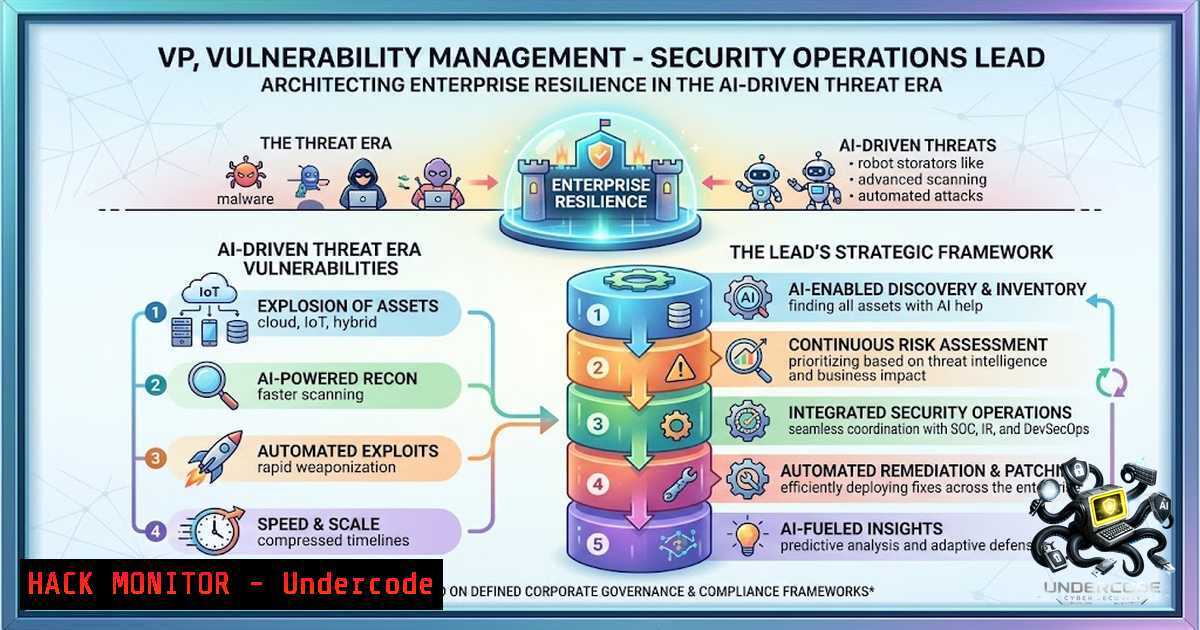
Introduction:
The modern enterprise operates across hybrid IT, multi-cloud, SaaS, and identity-centric environments where vulnerabilities can translate into immediate operational, financial, and reputational impact. With 48,185 CVEs published in 2025 alone—a 20.6% increase from the previous year—and nearly 35% of these vulnerabilities having publicly available exploit code, security teams face an unprecedented challenge. JPMorgan Chase & Co.’s search for a VP of Vulnerability Management in Singapore underscores a critical industry shift: vulnerability management is no longer a periodic compliance exercise but a continuous, intelligence-driven operational discipline that demands leadership capable of bridging cybersecurity strategy, AI capabilities, and cross-functional risk reduction.
Learning Objectives:
- Master the end-to-end vulnerability management lifecycle—from asset discovery and continuous scanning to risk-based prioritization, remediation, and verification—across hybrid enterprise environments.
- Integrate AI and machine learning capabilities into vulnerability management workflows to predict exploitability, reduce alert fatigue, and accelerate remediation SLAs.
- Operationalize compliance frameworks (NIST CSF 2.0, CIS Controls v8, ISO/IEC 27001:2022) through automated scanning, SBOM management, and SLA-driven remediation tiers.
- Deploy and manage enterprise-grade vulnerability scanning tools (Tenable Nessus, Qualys VMDR, Rapid7 InsightVM) with API-driven automation and DevSecOps pipeline integration.
- Implement cloud-1ative hardening and continuous compliance monitoring across AWS, Azure, and GCP using open-source tools like Prowler and infrastructure-as-code security controls.
You Should Know:
- The Vulnerability Management Lifecycle: From Discovery to Continuous Improvement
Vulnerability management is a lifecycle, not a task—discovery, prioritization, remediation, validation, and continuous improvement repeat forever. The six-phase continuous cycle operates as follows: asset discovery and inventory, vulnerability scanning and detection, risk analysis and prioritization, remediation and mitigation, verification and monitoring, and reporting and metrics.
Security teams begin with asset discovery, cataloging all assets discoverable on the network using automated attack surface management platforms. Vulnerability assessment then kicks off with scanning tools, penetration testing, and threat intelligence from CVE databases and NIST advisories. Critical systems receive more frequent scans; advanced tools run continuously for real-time visibility.
To operationalize this lifecycle at enterprise scale, security leaders must adopt a risk-based approach—stopping the practice of treating all vulnerabilities as equal. The Common Vulnerability Scoring System (CVSS) provides a consistent metric but faces well-documented criticism for creating false urgency—only 3% of vulnerabilities most frequently result in impactful exposure. The Exploit Prediction Scoring System (EPSS), maintained by FIRST, produces a 0–100% probability estimate of exploitation within 30 days using machine learning, offering more operationally accurate prioritization.
Practical Commands – EPSS Integration:
 Query EPSS score for a specific CVE via FIRST API
curl -s "https://api.first.org/data/v1/epss?cve=CVE-2024-3400" | python3 -m json.tool
 Python EPSS API client example
from epss_api import EPSS
client = EPSS()
scores = client.scores()
print(scores[bash])  Returns {'cve': 'CVE-1999-0013', 'epss': 0.00042, 'percentile': ...}
- AI-Powered Vulnerability Management: Augmenting Human Judgment with Machine Intelligence
Recent advancements in AI and ML have paved the way for the transformation of vulnerability management. By applying these techniques to large datasets consisting of historical vulnerability disclosures, threat intelligence reports, and internal context, security teams can predict the near-term exploitability of each vulnerability. This intelligence-driven approach, which continuously ingests fresh data and updates risk assessments, offers a more agile and effective means of prioritizing remediation efforts.
During baseline creation, AI accelerates asset discovery and identifies shadow IT. In assessment and risk analysis, machine learning models prioritize vulnerabilities based on exploit likelihood, asset criticality, and real-world threat intelligence. AI-driven remediation recommendations reduce operational disruption, while continuous monitoring leverages behavioral analytics and automated triage to minimize alert fatigue and improve response times. These capabilities enhance decision-making without replacing human judgment, embedding intelligence directly into governance and operational workflows.
However, security leaders must also address emerging risks associated with generative AI and large language models, including prompt injection, excessive agent permissions, and data leakage. Integrating AI governance with exposure management, identity security, and secure-by-design principles strengthens resilience while maintaining accountability and transparency.
3. Enterprise Vulnerability Scanning Tools: Deployment and Automation
Modern vulnerability management programs rely on a combination of commercial and open-source scanning tools:
- Qualys Cloud Platform: Cloud-based vulnerability management for servers, networks, and endpoints with continuous scanning, patch detection, and remediation tracking. Integrates with SIEM, ticketing, and DevOps pipelines.
- Tenable Nessus: One of the most trusted scanners, detecting over 75,000+ vulnerabilities with detailed risk scoring and compliance reporting.
- Rapid7 InsightVM: Real-time visibility across dynamic environments with Metasploit integration for exploit validation and AI-driven prioritization.
- OpenVAS (Greenbone): Open-source vulnerability scanner supporting thousands of CVEs with customizable scanning profiles—ideal for labs and learning.
- Microsoft Defender Vulnerability Management: Deep integration with Windows and Azure ecosystems with AI-based risk prediction and exposure analytics.
Practical Commands – Nessus Deployment on Linux:
 Start Nessus service
sudo systemctl start nessusd.service

Verify Nessus is running
sudo systemctl status nessusd.service

Launch command-line scan (example)
nessus -c /root/nessus/nessus.rc -T html -qx localhost 1241 batch batch1 /root/nessus/target /var/www/html/nessus/results.html
Qualys API – Launch Vulnerability Scan:
curl -X GET "<qualys_base_url>/csapi/v1.3/images/5d556c82899c/vuln/count" \
-H "Authorization: Bearer <YOUR_TOKEN>"
Rapid7 InsightVM API – List Sites (Python):
import requests
CONSOLE_URL = "https://your-console.com"
response = requests.get(f"{CONSOLE_URL}/api/3/sites", auth=("user", "pass"))
print(response.json())
4. Cloud Security Hardening and Continuous Compliance
Cloud-1ative vulnerability management requires embedding security checks into infrastructure-as-code and CI/CD pipelines. Key practices include enforcing hardened AMIs, ensuring S3 buckets are always encrypted, blocking overly permissive security groups, and preventing public IPs on sensitive workloads. The challenge is embedding checks to run consistently across AWS, Azure, and GCP environments.
Regulatory standards such as NIST CSF 2.0, CIS Controls v8, and ISO/IEC 27001:2022 don’t just recommend vulnerability scanning—they mandate it. ISO 27001 Annex A and the NIST CSF both name vulnerability management as a control in its own right. Scanner coverage becomes evidence that a control is operating, precisely what auditors want to see.
Practical Commands – Prowler for AWS Security Auditing:
 Run full AWS security audit
prowler aws

Scan specific services
prowler aws --services s3 iam ec2

Output results in JSON format
prowler aws -M json -o report.json

Run threat detection checks via CloudTrail analysis
prowler aws --category threat-detection
CIS Benchmark Hardening – AWS CLI Examples:
 Ensure CloudTrail is enabled in all regions
aws cloudtrail describe-trails --query 'trailList[?IsMultiRegionTrail==<code>true</code>]'

Ensure S3 bucket policy denies HTTP requests
aws s3api get-bucket-policy --bucket <BUCKET_NAME> --query 'Policy'
- JPMorgan Chase’s 10 Actions for AI-Ready Cyber Resilience
JPMorgan Chase’s recently published “Fortifying the enterprise: 10 actions to take now for AI-ready cyber resilience” provides a blueprint for enterprise vulnerability management. Key actions include:
Run the Latest Software Versions: Treat reducing technical debt as an immediate priority with senior-level oversight. Replace network and compute hardware before end-of-life. Upgrade unsupported operating systems and open-source dependencies to current stable releases.
Manage Assets and Software Components with Reference Data: Maintain a comprehensive, continuously updated inventory of all hardware, software, and cloud assets, including shadow IT and developer-provisioned resources. Catalog all software components using a Software Bill of Materials (SBOM) for every application. Enrich asset records with ownership, business criticality, internet exposure, and data classification so vulnerability and incident response teams can prioritize with context.
Build and Operate a Robust Vulnerability Management Program: Fix known vulnerabilities in order of criticality. Establish SLA-driven remediation timelines tiered by severity and exposure, with the most aggressive targets for critical and internet-facing assets. Integrate asset and software component data into vulnerability management, change management, and incident response workflows so that when a new threat emerges, teams can answer “where are we exposed?” in minutes, not days.
JPMorgan’s prescription emphasizes correlation across asset criticality, application context, reachability, and exploit availability as the only way to close the exposure gap. The firm also recommends stress-testing incident response with full restoration tests—not just tabletops—and knowing all SaaS and outsourced dependencies and their security posture.
What Undercode Say:
- Vulnerability management is a continuous operational discipline, not a periodic compliance checkpoint. Organizations that treat it as a lifecycle—with automation, AI augmentation, and SLA-driven remediation—will significantly reduce their breach risk. Those that rely on point-in-time assessments will remain exposed.
-
AI and machine learning are not optional enhancements; they are essential for survival. With over 48,000 CVEs published in 2025 and exploit timelines compressing, static CVSS scoring is no longer sufficient. Security leaders must adopt EPSS, threat intelligence correlation, and AI-driven prioritization to focus remediation where it matters most.
Analysis: The JPMorgan Chase VP role reflects a broader industry trend: vulnerability management leaders must now possess deep technical expertise in both traditional security operations and emerging AI capabilities. The role requires analyzing and managing critical vulnerabilities impacting infrastructure and applications while driving risk reduction activities across internal teams. This is not a siloed function—it demands cross-functional collaboration with development, cloud engineering, and compliance teams.
The 2025 threat landscape has fundamentally changed the risk calculus. Supply chain compromises, cloud-1ative workloads, and end-of-life infrastructure create attack surfaces that periodic patching cycles cannot adequately address. Organizations must shift left, integrating security into automated software development and change management practices to ensure the easy path is the safe path.
Furthermore, the rise of AI-powered attacks means defenders must leverage the same technology to defend. AI-driven vulnerability management platforms can continuously update risk assessments by integrating new vulnerability disclosures with emerging threat intelligence, allowing security teams to identify and remediate vulnerabilities most likely to be weaponized rather than depending on static severity assessments.
Prediction:
- +1 The integration of AI and machine learning into vulnerability management will become standard practice by 2027, with EPSS and dynamic threat intelligence replacing CVSS as the primary prioritization metric across enterprise security programs.
-
+1 The VP-level vulnerability management role will evolve into a “Cyber Resilience Architect” position, encompassing not just vulnerability identification but also automated remediation orchestration, SBOM governance, and AI security governance across the entire software supply chain.
-
-1 Organizations that fail to adopt SLA-driven remediation tiers with aggressive targets for critical assets will face increasing regulatory scrutiny and breach costs, with the average data breach projected to exceed $5 million by 2027.
-
-1 The widening gap between vulnerability discovery and remediation capacity will create a “patch debt” crisis, where enterprises accumulate unpatched vulnerabilities faster than they can fix them, necessitating automated remediation at scale to avoid catastrophic breaches.
▶️ Related Video (78% Match):
https://www.youtube.com/watch?v=7Y8djMP5Cxg
🎯Let’s Practice For Free:
🎓 Live Courses & Certifications:
Join Undercode Academy for Verified Certifications
🚀 Request a Custom Project:
Secure, high-velocity infrastructure and disruptive technological engineering. Contact our engineering team for high-tier development and proprietary systems:
[email protected]
💎 Smart Architecture | 🛡️ Secure by Design | ⭐ Trusted by Thousands
IT/Security Reporter URL:
Reported By: Httpsjobsrminecomjobnavp Vulnerability – Hackers Feeds
Extra Hub: Undercode MoN
Basic Verification: Pass ✅


