Listen to this Post
Introduction:
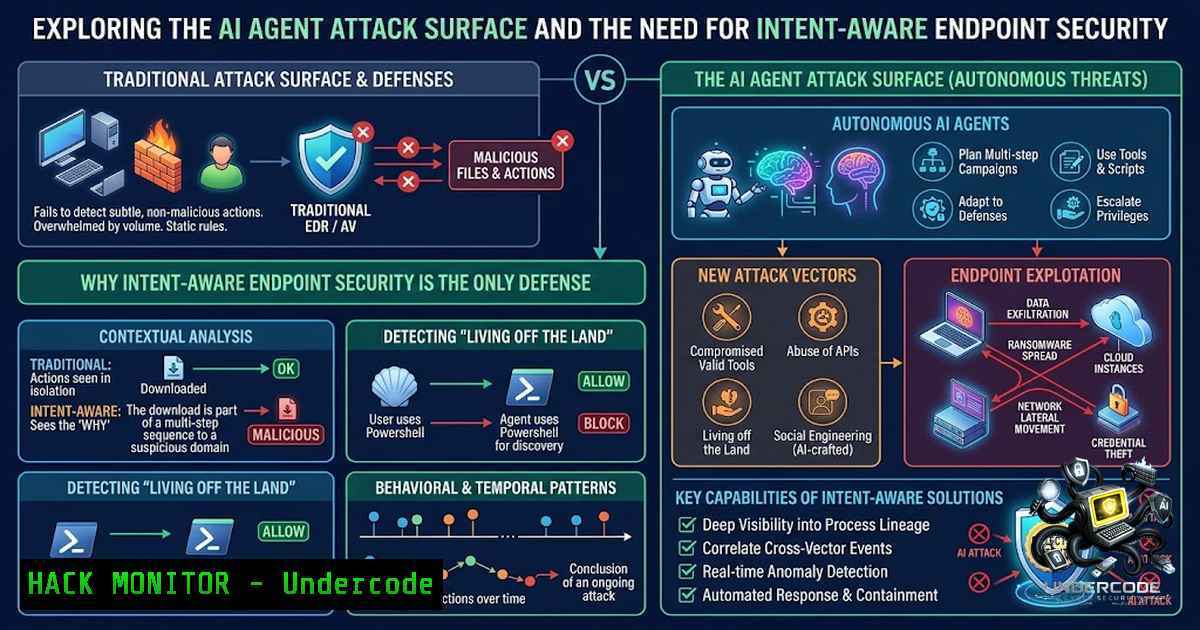
The cybersecurity industry has spent over a decade locked in a reactive loop—logging, detecting, and responding to breaches after the damage is done. But with the rise of autonomous AI agents executing automated workflows across corporate environments, the attack surface has expanded beyond human-operated endpoints to include machine-driven actions that can compromise systems in seconds. Traditional EDR, SIEM, and IAM tools are no longer sufficient; the future of security lies in understanding intent in real time across both people and AI agents, stopping risk before it becomes an incident.
Learning Objectives:
- Understand the unique security risks introduced by autonomous AI agents and LLM-driven automation in enterprise environments.
- Learn how to implement intent-aware endpoint security controls to prevent malicious activity before execution.
- Master practical configuration techniques for securing API gateways, cloud infrastructure, and AI agent tool integrations.
- The AI Agent Attack Surface: What You’re Not Seeing
Autonomous and semi-autonomous AI agents are being deployed across sales, marketing, and business process automation with minimal oversight. These agents often have more access and less governance than human users, creating “shadow permissions” and entitlement sprawl that traditional identity tools cannot track. The core problem is that AI agents can transform untrusted input into authorized action—a vulnerability security leaders are calling “authority laundering”. Attackers are already exploiting this gap, using prompt injection, tool misuse, and credential theft to turn AI agents into unwitting insider threats.
Step‑by‑step guide to auditing your AI agent attack surface:
- Inventory all AI agents and automations currently running in your environment—including unsanctioned “shadow AI” tools.
- Map each agent’s access permissions across applications, databases, and APIs. Document what data each agent can read, write, or modify.
- Review agent-to-agent communication channels and identify any unauthenticated or weakly authenticated pathways.
- Enable audit logging for all agent actions and configure alerts for anomalous behavior patterns.
- Implement tool allowlisting at the agent level to restrict which external services and APIs each agent can invoke.
Linux command to detect unauthorized AI agents running on endpoints:
 List all running processes and filter for known AI/automation frameworks
ps aux | grep -E "python|node|java|docker" | grep -E "langchain|autogen|crewai|openai|anthropic"

Check for unexpected outbound connections to AI API endpoints
sudo netstat -tunap | grep -E "443|80" | grep -E "api.openai.com|api.anthropic.com|api.deepseek.com"

Audit cron jobs and systemd timers for automated scripts
crontab -l 2>/dev/null
systemctl list-timers --all
Windows PowerShell command for agent discovery:
 Find processes with network connections to known AI services
Get-1etTCPConnection | Where-Object {$<em>.RemotePort -eq 443} | Select-Object -Property LocalAddress, LocalPort, RemoteAddress, RemotePort, State, OwningProcess | ForEach-Object { $proc = Get-Process -Id $</em>.OwningProcess -ErrorAction SilentlyContinue; [bash]@{ Process=$proc.ProcessName; PID=$<em>.OwningProcess; Remote=$</em>.RemoteAddress; State=$_.State } }

Check scheduled tasks for automation scripts
Get-ScheduledTask | Where-Object {$_.State -1e "Disabled"} | Select-Object TaskName, State, Actions
2. Intent-Aware Endpoint Security: The Prevention-First Paradigm
Ent, an intent-aware workspace security company founded by the creators of RiskIQ and Microsoft Security Copilot, has emerged from stealth with a $100 million seed round to address this exact challenge. The company deploys a lightweight software agent that introduces real-time AI reasoning directly to the endpoint device, continuously evaluating the behavioral patterns of both human users and agents at the moment of operation. Rather than relying on static rules tied to process or file events, the platform evaluates intent across applications, browsers, workflows, data transfers, and local runtimes, enforcing customer-defined policy through configurable, real-time interventions.
Step‑by‑step guide to implementing intent-aware security controls:
- Deploy lightweight endpoint agents across all workstations and servers that host AI agents or automation tools.
- Define behavioral baselines for normal human and agent activity within each business unit.
- Configure real-time intervention policies that trigger when behavior deviates from established baselines.
- Integrate with existing security stack including EDR, SIEM, SOAR, and IAM solutions.
- Enable continuous monitoring of all human and AI agent actions with full behavioral context for post-incident investigation.
Linux command to monitor endpoint behavior for anomaly detection:
 Monitor file system changes in real-time (audit suspicious agent file access)
sudo inotifywait -m -r -e create,modify,delete,access /home/ /tmp/ /var/tmp/ 2>/dev/null

Track process execution with timestamps and user context
sudo auditctl -a always,exit -F arch=b64 -S execve -k process_execution
sudo ausearch -k process_execution --format raw | tail -50

Monitor outbound network connections with geographic location (requires geoiplookup)
sudo tcpdump -i any -1 -c 100 'tcp[bash] & (tcp-syn) != 0' | while read line; do
ip=$(echo "$line" | grep -oE '([0-9]{1,3}.){3}[0-9]{1,3}' | head -1)
[ -1 "$ip" ] && geoiplookup "$ip" 2>/dev/null
done
3. Securing LLM Agents and MCP Integrations
The Center for Internet Security (CIS) has published three Companion Guides addressing security for Large Language Models (LLMs), AI Agents, and the Model Context Protocol (MCP). These guides adapt existing CIS Controls v8.1 to AI-driven architectures, covering prompt manipulation, context handling, tool execution safety, and non-human identity (NHI) management. Key risks include data leakage, retrieval poisoning, tool misuse, and unsafe autonomy.
Step‑by‑step guide to hardening LLM agent deployments:
- Apply least privilege to all AI agent credentials and API keys—scope every credential to the minimum it needs.
- Implement prompt validation and sanitization to prevent prompt injection and context manipulation attacks.
- Configure tool allowlisting at the agent level to restrict which external services can be invoked.
- Enable output validation to detect and block unsafe or malicious agent responses before execution.
- Set up human-in-the-loop approval gates for high-risk agent actions such as data exports or privilege changes.
API security commands for validating JWT tokens in agent integrations:
 Decode and validate JWT token structure (Linux)
echo "YOUR_JWT_TOKEN" | cut -d. -f2 | base64 -d 2>/dev/null | jq .

Verify JWT signature using public key (requires jose CLI)
jose jws verify -i token.jwt -k public.pem -a RS256

Check token expiration and issuer claims
echo "YOUR_JWT_TOKEN" | cut -d. -f2 | base64 -d 2>/dev/null | jq '.exp, .iss'
NIST-recommended API security baseline (2026 update): Every API route requires authentication unless explicitly carved out, with the default policy being deny rather than allow. Prefer short-lived OAuth bearer tokens over static API keys, validate JWTs strictly (pin the algorithm, verify signature), and store secrets hashed—never in URLs.
4. Cloud Hardening for AI Workloads
AI transformation initiatives are increasingly hosted in cloud environments across AWS, Azure, and GCP, introducing complex attack surfaces that span compute, storage, and orchestration layers. The convergence of enterprise IT networks with operational technology and AI infrastructure creates new exposure points that traditional security tools cannot adequately cover. Cloud hardening must address identity and access management (IAM), secrets management, and continuous vulnerability scanning across multi-cloud deployments.
Step‑by‑step guide to hardening cloud infrastructure for AI workloads:
- Implement workload identity using GCP Secret Manager, AWS IAM Identity Center, or Azure Managed Identities to eliminate static credentials.
- Use a centralized secrets management tool (HashiCorp Vault, AWS Secrets Manager, or Azure Key Vault) for all API keys and tokens.
- Deploy cloud-1ative security services such as AWS GuardDuty, Azure Defender, or Google Cloud SCC for threat detection.
- Scan for public storage buckets (S3, Azure Blobs, GCP Buckets) and remediate any publicly exposed data.
- Enable OS-level hardening on all compute instances using tools like hardbox with provider-matched profiles.
AWS CLI commands for hardening IAM and S3:
 List all S3 buckets and check public access settings
aws s3api list-buckets --query 'Buckets[].Name' --output text | xargs -I {} aws s3api get-bucket-public-access-block --bucket {} 2>/dev/null

Generate IAM credential report to audit permissions
aws iam generate-credential-report
aws iam get-credential-report --query 'Content' --output text | base64 -d

Enable AWS Config to monitor for compliance drift
aws configservice put-configuration-recorder --configuration-recorder name=default,roleARN=arn:aws:iam::ACCOUNT:role/config-role
aws configservice start-configuration-recorder --configuration-recorder-1ame=default
Azure CLI commands for security hardening:
 List storage accounts with public access enabled
az storage account list --query "[?allowBlobPublicAccess=='true'].{Name:name, RG:resourceGroup}" -o table

Enable Defender for Cloud on subscription
az security auto-provisioning-setting update --1ame default --auto-provision On

Audit network security groups for overly permissive rules
az network nsg list --query "[].{Name:name, Rules:securityRules[?access=='Allow' && (sourcePortRange=='' || destinationPortRange=='')]}" -o table
5. Vulnerability Management with Agentic AI
AgenticVM, a multi-agent framework integrating LLMs with security tools, demonstrates the power of AI-driven vulnerability management—reducing raw scanner outputs from 3,983 findings to 82 high-priority items (98% alert reduction) while predicting missing CVSS attributes with 89.3% accuracy. This approach automates vulnerability aggregation, enrichment, prioritization, and reporting, significantly reducing analyst workload without compromising risk coverage.
Step‑by‑step guide to implementing agentic vulnerability management:
- Deploy vulnerability scanners (Nessus, OpenVAS, Qualys) across your infrastructure.
- Integrate scanner outputs with an LLM-driven aggregation engine to deduplicate and enrich findings.
- Configure prioritization rules based on CVSS scores, exploit availability, and business context.
- Set up automated reporting with actionable remediation guidance for each critical finding.
- Implement human-in-the-loop governance for validation and approval of automated remediation actions.
Linux command for automated vulnerability scanning and reporting:
 Run Nmap vulnerability scan with script detection
nmap -sV --script=vuln -p- -T4 TARGET_IP -oA vuln_scan_results

Parse Nmap XML output to extract critical vulnerabilities
xsltproc vuln_scan_results.xml -o vuln_report.html

Use OpenVAS CLI for authenticated vulnerability scan (requires gvm-cli)
gvm-cli --gmp-username admin --gmp-password password socket --socketpath /var/run/gvmd.sock --xml '<create_task>...</create_task>'

Aggregate and prioritize findings using custom script
grep -E "CRITICAL|HIGH" vuln_scan_results.nmap | sort | uniq -c | sort -1r
Windows PowerShell for vulnerability assessment:
 Run Windows Defender offline scan
Start-MpScan -ScanType OfflineScan

Check for missing security patches
Get-HotFix | Sort-Object InstalledOn -Descending

Audit open ports and services
Get-1etTCPConnection | Where-Object {$<em>.State -eq "Listen"} | Select-Object LocalPort, OwningProcess | ForEach-Object { $proc = Get-Process -Id $</em>.OwningProcess; [bash]@{Port=$<em>.LocalPort; Process=$proc.ProcessName; PID=$</em>.OwningProcess} }
6. API Security for AI Integrations
APIs are the backbone of AI agent integrations, and misconfigured API gateways are now one of the highest-leverage attack surfaces in modern stacks. The NIST Special Publication 800-228-upd1 provides guidelines for identifying risk factors and implementing controls across the API lifecycle. Key controls include strong authentication, granular authorization, input validation, rate limiting, and comprehensive logging.
Step‑by‑step guide to securing API gateways for AI integrations:
- Configure authentication on every route by default, with explicit public markers for exceptions.
- Implement rate limiting with two distinct tiers: backend protection (per-API-key, 100-1000 req/s) and attack mitigation (per-IP, 10-50 req/s).
- Enforce schema validation (OpenAPI or GraphQL) at the gateway to reject malformed payloads.
- Use structured logging with explicit allowlists for captured fields—never log full request/response payloads.
- Rotate credentials regularly and use mTLS or signing for machine-to-machine authentication.
Nginx configuration for API gateway security:
 Rate limiting configuration
limit_req_zone $binary_remote_addr zone=api_limit:10m rate=10r/s;
limit_req_zone $api_key zone=api_key_limit:10m rate=100r/s;

JWT authentication validation
location /api/ {
auth_jwt "API Access";
auth_jwt_key_file /etc/nginx/keys/public.pem;
auth_jwt_validation_token_required on;

limit_req zone=api_limit burst=20 nodelay;
limit_req zone=api_key_limit burst=200 nodelay;

proxy_pass http://backend;
}

Request validation with custom headers
location /api/secure/ {
if ($http_x_api_key = "") { return 401; }
if ($http_user_agent ~ "curl|wget|python-requests") { return 403; }
proxy_pass http://backend;
}
What Undercode Say:
- Prevention over detection is no longer optional—AI-powered attacks compress the gap between breach and consequences from days to seconds. Organizations must shift from reactive logging to real-time intent evaluation.
- AI agents are the new insider threat—with more access and less oversight than human users, autonomous agents represent a fundamental shift in the attack surface that traditional IAM and EDR tools cannot address.
- Security frameworks are evolving—the CIS AI Companion Guides and NIST API security guidelines provide actionable, standards-aligned roadmaps for securing AI-driven architectures without introducing separate frameworks.
- Intent-aware security is the future—understanding the intent behind both human and agent actions at the moment of execution enables prevention rather than post-incident response.
Prediction:
- +1 Intent-aware endpoint security will become the dominant paradigm for enterprise cybersecurity within 24–36 months, with major vendors acquiring or building AI-1ative prevention capabilities to compete with startups like Ent.
- +1 The CIS AI Companion Guides will drive standardization of AI security controls, enabling organizations to audit and certify AI agent deployments with the same rigor as traditional IT systems.
- -1 Organizations that fail to implement agentic AI security controls will experience a 3x–5x increase in data breach incidents involving AI agents by 2028, as attackers increasingly target autonomous workflows.
- -1 The rapid adoption of AI agents without corresponding security governance will create a “shadow AI” crisis comparable to the cloud shadow IT wave of the early 2010s, requiring costly remediation efforts.
- +1 Agentic vulnerability management tools like AgenticVM will reduce analyst workloads by 80–90%, allowing security teams to focus on strategic threat hunting rather than manual triage of thousands of alerts.
- -1 API gateway misconfigurations will remain the 1 entry vector for AI agent compromise through 2027, as organizations prioritize speed of integration over security hardening.
- +1 The convergence of intent-aware security with zero-trust architecture will enable truly adaptive security postures that respond to behavioral anomalies in real time, closing the detection gap that has plagued the industry for decades.
▶️ Related Video (76% Match):
🎯Let’s Practice For Free:
🎓 Live Courses & Certifications:
Join Undercode Academy for Verified Certifications
🚀 Request a Custom Project:
Secure, high-velocity infrastructure and disruptive technological engineering. Contact our engineering team for high-tier development and proprietary systems:
[email protected]
💎 Smart Architecture | 🛡️ Secure by Design | ⭐ Trusted by Thousands
IT/Security Reporter URL:
Reported By: Kelseytsutton Joining – Hackers Feeds
Extra Hub: Undercode MoN
Basic Verification: Pass ✅


