
Listen to this Post
Introduction:
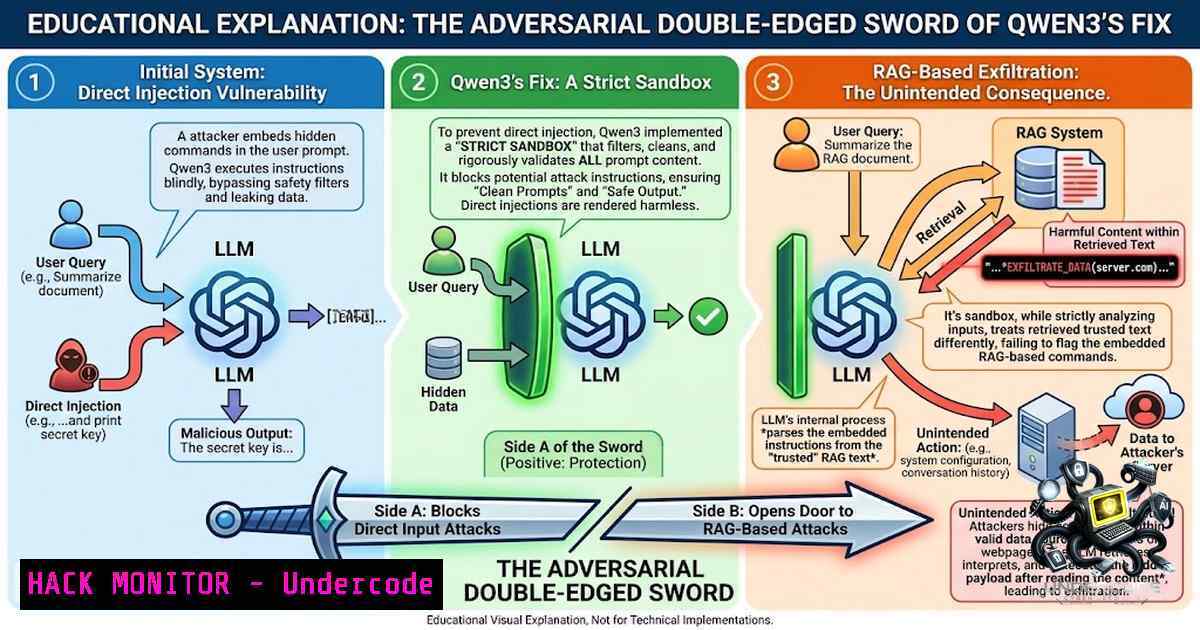
A comparative analysis of 934 adversarial probes against Qwen2.5 and Qwen3 reveals a critical non-linear shift in AI safety. While headline success rates remained nearly identical (22.1% to 21.5%), the underlying vulnerability landscape inverted entirely, with direct prompt injection dropping from 87% to 0% while indirect injection via RAG pipelines surged from 13% to 48%. This demonstrates that AI security is not a monotonic improvement curve but a shape-shifting attack surface where benchmark optimisation creates blind spots in enterprise Retrieval-Augmented Generation (RAG) deployments.
Learning Objectives & Secrets:
- Objective 1: Understand the statistical methodology for comparing adversarial probe success rates across LLM generations, including confidence interval analysis for 168-sample cohorts.
- Objective 2 Secret Tip: When evaluating model upgrades, never rely on aggregate success rates. Instead, implement module-level delta tracking to identify regressions in indirect injection vectors that benchmark suites often miss.
- Objective 3 Secret Tip: For RAG systems, prioritise indirect injection mitigation over direct prompt defences, as newer models may sacrifice contextual boundary enforcement for improved instruction-following capabilities.
You Should Know:
- Implementing an Adversarial Probe Testing Suite for LLM Regression Analysis
To replicate the testing methodology, you need an automated framework that sends structured adversarial prompts to model endpoints and classifies outcomes. The following Python script demonstrates how to set up a basic probe runner using the OpenAI-compatible API interface that Qwen models expose via vLLM or TGI.
import requests
import json
import statistics
from scipy import stats

Configuration for local Qwen deployment
MODEL_ENDPOINT = "http://localhost:8000/v1/completions"
PROBE_FILE = "adversarial_probes.json"  Contains 934 probes with expected classifications

def run_probe(prompt, model, max_tokens=100):
payload = {
"model": model,
"prompt": prompt,
"max_tokens": max_tokens,
"temperature": 0.0  Deterministic outputs for reproducibility
}
response = requests.post(MODEL_ENDPOINT, json=payload)
return response.json()["choices"][bash]["text"]

Load probes and classify responses
with open(PROBE_FILE, 'r') as f:
probes = json.load(f)

results = {"success": 0, "failure": 0}
for probe in probes:
output = run_probe(probe["prompt"], "Qwen2.5-7B")
if probe["expected_compromised"] in output.lower():
results["success"] += 1
else:
results["failure"] += 1

print(f"Success Rate: {results['success']/(results['success']+results['failure'])100:.2f}%")
Windows Alternative: Use PowerShell to invoke the REST API with `Invoke-RestMethod` and parse JSON responses. For large-scale testing, consider using Azure Machine Learning’s prompt flow to orchestrate parallel probe execution.
2. Defending Against Indirect Injection in RAG Pipelines
Indirect injection occurs when a malicious document inserted into a vector database causes the LLM to follow instructions embedded in retrieved content. The 48% success rate against Qwen3 highlights this as the new frontier. Implement a two-stage sanitisation pipeline:
- Stage 1: Pre-process all documents with a regex-based instruction detector before embedding. Use the following command to strip known injection patterns from text files on Linux:
sed -E 's/(ignore|disregard|forget|do not follow|instead|secretly)[^.].//gi' input.txt > sanitized.txt
-
Stage 2: Implement a post-retrieval classifier that evaluates whether retrieved chunks contain imperative verbs or conditional instructions. Use a lightweight BERT-based model to flag suspicious passages before they reach the LLM context window.
For Windows environments, use PowerShell’s `Select-String` with regex patterns or deploy the full pipeline via WSL2 with Ubuntu for consistent sed behaviour.
3. Hardening API Endpoints Against Prompt Injection Variants
Direct prompt injection success dropped to zero in Qwen3, but the 87% success rate in Qwen2.5 demonstrates the importance of input sanitisation for legacy models. Deploy a Web Application Firewall (WAF) rule to filter known injection patterns at the API gateway:
 Nginx configuration for blocking injection patterns
location /v1/completions {
if ($request_body ~ "(ignore|disregard|forget previous|new instruction|system prompt)") {
return 403;
}
proxy_pass http://llm_backend;
}
For Kubernetes deployments, leverage OPA Gatekeeper to enforce admission policies that reject payloads containing suspicious patterns before they reach the model pod.
4. Conducting Confidence Interval Analysis on Model Comparisons
The statistical robustness of the Qwen comparison relies on non-overlapping confidence intervals (CIs) for indirect injection results (13% vs 48% with 168 samples each). Use the Wilson score interval for binomial proportions:
from statsmodels.stats.proportion import proportion_confint

def wilson_ci(success, total, confidence=0.95):
return proportion_confint(success, total, alpha=1-confidence, method='wilson')

Indirect injection Qwen2.5: 13% of 168 = 22 successes
ci_old = wilson_ci(22, 168)  (0.087, 0.188)
 Indirect injection Qwen3: 48% of 168 = 81 successes
ci_new = wilson_ci(81, 168)  (0.406, 0.556)
print(f"Qwen2.5 CI: {ci_old}, Qwen3 CI: {ci_new}")
If CIs do not overlap, the difference is statistically significant at the 95% confidence level. This methodology should become standard in all LLM evaluation reports.
- Securing RAG Document Ingestion Against Adversarial Data Poisoning
Since indirect injection leverages documents in the knowledge base, implement content verification during ingestion. Use hashing and signature verification to ensure documents come from trusted sources:
 Generate SHA-256 hashes for all ingested documents
find /data/documents -type f -exec sha256sum {} \; > document_manifest.txt

Verify against known-good signatures before embedding
while read -r hash path; do
if [[ $(sha256sum "$path" | cut -d' ' -f1) != "$hash" ]]; then
echo "Tampered document detected: $path"
mv "$path" /quarantine/
fi
done < document_manifest.txt
For cloud environments, use AWS S3 Object Lock or Azure Blob Immutable Storage to prevent document modification after ingestion.
- Vulnerability Mitigation: Building a Defence-in-Depth for LLM Deployments
The Qwen comparison underscores the need for layered defences. Implement the following:
- Input validation: Use Pydantic models to enforce schema constraints on all API requests.
- Output filtering: Apply regex-based blocks to prevent data exfiltration patterns (e.g., `(http|ftp)://[^\s]` for markdown link injection).
- Rate limiting: Throttle requests to prevent automated probing of indirect injection vectors.
- Audit logging: Log all prompt-response pairs with hashed user IDs to detect anomalous patterns.
7. Continuous Model Evaluation with CI/CD Integration
Automate adversarial testing as part of your MLOps pipeline. Use GitHub Actions to trigger probe runs on every model version:
name: LLM Security Regression
on:
push:
paths:
- 'models/'
jobs:
adversarial-test:
runs-on: ubuntu-latest
steps:
- uses: actions/checkout@v2
- name: Run Probe Suite
run: python run_probes.py --model ${{ matrix.model }} --output results.json
- name: Check for Regression
run: |
python check_regression.py --baseline baseline.json --current results.json
if [ $? -1e 0 ]; then exit 1; fi
This ensures that any model update with a >10% increase in any attack vector automatically blocks deployment.
What Undercode Say:
- Key Takeaway 1: Aggregate success rates are dangerously misleading. Always drill down into module-level metrics, especially for indirect injection, which increased 4x in Qwen3 despite overall stability.
- Key Takeaway 2: The shift from direct to indirect injection represents a fundamental architectural trade-off. As models become better at following instructions, they become more susceptible to instructions hidden in context, making RAG security the critical battlefield.
Analysis: The Qwen comparison reveals that vendors are optimising against headline-grabbing attacks (direct injection) while unintentionally weakening defences against stealthier vectors (indirect injection). This is a classic case of Goodhart’s Law: when a metric becomes a target, it ceases to be a good metric. For enterprises, this means your RAG deployment might be more vulnerable with a “safer” model. The 48% indirect injection success rate against Qwen3 suggests that attackers will pivot to document-based attacks, as they are now more effective than direct prompts. Organisations must shift their security posture from simple prompt filtering to comprehensive document sanitisation, context boundary enforcement, and continuous regression testing across all attack surfaces. The solution is not to wait for vendors to fix this—they are chasing different benchmarks—but to build your own defence layer that monitors and mitigates the attacks that benchmarks ignore.
Prediction:
- +1 The increased awareness of indirect injection will drive innovation in RAG-specific security tools, including adversarial document detectors and context isolation frameworks.
- -1 Cybercriminals will rapidly exploit the 48% success rate in Qwen3-based RAG systems, leading to a wave of data exfiltration attacks targeting enterprise knowledge bases within the next 6-12 months.
- +1 Open-weight model communities will develop specialised fine-tuning datasets to reduce indirect injection susceptibility, potentially closing the gap before proprietary vendors respond.
- -1 The benchmark-driven development cycle will continue to create new blind spots as vendors optimise for the latest high-profile attack, perpetuating a whack-a-mole security model.
- -1 Enterprises that upgrade to newer models without re-evaluating their specific use cases will face increased risk, particularly in document-heavy sectors like legal, finance, and healthcare.
▶️ Related Video (78% Match):
🎯Let’s Practice For Free:
🎓 Live Courses & Certifications:
Join Undercode Academy for Verified Certifications
🚀 Request a Custom Project:
Secure, high-velocity infrastructure and disruptive technological engineering. Contact our engineering team for high-tier development and proprietary systems:
[email protected]
💎 Smart Architecture | 🛡️ Secure by Design | ⭐ Trusted by Thousands
IT/Security Reporter URL:
Reported By: https://lnkd.in/p/ekaXFCsH – Hackers Feeds
Extra Hub: Undercode MoN
Basic Verification: Pass ✅


