
Listen to this Post
Introduction:
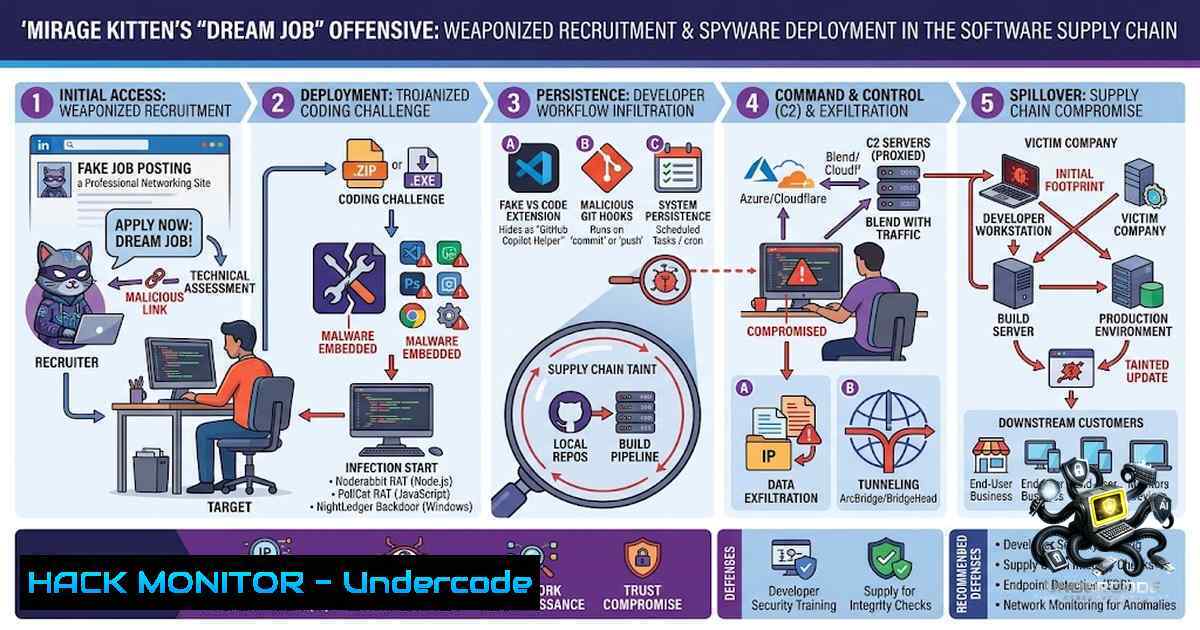
The convergence of social engineering and software supply chain compromise has reached a new apex with the emergence of Mirage Kitten (UNC1549/Smoke Sandstorm), an Iranian state-sponsored threat group. This adversary has shifted from traditional phishing to a highly sophisticated recruitment-themed attack chain targeting software developers and aerospace engineers. By weaponizing the job application process, they exploit the inherent trust between candidates and recruiters, utilizing fake video conferencing tools and poisoned coding tests to deploy a multi-stage spyware suite, including the NightLedger backdoor. This campaign represents a critical evolution in cyber-espionage, moving beyond endpoint compromise to directly targeting the lifeblood of modern enterprises: source code, API keys, and cloud infrastructure credentials.
Learning Objectives & Secrets:
- Objective 1: Understand the Social Engineering Lifecycle. Learn to identify the psychological triggers and technical red flags in recruitment-based attacks, from initial outreach to the final payload delivery.
- Objective 2 Secret Tip: Sandbox Everything. Discover the critical importance of executing all third-party code, including interview assessments, within isolated, ephemeral environments. Never run untrusted code on a host with access to production credentials.
- Objective 3 Secret Tip: Detect and Mitigate WebSocket Tunneling. Gain insight into identifying covert command-and-control (C2) channels like ArcBridge and BridgeHead that use WebSockets to bypass traditional network firewalls and proxies.
You Should Know:
1. The Anatomy of the Recruitment Attack Chain
The attack begins with the “Dream Job” bait, where threat actors impersonate recruiters from trusted global brands. This initial phase relies on open-source intelligence (OSINT) to identify developers with specific skillsets tied to critical infrastructure. The professional grooming phase involves detailed dialogue about salary and benefits, designed to lower the target’s defenses. The technical interview is the pivotal moment. Instead of a standard video call, the candidate receives a link to a fake meeting page that prompts them to download a malicious client or a specific code assignment. This dual-threat approach—either an infected executable or a poisoned code repository—ensures a high success rate. To defend against this, implement strict policies for reviewing external code: utilize `git clone –depth 1` to limit history exposure and always run `npm audit` or `pip check` to analyze dependencies for known vulnerabilities before execution.
2. Analyzing the Payload: NightLedger, ArcBridge, and BridgeHead
Once executed, the malware deploys a sophisticated suite. The NightLedger backdoor is a Windows-based implant capable of keylogging, screen capture, and process enumeration. This is complemented by ArcBridge and BridgeHead, which are custom WebSocket-based tunnelers. These tools are particularly dangerous because WebSockets use standard ports (80/443) and can easily blend into normal HTTPS traffic, evading egress filtering. For blue teams, this necessitates monitoring for unusual WebSocket handshakes (Upgrade: websocket) and long-lived connections to anomalous domains. To simulate detection, use `tcpdump -i eth0 ‘tcp[bash] & 0x10 != 0’` to capture packets with the ACK flag set, or utilize Windows `netsh trace start capture=yes` to analyze network sessions for known malicious IP ranges associated with Charming Kitten.
3. Post-Exploitation: Credential Harvesting and Lateral Movement
The ultimate objective of Mirage Kitten is credential theft. The malware systematically scans the compromised machine for API tokens, cloud provider keys (AWS, Azure, GCP), and password manager databases. This allows attackers to pivot from a single developer’s workstation into the entire enterprise network. If an AWS access key is compromised, an attacker can use the AWS CLI to enumerate resources: `aws sts get-caller-identity` to confirm the key, followed by `aws s3 ls` to list buckets. To mitigate this, enforce the principle of least privilege rigorously. Use AWS IAM roles with temporary credentials via `aws sts assume-role` instead of static keys. For developers, mandate the use of `aws-vault` or a similar tool to manage credentials securely in memory, and ensure that all secrets are stored in a vault solution like HashiCorp, not in plaintext `.env` files.
4. Protecting CI/CD Pipelines from Source Code Compromise
The breach of a single developer’s machine can grant attackers read/write access to source code repositories and CI/CD systems. This is a critical supply chain risk. Defenders must implement robust secrets scanning. Configure pre-commit hooks to prevent secrets from being committed to Git: `pre-commit install` and use `detect-secrets` to scan for high-entropy strings. Furthermore, enforce mandatory code reviews and require signed commits (git commit -S) to ensure code integrity. For CI/CD (e.g., Jenkins, GitLab CI), never store credentials in plaintext variables. Instead, use built-in secret management features and rotate build agent credentials frequently. To audit access, review repository audit logs regularly, looking for unusual `git clone` activity from unfamiliar IP addresses.
5. The Human Firewall and Cloud Sandboxing
The most effective defense against this threat is a combination of user awareness and technical controls. Organizations must train employees to verify recruiter identities via official company channels and to treat all third-party code as untrusted. Technical controls should include mandatory use of sandboxed development environments. For Windows, this can be achieved using Windows Sandbox or Hyper-V isolated containers. For Linux, tools like Firejail can restrict access: firejail --1et=eth0 --1oprofile ./malicious_assessment. Additionally, implement application whitelisting via Windows Defender Application Control (WDAC) or AppArmor to prevent unauthorized executables from running. To bolster this, deploy endpoint detection and response (EDR) solutions with behavioral analytics to detect unusual process injection or persistence mechanisms, such as registry run keys (HKLM\Software\Microsoft\Windows\CurrentVersion\Run).
What Undercode Say:
- Key Takeaway 1: Human trust is the attack vector. The line between professional recruitment and cyber-espionage is blurring; technical defenses must be augmented with strict policies against executing untrusted code on production-bound devices.
- Key Takeaway 2: Supply chain security is endpoint security. A developer’s machine is now a primary target; isolating development environments from production secrets is no longer optional but mandatory.
- Analysis: Mirage Kitten’s shift to supply chain infiltration reflects a broader trend in nation-state tactics. By targeting developers, they bypass traditional phishing filters and gain direct access to the source code of critical defense and aerospace projects. The use of WebSocket-based C2 highlights the inadequacy of port-based firewalls in modern threat landscapes. Organizations must invest in deep packet inspection and zero-trust network access. The reliance on OSINT for target selection means that developers must be vigilant about their public professional profiles. Ultimately, this threat underscores the necessity for a “never trust, always verify” approach to all third-party interactions, moving the security perimeter from the network edge to the individual endpoint and, crucially, to the cloud infrastructure itself.
Prediction:
- +1 Increased Adoption of Cloud-Based IDEs: We will see a surge in the use of browser-based development environments (like GitHub Codespaces or AWS Cloud9), which limit the local attack surface and enforce centralized security controls, making credential theft more difficult.
- +1 Rise of “Recruitment” Security Training: Security awareness programs will increasingly include modules specifically on recruitment fraud, treating job offers with the same skepticism as phishing emails.
- -1 Escalation of Malicious Open-Source Packages: This campaign will inspire copycat attacks, leading to a wave of poisoned libraries on public repositories. This will overwhelm existing package vulnerability databases and increase the burden on security researchers.
- -1 DevSecOps Fatigue: As the industry rushes to implement multiple layers of scanning (SAST, DAST, SCA), developers may face increased friction, leading to shadow IT and workarounds that inadvertently introduce new vulnerabilities.
- +1 Better API Key Hygiene: The high-profile nature of this attack will finally force widespread adoption of short-lived, dynamic credentials (e.g., using OAuth 2.0 with refresh tokens) over long-lived API keys, significantly reducing the blast radius of a single endpoint compromise.
🎯Let’s Practice For Free:
🎓 Live Courses & Certifications:
Join Undercode Academy for Verified Certifications
🚀 Request a Custom Project:
Secure, high-velocity infrastructure and disruptive technological engineering. Contact our engineering team for high-tier development and proprietary systems:
[email protected]
💎 Smart Architecture | 🛡️ Secure by Design | ⭐ Trusted by Thousands
IT/Security Reporter URL:
Reported By: https://lnkd.in/p/eD4HyNQx – Hackers Feeds
Extra Hub: Undercode MoN
Basic Verification: Pass ✅


