Listen to this Post
Introduction:
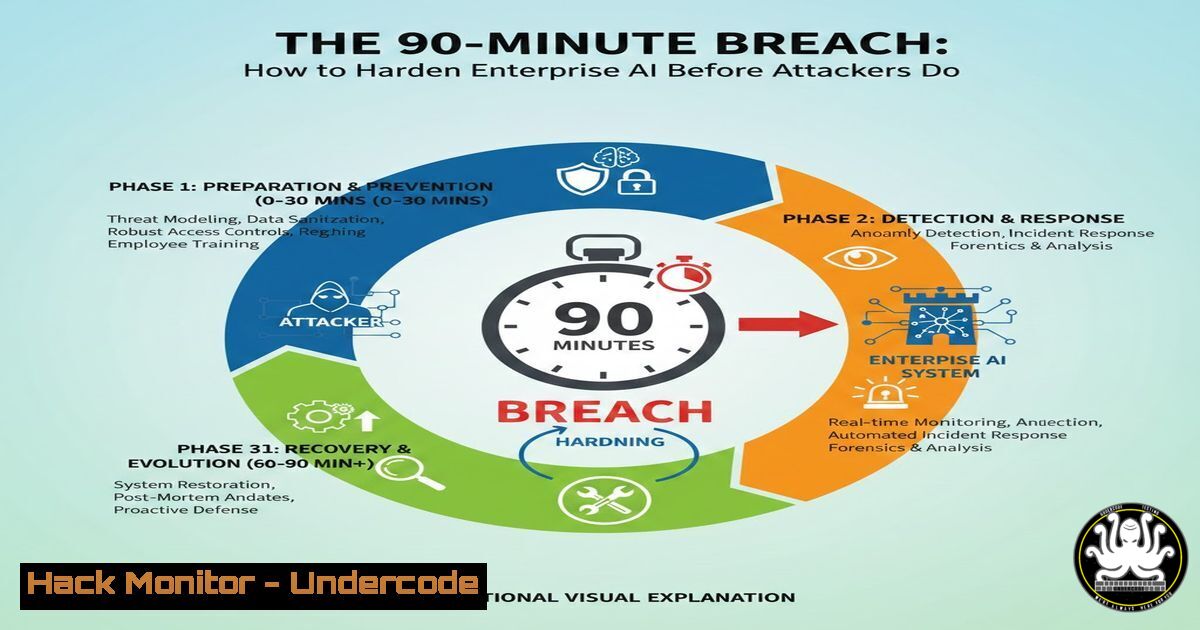
Enterprises are racing to deploy AI, but security is sprinting to catch up. Recent research from Zscaler reveals a stark reality: 90% of AI systems can be breached in under 90 minutes, with a median time to first critical failure of just 16 minutes. This isn’t theoretical; it is a live fire exercise happening inside Fortune 500 data centers today. Commenters on the original report—ranging from former White House engineers to OWASP contributors—agree: the vulnerability lies not in AI itself, but in architectural sloppiness, lack of asset inventory, and the absence of deterministic controls between model reasoning and autonomous execution.
Learning Objectives:
- Identify and inventory Shadow AI instances using network and endpoint telemetry.
- Implement Deterministic Intent Gating to prevent unauthorized model tool calls.
- Harden AI infrastructure against machine‑speed lateral movement using Zero Trust principles.
- Generate and validate a Machine Learning Bill of Materials (ML‑BOM).
- Deploy session binding controls to mitigate active session takeover.
- Apply Linux/Windows hardening commands specifically for AI workloads.
- Simulate an AI‑targeted breach to test defensive postures.
You Should Know:
- Inventorying Shadow AI with Network and Endpoint Forensics
Most organizations have no idea how many AI tools their employees are actually using. Grammarly alone processed 3,615 TB of enterprise data; ChatGPT another 2,021 TB. You cannot secure what you cannot see.
Linux‑based discovery:
Use Zeek or tcpdump to identify outbound traffic to known AI providers.
sudo tcpdump -i eth0 -nn -s 0 -c 10000 port 443 | grep -E "openai|grammarly|anthropic|cohere|huggingface"
Aggregate and count unique IPs:
tshark -r capture.pcap -Y "tls.handshake.extensions_server_name" -T fields -e tls.handshake.extensions_server_name | sort | uniq -c
Windows‑based discovery:
Use PowerShell to check for running AI assistant processes and browser artifacts.
Get-Process | Where-Object {$<em>.ProcessName -like "copilot" -or $</em>.ProcessName -like "grammarly"}
Get-ChildItem -Path "$env:APPDATA\Microsoft\Edge\User Data\Default\Local Storage\" | Select-String "chat.openai"
Step‑by‑step guide:
- Deploy a network tap or configure SPAN port to mirror traffic.
- Run the tcpdump capture during business hours for 24 hours.
- Parse the output to identify unauthorized AI tool usage.
- Cross‑reference with official procurement lists; flag discrepancies for immediate remediation or sanctioned approval.
2. Implementing Deterministic Intent Gating (OWASP ASI02)
Models cannot be trusted to self‑restrict. OWASP Agentic AI Top 10 lists “Tool Call Validation” as a critical control. Deterministic Intent Gating inserts an inline policy layer that inspects every tool invocation before execution.
Example middleware (Python / FastAPI):
from pydantic import BaseModel
from fastapi import FastAPI, HTTPException
import json

app = FastAPI()

ALLOWED_ACTIONS = {"read_calendar", "send_smtp", "query_sql_ro"}
BLOCKED_DOMAINS = {"exec", "eval", "<strong>import</strong>", "subprocess"}

class ToolCall(BaseModel):
tool: str
arguments: dict
session_id: str

@app.post("/gate/validate")
async def intent_gate(call: ToolCall):
if call.tool not in ALLOWED_ACTIONS:
raise HTTPException(status_code=403, detail="Tool not permitted")

args_str = json.dumps(call.arguments)
if any(bad in args_str for bad in BLOCKED_DOMAINS):
raise HTTPException(status_code=403, detail="Blocked argument pattern")

Pass to downstream execution only after validation
return {"status": "allowed", "session": call.session_id}
Deployment:
Place this middleware as a reverse proxy between the LLM and all backend APIs. No tool call reaches a database or filesystem without passing this gate.
3. Mitigating Session Takeover via T=0 Invariant Binding
Attackers don’t need credentials if they can ride an active session. Commenter Alex Natividad MD proposed “Session Control Binder tied to a T=0 invariant.” This binds a session to immutable client characteristics established at time zero.
Apache mod_rewrite binding (Linux):
RewriteEngine On
RewriteCond %{HTTP_USER_AGENT} ^.$
RewriteCond %{REMOTE_ADDR} ^(.)$
RewriteRule . - [E=CLIENT_BINDING:%{REMOTE_ADDR}_%{HTTP_USER_AGENT}]
Store this binding in a signed cookie or server-side cache. On each request, recompute and compare; reject if mismatched.
Windows IIS URL Rewrite binding:
<rewrite>
<rules>
<rule name="SessionBinding">
<match url="." />
<conditions>
<add input="{REMOTE_ADDR}" pattern="(.+)" />
<add input="{HTTP_USER_AGENT}" pattern="(.+)" />
</conditions>
<serverVariables>
<set name="CLIENT_BINDING" value="{C:1}_{C:2}" />
</serverVariables>
</rule>
</rules>
</rewrite>
Application‑layer check:
if (Request.Cookies["SessionBinding"] != $"{clientIp}_{userAgent}")
Session.Abandon();
- Generating a Machine Learning Bill of Materials (ML‑BOM)
NIST AI RMF (Govern 1.6) and commenter Richard Scott both stress: no inventory = no security. An ML‑BOM should list every model, version, dataset, and dependency.
Automated generation with `syft` (Linux/macOS):
syft dir:./ml_model_repo/ -o spdx-json > ml_bom_spdx.json
For models stored in S3 or blob storage:
aws s3 ls s3://your-models-bucket/ --recursive > model_inventory.txt
Enhance with hash verification:
find ./models -type f -exec sha256sum {} \; > bom_checksums.txt
Step‑by‑step guide:
- Locate all persistent storage locations where models are stored (cloud buckets, network shares, local volumes).
- Run checksum commands to fingerprint each model file.
- Cross‑reference model SHAs with vulnerability databases (e.g., OSV, NVD).
- Embed the BOM into your CI/CD pipeline; reject deployments lacking a complete BOM.
5. Hardening On‑Premises AI Stacks
On‑prem AI stacks reduce exfiltration risk but require hardening against perimeter penetration. Fusion HCI with Red Hat OpenShift was mentioned; below are baseline security commands.
Linux kernel hardening for AI servers:
 Restrict eBPF to root only (mitigate untrusted model escape)
sysctl -w kernel.unprivileged_bpf_disabled=1
 Disable kexec to prevent kernel replacement
sysctl -w kernel.kexec_load_disabled=1
 Restrict ptrace
sysctl -w kernel.yama.ptrace_scope=2
Container runtime security (containerd):
[plugins."io.containerd.grpc.v1.cri".containerd]
default_runtime_name = "nvidia"
[plugins."io.containerd.grpc.v1.cri".containerd.untrusted_workload_runtime]
runtime_type = "io.containerd.runc.v2"
[plugins."io.containerd.grpc.v1.cri".containerd.runtimes.nvidia]
runtime_type = "io.containerd.runc.v2"
[plugins."io.containerd.grpc.v1.cri".containerd.runtimes.nvidia.options]
SystemdCgroup = true
BinaryName = "/usr/bin/nvidia-container-runtime"
NoPivotRoot = false
AppArmor profile for model inference:
 Deny network creation inside container
deny /proc/ w,
deny /sys/ w,
deny /etc/shadow r,
6. Simulating a Machine‑Speed AI Breach
To validate defenses, run a controlled red‑team simulation targeting your AI pipeline.
Tool: Invoke‑ChainReactor (Python) – rapid lateral movement simulation:
import requests

targets = ["http://ai-gateway:8080", "http://vector-db:8001", "http://model-api:5000"]
payload = {"user": "redteam", "command": "list_files", "session": "valid-but-old"}

for t in targets:
try:
r = requests.post(f"{t}/api/v1/tools", json=payload, timeout=1)
if r.status_code == 200:
print(f"[!] Unauthenticated access at {t}")
except:
pass
Windows command line – test exposed endpoints:
$targets = @("ai-internal.corp:8501", "ml-lab.corp:8000")
foreach ($t in $targets) {
try {
$response = Invoke-RestMethod -Uri "http://$t/v1/models" -Method Get -ErrorAction Stop
Write-Host "Exposed model list at $t"
} catch {}
}
7. Enforcing Zero Trust for Agentic AI
Eliminate lateral movement by applying micro‑segmentation at the API and identity layer.
Kubernetes NetworkPolicy (deny all ingress to AI pods except authorized gateway):
apiVersion: networking.k8s.io/v1
kind: NetworkPolicy
metadata:
name: ai-zero-trust
spec:
podSelector:
matchLabels:
app: llm-inference
policyTypes:
- Ingress
ingress:
- from:
- podSelector:
matchLabels:
app: intent-gate
ports:
- protocol: TCP
port: 5000
Service mesh mTLS (Istio) enforcement:
kubectl apply -f - <<EOF
apiVersion: security.istio.io/v1beta1
kind: PeerAuthentication
metadata:
name: strict-mtls
namespace: ai-ns
spec:
mtls:
mode: STRICT
EOF
What Undercode Say:
– Key Takeaway 1: The breach speed is an architectural symptom, not an AI failure. Separating reasoning from execution with deterministic gates converts a 16‑minute compromise into a 16‑minute audit log.
– Key Takeaway 2: Governance must be executable, not documentary. An ML‑BOM stored in a drawer is useless; the same BOM integrated into CI/CD and runtime policy engines is what stops lateral movement.
– Analysis: The conversation around this report reveals a split: vendors selling “AI security” often push black‑box appliances, while practitioners on the ground advocate for basic hygiene—inventory, gating, and session binding. The latter is harder to package but infinitely more effective. Until enterprises treat AI components as critical infrastructure (with corresponding network segmentation, change control, and penetration testing requirements), the 90‑minute window will shrink. The comments also highlight a cultural deficit: managers avoid technical debt until breach costs force adoption. The organizations that survive the coming wave of autonomous attacks will be those that, today, assign ownership for Shadow AI, enforce deterministic policies, and simulate machine‑speed adversaries monthly.
Prediction:
Within 18 months, the first fully autonomous, LLM‑driven worm will propagate across interconnected agentic AI systems without human intervention. It will not exploit novel zero‑days; it will chain together exposed APIs, stolen sessions, and insufficient intent gating. This worm will trigger a regulatory mandate: any AI system capable of invoking a tool must, by law, implement OWASP ASI02‑level deterministic validation and maintain an immutable, cryptographically signed ML‑BOM. The distinction between “AI security” and “security” will evaporate.
▶️ Related Video (86% Match):
🎯Let’s Practice For Free:
IT/Security Reporter URL:
Reported By: Keith King – Hackers Feeds
Extra Hub: Undercode MoN
Basic Verification: Pass ✅


