Listen to this Post
Introduction:
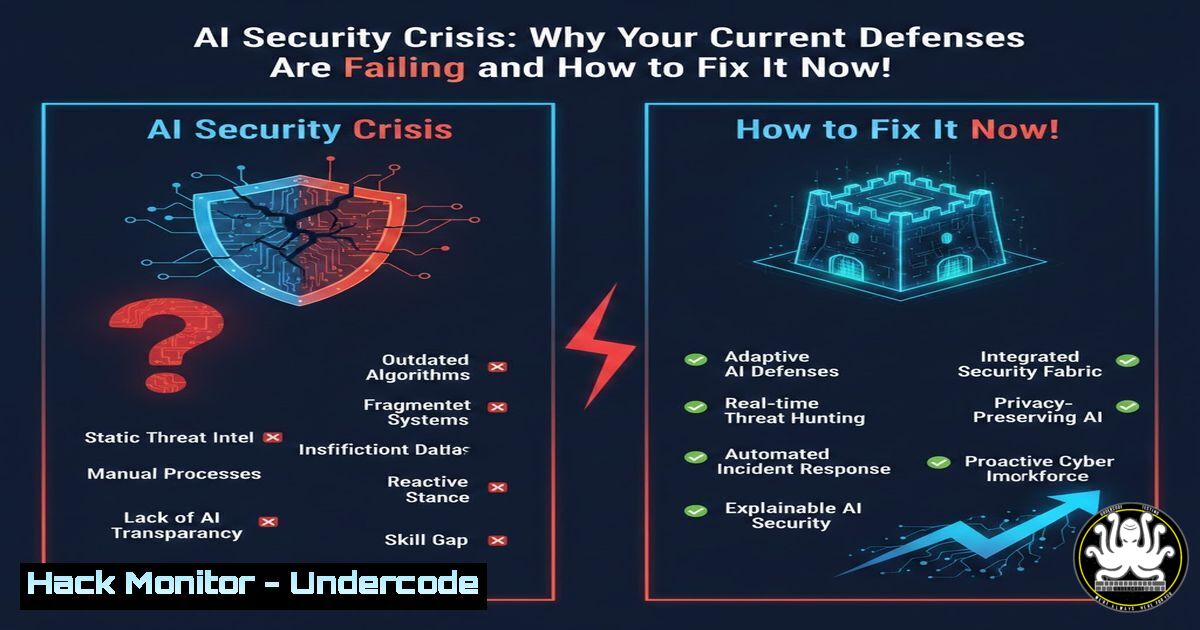
Artificial Intelligence systems have rapidly evolved from experimental projects to mission-critical enterprise assets, yet most organizations continue to protect them using legacy security frameworks designed for static data centers. This disconnect exposes AI pipelines, models, and inference endpoints to novel attack vectors like data poisoning, prompt injection, and model inversion—threats that bypass traditional firewalls and signature-based detection entirely. As cybercriminals weaponize AI for autonomous reconnaissance and adaptive malware, the imperative shifts: enterprises must rebuild their defense architectures around the intelligence itself, not just the infrastructure hosting it.
Learning Objectives:
- Identify and classify emerging attack surfaces specific to AI/ML pipelines and LLM deployments.
- Implement Zero-Trust identity controls for AI workloads across hybrid cloud environments.
- Deploy automated defense mechanisms to counter AI‑driven adversarial techniques.
You Should Know:
- Mapping the AI Attack Surface: From Training Pipelines to Inference APIs
Traditional vulnerability scanning misses the unique components of modern AI stacks. Attackers now target Jupyter Notebook servers, model registries, and unauthenticated MLflow tracking URIs. Begin by enumerating all AI‑related assets:
Linux Discovery Commands:
 Find exposed MLflow servers (default port 5000)
sudo netstat -tulpn | grep :5000

Locate insecure Jupyter configs allowing password‑less access
grep -r "c.NotebookApp.token" /home//.jupyter/

Identify unprotected model files
find / -name ".h5" -o -name ".pkl" -o -name ".pt" 2>/dev/null
Windows PowerShell Discovery:
 Check for open S3/Azure Blob endpoints used for datasets
Get-NetTCPConnection -LocalPort 9000,10000,9001

Search for hardcoded API keys in AI config files
Select-String -Path "C:\AI_Projects.py",".ipynb" -Pattern "api[_-]?key|secret|token"
2. Defending Training Pipelines Against Data Poisoning
Adversaries can inject backdoors by corrupting training data. Implement cryptographic provenance for datasets and use differential privacy during training. For PyTorch pipelines, integrate integrity checks:
import hashlib
import torch

def verify_dataset_integrity(file_path, expected_hash):
with open(file_path, 'rb') as f:
file_hash = hashlib.sha256(f.read()).hexdigest()
if file_hash != expected_hash:
raise ValueError("Dataset tampering detected!")

Example usage before training loop
verify_dataset_integrity("train.csv", "a1b2c3...")
On Linux, automate hash validation with inotify:
inotifywait -m /datasets -e create -e modify |
while read path action file; do
sha256sum "$path$file" >> /var/log/dataset_integrity.log
done
3. Zero‑Trust Identity Enforcement for AI Workloads
AI models often inherit over‑privileged service accounts. Implement fine‑grained IAM using SPIFFE/SPIRE for workload identity in Kubernetes:
apiVersion: spire.spiffe.io/v1alpha1
kind: ClusterSPIFFEID
metadata:
name: ai-model-identity
spec:
spiffeIDTemplate: "spiffe://trustdomain/ai/{{ .PodMeta.Namespace }}/{{ .PodMeta.Name }}"
podSelector:
matchLabels:
app: llm-inference
workloadAttestor: k8s
On Windows Server, use gMSA for AI containers:
New-ADServiceAccount -Name AISvcAcct -DNSHostName ai-svc.domain.local -PrincipalsAllowedToRetrieveManagedPassword "AI-Node-Group"
- Hardening AI APIs Against Prompt Injection and Model Manipulation
Injection attacks can coerce LLMs into leaking sensitive data. Deploy a reverse proxy to filter prompts and responses using regex pattern blocking. Nginx configuration example:
location /v1/completions {
 Block prompt injection attempts
if ($request_body ~ "ignore previous instructions|system prompt|admin:") {
return 403;
}

Apply rate limiting per API key
limit_req zone=aiapikey burst=20 nodelay;

proxy_pass http://llm_backend;
proxy_set_header X-Model-Name "gpt-3.5-turbo";
}
For input sanitization in Python Flask endpoints:
from flask import request, abort
import re

@app.route('/api/generate', methods=['POST'])
def generate():
prompt = request.json.get('prompt')
if re.search(r'\b(sudo|rm -rf|SELECT.FROM)\b', prompt, re.I):
abort(403, description="Malicious prompt detected")
 Continue normal processing
5. Cloud Hardening for AI Deployments
Misconfigured S3 buckets and Azure Blob storage expose training data. Enforce encryption and disable public access using infrastructure‑as‑code. Terraform for AWS:
resource "aws_s3_bucket" "training_data" {
bucket = "secure-ai-datasets"
acl = "private"

server_side_encryption_configuration {
rule {
apply_server_side_encryption_by_default {
sse_algorithm = "AES256"
}
}
}
}

resource "aws_s3_bucket_public_access_block" "block_public" {
bucket = aws_s3_bucket.training_data.id

block_public_acls = true
block_public_policy = true
ignore_public_acls = true
restrict_public_buckets = true
}
Azure CLI hardening:
az storage account update \
--name aistorageaccount \
--set minimumTlsVersion=TLS1_2 \
--allow-blob-public-access false
6. Autonomous Defense Readiness: AI‑Driven Detection and Response
As attackers adopt generative AI for polymorphic malware, defenders must deploy ML‑based anomaly detection. Install and configure Falco with ML plugins for behavioral monitoring on Kubernetes:
helm repo add falcosecurity https://falcosecurity.github.io/charts
helm install falco falcosecurity/falco \
--set driver.kind=ebpf \
--set falco.grpc.enabled=true \
--set falco.grpcOutput.enabled=true
Enable the falco‑ml plugin to detect cryptominers based on runtime patterns:
- name: ml_detector
output: "AI‑driven detection: CPU spikes consistent with illicit mining (user=%user.name)"
priority: CRITICAL
condition: >
(evt.type in (execve, clone)) and
proc.cmdline contains "xmrig" or
(cpu.user_pct > 80 and cpu.nr_cpus > 4)
7. Continuous Validation: Adversarial Simulation for AI Systems
Regularly red‑team AI components using tools like Counterfit (Azure) or TextFooler. Run an automated prompt injection test against your LLM endpoint:
from textattack import Attack
from textattack.datasets import HuggingFaceDataset
from textattack.attack_recipes import TextFoolerJin2019

attack = TextFoolerJin2019.build(model_wrapper)
dataset = HuggingFaceDataset("rotten_tomatoes", split="train")

for (text, label) in dataset:
result = attack.attack(text, label)
if result.goal_status == "SUCCEEDED":
print(f"Vulnerable input: {result.perturbed_text()}")
Log all attempts to a SIEM and configure alerts when adversarial success rate exceeds 5%.
What Undercode Say:
- Key Takeaway 1: Traditional perimeter defenses are obsolete for AI workloads. The attack surface has shifted from network ports to training data, model weights, and natural language interfaces—requiring controls embedded within the ML lifecycle, not bolted on afterward.
- Key Takeaway 2: Identity is the new firewall. Whether it’s a Jupyter notebook requesting S3 access or an LLM calling an internal API, each AI component must authenticate with a verifiable, short‑lived identity under Zero‑Trust principles.
- Analysis: The convergence of AI and security demands cross‑domain expertise; teams that combine data science fluency with traditional infosec practices will lead the next decade. Organizations still treating AI as just another “application” will find their models exfiltrated or turned against them—not by sophisticated nation‑states, but by script‑kiddies armed with automated prompt‑breakers and open‑source poisoning toolkits. The defensive shift must happen now, before generative AI makes social engineering indistinguishable at scale and polymorphic payloads rewrite themselves on the fly.
Prediction:
Within 18 months, regulatory bodies will mandate AI‑specific security audits for critical infrastructure sectors, mirroring early PCI DSS or HIPAA requirements. We will see the emergence of “AI Security Operations Centers” (AI‑SOCs) staffed with prompt engineers and adversarial ML researchers, running 24/7 red‑team exercises against production models. The first high‑profile breach involving a compromised LLM—perhaps a financial advisor bot manipulated to approve fraudulent transactions—will trigger a market correction, causing cybersecurity insurance premiums for AI‑dependent companies to skyrocket. Survivors will be those who have already instrumented their models for continuous adversarial testing and embedded verifiable cryptographic provenance into every training artifact.
▶️ Related Video (78% Match):
🎯Let’s Practice For Free:
IT/Security Reporter URL:
Reported By: To Sadham – Hackers Feeds
Extra Hub: Undercode MoN
Basic Verification: Pass ✅


