Listen to this Post
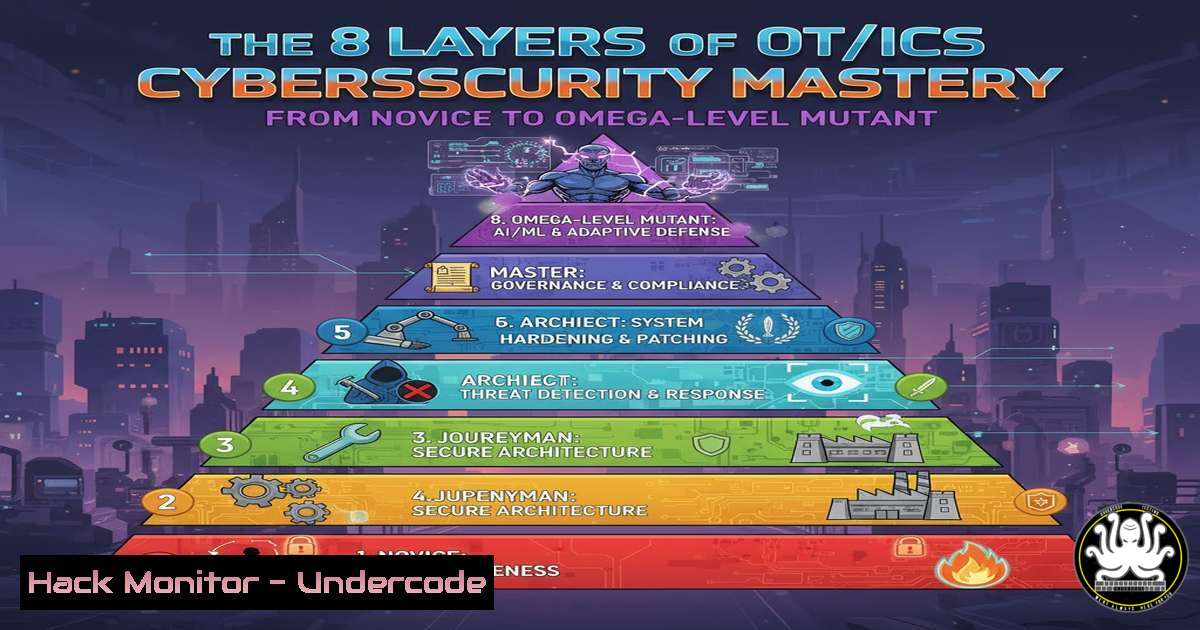
Introduction:
Operational Technology (OT) and Industrial Control Systems (ICS) cybersecurity present a unique and complex challenge, blending traditional IT security with critical engineering principles. While the fundamentals of cybersecurity apply, the stakes in OT environments—where cyber-physical systems control power plants, water treatment, and manufacturing—are safety and continuous operation. This article deconstructs the path to OT/ICS expertise, providing the technical commands and foundational knowledge required to navigate this specialized field.
Learning Objectives:
- Understand the critical differences between IT and OT cybersecurity and the corresponding technical controls.
- Acquire practical skills for network segmentation, monitoring, and secure architecture in an OT context.
- Learn to implement advanced detection mechanisms and analyze OT-specific threats.
You Should Know:
1. Establishing Foundational Network Visibility with tcpdump
Understanding your network traffic is the first step in OT security. Unlike IT networks, OT networks use specialized protocols.
sudo tcpdump -i eth0 -n -c 100 'port 502'
Step-by-step guide:
This command listens on interface `eth0` for the first 100 packets on port 502, the default port for the Modbus OT protocol. The `-n` option prevents DNS lookups for faster output. In an OT context, this helps you baseline normal Modbus communications between Programmable Logic Controllers (PLCs) and Human-Machine Interfaces (HMIs), making anomalous traffic easier to spot.
2. Implementing Basic Segmentation with Windows Firewall
Segmenting an engineering workstation from the corporate IT network is a primary OT security control.
New-NetFirewallRule -DisplayName "Block-IT-Network" -Direction Inbound -RemoteAddress 192.168.1.0/24 -Action Block
Step-by-step guide:
This PowerShell command creates a new Windows Firewall rule named “Block-IT-Network.” It blocks all inbound traffic from the `192.168.1.0/24` subnet, which you would replace with your corporate IT network’s IP range. This is a host-based method to enforce a logical air gap, a common requirement in OT environments like a power plant control room.
3. Scanning an OT Network Safely with Nmap
Aggressive scanning can disrupt fragile OT devices. Passive monitoring is preferred, but safe active scanning has its place.
nmap -sS -T 2 -p 1-1000 10.10.10.100
Step-by-step guide:
This command performs a TCP SYN scan (-sS) on the target OT device at `10.10.10.100` for the first 1000 ports. The `-T 2` flag sets the timing to “polite,” which drastically reduces the scan speed to minimize the risk of disrupting sensitive equipment. Always coordinate such scans during planned maintenance windows.
4. Building a Unidirectional Gateway with iptables
Data diodes are a physical or logical control for enforcing one-way communication, a key concept in ISA/IEC 62443.
 On the sending host (e.g., Data Historian)
iptables -A OUTPUT -d 192.168.2.50 -j ACCEPT
iptables -A INPUT -s 192.168.2.50 -j DROP

On the receiving host (e.g., Corporate DMZ)
iptables -A INPUT -s 192.168.2.100 -j ACCEPT
Step-by-step guide:
This is a simplistic logical implementation. On the sender (192.168.2.100), we allow outbound traffic to the receiver but drop all inbound traffic from it. On the receiver, we only accept traffic from the sender. True data diodes often involve physical fiber-optic connections, but this illustrates the principle of unidirectional network flow.
5. Detecting PLC Program Changes with Python
Monitoring for unauthorized changes to controller logic is a pro-level skill.
import snap7
client = snap7.client.Client()
client.connect('192.168.100.10', 0, 1)  IP, Rack, Slot
plc_info = client.get_cpu_info()
print(f"Module: {plc_info.ModuleTypeName}")
db_block = client.db_get(1)  Read Data Block 1
original_hash = hash(db_block)
 ... Later, re-read and compare hashes to detect changes.
Step-by-step guide:
This Python code uses the `python-snap7` library to communicate with a Siemens S7-1500 PLC. It connects to the PLC, reads its CPU info, and retrieves Data Block 1. By hashing this block of logic and comparing it to a known good hash later, you can programmatically detect if the PLC’s program has been tampered with, a critical detection mechanism.
6. Analyzing OT Protocol Traffic with Wireshark
Custom protocol forensics is essential for incident response in OT.
wireshark -r ot_capture.pcap -Y "modbus || enip || s7comm"
Step-by-step guide:
This command opens a packet capture file (ot_capture.pcap) in Wireshark and immediately applies a display filter for common OT protocols: Modbus, EtherNet/IP (CIP), and Siemens S7 communication. This allows an analyst to quickly filter out irrelevant IT traffic and focus on the industrial communications that matter, looking for malformed packets or unusual commands.
7. Hardening a Linux-based Data Historian
OT assets like data historians are high-value targets and must be hardened.
 Check for unnecessary services
systemctl list-unit-files --type=service | grep enabled
 Disable a non-essential service (e.g., avahi-daemon)
sudo systemctl stop avahi-daemon
sudo systemctl disable avahi-daemon
 Enforce key-based SSH authentication
echo "PasswordAuthentication no" | sudo tee -a /etc/ssh/sshd_config
Step-by-step guide:
These commands help harden a Linux server in an OT environment. First, list all enabled services to identify non-essential ones like avahi-daemon, which provides zero-configuration networking but is a security risk. Stop and disable it. Finally, disable password authentication for SSH to prevent brute-force attacks, relying solely on cryptographic keys.
What Undercode Say:
- The journey to OT/ICS mastery is a continuous climb, not a sprint. The “Abyss” and “Transcendence” layers involve skills like firmware reverse engineering, which are rare and highly specialized.
- The most critical gap is between the “Surface” and “Intermediate” levels. Practitioners must move beyond simply knowing acronyms (OT, ICS, SCADA) to understanding the tangible technical differences in how these networks are architected, monitored, and secured compared to IT.
The delineation of expertise provided by Holcomb is less of a ladder and more of a spectrum. True mastery (“Transcendence”) is characterized not just by technical prowess in areas like custom protocol forensics, but by a deep, intuitive understanding of the operational and safety consequences of cyber actions. The misconception that “OT is JUST like IT” is dangerously dismantled at the “Intermediate” level, where one learns that while an IT policy may prioritize confidentiality, an OT policy will irrevocably prioritize availability and integrity to prevent physical harm. The provided technical commands are the practical footholds for this climb, from basic network awareness with `tcpdump` to advanced change detection with Python scripts. The future of OT security will be defined by the professionals who can operate at these deep architectural and procedural levels.
Prediction:
The convergence of IT and OT networks will accelerate, driven by Industry 4.0 and IoT. This will expand the attack surface, making robust network segmentation and unidirectional gateways not just best practices, but existential necessities. Furthermore, the integration of AI, as hinted at in the “Abyss” layer, will evolve from a business goal to a primary defense mechanism. We will see AI-driven systems capable of predicting equipment failure based on network traffic anomalies and automatically isolating compromised subsystems, moving OT cybersecurity from a reactive to a predictive discipline. However, this will also give rise to AI-powered attacks specifically designed to manipulate physical processes, making the skills of the “Omega-level Mutant”—firmware reverse engineering and advanced malware analysis—critically important for national infrastructure defense.
🎯Let’s Practice For Free:
IT/Security Reporter URL:
Reported By: Mikeholcomb There – Hackers Feeds
Extra Hub: Undercode MoN
Basic Verification: Pass ✅


