Listen to this Post
Introduction:
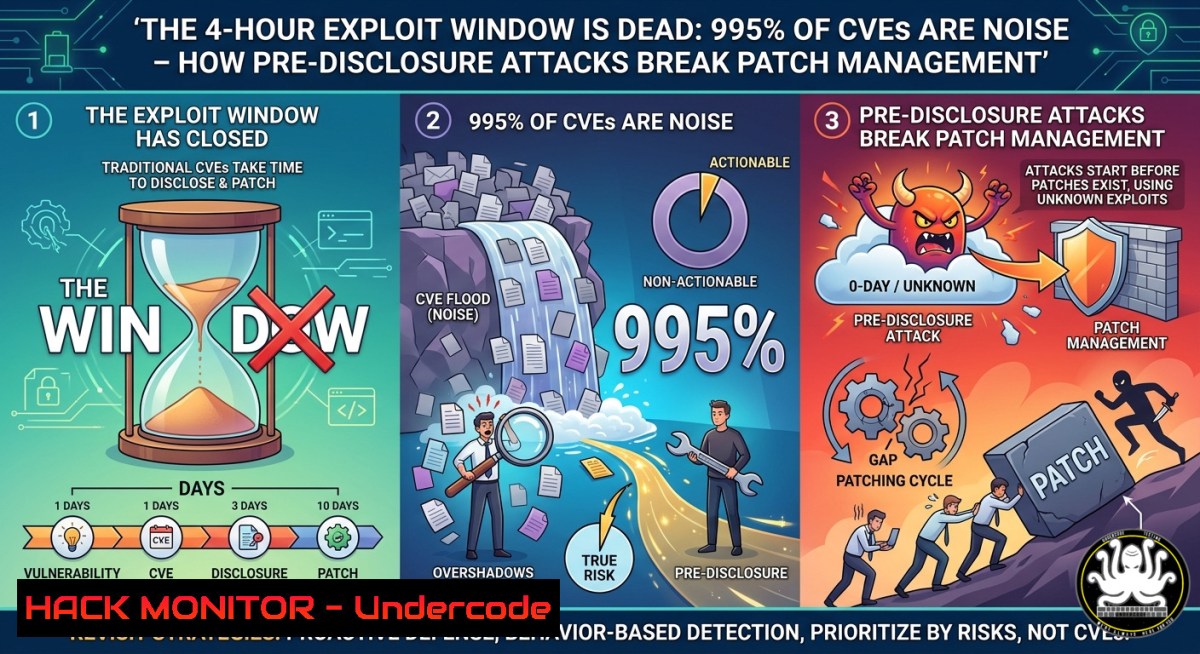
The 2025 vulnerability landscape shattered traditional defense assumptions: over 48,000 CVEs were published, yet only 256 were ever exploited in the wild – a signal-to-noise ratio of 1-in-188. More critically, the median time from disclosure to exploitation collapsed from 7 days in 2023 to 4 hours in 2024, and by 2025, exploitation often began before public disclosure, leaving defenders with no patch and no warning.
Learning Objectives:
- Understand the “funnel of relevance” and why CVSS‑first patching creates operational waste while missing real threats.
- Implement threat‑informed prioritization using exploitation evidence (KEV, EPSS) instead of volume‑based metrics.
- Build compensating controls and zero‑day response playbooks for scenarios where patches don’t exist or break production.
You Should Know:
- The Vulnerability Funnel – Filtering 48,000 CVEs Down to 256 Real Threats
The report shows that only 4.6% of published CVEs are confirmed exploitable, and just 0.53% are ever used in attacks. Patching everything is impossible; patching by CVSS score ignores the fact that 32 exploited CVEs in 2025 were rated Medium or Low.
Step‑by‑step guide to extract and prioritize real risk:
- Fetch the CISA Known Exploited Vulnerabilities (KEV) catalog – this is the gold standard for in‑the‑wild exploitation.
Linux / macOS curl -s https://www.cisa.gov/sites/default/files/feeds/known_exploited_vulnerabilities.json | jq '.vulnerabilities[] | {cveID, dateAdded, dueDate, requiredAction}' - Cross‑reference with your asset inventory using a simple Python script that flags CVEs present in KEV.
- Use the EPSS (Exploit Prediction Scoring System) to augment decision‑making. EPSS scores >0.1 indicate high probability of exploitation within 30 days.
import requests
cve = "CVE-2025-6965"
resp = requests.get(f"https://api.first.org/data/v1/epss?cve={cve}")
print(resp.json())
- Pre‑Disclosure Exploitation – Defending When No Patch Exists
The report’s most alarming finding: exploitation median time went negative in 2025 – attackers weaponized vulnerabilities before vendors even issued a CVE. Traditional patch cycles (average >30 days) are structurally obsolete.
Step‑by‑step compensating controls when patching is impossible:
- Deploy virtual patching via WAF – For web applications, ModSecurity with Core Rule Set can block exploit patterns before a vendor patch.
Install ModSecurity on Nginx (Ubuntu)
sudo apt install libmodsecurity3 nginx-module-modsecurity
sudo cp /etc/modsecurity/modsecurity.conf-recommended /etc/modsecurity/modsecurity.conf
sudo sed -i 's/SecRuleEngine DetectionOnly/SecRuleEngine On/' /etc/modsecurity/modsecurity.conf
sudo systemctl restart nginx
- Implement eBPF‑based runtime detection (Linux) to block anomalous syscalls associated with known exploit techniques.
Using tracee for suspicious process execution
sudo docker run --rm --pid=host --privileged aquasec/tracee --trace comm=curl,wget --output json
- For Windows, leverage PowerShell to monitor for exploit‑indicative events via Sysmon (Event ID 1 for process creation, 3 for network connections):
Install Sysmon with a known exploit detection config
.\Sysmon64.exe -accepteula -i exploit_detection.xml
Get-WinEvent -FilterHashtable @{LogName='Microsoft-Windows-Sysmon/Operational'; ID=1} | Select-Object -First 20
- The Severity Paradox – Why Medium/Low CVEs Get Exploited While Criticals Sit Unused
32 exploited CVEs in 2025 were rated Medium or Low by CVSS. Attackers don’t care about severity scores; they care about reachability, reliability, and impact in your environment.
Step‑by‑step to build an exploitability‑first triage dashboard:
- Pull data from NVD and EPSS, then cross‑reference with known ransomware or China‑nexus TTPs.
import requests, json nvd_resp = requests.get('https://services.nvd.nist.gov/rest/json/cves/2.0?resultsPerPage=100') for vuln in nvd_resp.json().get('vulnerabilities', []): cve_id = vuln['cve']['id'] cvss_score = vuln['cve']['metrics'].get('cvssMetricV31', [{}])[bash].get('cvssData', {}).get('baseScore') Get EPSS epss_resp = requests.get(f'https://api.first.org/data/v1/epss?cve={cve_id}') epss = epss_resp.json().get('data', [{}])[bash].get('epss', 0) if float(epss) > 0.05: print(f"[bash] {cve_id} | CVSS:{cvss_score} | EPSS:{epss} | Prioritize immediately") - Automate the deprioritization of CVSS 7+ vulnerabilities with EPSS <0.01 and no KEV entry – this eliminates ~80% of patching noise.
- AI‑Powered Exploit Generation – Defending Against Patch‑to‑Exploit Automation
The report highlights that attackers now use AI to reverse‑engineer patches and generate exploits in minutes. Google’s Big Sleep found a zero‑day before it was exploited, but Anthropic’s Mythos model autonomously discovers and weaponizes vulnerabilities.
Step‑by‑step API security hardening against automated exploit generation:
- Enforce strict input validation schemas for all APIs – AI‑generated payloads often break schema validations.
- Implement rate limiting and anomaly detection on API gateways:
NGINX rate limiting – blocks automated exploit probes limit_req_zone $binary_remote_addr zone=api_limit:10m rate=10r/m; location /api/ { limit_req zone=api_limit burst=5 nodelay; limit_req_status 429; } - Deploy fuzzing‑resistant endpoints using JSON Schema validation (Node.js example):
const Ajv = require('ajv');
const ajv = new Ajv();
const schema = { type: 'object', properties: { id: { type: 'integer' } }, required: ['id'], additionalProperties: false };
const validate = ajv.compile(schema);
if (!validate(req.body)) return res.status(400).json({ error: 'Invalid payload' });
- Security Products as the Top Target – Hardening Firewalls, VPNs, and EDR
The report explicitly states that security products themselves (firewalls, VPNs, EDR, IAM) were a primary attack vector. Compromising the defender’s tools provides the ultimate persistence.
Step‑by‑step configuration to protect security infrastructure:
- Isolate management interfaces – never expose admin consoles to the internet or corporate LAN without MFA.
Linux: restrict SSH access to only a jump host
sudo ufw allow from 192.168.1.100 to any port 22
sudo ufw default deny incoming
- Windows: Block inbound RDP and WinRM from untrusted subnets via PowerShell:
New-NetFirewallRule -DisplayName "Block RDP from non-jumpbox" -Direction Inbound -Protocol TCP -LocalPort 3389 -RemoteAddress 192.168.1.100/32 -Action Allow
New-NetFirewallRule -DisplayName "Block RDP from others" -Direction Inbound -Protocol TCP -LocalPort 3389 -Action Block
- Regularly rotate API keys and certificates used by EDR/SIEM integrations – attackers who compromise an EDR console can disable alerts. Use short‑lived JWTs with 1‑hour expiry.
- Ransomware and State Actors – Hunting for 33 Ransomware‑Linked CVEs (Clop’s 8 Zero‑Days)
Ransomware operators (Clop leading with 8 zero‑days) and China‑nexus groups accounted for 61 exploited CVEs with named attribution. These actors reuse exploits across victims.
Step‑by‑step YARA hunting for known ransomware exploit artifacts:
- Create a YARA rule to detect Clop‑related exploit leftovers:
rule Clop_Exploit_Indicator { meta: description = "Detects known Clop ransomware exploit artifacts" strings: $s1 = "TrueFirmwareUpdate.exe" nocase $s2 = "SysCeo" wide $s3 = "SEND_MESSAGE_TO_CLOP" ascii condition: any of them } - Run a Linux hunt across endpoints:
yara64.exe -r clop_rules.yara C:\  Windows
yara -r clop_rules.yara /  Linux
- Automate Sigma rule conversion for SIEM alerts (e.g., Splunk or Elastic):
Install sigmac
pip install sigma-cli
sigma convert -t splunk ransomware_ttps.yml
- The Patch Gap Crisis – Rewiring Change Management for 4‑Hour (or Negative) Windows
The average enterprise takes >30 days to patch, but attackers now exploit before disclosure. The report calls this a “structural failure.”
Step‑by‑step emergency patch pipeline using Ansible and Windows Update:
- Create an Ansible playbook for emergency CVE remediation (bypassing normal change approval):
</li>
<li>name: Emergency patch deployment for critical CVE
hosts: all
become: yes
tasks:</li>
<li>name: Update apt cache (Ubuntu)
apt:
update_cache: yes
when: ansible_os_family == "Debian"</li>
<li>name: Install security updates only
apt:
name: ""
state: latest
update_cache: yes
only_upgrade: yes
when: ansible_os_family == "Debian"</li>
<li>name: Windows - Install specific KB
win_updates:
category_names:</li>
<li>SecurityUpdates
server_selection: windows_update
when: ansible_os_family == "Windows"
- Run emergency playbook with `ansible-playbook -i inventory emergency_patch.yml –limit “cve_affected_hosts”`
– For Windows without Ansible, use PowerShell to force immediate patch install for a given KB:$Session = New-Object -ComObject Microsoft.Update.Session $Searcher = $Session.CreateUpdateSearcher() $Criteria = "IsInstalled=0 and Type='Software' and IsHidden=0 and CategoryIDs contains 'Security'" $SearchResult = $Searcher.Search($Criteria) $Downloader = $Session.CreateUpdateDownloader() $Downloader.Updates = $SearchResult.Updates $Downloader.Download() $Installer = $Session.CreateUpdateInstaller() $Installer.Updates = $SearchResult.Updates $Installer.Install()
What Undercode Say:
- Key Takeaway 1: 99.5% of published CVEs are never exploited. Patching by volume or CVSS score is not just inefficient – it actively drowns defenders in noise while real threats (including Medium/Low severity flaws) go untouched.
- Key Takeaway 2: The median exploit window has collapsed from 7 days to negative time (pre‑disclosure). Traditional patch cycles are a structural liability; compensating controls (WAF, segmentation, runtime detection) are now the primary defense for zero‑days.
Analysis (10 lines): The Hiveforce Labs report exposes a fundamental mismatch between vulnerability management tools and attacker behavior. Most organizations still rely on CVSS scores and patch‑everything policies, but the data shows that attackers consistently focus on a tiny subset of flaws – roughly 250 per year – that are reliably exploitable. The shift to pre‑disclosure exploitation means that even perfectly executed patching (same‑day) may arrive too late if the vulnerability was weaponized before the CVE was published. AI is accelerating both sides, but defenders face asymmetric feedback loops: attackers know immediately if an exploit works; defenders discover breaches months later. The report’s prescription – threat‑informed prioritization using exploitation evidence (KEV, EPSS, ransomware attribution) – is no longer a best practice; it is the only viable survival strategy for 2026. Enterprises must renegotiate change management processes to allow emergency patching within hours, while simultaneously investing in compensating controls that do not require a patch at all.
Expected Output:
Prediction:
By late 2026, the combination of AI‑generated exploits (like Anthropic’s Mythos) and pre‑disclosure weaponization will render traditional vulnerability scanners nearly obsolete. We will see the emergence of “real‑time exploit intelligence” as a commercial category – services that deliver detection signatures for vulnerabilities before they are publicly disclosed, derived from dark web telemetry and honeypots. Regulatory bodies (SEC, EU Cyber Resilience Act) will begin mandating not just patch timelines, but evidence of compensating controls for zero‑day windows. Organizations that fail to replace CVSS‑first triage with threat‑informed prioritization will experience a breach rate 10x higher than peers, as attackers systematically target the 99.5% of noise that defenders waste resources on. The only defensive counter‑move is to automate the collection of exploitation evidence (KEV, EPSS, threat actor TTPs) and tie it directly to emergency patch workflows and virtual patching rules – turning the defender’s lag into a proactive, intelligence‑driven posture.
▶️ Related Video (72% Match):
🎯Let’s Practice For Free:
IT/Security Reporter URL:
Reported By: Mthomasson Global – Hackers Feeds
Extra Hub: Undercode MoN
Basic Verification: Pass ✅
🎓 Live Courses & Certifications:
Join Undercode Academy for Verified Certifications
🚀 Request a Custom Project:
Secure, high-velocity infrastructure and disruptive technological engineering. Contact our engineering team for high-tier development and proprietary systems:
[email protected]


