Listen to this Post
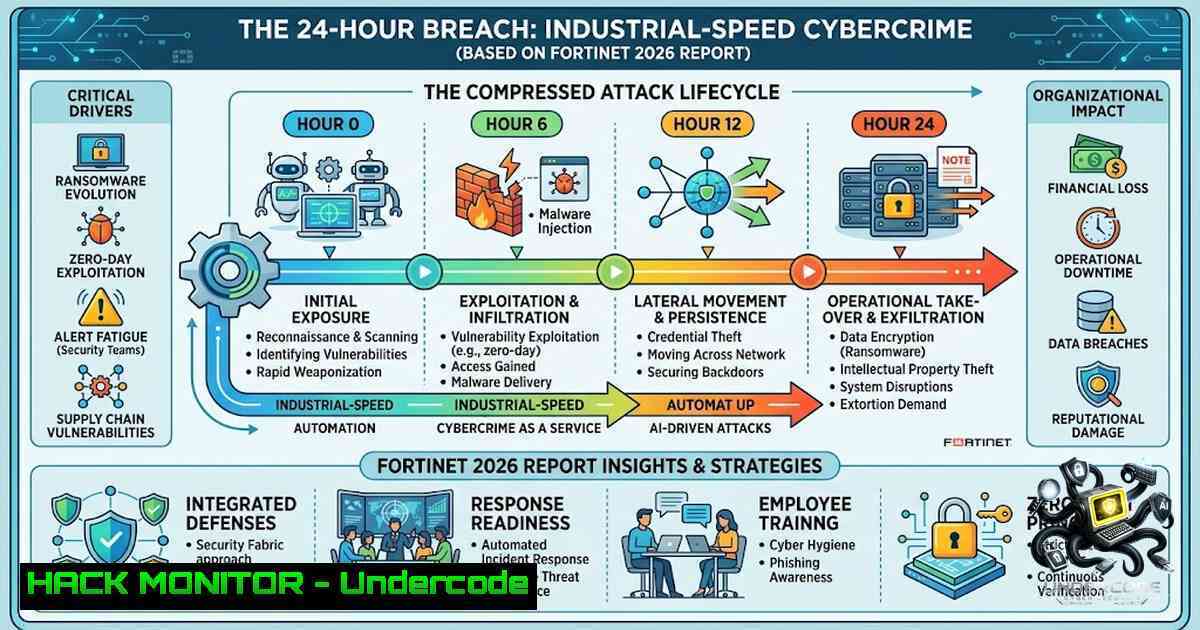
Introduction:
Cyber risk is no longer measured in days—it is measured in hours. Fortinet’s 2026 Global Threat Landscape Report, derived exclusively from FortiGuard Labs telemetry, reveals a seismic shift in the cyber threat landscape: the average time-to-exploit (TTE) for critical vulnerabilities has collapsed from 4.76 days to just 24–48 hours. This compression is driven by the industrialization of cybercrime, where AI, automation, and service-based criminal ecosystems have transformed isolated attacks into systematic, machine-speed operations. For defenders, this means that the window to patch, detect, and respond has effectively been cut in half, demanding an equally industrialized defense strategy.
Learning Objectives:
- Understand how AI and automation have reduced time-to-exploit (TTE) to 24–48 hours and what this means for SOC operations.
- Learn to identify and mitigate the top attack vectors identified in the report, including identity-based cloud breaches and AI-enabled ransomware.
- Gain practical, actionable commands and configurations for Linux, Windows, and cloud environments to harden defenses against industrialized threats.
You Should Know:
1. Velocity Defines Risk: The Collapse of Time-to-Exploit
The most critical finding of the 2026 report is the dramatic reduction in TTE. FortiGuard Labs observed that critical vulnerabilities can now be exploited within 24 to 48 hours of public disclosure, compared to earlier reports that placed the average at 4.76 days. In some cases, such as the React2Shell vulnerability, active exploitation attempts were made within hours of public disclosure. This acceleration is fueled by AI-driven reconnaissance, weaponization, and execution, allowing attackers to move from vulnerability discovery to compromise at unprecedented speed.
Step-by-Step Guide: Reducing Your Exposure Window
To counter this compressed timeline, organizations must adopt a continuous threat exposure management (CTEM) approach. Here’s how to operationalize it:
- Automate Vulnerability Scanning: Deploy tools like `Nessus` or `OpenVAS` to scan your environment daily. For Linux, use `sudo apt-get install openvas` and run `sudo gvm-setup` to initialize. Schedule scans using cron:
0 2 /usr/bin/openvas -s -o /var/log/vuln_scan.log. -
Prioritize Based on Exploitability: Not all vulnerabilities are equal. Use the Exploit Prediction Scoring System (EPSS) to prioritize. On Windows, use PowerShell to query the CVE database:
Get-Cve -CveId CVE-2026-XXXX | Select-Object -Property EPSS. -
Implement Virtual Patching: For critical vulnerabilities without an available patch, deploy virtual patches via Web Application Firewalls (WAF) or intrusion prevention systems (IPS). For FortiGate, use the CLI:
config ips sensor edit "virtual_patch" config entries edit 1 set rule CVE-2026-XXXX set action block end. -
Establish a 24-Hour Patching SLA: For critical and high-severity vulnerabilities, mandate patching within 24 hours. Use tools like `Ansible` to automate patching across Linux and Windows: `ansible-playbook -i inventory.ini patch_servers.yml` with a playbook that includes `apt update && apt upgrade -y` for Ubuntu or `Install-WindowsUpdate -MicrosoftUpdate -AcceptAll -AutoReboot` for Windows.
2. The 389% Ransomware Surge: AI-Enabled Offensive Tools
The report identified 7,831 confirmed ransomware victims globally, a staggering 389% increase year-over-year. This surge is directly attributed to the availability of AI-powered crime service kits such as WormGPT, FraudGPT, HexStrike AI, and BruteForceAI, which lower the skill barrier for attackers and enable automated exploitation workflows. These tools are used for reconnaissance, attack-path generation, form analysis, and even automated ransom negotiations.
Step-by-Step Guide: Hardening Against AI-Driven Ransomware
Defending against AI-powered ransomware requires a multi-layered approach:
- Deploy Endpoint Detection and Response (EDR): Install and configure an EDR solution like FortiEDR or Microsoft Defender for Endpoint. On Windows, ensure real-time protection is enabled:
Set-MpPreference -DisableRealtimeMonitoring $false. On Linux, use `sudo apt-get install clamtk` and schedule regular scans. -
Implement Application Allowlisting: Prevent unauthorized executables from running. On Windows, use AppLocker: `New-AppLockerPolicy -RuleType Exe -User Everyone -Action Allow -Path “C:\Program Files\”` and enforce via Group Policy. On Linux, use `fapolicyd` to whitelist approved applications.
-
Harden Remote Desktop Protocol (RDP): RDP is a common ransomware entry point. Disable RDP unless necessary: on Windows,
Set-ItemProperty -Path "HKLM:\System\CurrentControlSet\Control\Terminal Server" -1ame "fDenyTSConnections" -Value 1. Use a VPN for remote access and implement network-level authentication (NLA). -
Backup and Recovery Testing: Implement the 3-2-1 backup rule (3 copies, 2 media types, 1 offsite). Use `rsync` for Linux backups:
rsync -avz /data/ user@backup-server:/backup/. For Windows, usewbadmin start backup -backupTarget:\\backup-server\share -include:C: -allVersions -quiet. Test restoration quarterly. -
Identity Is the New Perimeter: Cloud Credential Exploitation
FortiCNAPP intelligence found that most confirmed cloud incidents in 2025 originated from stolen, exposed, or misused credentials, rather than direct infrastructure exploitation. Sectors with large identity populations, federated access models, and complex cloud integrations—such as hospitals, physician clinics, and retail—were the most targeted. The report also noted a 79% increase in data from systems compromised by infostealer malware, with RedLine, Lumma, and Vidar being the most prominent stealers.
Step-by-Step Guide: Securing Cloud Identities
To mitigate identity-based risks, implement the following:
- Enable Multi-Factor Authentication (MFA): Enforce MFA for all cloud and on-premises accounts. For Azure AD, use PowerShell: `Connect-MgGraph -Scopes “Policy.ReadWrite.AuthenticationMethod”` then
Update-MgPolicyAuthenticationMethod -AuthenticationMethodId "MicrosoftAuthenticator" -RequireMfa $true. For AWS, use the CLI:aws iam update-account-password-policy --minimum-password-length 14 --require-symbols. -
Monitor for Infostealer Malware: Deploy endpoint protection that detects credential-stealing behavior. Use Sysmon on Windows to log process creation and network connections:
Sysmon64.exe -accepteula -i sysmon-config.xml. On Linux, use `auditd` to monitor sensitive file access:auditctl -w /etc/passwd -p wa -k passwd_changes. -
Implement Just-In-Time (JIT) Access: For cloud environments, use JIT access to reduce standing privileges. In Azure, use `az vm access get-credentials` to request temporary access. In AWS, use `aws ssm start-session –target instance-id` for temporary shell access.
-
Continuous Credential Monitoring: Use tools like FortiCNAPP or AWS IAM Access Analyzer to detect unused or overly permissive roles. Run
aws iam list-roles --query 'Roles[?RoleName!=null]'to audit IAM roles. For Azure, useGet-AzRoleAssignment | Where-Object { $_.Scope -like "/subscriptions/" }. -
The Decline of Brute Force and the Rise of Targeted Exploitation
Interestingly, the report found that brute-force attempts declined by 22% year-over-year, suggesting that attackers are becoming more targeted and efficient. However, FortiGate IPS telemetry still recorded approximately 67.65 billion brute-force events globally—roughly 185 million attempts per day. At the same time, global exploitation attempts increased by 25.49% year-over-year, indicating a shift from volume-based to precision-based attacks.
Step-by-Step Guide: Defending Against Targeted Exploitation
To defend against targeted attacks, focus on reducing the attack surface and improving detection:
- Harden Network Perimeters: Disable unnecessary services and ports. On Linux, use `nmap -sV -p- localhost` to identify open ports, then use `ufw deny
` to close them. On Windows, use netsh advfirewall firewall add rule name="Block Port" dir=in action=block protocol=TCP localport=8080. -
Implement Network Segmentation: Use VLANs and firewalls to segment critical assets. On FortiGate, create a VLAN interface:
config system interface edit "vlan10" set vlanid 10 set interface "port1" set ip 192.168.10.1/24 end. Use firewall policies to restrict traffic between segments. -
Deploy Deception Technology: Use honeypots and decoys to detect lateral movement. Deploy FortiDeceptor or open-source tools like `T-Pot` to create realistic decoys. Monitor for interactions with decoy systems as an indicator of compromise.
-
Enhance Logging and Monitoring: Enable verbose logging for all critical systems. On Linux, configure `rsyslog` to forward logs to a SIEM:
. @siem-server:514. On Windows, usewevtutil set-log Microsoft-Windows-Sysmon/Operational /enabled:true /retention:false /maxsize:1073741824. -
The Role of AI in Defense: Industrialized Security Operations
As attackers leverage agentic AI to execute sophisticated attacks, defenders must evolve cybersecurity operations into an industrialized defense. This means adopting AI-enabled tools that can respond at the same velocity as modern threats. The report emphasizes the need for unified, adaptive security postures that bring together threat intelligence, exposure management, and automated response.
Step-by-Step Guide: Building an AI-Enabled SOC
To industrialize your security operations, consider the following steps:
- Integrate Threat Intelligence: Use platforms like FortiGuard Threat Intelligence or open-source MISP to ingest and correlate threat data. Set up MISP on Linux: `sudo apt-get install misp` and configure feeds.
-
Automate Incident Response: Use SOAR platforms to automate repetitive tasks. Create playbooks for common incidents like phishing or ransomware. For example, use `ansible` to isolate an infected host:
ansible-playbook isolate_host.yml -e "host=target_ip". -
Deploy AI-Powered Detection: Implement NDR solutions that use machine learning for behavioral analysis. FortiNDR Cloud, for instance, detects shadow AI, prompt injection, and non-human activity. Configure it to monitor east-west traffic for anomalies.
-
Conduct Regular Purple Team Exercises: Simulate attacks and test your defenses. Use frameworks like MITRE ATT&CK to map your detection coverage. Tools like `Caldera` can automate adversary emulation:
sudo systemctl start caldera.
What Undercode Say:
- Key Takeaway 1: The collapse of time-to-exploit to 24–48 hours means that traditional patch cycles are obsolete. Organizations must adopt continuous vulnerability management and virtual patching to survive.
- Key Takeaway 2: AI is a double-edged sword. While it empowers attackers with tools like WormGPT, it also enables defenders to scale their operations. The race is no longer about technology alone—it’s about operational velocity and integration.
Analysis: The Fortinet 2026 report underscores a fundamental truth: cybercrime has become an industry. The use of AI, automation, and service-based models has transformed hacking from a technical skill into a scalable business. For defenders, this means moving away from siloed tools and toward unified platforms that can correlate data across the entire attack surface. The 389% increase in ransomware victims is not just a statistic—it is a call to action. Organizations must prioritize identity security, cloud credential monitoring, and ransomware preparedness. The decline in brute-force attempts suggests that attackers are evolving, but the sheer volume of remaining attempts (185 million per day) indicates that basic hygiene still matters. The future of cybersecurity lies in industrialized defense: AI-driven, automated, and integrated.
Prediction:
- -1 The 24–48 hour exploit window will continue to shrink as AI agents become more autonomous, potentially reaching near-real-time exploitation within 12 hours by 2027.
- -1 Ransomware-as-a-Service (RaaS) will fully integrate AI negotiation bots, making ransom payments faster and more efficient for attackers, while complicating incident response for defenders.
- +1 The adoption of AI in security operations will accelerate, leading to the development of autonomous response systems that can outpace attackers, but only for organizations with mature security programs.
- -1 The concentration of ransomware victims in manufacturing and business services will persist, as these sectors have high operational technology (OT) exposure and complex supply chains.
- +1 Regulatory frameworks will begin to mandate AI security and continuous threat exposure management (CTEM), driving standardization and forcing organizations to adopt minimum security baselines.
▶️ Related Video (88% Match):
🎯Let’s Practice For Free:
🎓 Live Courses & Certifications:
Join Undercode Academy for Verified Certifications
🚀 Request a Custom Project:
Secure, high-velocity infrastructure and disruptive technological engineering. Contact our engineering team for high-tier development and proprietary systems:
[email protected]
💎 Smart Architecture | 🛡️ Secure by Design | ⭐ Trusted by Thousands
IT/Security Reporter URL:
Reported By: Chee Han – Hackers Feeds
Extra Hub: Undercode MoN
Basic Verification: Pass ✅


